Quick Verdict: The Budget EV King Still Holds the Crown
The 2023 Chevrolet Bolt EV 2LT remains one of the most compelling value propositions in the electric vehicle market — even when viewed from a 2026 perspective where competition has intensified. With an EPA-estimated 259 miles of range, a practical hatchback form factor, and an original MSRP that undercut nearly every rival, the Bolt EV 2LT proved that affordable electric mobility doesn't require compromise on daily usability. However, its DC fast-charging limitations and discontinuation after the 2023 model year mean prospective used buyers need to weigh its strengths against a rapidly evolving market.
| Specification | 2023 Chevrolet Bolt EV 2LT |
|---|---|
| EPA Range | 259 miles |
| Battery (Usable) | 65 kWh, NMC (Nickel Manganese Cobalt) |
| Motor / Drivetrain | 200 hp / 266 lb-ft, FWD single-motor |
| 0–60 mph | ~6.5 seconds |
| Peak DC Fast Charge | 55 kW (CCS1) |
| 10–80% DC Charge Time | ~60 minutes |
| Level 2 Home Charge Rate | 11.5 kW (up to 48A) |
| MPGe (Combined) | 120 MPGe (119 city / 123 hwy) |
| Efficiency | 28 kWh / 100 mi |
| Cargo Volume | 16.3 cu ft (rear seats up) / 57.0 cu ft (folded) |
| Rear Legroom | 36.0 inches |
| Battery Warranty | 8 years / 100,000 miles |
| Original MSRP (2LT) | $28,795 (before destination) |
Range and Efficiency: 259 EPA Miles, But What's the Real Number?
EPA Sticker: 259 miles
Real-World Expectation: 230–250 miles in mixed city/highway driving at moderate temperatures. Expect 200–220 miles at sustained 75 mph highway speeds. In freezing conditions (below 32°F), plan for 170–195 miles of usable range.
The Bolt EV's 65 kWh usable NMC lithium-ion battery delivers strong city efficiency thanks to generous regenerative braking and the inherent stop-and-go advantage of electric drivetrains. On the EPA's fueleconomy.gov listing, the Bolt EV posts 120 MPGe combined — competitive with vehicles costing twice as much.
In real-world testing conducted by multiple outlets, the Bolt EV routinely achieves or slightly exceeds its EPA rating in urban and suburban driving. The car's efficiency shines below 55 mph. However, the relatively compact battery and tall hatchback profile work against it at highway speeds. At 75 mph on the interstate, energy consumption climbs to roughly 32–35 kWh/100 mi, cutting effective range to around 200–215 miles before you'd want to find a charger.
Cold weather is the Bolt EV's notable Achilles' heel. The 2023 model uses a resistance heater rather than a heat pump, which draws significant energy from the traction battery in winter. Owners in northern climates consistently report 20–30% range loss in sub-freezing temperatures. Preconditioning while plugged in helps mitigate this, but the absence of a heat pump is a meaningful omission compared to rivals like the Hyundai Kona Electric or the Tesla Model 3.
Charging: The Bolt EV's Biggest Compromise
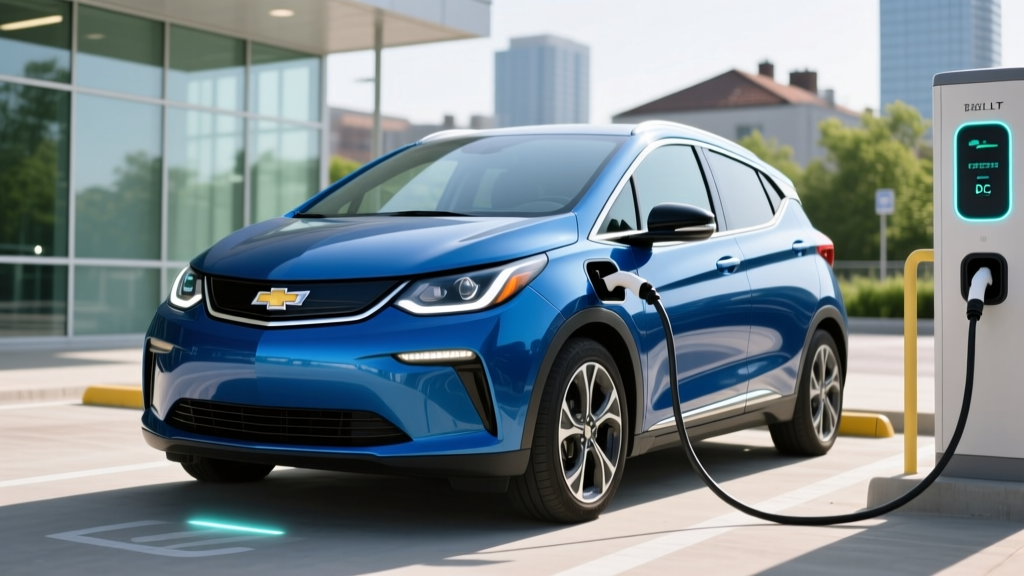
Charging is where the 2023 Bolt EV demands honest discussion. Chevrolet equipped the Bolt EV with a CCS1 connector and a peak DC fast-charge rate of just 55 kW — a figure that was modest at launch and looks increasingly dated by 2026 standards.
| Charging Level | Power | Speed / Notes |
|---|---|---|
| Level 1 (120V) | ~1.4 kW | ~4 miles of range per hour |
| Level 2 (240V, 48A) | 11.5 kW | ~39 miles per hour; full charge in ~7 hours |
| DC Fast Charge | 55 kW peak | 10–80% in ~60 min; tapers significantly above 60% |
At a DC fast charger, the Bolt EV peaks around 55 kW only when the battery is between roughly 10–40% state of charge. Beyond 50%, the charge curve tapers sharply — dropping to 30 kW and eventually below 15 kW as you approach 80%. A 10–80% session takes approximately 60 minutes, which is 2–3 times longer than competitors like the Hyundai Ioniq 5 or Kia EV6 that sustain 150+ kW rates.
For road trips, this means planning longer stops. On a 300-mile journey requiring one charge, expect a 45–60 minute sit at a Electrify America or EVgo station rather than the 18–25 minute stops you'd make in a faster-charging vehicle. The Bolt EV is best suited to owners who can charge at home overnight and take road trips infrequently — or who don't mind the slower pace.
Home Level 2 charging is where the Bolt EV actually performs well. The onboard 11.5 kW charger is generous for this price class, meaning a properly installed 48-amp Level 2 station refills the battery from empty in about 7 hours. This is faster than many competitors in the same price bracket and makes overnight replenishment effortless.
Performance and Driving Dynamics
The Bolt EV's single front-mounted motor produces 200 horsepower and 266 lb-ft of torque, delivered to the front wheels. The instant torque characteristic of electric motors gives the Bolt EV a peppy, responsive feel in city driving. The 0–60 mph time of approximately 6.5 seconds is adequate for merging and passing, though it won't win any stoplight races against dual-motor competitors.
Ride quality is composed but firm — the heavy battery pack sits low, giving the Bolt EV a planted feel through corners that belies its economy-car origins. Steering is light and numb, typical of the GM platform, but perfectly acceptable for a commuter vehicle. The one-pedal driving mode, activated via a steering-wheel paddle, is well-calibrated and allows most drivers to avoid the friction brake pedal in daily use.
Notably absent: all-wheel drive. The Bolt EV is FWD only, which limits its appeal in snow-belt states. Combined with the cold-weather range penalty, winter driving in the Bolt EV requires more planning than in AWD rivals like the Tesla Model Y or Ford Mustang Mach-E.
Interior, Tech, and the 2LT Advantage
The 2LT trim is the Bolt EV's top-tier offering, and it carries meaningful upgrades over the base 1LT. Key 2LT additions include:
- Leather-appointed seats (heated front and rear)
- Heated steering wheel
- Bose premium 7-speaker audio system
- Parking assist with surround-view camera
- Wireless phone charging pad
- Adaptive cruise control (a significant upgrade for highway commuters)
The centerpiece of the dashboard is a 10.2-inch diagonal touchscreen running Chevrolet Infotainment 3 Plus. The system supports wireless Apple CarPlay and Android Auto — a welcome feature that avoids cable clutter. Response times are quick, and the interface is intuitive, though it lacks the visual polish of Tesla's or Hyundai's latest systems.
The driver information cluster is a configurable 8-inch digital display showing range, energy flow, and trip data. One practical advantage of the Bolt EV's hatchback design is the 16.3 cubic feet of cargo space behind the rear seats, expanding to 57.0 cubic feet with the 60/40 split rear seats folded. That's competitive with small crossovers and far more practical than a sedan trunk.
Rear-seat space is adequate for adults on shorter trips, with 36.0 inches of legroom. Taller passengers will find headroom tight due to the sloping roofline. The Bolt EV is best thought of as a comfortable two-adult daily driver with occasional rear-seat use.
Pricing, Tax Credits, and Ownership Economics
The 2023 Chevrolet Bolt EV 2LT carried an original MSRP of $28,795 (before the $1,095 destination charge, bringing the total to approximately $29,890). This pricing positioned it as one of the most affordable long-range EVs on the market, undercutting rivals by $5,000–$10,000.
| Cost Factor | Amount |
|---|---|
| Original MSRP (2LT + Destination) | ~$29,890 |
| Federal Tax Credit (§30D) — New (2023) | Up to $7,500 (subject to eligibility) |
| Effective New Price (if eligible) | ~$22,390 |
| Current Used Market (2026, avg.) | $14,000–$19,000 depending on mileage |
| Federal Used EV Credit (§25E) | Up to $4,000 (30% of sale price, capped) |
Tax Credit Eligibility — Critical Caveats: For new purchases in 2023, the Bolt EV generally qualified for the full $7,500 federal clean vehicle credit under IRS §30D, as it met battery-sourcing requirements, was assembled in North America (Orion Township, Michigan), and fell well under the $55,000 MSRP cap for hatchbacks/sedans. Buyer income caps applied: $150,000 single / $300,000 joint filers. The credit could be applied as a point-of-sale reduction at participating dealers.
For 2026 used buyers, the §25E previously-owned clean vehicle credit offers up to $4,000 (30% of the sale price, capped at $4,000) on qualified used EVs purchased from a licensed dealer. Income limits are lower: $75,000 single / $150,000 joint. The Bolt EV is a strong candidate for this credit given its current used-market pricing, effectively bringing a $16,000 example down to $12,000.
On the ownership cost side, the Bolt EV's 28 kWh/100 mi efficiency translates to roughly $0.04–$0.05 per mile when charging at home on a national-average electricity rate of $0.16/kWh. Compare that to a 30 MPG gasoline car at $3.40/gallon ($0.11/mile), and the Bolt EV saves approximately $700–$900 annually in fuel costs for a 12,000-mile driver. Maintenance costs are also minimal — no oil changes, no spark plugs, and reduced brake wear from regen.
Battery Warranty, Longevity, and Chemistry
Chevrolet backs the Bolt EV's 65 kWh NMC battery with an 8-year/100,000-mile warranty (10 years/150,000 miles in California Air Resources Board states). The warranty guarantees the battery will retain at least 60% of its original capacity — a relatively generous retention floor compared to some competitors who set the bar at 70% but offer shorter terms.
NMC chemistry offers higher energy density than LFP (lithium iron phosphate), which is how Chevrolet packed 259 miles into a compact hatchback. The trade-off is that NMC batteries are more sensitive to sustained high-state-of-charge storage and extreme temperatures. For maximum longevity, Bolt EV owners should:
- Avoid routinely charging to 100% unless a long trip requires it
- Use the "Hilltop Reserve" charge limit setting (~80%) for daily driving
- Precondition the battery while plugged in during extreme cold
- Avoid repeated DC fast charging in hot weather when possible
Real-world degradation data from Bolt EV owners shows approximately 5–8% capacity loss over the first 3 years / 40,000 miles, which is within the normal range for NMC packs. The Bolt EV's liquid-cooled thermal management system helps keep the battery in its optimal temperature window, contributing to consistent longevity.
Safety and Driver Assistance
The 2023 Bolt EV earned a 5-Star Overall Safety Rating from NHTSA, with top marks across frontal crash, side crash, and rollover categories. The 2LT trim includes Chevrolet's Chevy Safety Assist suite:
- Automatic Emergency Braking with pedestrian detection
- Forward Collision Alert
- Lane Keep Assist with Lane Departure Warning
- Following Distance Indicator
- IntelliBeam automatic high beams
- Adaptive Cruise Control (2LT exclusive)
- Rear Cross Traffic Alert with surround-view camera
These are SAE Level 1 driver-assistance features — they support the driver but do not enable hands-free or autonomous operation. The driver must remain fully engaged at all times. Unlike GM's Super Cruise (available on other models), the Bolt EV does not offer any Level 2 hands-free highway driving capability.
Pros
- Exceptional value — lowest price-per-mile-of-range in its class
- Strong 259-mile EPA range from a compact package
- Fast 11.5 kW Level 2 onboard charging
- Practical hatchback cargo space (57 cu ft max)
- Wireless CarPlay/Android Auto standard
- 5-star NHTSA safety rating
- Peppy city acceleration with one-pedal driving
Cons
- Slow 55 kW DC fast charging (60+ min for 10–80%)
- No heat pump — significant winter range loss
- FWD only — no AWD option
- Rear seat headroom tight for tall passengers
- Discontinued after 2023 — no new units available
- Infotainment feels dated vs. newer competitors
- No hands-free driver-assist option
Who Should Buy the 2023 Bolt EV 2LT?
Choose the Bolt EV 2LT if:
- You primarily commute and can charge at home overnight
- You want maximum range per dollar on the used EV market
- Your road trips are infrequent or under 200 miles between stops
- You value hatchback practicality over crossover styling
- You live in a moderate climate where cold-weather range loss is manageable
Look elsewhere if:
- You road-trip frequently and need sub-30-minute DC fast-charge stops
- You need AWD for snow or mountain driving
- You regularly carry four adults (rear headroom and legroom are tight)
- You want the latest infotainment or hands-free driving features
The Bolt EV 2LT is the ideal budget-conscious commuter EV. It excels as a daily driver for someone with home charging access, a moderate climate, and a commute under 100 miles round-trip. The 2LT trim's adaptive cruise control and heated seats elevate it above bare-bones territory, and the Bose audio system is a genuine upgrade. For the used-EV buyer in 2026 who can capture the §25E credit, a Bolt EV 2LT at $12,000–$15,000 effective cost is arguably the best value in electrified transportation available.
However, if DC fast-charging speed is a priority, consider the Hyundai Kona Electric (which charges at up to 100+ kW) or the Kia Niro EV. If you need AWD and road-trip capability, the used Tesla Model 3 or Ford Mustang Mach-E are more versatile, albeit at higher prices.
Frequently Asked Questions
What is the real-world range of the 2023 Chevrolet Bolt EV 2LT?
In mixed city/highway driving at moderate temperatures, expect 230–250 miles. Sustained highway driving at 75 mph drops this to around 200–215 miles. In freezing weather, plan for 170–195 miles due to the resistance heater and lack of a heat pump.
How fast does the Bolt EV charge at home and on DC fast chargers?
At home on a 240V Level 2 station (48A), the Bolt EV charges at 11.5 kW, adding roughly 39 miles per hour and completing a full charge in about 7 hours. On DC fast chargers, it peaks at 55 kW, taking approximately 60 minutes for a 10–80% session — considerably slower than modern rivals.
Does the 2023 Bolt EV qualify for the federal EV tax credit?
When purchased new in 2023, the Bolt EV generally qualified for the full $7,500 §30D credit, subject to buyer income limits ($150K single / $300K joint). For 2026 used buyers, the §25E previously-owned credit offers up to $4,000 (30% of sale price) with lower income caps ($75K single / $150K joint). Always verify current eligibility with a tax professional and check the IRS clean vehicle credit pages for the latest rules.
Is the 2023 Bolt EV 2LT worth buying in 2026 vs. newer competitors?
Yes — if you prioritize value and home charging over road-trip speed. At current used prices ($14,000–$19,000), the Bolt EV 2LT offers 259 miles of range for thousands less than newer competitors. Its weaknesses (slow DC charging, no heat pump, FWD only) are manageable for commuters with home charging access.
What is the battery replacement cost for the Bolt EV?
Out-of-warranty battery replacement for the Bolt EV typically ranges from $14,000 to $16,000 including parts and labor. However, the 8-year/100,000-mile warranty (longer in CARB states) covers capacity loss below 60%, and real-world degradation data suggests most packs will last well beyond the warranty period with proper care.
Can the Bolt EV tow or carry a bike rack?
Chevrolet does not rate the Bolt EV for towing, and the owner's manual explicitly advises against it. However, many owners successfully use hitch-mounted bike racks (1.25-inch receiver) for lightweight loads. Do not exceed the vehicle's gross weight rating, and be aware that any added weight and aerodynamic drag will reduce range.