Quick Verdict: The Electric Flagship That Actually Drives Like a BMW
The 2023 BMW i7 xDrive60 is BMW's first all-electric 7 Series, and it arrives with a clear mission: prove that a full-size luxury sedan can go electric without sacrificing the driving dynamics and cabin refinement the 7 Series badge demands. With 536 horsepower, a 101.7 kWh battery, and an EPA-estimated 318 miles of range, the i7 xDrive60 is a legitimate long-distance cruiser — but at a starting MSRP above $120,000, it occupies a narrow slice of the EV market where buyers expect perfection, not just adequacy.
After spending time with the i7's specs, charging behavior, and real-world efficiency data, our take is that BMW has built a genuinely impressive electric flagship. The dual-motor AWD powertrain delivers effortless acceleration, the cabin is whisper-quiet at highway speeds, and DC fast charging peaks at a respectable 195 kW. The trade-offs are predictable for a vehicle this size: weight, price, and a tax-credit situation that is complicated at best. Here is everything you need to know before putting down a deposit.
Range, Battery, and Real-World Efficiency
The i7 xDrive60 uses a 101.7 kWh usable lithium-ion battery pack (gross capacity approximately 105.7 kWh) built with NMC (nickel manganese cobalt) cell chemistry. BMW opted for NMC over LFP to prioritize energy density — critical in a sedan where packaging the battery low without compromising cabin or trunk space is a constant engineering challenge.
| Metric | Figure |
|---|---|
| EPA Estimated Range | 318 miles (with 19" wheels; 313 mi with 20"; ~295 mi with 22") |
| Real-World Highway (70-75 mph) | ~265–285 miles |
| Real-World City / Mixed | ~290–310 miles |
| Cold Weather (below 32°F) | ~225–260 miles (20–30% reduction typical for NMC packs) |
| EPA Efficiency | 82 MPGe combined / 41 kWh per 100 miles |
The i7's efficiency of roughly 2.4 miles per kWh is respectable for a 5,800+ lb luxury sedan, but it means highway driving at sustained speeds will consume energy noticeably faster than the EPA sticker suggests. If your commute is predominantly stop-and-go city driving, you'll land closer to the EPA number. Road-trippers should plan charging stops assuming roughly 270 miles of usable range in fair weather.
The i7 features a heat pump as standard equipment, which helps mitigate cold-weather range loss compared to resistive cabin heating. BMW's thermal management system also supports battery preconditioning — when you navigate to a DC fast charger in the iDrive system, the pack warms itself to an optimal temperature, reducing charge-time taper at the stall. According to fueleconomy.gov, the i7 xDrive60's combined MPGe of 82 places it roughly on par with the Mercedes EQS 450+ (97 MPGe for the RWD variant, but the EQS 450 4MATIC AWD drops closer to the BMW's territory).
Charging Speed: DC Fast, Level 2, and Level 1
Charging performance is where luxury EV buyers have every right to expect excellence, and the i7 xDrive60 delivers solid — if not class-leading — numbers.
| Charging Level | Power / Rate | Time / Speed |
|---|---|---|
| DC Fast Charge (Peak) | 195 kW max (CCS1 connector) | 10–80% in ~34 minutes |
| DC Fast Charge (Sustained Avg.) | ~130–150 kW average to 80% | ~180 miles added in 20 min |
| Level 2 (Home / Public AC) | 11 kW onboard charger (max) | ~22 miles per hour of charging; 0–100% in ~10 hours |
| Level 1 (120V Household) | ~1.4 kW | ~3 miles per hour (emergency/trickle only) |
The 195 kW peak DC rate means the i7 won't match the 250+ kW peaks of Hyundai's E-GMP vehicles or the Lucid Air, but it is competitive with the Mercedes EQS (200 kW peak). The critical detail is the charge curve: the i7 sustains above 150 kW through roughly 40% SoC before tapering progressively. Expect the 10–80% session to average around 130–150 kW in practice, which is adequate for highway rest-stop charging but not exceptional.
For home charging, the 11 kW onboard charger is a strong point. On a 48-amp Level 2 circuit (the most common residential install), you'll see roughly 11 kW / 22 miles of range per hour, meaning a full overnight charge is easily achievable. BMW includes a portable Level 1/2 charging cable with the vehicle, but most owners will want a dedicated BMW Wallbox or a quality third-party Level 2 unit like a ChargePoint Home Flex or Emporia Vue installed on a 60-amp breaker.
Performance, Drivetrain, and Driving Dynamics
| Spec | Value |
|---|---|
| Powertrain | Dual-motor AWD (xDrive) |
| Horsepower | 536 hp |
| Torque | 549 lb-ft |
| 0–60 mph | 4.5 seconds (BMW estimate); independent tests ~4.2–4.4 sec |
| Top Speed | 149 mph (electronically limited) |
| Curb Weight | ~5,975 lbs |
| Towing Capacity | Not rated (BMW does not recommend towing with the i7) |
Despite its nearly 6,000-pound curb weight, the i7 xDrive60 moves with the kind of effortless, surge-of-torque acceleration that defines great electric luxury sedans. The 4.5-second 0–60 time won't embarrass a Tesla Model S Plaid, but it's plenty quick for a full-size sedan and more than sufficient for highway merging and overtaking.
BMW has fitted the i7 with rear-axle steering (up to 3 degrees), which dramatically shrinks the car's effective turning radius and makes parking-lot maneuvering far less stressful than a 17.3-foot sedan has any right to be. The adaptive two-axle air suspension is standard, offering adjustable ride height and firmness that transitions from supple highway cruiser to genuinely composed corner-carver depending on your drive-mode selection. It's not a sports sedan, but among full-size luxury EVs, the i7's chassis tuning is a standout.
Regenerative braking is adjustable through three levels (low, medium, high) plus an adaptive mode that uses radar and navigation data to modulate regen based on traffic ahead. The i7 does not offer true one-pedal driving to a full stop in all modes, which is a deliberate BMW choice — the company prefers a coasting-oriented efficiency strategy that many longtime BMW drivers will find familiar.
Interior Space, Cargo, and Technology
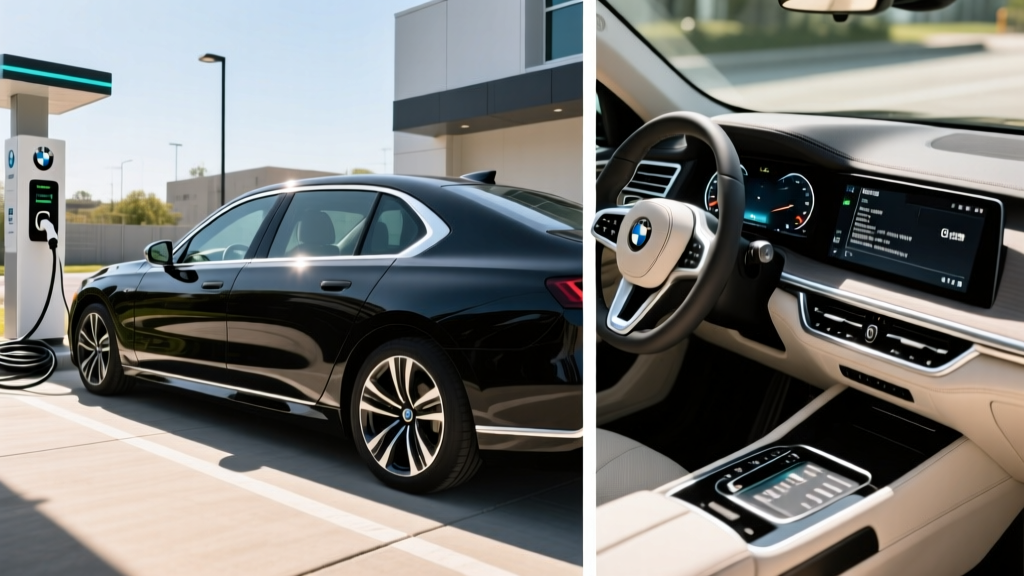
The i7's cabin is a showcase for BMW's latest design language, blending the brand's traditional driver-focused ergonomics with the screen-heavy layout modern luxury buyers expect.
| Measurement | Value |
|---|---|
| Front Headroom | 40.0 in |
| Front Legroom | 41.2 in |
| Rear Headroom | 38.6 in |
| Rear Legroom | 42.7 in |
| Trunk Volume | 17.7 cu ft |
| Frunk (Front Trunk) | None |
Rear-seat space is limousine-grade — the 42.7 inches of rear legroom exceeds the Mercedes EQS and rivals the long-wheelbase S-Class. The optional Executive Lounge Seating package adds reclining rear seats with massage, heated and ventilated cushions, and individual rear entertainment screens. The trunk, at 17.7 cubic feet, is generous for a sedan but notably lacks a power-folding rear seat for expanded cargo — an omission that matters if you regularly haul long items.
There is no frunk. BMW has used the space typically reserved for a front trunk to house power electronics and HVAC components, which is a packaging choice that frustrates some EV buyers accustomed to dual-trunk layouts.
Infotainment and Driver Assistance
The i7 runs BMW's iDrive 8 system on a curved display that pairs a 12.3-inch instrument cluster with a 14.9-inch central touchscreen. The system is fast, visually polished, and supports wireless Apple CarPlay and Android Auto. Physical shortcut buttons for climate and volume are retained — a welcome decision in an era of touchscreen-only competitors.
The standout tech feature is the optional 31-inch BMW Theater Screen, an 8K ultra-wide display that deploys from the ceiling for rear passengers, complete with integrated Amazon Fire TV. It's a gimmick if you don't have rear-seat passengers who enjoy movies, but it's a genuinely impressive party trick and a differentiator against the EQS and Lucid Air.
On the driver-assistance front, the i7 comes standard with Driving Assistant Professional, which includes adaptive cruise control with stop-and-go, lane-keeping assist, and automatic lane-change capability. This is a SAE Level 2 system — the driver must remain fully engaged and hands cannot leave the wheel for extended periods. BMW's Highway Assistant (a hands-off, eyes-on system approved for use up to 80 mph on divided highways in certain markets) is available in some regions but has limited availability in the US. Do not confuse any of these features with autonomous driving.
Pricing, Trims, and Federal Tax Credit Eligibility
| Item | Amount |
|---|---|
| Base MSRP (xDrive60) | $119,300 |
| Destination Charge | $995 |
| As-Tested (well-equipped) | $135,000–$145,000+ |
| Federal §30D Tax Credit | $0 — does not qualify (see below) |
Under IRS §30D rules, the 2023 BMW i7 xDrive60 fails the federal tax credit on two fronts:
- MSRP Cap: The §30D credit caps eligible sedans at an MSRP of $55,000. The i7's $119,300 base price exceeds this by a wide margin.
- Battery Sourcing: Even if priced within limits, the i7's battery cells and critical minerals do not meet the North American sourcing thresholds required for the full $7,500 credit in 2023 and beyond.
Buyers should not expect any federal purchase incentive. Some state-level rebates (California's CVRP, for example, has income and price caps that would also exclude the i7) may offer partial relief, but check your state and local incentive programs directly, as rules change frequently. Consult a tax professional for personalized eligibility advice.
Options can push the i7 well past $140,000. Key packages include the Executive Lounge Seating ($3,800), the Bowers & Wilkins Diamond Surround Sound system ($3,400), the BMW Theater Screen ($2,000), and 22-inch wheels ($2,200). A fully loaded i7 with the M Sport package, rear-axle steering, and every luxury option can approach $150,000.
Ownership Costs, Warranty, and Maintenance
| Coverage | Terms |
|---|---|
| Limited Vehicle Warranty | 4 years / 50,000 miles |
| Battery & Powertrain Warranty | 8 years / 100,000 miles (covers capacity loss below 70% of original) |
| Corrosion Warranty | 12 years / unlimited miles |
| Complimentary Maintenance | 3 years / 36,000 miles (BMW Ultimate Care) |
Battery replacement cost, should it be needed out of warranty, is estimated in the $25,000–$35,000 range for a pack of this size, though NMC degradation in a thermally managed pack with moderate use typically stays within 10–15% over 8–10 years. BMW's 70% retention threshold at 8 years/100,000 miles is industry-standard and aligns with Mercedes, Audi, and Tesla's warranty terms.
Insurance premiums for the i7 are elevated — expect annual costs in the $3,500–$5,000 range depending on your profile, driven by the vehicle's value, repair costs for the aluminum-intensive body structure, and the specialized labor required for high-voltage systems. Get quotes before purchasing.
Charging costs are modest relative to the purchase price. At a national average residential electricity rate of ~$0.16/kWh, a full home charge costs roughly $16.27 (101.7 kWh × $0.16), yielding a cost per mile of about $0.05–0.06. DC fast charging at public rates ($0.35–$0.50/kWh) pushes that to $0.14–$0.19 per mile — still below the ~$0.18–$0.22 per mile a comparable gas-powered 740i would cost at 25 MPG combined and $3.50/gallon.
Pros, Cons, and Who Should Buy
- Genuine 300+ mile EPA range with heat pump and preconditioning
- Outstanding ride quality via adaptive air suspension and rear-axle steering
- Class-leading rear-seat space (42.7" legroom) and optional Theater Screen
- Refined, quiet cabin with high-quality materials throughout
- 11 kW Level 2 onboard charger enables practical overnight home charging
- Strong 536 hp / 4.5s 0–60 performance without sacrificing comfort
- $120K+ MSRP with no federal tax credit eligibility
- No frunk — unusual for an EV in this price class
- DC fast charge peak of 195 kW is good but trails Lucid Air and Porsche Taycan
- Heavy at ~5,975 lbs — tire wear and braking distances reflect the mass
- Real-world highway range drops to ~270 miles; plan road trips accordingly
- iDrive 8 learning curve; some functions buried in touchscreen menus
- Executive commuters who want a silent, refined daily driver with premium rear-seat accommodations for clients or family.
- Home-charging-capable owners with a garage or driveway where a Level 2 charger can be installed — the i7's 11 kW onboard charger rewards home charging with fast, cheap overnight top-ups.
- BMW loyalists upgrading from a 740i or 750i who want electrification without switching brands or learning a new ecosystem.
Look elsewhere if: You need maximum DC fast-charge speed for frequent 400+ mile road trips (consider the Lucid Air Grand Touring), you want a frunk for gear, or your budget is below $100K (the BMW i5 or Mercedes EQE are better fits).
How It Compares: i7 vs. Key Rivals
| Spec | 2023 BMW i7 xDrive60 | 2023 Mercedes EQS 450 4MATIC | 2023 Lucid Air Grand Touring |
|---|---|---|---|
| EPA Range | 318 mi | 305 mi | 516 mi |
| Battery (usable kWh) | 101.7 kWh (NMC) | 107.8 kWh (NMC) | 112 kWh (NMC) |
| Peak DC Charge | 195 kW | 200 kW | 250 kW (est. ~300 mi in 20 min) |
| 10–80% Time | ~34 min | ~31 min | ~20 min |
| Horsepower | 536 hp | 355 hp | 819 hp |
| 0–60 mph | 4.5 sec | 5.3 sec | 3.0 sec |
| Base MSRP | $119,300 | $105,550 | $138,000 |
| Rear Legroom | 42.7 in | 41.9 in | 37.6 in |
| Federal Tax Credit | No | No | No |
The Lucid Air Grand Touring dominates on range and charging speed, but its rear seat is noticeably tighter and its brand lacks BMW's dealer network. The Mercedes EQS offers a slightly lower entry price and comparable luxury, though its driving dynamics are more comfort-biased and its efficiency (MPGe) trails. The i7 occupies a middle ground: it's the best driver's car in this trio, with the most rear-seat space and a tech-forward cabin, but it can't match the Air's road-trip practicality.
Frequently Asked Questions
What is the real-world range of the 2023 BMW i7 xDrive60?
The EPA rates the i7 xDrive60 at 318 miles with 19-inch wheels. In real-world mixed driving, expect 290–310 miles. At sustained highway speeds of 70–75 mph, plan for 265–285 miles. In freezing temperatures, the NMC battery and heat pump still result in a 20–30% range reduction, bringing usable range to roughly 225–260 miles.
How fast does the i7 charge at home and on the road?
On a DC fast charger, the i7 peaks at 195 kW and charges from 10–80% in approximately 34 minutes. At home on a Level 2 charger (240V, 48A), the 11 kW onboard charger adds about 22 miles of range per hour, meaning a full charge takes roughly 10 hours — easily achievable overnight.
Does the 2023 BMW i7 qualify for the federal EV tax credit?
No. The i7 xDrive60's MSRP of $119,300 far exceeds the $55,000 sedan cap set by IRS §30D. Additionally, its battery sourcing does not meet the critical-mineral and component requirements. No federal purchase incentive applies. Check IRS.gov and your state programs for any applicable local incentives.
Is the BMW i7 worth buying vs. the Mercedes EQS or Lucid Air?
If you prioritize driving engagement, rear-seat space, and BMW's dealer/service network, the i7 is the strongest choice. If maximum range and fast-charging speed are your top priorities, the Lucid Air Grand Touring is objectively superior. If you want a lower starting price and a more comfort-focused ride, the EQS 450 4MATIC is worth cross-shopping.
What are the biggest drawbacks of the i7 xDrive60?
The main compromises are price (no tax credit relief), the lack of a frunk, a DC fast-charge speed that trails the best in class, and real-world highway range that falls notably short of the EPA sticker. Insurance costs are also elevated relative to non-luxury EVs.
Does the i7 support hands-free driving?
The i7's Driving Assistant Professional is a SAE Level 2 driver-assist system. It offers adaptive cruise, lane-centering, and automatic lane changes, but the driver must remain fully attentive with hands on or near the wheel at all times. It is not a self-driving system.