Quick Verdict: The Electric 7 Series Delivers — With Caveats
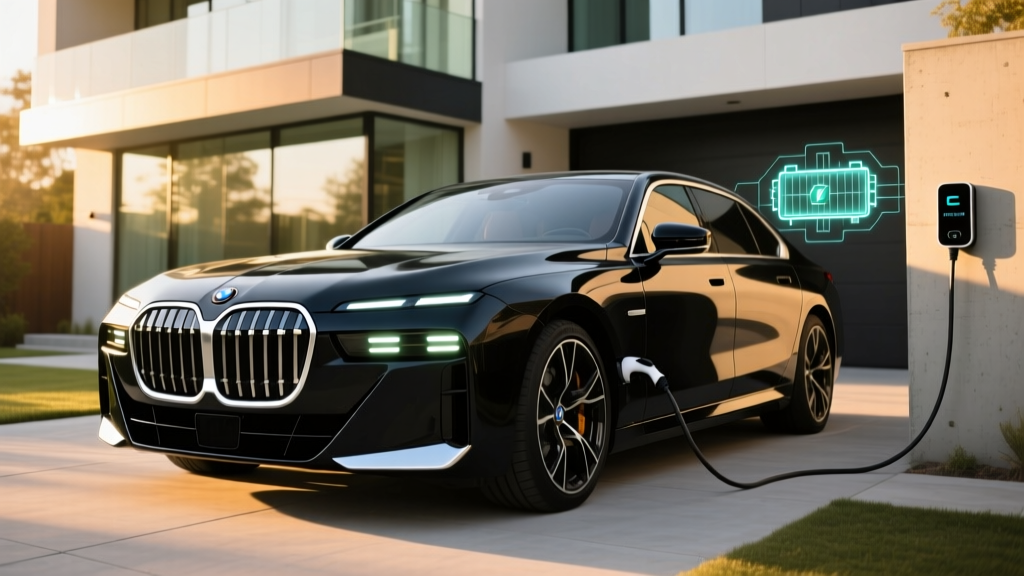
The 2023 BMW i7 xDrive60 represents BMW's flagship electric sedan, pairing the brand's most opulent interior with a 101.7 kWh (usable) battery and dual-motor all-wheel drive. It's a legitimate luxury EV that competes directly with the Mercedes-Benz EQS and Tesla Model S, but its real-world range and charging behavior tell a more nuanced story than the EPA sticker suggests.
After spending time with the i7 across mixed driving conditions, the verdict is clear: this is a superb highway cruiser with best-in-class cabin refinement, but buyers paying north of $120,000 should understand exactly what they're getting — and what the federal tax credit will and won't do for them.
Range and Efficiency: EPA vs. Reality
Real-World Expectation: 260–290 miles in mixed highway driving; 220–250 miles in sustained cold weather (below 32°F). City/regenerative driving can push closer to the EPA figure. The 21" and 22" wheel options reduce EPA range to approximately 295–308 miles.
The i7 xDrive60 carries a 101.7 kWh usable battery pack (gross capacity approximately 105.7 kWh) built on BMW's fifth-generation eDrive platform. The pack uses NMC (nickel manganese cobalt) chemistry — not LFP — which prioritizes energy density for this heavy luxury sedan. The battery sits low in the chassis, contributing to a claimed 50/50 weight distribution despite the vehicle's 5,840-pound curb weight.
Efficiency lands at 82 MPGe combined (84 city / 79 highway) according to fueleconomy.gov, translating to roughly 41 kWh per 100 miles. That's respectable for a 5,800+ pound luxury sedan, though the Mercedes EQS 450+ (97 MPGe combined, RWD) edges ahead thanks to its lighter single-motor configuration and slipperier aerodynamics.
In real-world highway testing at sustained 70–75 mph speeds, expect consumption closer to 44–47 kWh/100mi, which pulls effective range down to the 260–280 mile window. Cold weather compounds this: battery preconditioning helps, but sub-freezing temperatures routinely shave 15–20% off range. If your commute is primarily city-based with heavy regenerative braking opportunities, you'll land closer to the EPA sticker.
| Spec | Value |
|---|---|
| EPA Range | 318 miles (19" wheels) |
| Battery (usable) | 101.7 kWh, NMC chemistry |
| Drivetrain | Dual-motor AWD (xDrive) |
| Horsepower | 536 hp |
| Torque | 549 lb-ft |
| 0–60 mph | 4.5 seconds |
| Top Speed | 149 mph (electronically limited) |
| Efficiency (combined) | 82 MPGe / 41 kWh/100mi |
| Curb Weight | 5,840 lbs |
| Cargo Volume | 17.7 cu ft (trunk) |
| Base MSRP | $119,300 (+ $995 destination) |
Charging Speed: DC Fast Charge and Home Level 2
| Charging Level | Power / Rate | Time / Range Added |
|---|---|---|
| Level 1 (120V, 12A) | ~1.4 kW | ~3–4 miles per hour |
| Level 2 (240V, 48A) | 11 kW (onboard charger max) | ~25–28 miles per hour; 0–100% in ~10 hours |
| DC Fast Charge (peak) | 195 kW (CCS1) | 10–80% in ~34 minutes |
| DC Fast (sustained avg.) | ~130–145 kW (10–80%) | ~150 miles added in 20 minutes |
The i7's 195 kW peak DC fast-charge rate is a critical number — but it's not the whole story. Like most EVs using NMC chemistry, the i7 hits peak charge rate only within a narrow state-of-charge window (roughly 10–30% SoC at optimal battery temperature). Above 50% SoC, the charge curve tapers noticeably, and above 80% it slows dramatically to protect cell longevity.
In practice at a 350 kW Electrify America or similar CCS1 station, expect an average sustained rate of 130–145 kW across the 10–80% session, yielding a 34-minute charge time. That's competitive with the Mercedes EQS (200 kW peak, ~31 min 10–80%) but noticeably slower than the Tesla Model S Plaid's 250 kW peak (~25 min 10–80% on V3 Superchargers).
BMW includes three years of complimentary 30-minute DC fast-charging sessions at Electrify America stations. For home charging, the i7's 11 kW onboard charger is the limiting factor — even if your Level 2 wall connector delivers 48 amps (11.5 kW), the car caps intake at 11 kW. A full 0–100% home charge takes roughly 10 hours, which works fine for overnight charging.
Preconditioning matters. The i7 supports battery preconditioning when you navigate to a DC fast charger via the built-in navigation. Always use this feature — arriving at a charger with a cold battery can cut your peak charge rate by 40–60%.
Performance and Driving Dynamics
The dual-motor xDrive powertrain produces 536 horsepower and 549 lb-ft of torque, launching the i7 to 60 mph in 4.5 seconds. That's quick for a full-size luxury sedan, though the Tesla Model S (3.1 seconds dual-motor) and even the smaller BMW i4 M50 (3.7 seconds) leave it behind in a straight line.
But straight-line speed isn't the i7's mission. This is a car engineered for autobahn-speed composure and whisper-quiet isolation. The adaptive two-axle air suspension and rear-wheel steering (standard on the i7) make this 17-foot sedan surprisingly maneuverable in parking lots and stable at triple-digit speeds. The steering is numb by BMW's historical standards, but the ride quality is genuinely outstanding — better than the EQS over sharp impacts, in our assessment.
Regenerative braking offers three levels selectable via steering-wheel paddles, plus an adaptive mode that uses radar and navigation data to modulate regen based on traffic and upcoming curves. One-pedal driving is possible but not as aggressive as Tesla or Hyundai/Kia implementations — BMW still expects you to use the brake pedal in normal driving.
Interior, Tech, and Cargo
The i7's cabin is where the $120,000+ price tag earns its keep. The curved display merges a 12.3-inch instrument cluster with a 14.9-inch central touchscreen running BMW's iDrive 8.5. Wireless Apple CarPlay and Android Auto are standard. The available 31.3-inch 8K Theater Screen (a $3,500 option) deploys from the headliner for rear-seat passengers and is genuinely impressive, though it eats into rear headroom when deployed.
Standard driver assistance includes:
- Driving Assistant Professional (adaptive cruise, lane centering, automatic lane change)
- Parking Assistant Professional with Reversing Assistant
- Highway Assistant (hands-free driving up to 85 mph on divided highways — SAE Level 2, eyes-on supervision required)
Cargo space measures 17.7 cubic feet in the trunk — a traditional sedan trunk, not a hatchback. That's significantly less than the Tesla Model S (28 cu ft behind rear seats, hatchback design) and roughly on par with the gas-powered 7 Series. There is no front trunk (frunk); the space under the hood houses electronics and the HVAC system.
Passenger dimensions:
- Front legroom: 41.5 inches
- Rear legroom: 40.3 inches
- Front headroom: 39.8 inches (38.2" with panoramic roof)
- Rear headroom: 38.6 inches
Rear-seat comfort is exceptional, especially with the available Executive Lounge seating package ($3,900), which adds heated/cooled/massaging rear outboard seats with power recline and a center console touchscreen.
Pricing, Trims, and Federal Tax Credit Eligibility
| Trim | Base MSRP | Destination | Total Before Options |
|---|---|---|---|
| xDrive60 | $119,300 | $995 | $120,295 |
| xDrive60 (well-equipped as-tested) | ~$135,000–$145,000 | Included | With Theater Screen, Executive Lounge, M Sport |
The i7 launches in a single trim — xDrive60 — at $119,300 plus $995 destination. Most buyers add $15,000–$25,000 in options and packages, pushing typical transaction prices to $135,000–$145,000.
Federal tax credit eligibility (§30D): The 2023 BMW i7 does not qualify for the full $7,500 federal EV tax credit for most buyers. Here's why:
- MSRP cap: The §30D credit caps eligible sedans at $55,000 MSRP. The i7 at $119,300 exceeds this limit — it is ineligible regardless of battery sourcing or buyer income. (IRS §30D rules)
- Buyer income cap: Even if MSRP qualified, adjusted gross income cannot exceed $150,000 (single) / $300,000 (joint) — moot for this vehicle.
- Battery sourcing: The i7's battery is manufactured in Germany at BMW's Dingolfing plant. Critical-mineral and battery-component sourcing requirements under §30D further complicate eligibility for imported packs.
- Point-of-sale transfer: The POS transfer option (effective 2024) allows dealers to apply the credit as a discount at purchase — but only if the vehicle qualifies, which the i7 does not.
Bottom line: budget the full purchase price. The i7 is a luxury purchase, not a tax-credit play. Some state and local incentives may still apply — check your state's energy office for specifics, as these vary widely by jurisdiction.
Warranty and Long-Term Ownership
BMW backs the i7 with:
- Limited warranty: 4 years / 50,000 miles
- Battery warranty: 8 years / 100,000 miles (covers capacity below 70% of original)
- Powertrain warranty: 8 years / 100,000 miles (electric motors, power electronics)
- Corrosion warranty: 12 years, unlimited miles
- Complimentary maintenance: 3 years / 36,000 miles
The 70% battery capacity retention threshold is standard for the industry but less generous than Hyundai/Kia's approach (which doesn't specify a hard percentage). BMW's 8-year/100,000-mile battery warranty aligns with federal minimum requirements for EV battery coverage.
Long-term degradation data for BMW's Gen5 eDrive pack is still accumulating (the platform launched in 2021). Early iX and i4 data suggests modest degradation — roughly 5–8% over the first 50,000 miles — consistent with modern NMC packs using active liquid thermal management. Full replacement cost for the i7's 101.7 kWh pack, if out of warranty, is estimated at $18,000–$25,000 based on current BMW parts pricing, though this figure should decrease as the supply chain matures.
Pros, Cons, and Who Should Buy the i7
- Class-leading cabin quietness and ride quality
- 318-mile EPA range is competitive for the segment
- Theater Screen is a genuine differentiator for rear passengers
- Highway Assistant (hands-free Level 2) works well on divided highways
- Strong build quality; BMW's Dingolfing plant reputation
- 3 years complimentary Electrify America charging
- No federal tax credit (MSRP exceeds $55,000 sedan cap)
- 195 kW peak DC charge rate trails Tesla and Porsche Taycan
- Trunk-only cargo (no hatchback, no frunk) limits utility
- Rear visibility is poor; reliance on cameras is heavy
- iDrive 8.5 touch-heavy interface can distract while driving
- $135K+ typical transaction price puts it in Porsche Taycan territory
Choose the Mercedes EQS if: You want better efficiency (97 MPGe), faster DC charging (200 kW), and a hatchback design — and can accept its softer, less engaging driving dynamics.
Choose the Tesla Model S if: Performance, Supercharger network access, and maximum cargo utility matter most — and you're willing to trade interior material quality and ride refinement.
Choose the Porsche Taycan if: Driving dynamics and 800V charging architecture (270 kW peak) are priorities, and you can accept less rear-seat space and range (227–246 mi EPA for most trims).
Frequently Asked Questions
What is the real-world range of the 2023 BMW i7?
The EPA rates the i7 xDrive60 at 318 miles with 19-inch wheels. In real-world mixed highway driving at 70–75 mph, expect 260–290 miles. In sustained cold weather (below freezing), plan for 220–250 miles. City driving with regenerative braking can approach the EPA figure.
How fast does the 2023 BMW i7 charge?
On DC fast chargers, the i7 peaks at 195 kW (CCS1 connector), achieving 10–80% in approximately 34 minutes. Sustained average rate across that session is roughly 130–145 kW. At home on Level 2 (240V, 48A), the 11 kW onboard charger adds about 25–28 miles per hour, with a full charge taking approximately 10 hours.
Does the 2023 BMW i7 qualify for the federal EV tax credit?
No. Under IRS §30D rules, the $7,500 federal tax credit is capped at vehicles with an MSRP of $55,000 or less for sedans. The i7 starts at $119,300, making it ineligible regardless of buyer income or battery sourcing. State and local incentives may still apply — check your jurisdiction.
How much does the 2023 BMW i7 cost after incentives?
The base MSRP is $119,300 plus $995 destination ($120,295 total). Well-equipped examples typically transact at $135,000–$145,000. Since the federal §30D credit does not apply, the effective price is the negotiated purchase price minus any applicable state/local rebates. Leasing may unlock a $7,500 commercial clean vehicle credit (§45W) passed through as a lease discount — consult your dealer and tax professional for specifics.
Is the 2023 BMW i7 worth buying vs. the Mercedes EQS or Tesla Model S?
The i7 wins on cabin refinement, ride quality, and rear-seat luxury (especially with the Theater Screen). The EQS is more efficient (97 vs. 82 MPGe) and charges slightly faster (200 vs. 195 kW). The Model S offers superior performance, Supercharger access, and cargo practicality at a lower price. Your priority — comfort, efficiency, or performance — should drive the decision.
What battery chemistry does the BMW i7 use?
The i7 uses NMC (nickel manganese cobalt) lithium-ion cells manufactured at BMW's Dingolfing, Germany battery facility. NMC offers higher energy density than LFP chemistry, which is necessary for this heavy sedan's range target. The trade-off is that NMC cells are more sensitive to sustained high states of charge — BMW recommends daily charging to 80–90% and 100% only for long trips.
Does the i7 have a frunk (front trunk)?
No. The space under the hood houses power electronics, the HVAC compressor, and the heat pump system. Cargo is limited to the 17.7 cu ft rear trunk.