If you've been searching for a 2023 BMW i3, here's the critical fact to know first: BMW discontinued the i3 globally in July 2022, and the last model year sold in the United States was 2021 (with some 2022 residual inventory). There is no 2023 model year BMW i3. However, the i3's legacy as one of the first mass-market premium EVs makes it one of the most compelling used electric vehicles available today — especially with the federal used-EV tax credit potentially knocking up to $4,000 off the price.
This review covers the final-generation BMW i3 (the 120 Ah variant with the 42.2 kWh battery), which represents the peak of the i3's development. We'll break down its real-world range, charging characteristics, ownership costs, and whether it still holds up against modern EVs in 2026.
Final-Generation BMW i3: Quick Verdict
The BMW i3 was a pioneer — a carbon-fiber-reinforced plastic (CFRP) city car with a radical design that was years ahead of its time. The final 120 Ah version delivers an EPA-estimated 153 miles of range from its 42.2 kWh battery pack, paired with a 170-hp electric motor and the quirky charm of rear-hinged "coach doors." It's not a road-trip EV, and it was never meant to be. But as a used commuter car with premium build quality, a tight turning radius, and access to the up-to-$4,000 federal used-EV tax credit (§25E), the i3 is arguably the best bargain in the used EV market right now.
EPA Estimate: 153 miles (BEV 120 Ah variant)
Real-World Expectation: Plan for 120–140 miles in mixed driving. Highway-only driving at 70+ mph drops this to roughly 110–125 miles. In cold weather (below 32°F), expect a 20–30% reduction, bringing usable range to approximately 90–115 miles. The i3 lacks a heat pump, so cabin heating draws directly from the traction battery.
Range, Battery, and Efficiency Specs
| Spec | Value |
|---|---|
| EPA Range | 153 miles |
| Battery Capacity | 42.2 kWh total / ~37.9 kWh usable |
| Battery Chemistry | NMC (Nickel Manganese Cobalt) — Samsung SDI cells |
| EPA Efficiency | 113 MPGe combined (30 kWh/100 mi) |
| 0–60 mph | 6.9 seconds |
| Horsepower | 170 hp (125 kW) |
| Torque | 184 lb-ft |
| Drivetrain | Rear-wheel drive (single motor) |
| Top Speed | 93 mph (electronically limited) |
| Curb Weight | ~2,952 lbs |
The i3's 42.2 kWh Samsung SDI battery pack uses NMC (nickel manganese cobalt) chemistry — the standard for most EVs of this era. BMW designed a generous buffer: roughly 4.3 kWh is reserved and inaccessible to the driver, which helps protect long-term battery health. According to fueleconomy.gov, the combined efficiency rating of 113 MPGe (30 kWh per 100 miles) makes the i3 one of the most energy-efficient EVs ever sold in the US.
Degradation note: Real-world data from i3 owners suggests typical capacity loss of 8–12% over the first 5–6 years and 60,000–80,000 miles. A 2019–2021 i3 in 2026 should still retain roughly 85–92% of its original capacity, translating to approximately 130–140 real-world miles on a full charge. Always request a battery health report or use an OBD-II reader with the BMW-specific Carly or BimmerCode app to check State of Health (SoH) before purchasing.
Charging Speed: DC Fast Charge and Home Level 2
The i3 uses the CCS1 (Combo) DC fast-charging connector on models equipped with the optional DC fast-charge package. Not all i3s have this — many early and base models were sold with AC-only charging. Verify CCS port presence before purchasing.
| Charging Level | Power (kW) | Speed / Time | Connector |
|---|---|---|---|
| Level 1 (120V household) | ~1.4 kW | ~3.5 miles per hour | J1772 |
| Level 2 (240V home) | 7.4 kW (max onboard charger) | ~21 miles per hour / full charge ~5.5 hrs | J1772 |
| DC Fast Charge | 50 kW peak | 10–80% in ~35–40 minutes | CCS1 (optional) |
The i3's 50 kW peak DC charge rate was respectable in 2018 but is slow by 2026 standards. For context, modern EVs like the Hyundai Ioniq 5 peak at 240 kW and can do 10–80% in roughly 18 minutes. The i3's charge curve is fairly flat up to about 60% SoC, then tapers significantly past 80% — typical for NMC cells managed conservatively. On a road trip, plan for 35–40 minute stops at 50 kW CCS chargers to get from 10% to 80%.
For home charging, the 7.4 kW onboard charger is the practical sweet spot. A full Level 2 installation (240V/40A circuit) will replenish the i3's battery from empty to full in about 5.5 hours — more than enough for overnight charging. Given the small battery, even a Level 1 (120V) outlet can add ~35 miles of range overnight, making the i3 viable even without dedicated home charging infrastructure if your commute is short.
Performance and Driving Dynamics
The i3's 170-hp electric motor delivers instant torque to the rear wheels, making it surprisingly quick off the line in city traffic. The 0–60 mph time of 6.9 seconds feels faster than the number suggests because there's no transmission lag — just immediate, linear acceleration from 0 rpm.
The i3's secret weapon is its extremely tight 32.3-foot turning circle, which makes it arguably the best urban EV ever built for navigating narrow streets and U-turns. The ultra-light CFRP (carbon fiber reinforced plastic) body structure keeps weight under 3,000 lbs — remarkably light for an EV — and contributes to the car's nimble handling and excellent efficiency.
One-pedal driving is strong in the i3, with aggressive regenerative braking that can bring the car to a complete stop without touching the brake pedal in most city driving scenarios. The steering is quick but light, and the narrow 155/70R19 tires prioritize low rolling resistance over grip — the i3 is not a canyon carver, and that's by design.
Interior, Cargo, and Technology
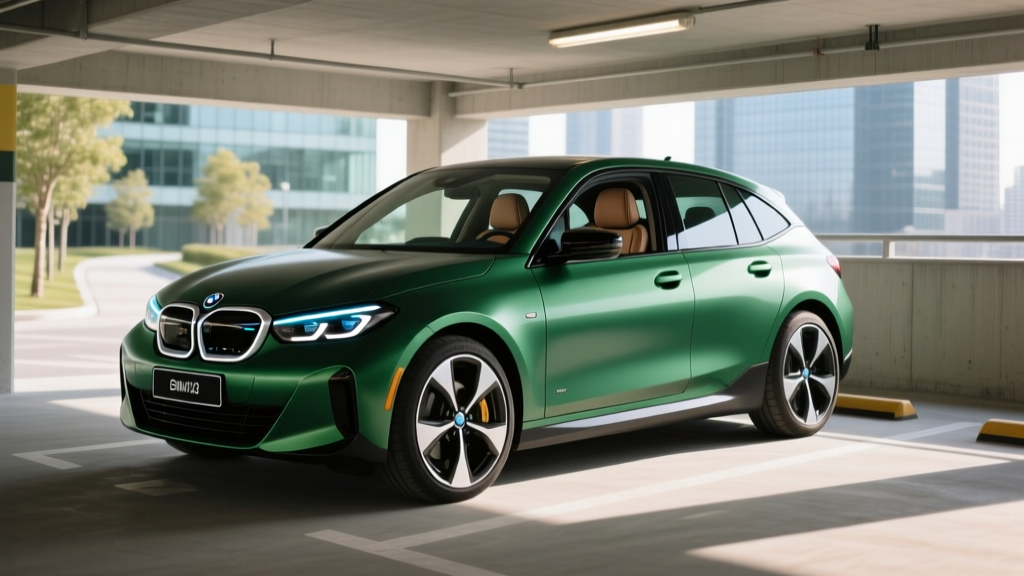
The i3's interior is unlike any other BMW — a minimalist, loft-like cabin with sustainable materials including eucalyptus wood trim, recycled wool-blend upholstery, and olive-leaf-tanned leather on higher trims. The freestanding 10.25-inch infotainment display runs BMW's iDrive system, which remains one of the best interfaces in the industry, complete with a rotary controller on the center console.
Cargo and passenger dimensions:
- Cargo volume (rear seats up): 15.1 cu ft
- Cargo volume (rear seats folded): 39.2 cu ft
- Front legroom: 40.5 inches
- Rear legroom: 31.9 inches (tight for adults on longer trips)
- Front headroom: 39.6 inches
The rear-hinged coach doors look dramatic but require both front and rear doors to open for rear-seat access — a practical annoyance in tight parking spaces. Rear seats accommodate two passengers and are best suited for children or occasional adult use on short trips. Cargo space is adequate for groceries and carry-on luggage but limited for larger hauls.
Standard tech features include navigation, Apple CarPlay (added for the final model years), Bluetooth, and BMW ConnectedDrive services. Driver-assistance features are basic by 2026 standards: adaptive cruise control, lane-departure warning, and front collision warning with city braking were available but not comprehensive. There is no highway lane-centering system — the i3's ADAS is firmly SAE Level 1, meaning it offers warnings and limited interventions, not active steering assist.
Pricing, Tax Credits, and Used Market Value
When new, the final BMW i3 120 Ah started at approximately $44,450 MSRP (base) and could climb to $51,000+ with the i3s performance variant and options. The i3s variant bumped output to 184 hp, widened the track, and added a sport suspension, but sacrificed a few miles of range (EPA 153 miles for both the standard i3 and i3s in the final year, though real-world testing showed the i3s slightly lower).
| Item | Amount |
|---|---|
| Original MSRP (2021 i3 base) | ~$44,450 |
| Typical 2026 Used Price | $17,000–$25,000 (depending on mileage, condition, trim) |
| Federal Used EV Tax Credit (§25E) | Up to $4,000 (30% of sale price, capped) |
| Effective Price After Credit | ~$13,000–$21,000 |
Federal used-EV tax credit (§25E) eligibility for the i3: The IRS §25E credit provides 30% of the sale price, up to a maximum of $4,000, for qualifying used EVs. Key requirements include:
- Vehicle price cap: Sale price must be $25,000 or less
- Buyer income caps: AGI must not exceed $75,000 (single), $112,500 (head of household), or $150,000 (joint filers)
- Vehicle age: Must be at least 2 model years old (any i3 qualifies)
- Dealer requirement: Must be purchased from a licensed dealer (private-party sales don't qualify)
- First-time transfer: The credit applies only once per vehicle after August 16, 2022 — verify the specific VIN hasn't already been claimed
Important: The i3 does not qualify for the new-vehicle §30D credit since it's no longer manufactured. All tax credit eligibility depends on your individual tax situation — consult a tax professional and review current IRS guidance before relying on credit amounts.
Warranty and Long-Term Ownership
BMW's original warranty for the i3 included:
- Battery warranty: 8 years / 100,000 miles (against capacity dropping below 70% of original)
- Powertrain warranty: 4 years / 50,000 miles
- Bumper-to-bumper: 4 years / 50,000 miles
For a 2021 model-year i3 in 2026, the battery warranty still has approximately 3 years or significant remaining mileage — a meaningful safety net. If the battery capacity drops below 70% of its original 42.2 kWh (i.e., below ~29.5 kWh usable), BMW is obligated to repair or replace it. In practice, most i3 batteries hold up well, and full replacements have been rare.
If the battery does need replacement out of warranty, expect costs in the $12,000–$16,000 range for a new or refurbished pack through BMW. Third-party options may be cheaper but are limited for the i3's specific Samsung SDI cell configuration.
Pros and Cons: The Honest Assessment
✅ Pros
- Exceptional efficiency — 113 MPGe, one of the best ever
- Ultra-tight turning circle (32.3 ft) — ideal city car
- Lightweight CFRP construction feels premium and unique
- Strong regenerative braking for one-pedal driving
- Eligible for up to $4,000 federal used-EV credit
- BMW iDrive infotainment is excellent
- Low running costs — ~$0.04–0.06 per mile on home electricity
- Remaining battery warranty on 2020–2021 models
❌ Cons
- Only 153 miles EPA range — limits road-trip viability
- 50 kW max DC charge rate is slow by 2026 standards
- CCS fast-charging was optional — not all i3s have it
- Rear coach doors are impractical in tight spaces
- Rear seat is cramped for adults
- No heat pump — cold-weather range suffers significantly
- Discontinued — no new-vehicle support or updates
- Narrow tires limit wet/snow traction
- ADAS features are basic — no lane centering
Who Should Buy the BMW i3 in 2026?
Buy the i3 if:
- You need a city commuter with a round trip under 80 miles
- You have access to home or workplace Level 2 charging
- You value premium build quality and unique design at a bargain price
- You want the cheapest possible entry into a premium-brand EV (as low as ~$13,000 after credit)
- You prioritize efficiency and low running costs over range
Look elsewhere if:
- You regularly drive more than 100 miles in a day
- You need DC fast charging for road trips (or your i3 lacks CCS)
- You need rear-seat space for adults or car seats
- You live in a very cold climate without a garage
- You want modern ADAS features like lane centering or hands-free driving
BMW i3 vs. Key Used-EV Competitors
The i3 competes in the used market against several other EVs in the $15,000–$25,000 range:
- Chevrolet Bolt EV (2017–2022): 238–259 miles EPA range, 55 kW DC charging (100 kW on 2022+). Far more range and practicality, but less premium interior feel. Often the better all-around choice.
- Nissan LEAF (2018–2022): 149–226 miles depending on battery size (40 vs 62 kWh). CHAdeMO connector (not CCS) limits charging network access. Air-cooled battery degrades faster in hot climates.
- Volkswagen e-Golf (2017–2019): 125 miles EPA range, conventional hatchback practicality. Lower range than the i3, but more normal driving experience and cargo space.
- Tesla Model 3 (2018–2019, higher mileage): 220–310 miles, Supercharger access, better tech. But typically $22,000–$30,000 used — a tier above the i3 in price.
The i3's best advantage is price after the used-EV credit. A $20,000 i3 with the $4,000 credit drops to $16,000 — a price point almost no other premium EV can match. Its weakness is range: if you need more than ~120 real-world miles, the Bolt EV is the superior used buy.
Frequently Asked Questions
What is the real-world range of the BMW i3?
The EPA rates the final i3 120 Ah at 153 miles. In real-world mixed driving, expect 120–140 miles. Highway driving at 70+ mph reduces this to approximately 110–125 miles, and cold weather (below freezing) can drop it further to 90–115 miles due to the lack of a heat pump.
How fast does the BMW i3 charge?
On a DC fast charger (CCS, if equipped), the i3 peaks at 50 kW and charges from 10–80% in approximately 35–40 minutes. On a home Level 2 charger (240V, 7.4 kW), a full charge takes about 5.5 hours, adding roughly 21 miles of range per hour. Level 1 (120V) charging adds about 3.5 miles per hour.
Does the BMW i3 qualify for any federal tax credit?
Not the new-vehicle §30D credit — the i3 is discontinued. However, it can qualify for the federal used-EV tax credit (§25E) of up to $4,000, provided the sale price is $25,000 or less, the buyer meets income limits ($75K single / $150K joint), and the purchase is through a licensed dealer. Verify VIN eligibility and consult a tax professional.
How much does a used BMW i3 cost in 2026?
Typical used prices range from $17,000 to $25,000 depending on model year (2019–2021), mileage, condition, and trim (standard i3 vs. i3s). After the up-to-$4,000 used-EV credit, effective prices can drop to approximately $13,000–$21,000.
Is the BMW i3 worth buying vs. a Chevrolet Bolt EV?
It depends on your priorities. The Bolt EV offers significantly more range (238–259 miles EPA), more cargo space, and a more conventional form factor — making it the better all-around EV. The i3 wins on premium build quality, city maneuverability, efficiency, and potentially lower price after the used-EV credit. If your commute is short and you value BMW's driving dynamics and interior, the i3 is a compelling bargain. If you need versatility and road-trip capability, choose the Bolt.
Does every BMW i3 have DC fast charging?
No. CCS DC fast charging was an optional package on the i3. Many base models were sold with AC-only (J1772) charging. Always verify the presence of the CCS port below the standard J1772 port before purchasing. An i3 without DC fast charging is limited to ~7.4 kW Level 2 charging, which is fine for daily home use but impractical for road trips.
What is the i3's battery warranty status in 2026?
BMW's battery warranty covers 8 years / 100,000 miles against capacity dropping below 70%. For a 2021 model-year i3, this warranty extends to 2029 or 100,000 miles — meaning most 2021 i3s still have several years of coverage remaining in 2026. A 2019 model-year i3's warranty would expire in 2027.