Quick Verdict: Still a Benchmark Compact Electric SUV
The 2022 Tesla Model Y remains one of the most compelling compact electric SUVs on the used market in 2026. With EPA range up to 330 miles (Long Range AWD), access to Tesla's Supercharger network, and class-leading efficiency, it set the template that competitors are still chasing. However, buyers shopping for a 2022 model today need to understand the nuances — there were significant mid-year battery chemistry changes, trim configurations that affect range and charging, and evolving federal tax credit rules that impact the total cost of ownership.
This profile covers every number that matters: real-world range reconciliation, DC fast-charging curves, battery chemistry trade-offs, and what you'll actually pay after incentives in today's market.
Core Specifications at a Glance
| Spec | Long Range AWD | Performance AWD | RWD (Standard Range) |
|---|---|---|---|
| EPA Range | 330 miles | 303 miles | 244 miles (later 279 mi) |
| Battery (usable) | ~75 kWh (NMC) | ~75 kWh (NMC) | ~60 kWh (LFP) |
| Drivetrain | Dual Motor AWD | Dual Motor AWD | Single Motor RWD |
| Horsepower | 384 hp | 456 hp | 295 hp |
| 0-60 mph | 4.8 seconds | 3.5 seconds | 6.6 seconds |
| Top Speed | 135 mph | 155 mph | 135 mph |
| EPA Efficiency | 122 MPGe (28 kWh/100mi) | 111 MPGe (30 kWh/100mi) | 129 MPGe (26 kWh/100mi) |
| Max DC Fast Charge | 250 kW | 250 kW | 170 kW |
| 10-80% DCFC Time | ~27 minutes | ~27 minutes | ~32 minutes |
| Level 2 Home Charge | 11.5 kW (44 mi/hr) | 11.5 kW (44 mi/hr) | 11.5 kW (44 mi/hr) |
| Original MSRP (2022) | $65,990 | $69,990 | $58,990 |
Sources: EPA fueleconomy.gov, Tesla 2022 order archives.
Real-World Range: What the EPA Number Doesn't Tell You
Long Range AWD: EPA 330 miles. Expect ~270-290 miles on a sustained highway trip at 70-75 mph. In freezing weather (below 32°F), plan for ~220-250 miles of usable range.
Performance AWD: EPA 303 miles. Highway reality is ~245-265 miles; cold weather drops this to roughly 200-225 miles.
RWD (LFP): EPA 244-279 miles depending on build date. Highway reality is ~200-230 miles; cold weather can reduce this to 165-190 miles.
The Model Y's efficiency is genuinely best-in-class for the compact EV SUV segment. Tesla's heat pump (standard on all 2022 models) recovers waste heat from the drivetrain to warm the cabin, reducing cold-weather range loss compared to resistive-heating EVs. That said, physics is physics — any lithium-ion battery loses roughly 15-30% of its effective capacity in sub-freezing temperatures, and the Model Y is no exception.
For mixed city/highway commuting in moderate climates, most Long Range owners report achieving within 5-10% of their EPA sticker. Highway driving at sustained speeds above 70 mph is the biggest efficiency killer — aerodynamic drag scales with the square of velocity, and the Model Y's crossover profile generates more drag than a sedan like the Model 3.
Battery Chemistry: The 2022 LFP vs. NMC Shift
The 2022 model year was a transition point for the Model Y's battery pack, and understanding this is critical for used buyers:
- Long Range and Performance trims: Use NMC (nickel manganese cobalt) chemistry in a ~75 kWh usable pack. NMC offers higher energy density, which is why these trims achieve the longest range. Tesla recommends daily charging to 80-90% for NMC longevity, with 100% reserved for trips.
- RWD / Standard Range (built from late 2021 onward): Use LFP (lithium iron phosphate) chemistry in a ~60 kWh usable pack. LFP has lower energy density (hence the shorter range) but superior cycle life and thermal stability. Tesla recommends charging LFP packs to 100% regularly — in fact, the car will prompt you to do so at least weekly for accurate state-of-charge calibration.
For a used 2022 Model Y buyer, this matters: LFP packs are more tolerant of daily 100% charges and generally show slower long-term degradation, but you're giving up ~80-90 miles of EPA range versus the Long Range. If your commute is under 40 miles round-trip and you have reliable home charging, the LFP RWD model is an excellent value play. If you road-trip regularly or live in a cold climate, the Long Range NMC is the stronger choice.
Charging Speed: Supercharger Access and Home Setup
| Charging Method | Power (kW) | Rate | Miles Added per Hour | Best For |
|---|---|---|---|---|
| Level 1 (120V household) | ~1.4 kW | Slow | ~3-5 mi/hr | Emergency / overnight trickle |
| Level 2 (240V home) | 11.5 kW | Standard | ~44 mi/hr | Daily home charging |
| DC Fast Charge (Supercharger V3) | Up to 250 kW (LR/Perf) Up to 170 kW (RWD) | Rapid | ~1,000+ mi/hr (peak) | Road trips |
The charging curve reality: The 250 kW peak rate on Long Range and Performance models is not sustained for the full session. In real-world testing at V3 Superchargers, the Model Y typically holds 200-250 kW from roughly 5-30% state of charge, then tapers to ~150 kW by 50%, ~75 kW by 70%, and drops sharply above 80%. The 10-80% time of approximately 27 minutes reflects this taper. Charging from 80-100% can add another 20-25 minutes — plan accordingly on road trips and aim to leave chargers at 80% for the fastest overall travel time.
The RWD model's 170 kW DC fast-charge ceiling is a function of its smaller LFP pack — smaller batteries accept lower peak charge rates (measured in C-rate). The 10-80% time stretches to roughly 32 minutes, which is still competitive for the segment but noticeably slower than the Long Range.
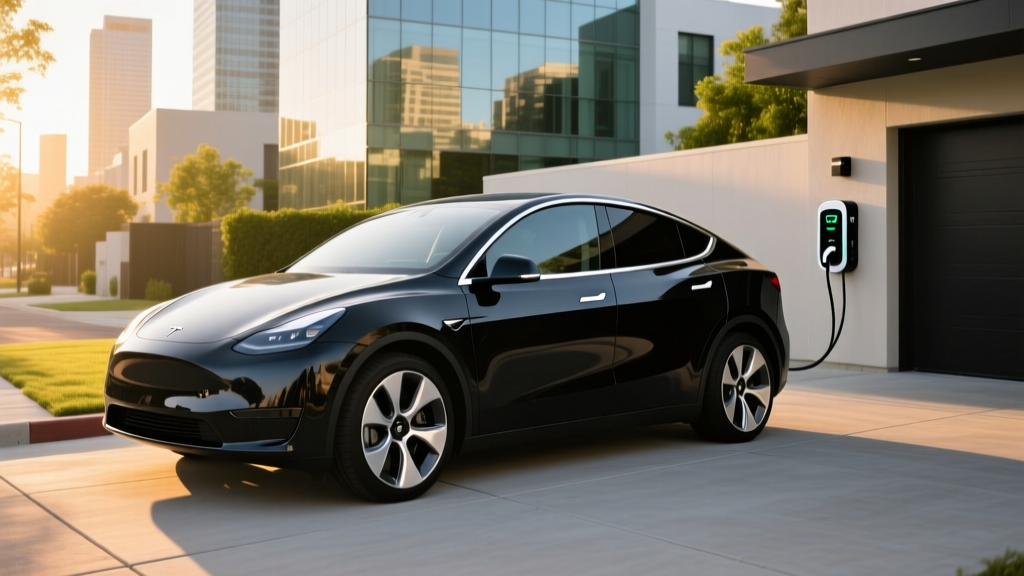
Home Level 2 charging: At 11.5 kW on a 48-amp circuit, you'll add roughly 44 miles of range per hour. A full overnight charge (8-10 hours) easily replenishes a daily commute. Installation of a Tesla Wall Connector or equivalent 48-amp Level 2 unit typically costs $500-$1,500 for the equipment and $800-$2,500 for electrician labor and permitting, depending on your panel capacity and run distance. Homes with 100-amp service may require a $1,500-$3,000 panel upgrade.
Supercharger network: The 2022 Model Y uses Tesla's proprietary NACS connector natively. As of 2026, the Supercharger network exceeds 6,000 U.S. stations with 60,000+ individual chargers, and it now supports non-Tesla EVs via adapters. For a 2022 Model Y owner, native NACS means no adapter is needed at Tesla chargers — a significant convenience advantage over CCS-equipped competitors.
Interior, Cargo, and Daily Livability
The Model Y's cabin is minimalism taken to its logical extreme: a single 15-inch touchscreen handles virtually all controls, from climate to mirrors to glovebox release. There is no instrument cluster — speed and navigation appear on the left third of the center screen. Love it or find it distracting, this layout is non-negotiable in a 2022 build.
Cargo capacity:
- Behind second row: 30.2 cu ft (five-seat config)
- Second row folded: 76.2 cu ft
- Front trunk (frunk): 4.1 cu ft
- Optional third row (7-seat): reduces behind-second-row space to 12.8 cu ft — tight and best suited for small children
Passenger space:
- Front legroom: 41.8 inches
- Rear legroom: 40.5 inches (five-seat); 26.5 inches (optional third row)
- Headroom (front/rear): 40.3 / 39.4 inches
The cargo area is genuinely SUV-competitive, outclassing the Hyundai Ioniq 5 and Ford Mustang Mach-E in total volume. The flat floor (no transmission tunnel) and available power-folding second row make it practical for families and gear-heavy commuters. The optional third row is cramped — treat it as a 5+2 occasional-use configuration, not a true seven-seater.
Pricing, Tax Credits, and 2026 Used Market Value
The 2022 Model Y is no longer available new. On the used market in 2026, pricing typically falls in these ranges depending on mileage, condition, and trim:
| Trim | Original MSRP | 2026 Used Range | Used EV Credit (§25E) | Effective Floor |
|---|---|---|---|---|
| RWD (Standard Range) | $58,990 | $22,000-$29,000 | Up to $4,000 | ~$18,000-$25,000 |
| Long Range AWD | $65,990 | $27,000-$35,000 | Up to $4,000 | ~$23,000-$31,000 |
| Performance AWD | $69,990 | $29,000-$37,000 | Up to $4,000 | ~$25,000-$33,000 |
Federal tax credit for used EVs (IRC §25E): A 2022 Model Y purchased from a licensed dealer may qualify for up to $4,000 (30% of the sale price, capped at $4,000) under the used clean vehicle credit. Key requirements per IRS §25E rules:
- Sale price must be $25,000 or less to qualify for the full $4,000
- Buyer income caps: $75,000 single / $112,500 head of household / $150,000 joint (modified AGI)
- Vehicle must be at least 2 model years old (2022 models qualify in 2024+)
- Must purchase from a licensed dealer (private-party sales do not qualify)
- Vehicle must have a battery capacity of at least 7 kWh (all Model Y trims qualify)
- Point-of-sale transfer is available — the dealer applies the credit as a price reduction at purchase
Note on the new-vehicle §30D credit: If you had purchased this vehicle new in 2022, it would have been subject to the pre-Inflation Reduction Act rules. Under current §30D rules (2023+), a new Model Y may qualify for up to $7,500, subject to MSRP caps ($80,000 for SUVs), buyer income limits, and critical-mineral/battery-component sourcing requirements. These rules do not apply to used purchases — the §25E credit governs pre-owned vehicles.
Warranty and Battery Longevity
Tesla's warranty structure for the 2022 Model Y:
- Basic Vehicle: 4 years / 50,000 miles (bumper-to-bumper)
- Battery and Drive Unit: 8 years / 120,000 miles (Long Range & Performance) — retains minimum 70% capacity
- Battery and Drive Unit (RWD/LFP): 8 years / 100,000 miles — retains minimum 70% capacity
For a 2022 model in 2026, you're 4 years into the basic warranty (likely expired) but still within the 8-year battery and drive unit coverage. This is a meaningful safety net for used buyers. Tesla's battery degradation data across the fleet shows an average capacity loss of approximately 10-12% at 150,000 miles for NMC packs, with LFP packs showing even slower degradation curves. A 2022 Model Y with 30,000-50,000 miles should still have 92-96% of its original battery capacity.
Out-of-warranty battery replacement for the Model Y ranges from $12,000 to $16,000 depending on pack size and labor — a worst-case scenario that most owners will never face, but one worth budgeting awareness for high-mileage used purchases.
Technology and Driver Assistance
Infotainment: The 15-inch landscape touchscreen runs Tesla's proprietary OS with built-in navigation, streaming (Netflix, YouTube, Spotify), over-the-air updates, and a mobile app for remote preconditioning, charging management, and vehicle location. There is no Apple CarPlay or Android Auto — Tesla's ecosystem is self-contained. The 2022 model year received the AMD Ryzen infotainment processor (replacing Intel Atom), which significantly improved screen responsiveness and navigation rendering.
Tesla's Autopilot and Full Self-Driving (Supervised) are SAE Level 2 driver-assistance systems. They provide steering, acceleration, and braking support, but the driver must remain fully attentive with hands on or near the wheel at all times. These systems do not make the vehicle self-driving. Tesla's FSD (Supervised) adds features like Navigate on Autopilot, Auto Lane Change, and traffic light recognition, but it requires continuous driver supervision and does not handle all road scenarios.
Standard Autopilot (included): Traffic-Aware Cruise Control and Autosteer (lane-centering) on marked roads.
Enhanced Autopilot ($6,000 option): Adds Navigate on Autopilot, Auto Lane Change, Autopark, Summon, and Smart Summon.
Full Self-Driving (Supervised) ($12,000 option or $199/month subscription in 2022): Adds all Enhanced features plus traffic light and stop sign recognition, with city-street autosteer capability (beta/supervised). Check whether FSD transfers with a used purchase — Tesla has periodically restricted FSD transfers on resale, and as of 2026, used-vehicle FSD transferability varies. Confirm with Tesla directly before paying a premium for an FSD-equipped used Model Y.
Pros, Cons, and the Competition
- Best-in-class efficiency (28 kWh/100mi Long Range)
- Extensive Supercharger network with native NACS
- Strong cargo capacity (76.2 cu ft max)
- OTA updates keep software current years after purchase
- Heat pump standard — better cold-weather range retention
- AMD Ryzen processor for responsive infotainment
- 8-year battery warranty still active on 2022 models
- No Apple CarPlay or Android Auto
- Minimalist interior not for everyone (no physical buttons, no instrument cluster)
- Ride quality firm — road imperfections transmit into the cabin
- Build quality inconsistent (panel gaps, paint — improved in later years)
- FSD transferability on resale is uncertain
- Insurance premiums 20-40% above segment average
- Optional third row is impractical for adults
Key competitors to cross-shop:
- 2022 Hyundai Ioniq 5: More distinctive design, 800V architecture for fast charging (10-80% in ~18 min at 350 kW), but lower range (303 mi max) and no native Supercharger access without an adapter.
- 2022 Ford Mustang Mach-E: Engaging driving dynamics, available CarPlay, but lower efficiency and a less mature public charging experience.
- 2022 BMW iX xDrive50: Premium interior and ride quality, but starts at a significantly higher used price ($45,000+).
- You road-trip frequently and want the most reliable DC fast-charging network
- You prioritize efficiency and range per dollar over interior luxury
- You have home Level 2 charging and want a practical family EV
- You value OTA software updates and a tech-forward experience
- You require Apple CarPlay or Android Auto
- You prefer physical buttons and a traditional instrument cluster
- Ride comfort is a higher priority than efficiency
- You want the fastest DC charging speeds (Ioniq 5's 800V is quicker)
Frequently Asked Questions
What is the real-world range of the 2022 Tesla Model Y?
The Long Range AWD achieves an EPA-estimated 330 miles, but expect approximately 270-290 miles on highway trips at 70-75 mph, and 220-250 miles in freezing weather. The RWD (LFP) model's 244-279 EPA miles translate to roughly 200-230 miles highway. City driving with regenerative braking recovers more energy, often matching or exceeding EPA estimates.
How fast does the 2022 Model Y charge?
On a Tesla V3 Supercharger (250 kW capable), the Long Range and Performance models charge from 10-80% in approximately 27 minutes. The RWD model peaks at 170 kW and takes about 32 minutes for 10-80%. At home on a 48-amp Level 2 charger (11.5 kW), you add roughly 44 miles of range per hour — enough to fully replenish overnight.
Does the 2022 Tesla Model Y qualify for a federal tax credit in 2026?
As a used vehicle, it may qualify for the IRC §25E Used Clean Vehicle Credit of up to $4,000 when purchased from a licensed dealer for $25,000 or less. Buyer income must not exceed $75,000 (single) or $150,000 (joint). The new-vehicle §30D credit no longer applies to 2022 models sold used. Always verify eligibility with your tax professional before purchase.
Is the 2022 Model Y worth buying vs. competitors?
For buyers who prioritize range, efficiency, and charging infrastructure access, the 2022 Model Y is still the segment benchmark. If you value faster peak charging speeds and a more conventional interior, the Hyundai Ioniq 5 is a strong alternative. If driving engagement and CarPlay matter, consider the Ford Mustang Mach-E. The Model Y wins on total ecosystem convenience and real-world efficiency.
What are the biggest ownership costs to watch?
Insurance is the standout — Model Y premiums run 20-40% above comparable compact SUVs due to repair costs and Tesla's direct-body-shop limitations. Tire wear is higher than average (EVs are heavy and torque-rich; expect 25,000-35,000 miles from a set). Beyond that, the lack of oil changes, transmission fluid, and exhaust maintenance keeps routine costs low. Electricity costs average $0.04-$0.06 per mile at home (varies by local utility rate), versus $0.12-$0.16 per mile for a 25 MPG gas SUV at $3.50/gallon.
Does Full Self-Driving transfer when buying a used 2022 Model Y?
FSD transferability on used Tesla purchases is not guaranteed. Tesla has periodically restricted FSD to original owners or limited transfers to specific programs. Before paying a premium for an FSD-equipped used Model Y, confirm with Tesla directly (provide the VIN) whether the FSD license transfers to you. As of 2026, Tesla occasionally runs promotional FSD transfer programs — check current policy before committing.