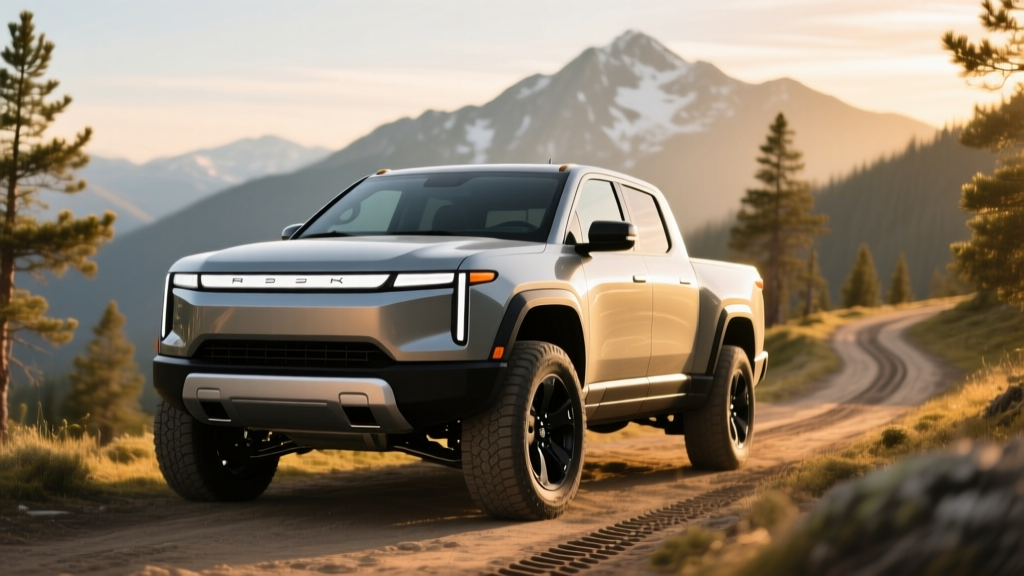
If you are shopping for a used electric pickup in 2026, the 2022 Rivian R1T remains one of the most capable — and most scrutinized — options on the market. As Rivian's first production year, 2022 models carry unique warranty terms, early-production quirks, and a rapidly maturing software platform that make them distinct from 2024 and 2025 trucks rolling out of the Normal, Illinois factory today.
This review focuses on what matters most to second-hand buyers: the 2022 Rivian R1T warranty structure, real-world range and charging behavior, current pricing against the used-EV tax credit, and how the truck holds up against newer competitors like the Ford F-150 Lightning and Chevrolet Silverado EV.
2022 Rivian R1T at a Glance: Core Specifications
| Attribute | Value |
|---|---|
| EPA Range (Large Pack, Dual-Motor) | 314 miles |
| Usable Battery Capacity | ~128.9 kWh (135 kWh gross), NMC chemistry |
| Peak DC Fast-Charge Rate | ~200 kW (early software); up to 220 kW with OTA updates |
| 10–80% DC Fast Charge | ~40–45 minutes (Large Pack) |
| Level 2 Home Charging (11.5 kW onboard) | ~25 miles per hour of charging |
| 0–60 mph | 3.0 seconds (Dual-Motor, Launch Edition) |
| Horsepower / Torque | 600 hp / 600 lb-ft (Dual-Motor) |
| Drivetrain | Dual-Motor AWD (Quad-Motor available on later builds) |
| Max Tow Rating | 11,000 lbs |
| MPGe (Combined) | 70 MPGe |
| Efficiency | 48 kWh/100 mi |
| Original Base MSRP (Launch Edition) | $73,000 (before destination) |
| Typical 2026 Used Price | $48,000–$62,000 depending on mileage and pack |
Sources: EPA fueleconomy.gov, Rivian owner's manual and press archive.
Real-World Range: What the EPA Sticker Doesn't Tell You
The R1T's boxy aerodynamics (drag coefficient around 0.39) penalize highway efficiency more than a sleeker EV like the Tesla Model X. Owners who primarily drive urban and suburban routes report consistently hitting 280–310 miles per charge, while cross-country road-trippers should plan charging stops every 200–220 miles to maintain a comfortable buffer.
The Max Pack (180 kWh) option, available on later 2022 builds, pushes EPA range to 400 miles and real-world highway range to approximately 310–340 miles — a meaningful upgrade for frequent towers and road-trippers. However, Max Pack trucks command a $5,000–$8,000 premium on the used market in 2026.
Charging Speeds: DC Fast Charging and Home Setup
The 2022 R1T uses a CCS1 connector for DC fast charging (NACS adapters became available from Rivian in 2024 for Tesla Supercharger access). The truck's charging curve is a critical detail many spec sheets gloss over:
| Charging Level | Power (kW) | Miles Added per Hour | Notes |
|---|---|---|---|
| Level 1 (120V household) | ~1.4 kW | ~3 mi/hr | Emergency/trickle only |
| Level 2 (240V, 48A) | 11.5 kW | ~25 mi/hr | Full charge in ~13 hours (Large Pack) |
| DC Fast Charge (peak) | ~200–220 kW | N/A | Peak only from 10–30% SoC |
| DC Fast Charge (sustained avg, 10–80%) | ~120–140 kW avg | N/A | 10–80% in ~40–45 min |
The R1T's charge curve peaks near 200 kW only between roughly 10% and 30% state of charge, then tapers progressively. From 50% to 80%, the truck pulls closer to 80–100 kW. This is typical for large NMC packs with conservative thermal management, but it means the "200 kW peak" headline figure is not representative of average charging speed across the full session.
Preconditioning matters: The R1T will precondition its battery when a DC fast charger is set as your navigation destination, warming the pack for faster charge acceptance. Skipping preconditioning in cold weather can add 10–15 minutes to a 10–80% session.
For home charging, Rivian's Wall Charger (11.5 kW / 48A) requires a 60A dedicated circuit. Installation costs typically range from $800–$2,500 depending on panel capacity and conduit runs. Owners with 200A electrical panels should confirm capacity with a licensed electrician — a panel upgrade to 400A can add $2,000–$5,000.
2022 Rivian R1T Warranty: What's Covered and What Isn't
The warranty structure is the primary reason buyers search for "2022 Rivian R1T warranty" specifically — and it's more generous than most competitors in one critical area:
| Component | Coverage Period | Mileage Limit | Notes |
|---|---|---|---|
| Bumper-to-Bumper (Limited) | 5 years | 60,000 miles | |
| Battery Pack | 8 years | 175,000 miles | Covers defects; retains ≥70% capacity |
| Drive Unit(s) / Powertrain | 8 years | 175,000 miles | |
| Corrosion Perforation | 5 years | Unlimited miles | |
| Roadside Assistance | 5 years | 60,000 miles |
Key takeaway on the battery warranty: Rivian's 8-year/175,000-mile battery warranty exceeds the federal minimum requirement (8 years/100,000 miles) and is notably more generous on mileage than the Ford F-150 Lightning's 8-year/100,000-mile battery warranty. The 70% capacity retention threshold is industry-standard — if your Large Pack drops below roughly 90 kWh usable within 8 years or 175,000 miles, Rivian will repair or replace it.
Important for 2026 buyers: A 2022 R1T purchased in 2026 still has approximately 6 years of battery and powertrain warranty remaining (through 2030 or 175,000 miles from original in-service date). However, the bumper-to-bumper warranty may be nearing expiration depending on the original delivery date and accumulated mileage. Confirm the exact in-service date with Rivian using the VIN.
Warranty transferability: Rivian's warranty is tied to the vehicle, not the owner. A used 2022 R1T retains its full remaining warranty coverage when sold privately or through a dealer — no transfer fee or re-registration required.
Pricing, Trims, and Federal Tax Credit Eligibility in 2026
When new, the 2022 R1T launched exclusively as the Launch Edition (Dual-Motor, Large Pack) at approximately $73,000 before destination. Later in the model year, Rivian introduced the Adventure and Exploration packages, and the single-motor Standard Pack became available on 2023 models.
| Configuration | Original MSRP | 2026 Used Price (est.) | Federal Used-EV Credit (§25E) |
|---|---|---|---|
| Launch Edition (Dual-Motor, Large) | $73,000 | $55,000–$62,000 | Up to $4,000 (30% of sale price) |
| Adventure Package (Dual-Motor, Large) | $75,500 | $52,000–$58,000 | Up to $4,000 |
| Exploration Package (Dual-Motor, Large) | $74,000 | $48,000–$54,000 | Up to $4,000 |
Used-EV tax credit rules (IRS §25E): Unlike the new-vehicle §30D credit, the used-EV credit applies to pre-owned EVs sold for $25,000 or less (not applicable to most R1Ts) — or 30% of the sale price up to $4,000, whichever is lower. To qualify:
- The vehicle must be at least 2 model years old (2022 qualifies in 2026)
- Buyer income caps: $75,000 single / $112,500 head of household / $150,000 joint (modified AGI)
- The vehicle must be purchased from a licensed dealer (private-party sales do not qualify)
- The credit can be transferred to the dealer at point of sale as a price reduction
- The vehicle must have a battery capacity of at least 7 kWh (R1T qualifies at 128.9 kWh)
For a 2022 R1T selling at $52,000 from a dealer, the maximum credit is $4,000 (30% of $52,000 = $15,600, but capped at $4,000). This brings the effective purchase price to approximately $48,000 — a significant discount. Verify current eligibility at IRS.gov §25E and confirm with a tax professional, as rules can shift annually.
Cargo, Passenger Space, and the Gear Tunnel Advantage
The R1T's packaging is where Rivian's skateboard platform pays dividends. Despite riding on a shorter wheelbase than a full-size F-150, the R1T maximizes usable space:
- Bed length: 4.5 feet (54 inches) — shorter than a traditional 5.5- or 6.5-foot bed, but compensated by the Gear Tunnel
- Gear Tunnel: 11 cubic feet of lockable, pass-through storage between the cab and bed — exclusive to Rivian and ideal for camping gear, tools, or groceries
- Frunk (front trunk): 11 cubic feet, drainable, with a built-in air compressor option
- Total cargo volume: ~67 cubic feet (bed + Gear Tunnel + frunk combined)
- Front legroom: 41.3 inches
- Rear legroom: 38.2 inches — adequate for adults on shorter trips, tighter than an F-150 SuperCrew
- Towing: 11,000 lbs max (reduces range by 40–50% when towing near max capacity)
The Gear Tunnel is the R1T's most distinctive feature and a genuine differentiator. It transforms the truck from a 4.5-foot bed into something far more versatile — think of it as a built-in tonneau-covered trunk that's accessible from either side of the vehicle.
Tech, Driver Assistance, and Software Maturity
The 2022 R1T launched with Rivian's Driver+ system — a Level 2 driver-assistance suite that includes adaptive cruise control, lane-centering, and automatic emergency braking. It is not a self-driving system; the driver must remain engaged with hands on the wheel at all times.
Key technology features on the 2022 R1T:
- 15.6-inch center touchscreen with embedded navigation, media, and vehicle controls
- 12.3-inch digital driver display
- Over-the-air (OTA) updates — Rivian has delivered significant improvements to range estimation, charging speed, suspension tuning, and Driver+ since 2022 launch
- Quad-motor tank turns (on Quad-Motor trims only, introduced mid-2022)
- Adjustable air suspension with up to 14.9 inches of ground clearance
- Built-in air compressor (optional, mounted in frunk)
- Vehicle-to-load (V2L) capability via bed-mounted 120V outlets (up to 2.4 kW output)
Notable drawbacks: Early 2022 software had range-estimation accuracy issues (largely addressed via OTA), phantom braking incidents with Driver+ on certain highway markings, and occasional infotainment lag. Most of these have been improved through software updates, but buyers should ensure the truck is running the latest firmware at purchase.
Pros, Cons, and the Verdict for 2026 Buyers
Pros
- Class-leading 175,000-mile battery warranty
- Gear Tunnel and frunk offer unmatched cargo versatility
- 3.0-second 0–60 mph — sports car acceleration in a pickup
- Air suspension with adjustable ride height (8.7–14.9 in.)
- Strong OTA update track record since launch
- Up to $4,000 used-EV tax credit available
Cons
- 4.5-foot bed is shorter than most traditional pickups
- Highway efficiency suffers (48 kWh/100 mi) — range drops fast at 75+ mph
- DC fast charging tapers early — 10–80% takes 40+ minutes
- Rear legroom is tighter than full-size crew cabs
- Towing severely reduces range (expect ~150–170 mi at max tow)
- No hands-free driving mode (unlike BlueCruise/Super Cruise)
Who Should Buy the 2022 Rivian R1T in 2026?
Choose the 2022 R1T if: You want a premium electric pickup for outdoor adventures, weekend towing (boats, campers under 8,000 lbs), and daily commuting with best-in-class cargo flexibility. The Gear Tunnel and air suspension make it ideal for overlanding and backcountry access.
Look elsewhere if: You need a full-size 6.5-foot bed for commercial work, regularly tow above 8,000 lbs (range becomes impractical), or need maximum rear-seat space for three adults. The F-150 Lightning offers a larger bed, more rear legroom, and faster DC charging at a lower used price.
Frequently Asked Questions
Is the 2022 Rivian R1T battery warranty transferable to a second owner?
Yes. Rivian's warranty follows the vehicle, not the original owner. When you buy a used 2022 R1T, the remaining 8-year/175,000-mile battery and powertrain warranty transfers automatically with no paperwork or fee required.
What is the real-world range of the 2022 R1T when towing?
When towing near the 11,000-lb maximum, expect range to drop to approximately 140–170 miles depending on trailer aerodynamics, terrain, and speed. For trailers in the 4,000–6,000 lb range (typical boat or small camper), plan for 180–220 miles of real-world range.
Does the 2022 R1T qualify for the $7,500 federal EV tax credit?
No — the $7,500 credit (IRS §30D) applies only to new EV purchases. However, as a used vehicle in 2026, the 2022 R1T may qualify for the §25E used-EV credit of up to $4,000, subject to buyer income caps ($75K single / $150K joint), dealer purchase requirement, and the vehicle being at least 2 model years old.
How does the R1T's charging speed compare to the F-150 Lightning?
The F-150 Lightning Extended Range peaks at approximately 150–170 kW and completes a 10–80% charge in roughly 38–41 minutes. The R1T Large Pack peaks higher (~200–220 kW) but sustains peak rate for a shorter window, resulting in a similar 40–45 minute 10–80% time. Neither truck is a class leader in charging speed — the Hyundai Ioniq 5 and Kia EV9 charge significantly faster due to 800V architectures.
What should I check before buying a used 2022 R1T?
Request the vehicle's battery State of Health (SoH) report from Rivian service. Confirm the truck is running the latest OTA software version. Inspect the air suspension for leaks or uneven ride height. Check the in-service date to calculate remaining bumper-to-bumper warranty. And verify the VIN has no open recalls — early R1Ts had recalls related to seat-belt fasteners and windshield defrost wiring (check NHTSA.gov).