What Is the 2022 Rivian EDV — And Why Can't You Buy One?
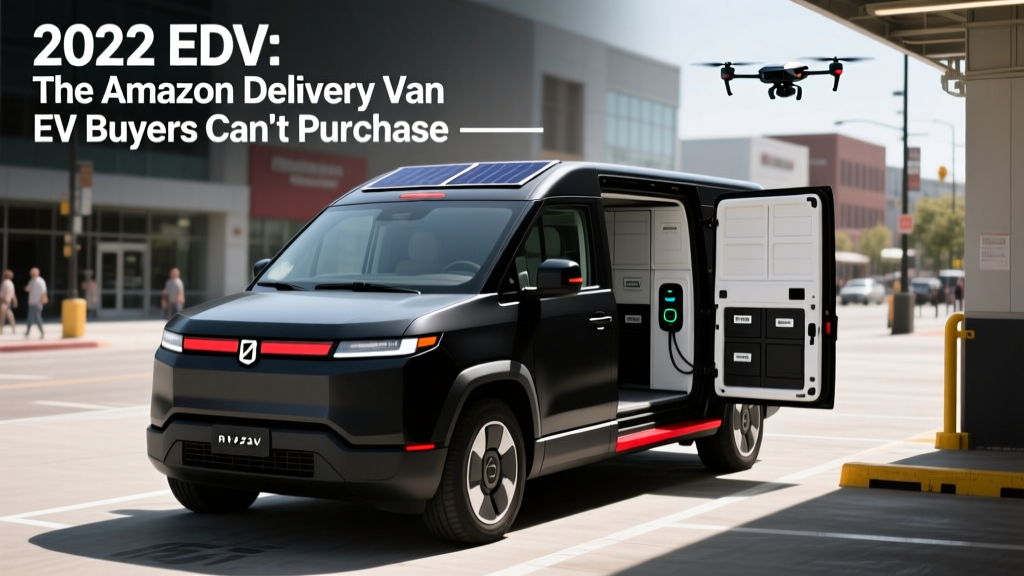
The 2022 Rivian EDV (Electric Delivery Van) is a purpose-built, all-electric commercial delivery vehicle designed exclusively for Amazon's last-mile logistics network. It represents the first production output of Rivian's Normal, Illinois manufacturing facility and the foundation of the company's commercial van division. If you've seen a boxy, blue-gray Rivian-branded van dropping packages in your neighborhood since late 2022, you've seen the EDV in action.
Here's the critical detail for consumers searching for this vehicle: the Rivian EDV is not available for retail purchase. Amazon holds an exclusivity agreement on the EDV platform, meaning private buyers, small fleets, and independent owner-operators cannot order one. This review profiles the EDV's engineering, specs, and real-world operational data — valuable context for fleet managers watching for future availability, Rivian investors tracking production volumes, and EV enthusiasts curious about the van that built Rivian's manufacturing backbone.
For buyers seeking a personal-use electric van or truck, the relevant Rivian products are the R1T pickup and R1S SUV. The EDV shares Rivian's skateboard platform architecture but uses a unique body, commercial-grade battery, and fleet-optimized software.
2022 Rivian EDV Specifications at a Glance
| Specification | Value |
|---|---|
| EPA Estimated Range | ~150 miles (EDV-700 variant) |
| Usable Battery Capacity | ~149 kWh (NMC chemistry) |
| Max DC Fast Charge Rate | ~150 kW peak |
| 10–80% DC Fast Charge Time | ~45 minutes (estimated) |
| Level 2 AC Charge Rate | ~19.2 kW (depot charging) |
| Drivetrain | Rear-wheel drive, single motor |
| Motor Output | ~275 kW (~369 hp) |
| 0–60 mph | Not officially published (~8–10 sec estimated) |
| Cargo Volume (EDV-700) | ~689 cu ft |
| Payload Capacity | ~2,500 lbs (EDV-700) |
| Base MSRP | Not publicly listed (fleet/contract pricing) |
| Federal Tax Credit | Commercial clean vehicle credit (§45W), not §30D |
| Battery/Powertrain Warranty | 8 years / 150,000 miles (fleet terms) |
Real-World Range: What 150 Miles Means on a Delivery Route
EPA estimate: ~150 miles (EDV-700, 149 kWh battery)
Real-world delivery route: ~120–140 miles typical; drops to ~90–110 miles in cold weather (below 32°F) or sustained highway driving above 55 mph.
Why it matters: Amazon's last-mile routes average 80–120 miles per day with frequent stops, making the 150-mile EPA range sufficient for most urban/suburban delivery cycles — but tight for rural routes or extreme cold-weather markets like Minneapolis or Chicago in January.
Rivian designed the EDV for Amazon's specific operational profile: dense urban and suburban delivery routes with 150–200 stops per day, average speeds under 35 mph, and heavy use of regenerative braking during stop-and-go driving. Regenerative braking recovers kinetic energy during deceleration, which is highly effective in delivery scenarios and extends practical range beyond what highway-heavy driving would achieve.
The EDV's single-speed, rear-wheel-drive powertrain is optimized for efficiency at low speeds rather than highway performance. At 65–70 mph on the interstate, energy consumption rises significantly — the large frontal area and boxy aerodynamic profile create substantial drag. For fleet operators considering the EDV for highway-heavy routes, the effective range drops to roughly 90–100 miles, which limits operational flexibility.
Cold-weather impact is significant. NMC lithium-ion batteries experience reduced ionic conductivity at low temperatures, and cabin/driver-compartment heating draws from the same 149 kWh pack. Amazon has deployed the EDV in cold-weather markets including Chicago, Detroit, and the Northeast, but route planning must account for 20–30% range reduction in sub-freezing conditions. The EDV includes a thermal management system with active battery heating and cooling, but preconditioning while plugged in at the depot is essential for maximizing usable range in winter.
Battery, Chemistry, and the EDV's 149 kWh Pack
The 2022 Rivian EDV uses a ~149 kWh usable capacity battery pack with NMC (nickel manganese cobalt) chemistry. This is a larger pack than the R1T/R1S consumer vehicles (which use 128 kWh Max Pack or 92 kWh Standard Pack configurations as of 2024), reflecting the EDV's heavier curb weight and commercial duty cycle.
NMC chemistry was chosen for energy density — the EDV needs maximum range within the physical constraints of a delivery van platform. The trade-off versus LFP (lithium iron phosphate) is that NMC degrades somewhat faster over calendar life and is more sensitive to sustained high state-of-charge (SoC). However, Amazon's operational model typically charges vans overnight at the depot and deploys them on routes that consume 60–80% of the battery daily, which is a favorable cycle pattern for NMC longevity.
Rivian's battery thermal management system actively heats and cools the pack to maintain optimal operating temperature (roughly 25–35°C). This is critical for both charging speed and long-term degradation. The EDV's battery warranty covers 8 years or 150,000 miles, which aligns with Amazon's vehicle replacement cycle. Fleet data from early EDV deployments (2022–2024) suggests degradation of roughly 5–8% over the first two years of heavy daily cycling — within acceptable bounds for commercial fleet operations.
Charging Speed: Depot DC Fast Charging and Overnight Level 2
| Charging Level | Power (kW) | Estimated Time (10–80%) | Typical Use Case |
|---|---|---|---|
| Level 1 (120V AC) | ~1.4 kW | N/A (not practical) | Not used in fleet operations |
| Level 2 (240V AC, depot) | ~19.2 kW | ~6–7 hours (0–100%) | Overnight depot charging |
| DC Fast Charge | ~150 kW peak | ~45 minutes (10–80%) | Mid-day top-up / opportunity charging |
The EDV's primary charging strategy is overnight Level 2 depot charging. Amazon has installed thousands of Level 2 charge points at its delivery stations across the U.S., using 19.2 kW AC chargers that fully replenish the 149 kWh pack in approximately 6–7 hours. Vans return to the depot in the late afternoon, plug in, and are fully charged by the next morning's route dispatch. This is the most cost-effective and battery-friendly charging method.
DC fast charging at ~150 kW peak is available for mid-day opportunity charging — useful when a van returns early with remaining route capacity or needs a quick top-up between shifts. At 150 kW, the EDV can add roughly 80–90 miles of range in 20 minutes, though the charge curve tapers significantly above 80% SoC. Sustained charging above 80% drops to under 50 kW, which is why fleet operators typically target 10–80% for DC sessions.
The EDV uses a CCS1 (Combined Charging System) connector, consistent with Rivian's commercial fleet approach. Note that Rivian's consumer vehicles (R1T/R1S) have transitioned to the NACS (North American Charging Standard) connector for 2025+ models, but the EDV fleet retains CCS1 for compatibility with existing depot and public infrastructure. Amazon's depot chargers are hardwired CCS1 units, and a fleet-wide connector change would require significant infrastructure investment.
Performance, Drivetrain, and Commercial-Grade Engineering
The 2022 Rivian EDV is offered in three body sizes, designated by cargo volume:
- EDV-500: ~420 cu ft cargo volume, shorter wheelbase
- EDV-700: ~689 cu ft cargo volume, standard wheelbase (most common)
- EDV-900: ~840 cu ft cargo volume, extended wheelbase (limited deployment)
All variants use a single-motor, rear-wheel-drive configuration with approximately 275 kW (369 hp) output. Unlike the R1T and R1S, which offer dual-motor and quad-motor AWD configurations, the EDV is RWD-only. This reduces cost, weight, and mechanical complexity — appropriate for a delivery van that rarely encounters off-road conditions or heavy snow traction demands.
Rivian has not published an official 0–60 mph time for the EDV, and acceleration is not a performance priority for a commercial delivery vehicle. Based on curb weight (~8,500 lbs for the EDV-700 loaded) and motor output, estimated 0–60 time is in the 8–10 second range. What matters more for delivery operations is low-speed torque delivery — the EDV's single-speed reduction gear provides strong initial acceleration from stops, which is critical for merging into traffic and navigating stop-heavy urban routes.
The EDV's suspension is tuned for load-carrying capacity and durability over comfort. Leaf-spring rear suspension handles the 2,500+ lb payload capacity, while the independent front suspension provides reasonable steering response for a vehicle of this size. Drivers report that the EDV handles predictably at city speeds but requires attention on highway on-ramps and in crosswinds due to the tall, flat-sided body.
Driver Technology, Safety, and Fleet Software
The EDV's cabin technology is purpose-built for delivery work, not consumer infotainment. The center console features a large touchscreen running Amazon's proprietary delivery management software, which handles route navigation, package scanning, delivery confirmation, and real-time fleet tracking. There is no Apple CarPlay, Android Auto, or consumer streaming functionality — the system is a commercial logistics tool.
Driver-assistance features include:
- Automatic emergency braking (AEB) with pedestrian detection
- Lane departure warning and lane-keeping assist
- Blind-spot monitoring with trailer-aware coverage
- 360-degree camera system for low-speed maneuvering in tight delivery areas
- Adaptive cruise control (available but not commonly used on delivery routes)
The Rivian EDV's driver-assistance suite is SAE Level 1–2, meaning the driver must remain fully engaged, hands on the wheel, and eyes on the road at all times. There is no autonomous or "self-driving" capability. Amazon's delivery drivers are responsible for all vehicle operation, and the ADAS features serve as safety nets — not replacements for attentive driving.
A standout feature for delivery drivers is the EDV's powered cargo-area access. The van includes an automated bulkhead door between the driver compartment and cargo area, plus powered sliding curbside doors that open with a button press. This eliminates the physical strain of manually opening and closing heavy doors hundreds of times per day — a significant ergonomic improvement over traditional delivery vans like the Mercedes-Benz Sprinter or Ford Transit.
The EDV also features a unique "Door Detect" system that warns the driver if a cyclist or pedestrian is approaching from the rear before the curbside door opens, reducing the risk of dooring incidents in dense urban environments.
Pricing, Tax Credits, and Why Consumers Can't Buy the EDV
Rivian does not publish a consumer MSRP for the EDV because it is not sold through retail channels. The vehicle is produced under a commercial supply agreement with Amazon, and pricing is negotiated at the fleet-contract level. Industry estimates place the per-unit cost in the $70,000–$90,000 range depending on variant (EDV-500/700/900) and volume commitments, though neither Rivian nor Amazon has confirmed specific figures.
| Factor | Detail |
|---|---|
| Retail Availability | Not available — Amazon exclusivity agreement |
| Estimated Fleet Unit Cost | $70,000–$90,000 (unconfirmed) |
| Federal Tax Credit (Consumer §30D) | Not applicable — not available for retail purchase |
| Federal Tax Credit (Commercial §45W) | Up to $40,000 for qualified commercial EVs (30% of cost basis) |
| Consumer Alternative | Rivian R1T (pickup) or R1S (SUV) — eligible for §30D up to $7,500 |
For the tax credit question: the EDV does not qualify for the IRS §30D consumer clean vehicle credit (the familiar $7,500 credit for individual buyers) because it is not available for retail purchase. However, it does qualify for the §45W Commercial Clean Vehicle Credit, which provides up to 30% of the vehicle's cost basis (maximum $40,000 for vehicles over 14,000 lbs GVWR). Amazon, as the purchasing entity, claims this credit. Per IRS guidance on the commercial clean vehicle credit, eligibility requires the vehicle to be placed in service by a business and meet battery-component and critical-mineral sourcing requirements.
For individual EV shoppers who found this page searching for the "2022 Rivian EDV," the relevant Rivian products are:
- Rivian R1T (electric pickup): Starting ~$69,900, up to 420 miles EPA range (Max Pack), eligible for §30D credit up to $7,500 if income and sourcing requirements are met.
- Rivian R1S (electric SUV): Starting ~$74,900, up to 410 miles EPA range (Max Pack), same §30D eligibility as R1T.
Under current IRS §30D rules, the $7,500 credit requires the buyer to meet income caps ($150,000 single / $300,000 joint MAGI), the vehicle MSRP must not exceed $80,000 for SUVs/pickups, and the battery must meet critical-mineral and component-sourcing thresholds that tighten annually through 2032.
Who the Rivian EDV Suits — And Who Should Look Elsewhere
The EDV is purpose-built for: Amazon's last-mile delivery network. It excels at high-stop-count urban and suburban routes, depot-based overnight charging, and commercial fleet management with centralized route software. The 150-mile range, 2,500-lb payload, and ergonomic cargo access are optimized for this exact use case.
The EDV is NOT for: Individual buyers, small business fleets, owner-operators, or anyone seeking a personal-use electric van. Amazon's exclusivity agreement blocks retail access, and even if the EDV became available commercially, its proprietary delivery software, lack of consumer infotainment, and fleet-oriented ergonomics make it unsuitable for personal use.
Alternatives for buyers seeking an electric commercial van:
- Ford E-Transit: ~126 miles EPA range, ~68 kWh battery, starting ~$45,000, widely available to fleets and small businesses. Eligible for §45W commercial credit.
- Mercedes-Benz eSprinter: ~200 miles estimated range, ~113 kWh battery, higher price point (~$75,000+), available to fleets.
- BrightDrop Zevo 600 (GM subsidiary): ~250 miles range, ~195 kWh battery, available to commercial fleets.
Pros, Cons, and the Bottom Line on the 2022 Rivian EDV
- Purpose-built for delivery ergonomics — powered doors, automated bulkhead, low step-in height
- 149 kWh battery provides adequate range for most urban/suburban delivery routes
- Regenerative braking maximizes efficiency in stop-heavy driving
- Door Detect safety system reduces urban dooring risk
- 360-degree camera aids maneuvering in tight spaces
- Commercial §45W tax credit up to $40,000 for fleet buyers
- 8-year / 150,000-mile battery warranty aligns with fleet lifecycle
- Not available for retail purchase — Amazon exclusivity blocks all other buyers
- 150-mile EPA range is tight for highway-heavy or rural routes
- 20–30% cold-weather range loss impacts winter operations in northern markets
- 150 kW peak DC charging is slower than some competitors (BrightDrop, Ford E-Transit at ~115–150 kW)
- No consumer infotainment, CarPlay, or Android Auto
- Single-motor RWD only — no AWD option for snow/ice markets
- Proprietary Amazon software limits aftermarket fleet-management flexibility
The 2022 Rivian EDV is an impressive piece of commercial EV engineering — purpose-built for a specific operational profile and executed with thoughtful ergonomics, adequate range, and fleet-grade durability. But for the individual EV shopper, it remains a vehicle you can admire on your doorstep but never drive yourself. Rivian's consumer future lies with the R1T, R1S, and the upcoming R2 platform — not the EDV, which remains Amazon's exclusive workhorse.
Frequently Asked Questions
Can I buy a 2022 Rivian EDV as a private buyer?
No. The Rivian EDV is produced exclusively for Amazon under a commercial supply agreement. Amazon holds exclusivity rights on the EDV platform, and the vehicle is not available through Rivian's consumer sales channels or any dealership network. Private buyers, small fleets, and independent owner-operators cannot purchase the EDV as of 2026.
What is the real-world range of the Rivian EDV?
The EPA estimate is approximately 150 miles for the EDV-700 variant. In real-world delivery operations, expect 120–140 miles on typical urban/suburban routes with frequent stops and regenerative braking. Highway driving above 55 mph reduces range to roughly 90–100 miles. In cold weather (below 32°F), range drops 20–30%, yielding roughly 90–110 miles on mixed routes.
How fast does the Rivian EDV charge?
At a DC fast charger, the EDV peaks at approximately 150 kW, achieving a 10–80% charge in roughly 45 minutes. Overnight Level 2 depot charging at 19.2 kW fully replenishes the 149 kWh battery in 6–7 hours. Level 1 (120V) charging is not practical for fleet operations and is not used.
Does the Rivian EDV qualify for the federal EV tax credit?
The EDV does not qualify for the consumer §30D credit ($7,500) because it is not available for retail purchase. It does qualify for the §45W Commercial Clean Vehicle Credit, which provides up to 30% of the vehicle cost basis (maximum $40,000 for vehicles over 14,000 lbs GVWR). Amazon claims this credit as the purchasing entity.
Is the Rivian EDV the same as the R1T or R1S?
No. The EDV shares Rivian's underlying skateboard platform architecture (battery, motors, suspension mounting points) but uses a completely unique body, cargo area, driver compartment, and commercial software stack. The R1T (pickup) and R1S (SUV) are consumer vehicles with different battery options, dual/quad-motor AWD configurations, consumer infotainment, and retail pricing starting around $69,900–$74,900.
Will Rivian ever sell the EDV to other fleets or consumers?
As of 2026, Amazon's exclusivity agreement remains in place. Rivian has indicated interest in eventually offering a commercial van to broader fleet customers, but any future product would likely be a derivative or next-generation platform rather than the current Amazon-specific EDV. Fleet managers should monitor Rivian's commercial vehicle announcements but should not expect EDV availability in the near term.
What is the Rivian EDV's battery warranty?
The EDV's battery and powertrain warranty covers 8 years or 150,000 miles, which aligns with Amazon's typical vehicle replacement cycle. The warranty guarantees a minimum battery capacity retention threshold (typically 70% of original capacity), consistent with industry standards for commercial EV fleet warranties.