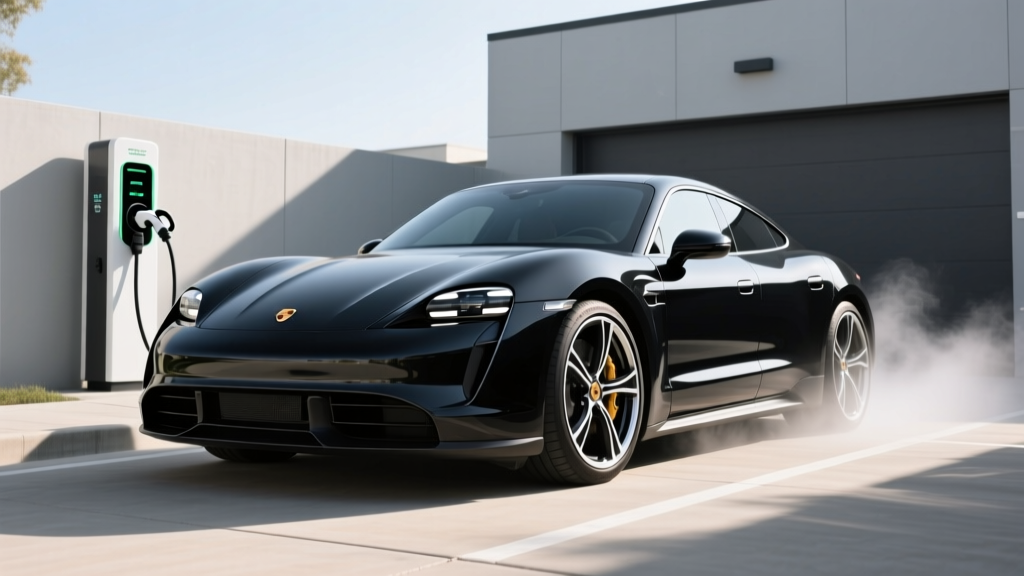
The 2022 Porsche Taycan Turbo S sits at the apex of the electric performance sedan market. It's a car that prioritizes blistering acceleration, precise handling, and 800-volt charging architecture over maximum range or cargo practicality. For buyers cross-shopping against the Tesla Model S Plaid, Audi e-tron GT, or Lucid Air, the Turbo S demands a careful look at what you gain — and what you sacrifice — at its price point.
This review covers the 2022 model year specifically. Porsche has since updated the Taycan line for 2025 with a larger battery and revised powertrain, so if you're shopping new, consult our latest Taycan coverage. If you're evaluating a certified pre-owned 2022 Turbo S or comparing it against current competitors, the data below gives you the exact numbers you need.
2022 Porsche Taycan Turbo S: Key Specifications
| Specification | Value |
|---|---|
| EPA Range | 222 miles (Performance Battery Plus) |
| Battery Capacity (Usable) | 83.7 kWh (93.4 kWh gross), NMC lithium-ion |
| Drivetrain | Dual-motor AWD with 2-speed rear transmission |
| Peak Horsepower (Launch Control) | 750 hp |
| 0–60 mph | 2.4 seconds (manufacturer, with Launch Control) |
| Top Speed | 162 mph |
| Max DC Fast Charge Rate | 270 kW (peak) |
| 10–80% DC Fast Charge Time | ~22.5 minutes (optimal conditions) |
| Level 2 Home Charge Rate | 9.6 kW (onboard charger) |
| EPA Efficiency | 68 MPGe combined / 49 kWh/100 mi |
| Cargo Volume (Trunk + Frunk) | 14.3 cu ft total (12.9 rear + 1.4 front) |
| Rear Legroom | 32.7 inches |
| Curb Weight | 5,132 lbs |
| Battery/Powertrain Warranty | 8 years / 100,000 miles |
| Base MSRP (2022) | $185,000 |
Real-World Range: What the EPA Number Doesn't Tell You
EPA sticker: 222 miles (with Performance Battery Plus, standard on Turbo S)
Real-world highway (70 mph, moderate climate): ~180–200 miles
Real-world cold weather (below 32°F, mixed driving): ~150–175 miles
City / stop-and-go with regen: ~210–225 miles
The 2022 Taycan Turbo S carries an EPA-estimated 222 miles of range when equipped with the Performance Battery Plus (the 93.4 kWh gross pack, which is standard on the Turbo S trim). That number places it behind the Tesla Model S Long Range (~405 mi) and the Lucid Air Grand Touring (~516 mi), and roughly on par with the Audi e-tron GT (~238 mi).
Why the gap between EPA and highway reality? The Taycan Turbo S is a heavy, wide, high-performance sedan with sticky summer tires and aggressive aerodynamic drag at speed. At sustained 70–80 mph highway cruising, expect to consume around 55–60 kWh/100 mi, which translates to roughly 180–200 miles before you need to find a charger. In cold weather, NMC chemistry loses efficiency due to increased internal resistance and cabin heating demands — plan for 150–175 miles in sub-freezing conditions.
City driving is where the Taycan recovers some ground. Porsche's regenerative braking system can recuperate up to 290 kW, and the two-speed rear transmission helps optimize efficiency at lower speeds. In stop-and-go traffic, owners report achieving close to or slightly above the EPA figure.
Ownership insight: The Taycan's range is adequate for daily commuting and moderate road trips if you plan charging stops. It is not a car you buy for maximum distance between charges. If 350+ mile range is a priority, look at the Lucid Air or Tesla Model S.
Charging Speed: 800-Volt Architecture Delivers
The 2022 Taycan Turbo S was one of the first production EVs built on an 800-volt architecture, and this remains its most significant charging advantage. Higher voltage allows the car to accept more power (kW) at lower current, reducing heat and enabling faster sustained charging.
| Charging Level | Power / Rate | Estimated Time / Range Added |
|---|---|---|
| Level 1 (120V household) | ~1.4 kW | ~3–4 miles per hour |
| Level 2 (240V, 40A circuit) | 9.6 kW (onboard charger max) | ~25 miles per hour; full charge in ~9.5 hours |
| DC Fast Charge (peak) | 270 kW | 10–80% in ~22.5 min (optimal battery temp) |
| DC Fast Charge (50 kW station) | 50 kW | 10–80% in ~75 min |
The charging curve matters. The Taycan Turbo S peaks at 270 kW only under ideal conditions: battery preconditioned to optimal temperature (the car does this automatically when you navigate to a DC fast charger), and starting from a low state of charge (~5–10%). The 270 kW peak is sustained briefly — typically from about 5% to 25% SoC — before tapering. From 25% to 50%, expect roughly 180–200 kW. Above 80%, charge speed drops significantly to protect battery health, often to 50 kW or below.
On a road trip, this means your 10–80% stop takes about 22–25 minutes at a 350 kW Electrify America or comparable station. That's competitive with the Hyundai Ioniq 5 and faster than most 400V competitors, though newer 2025+ EVs with improved charge curves are closing the gap.
Level 2 home charging: The onboard charger accepts up to 9.6 kW. On a standard 48A Level 2 home charger (like a ChargePoint Home Flex or Tesla Wall Connector with J1772 adapter), you'll add about 25 miles of range per hour, or fully recharge overnight from near-empty in roughly 9.5 hours. Porsche also offered an optional 19.2 kW onboard charger for 2022, which cuts Level 2 time roughly in half — worth checking if your CPO model has it and if your home electrical panel supports the required 100A circuit.
Connector note: The 2022 Taycan uses a CCS1 connector for DC fast charging. As of 2025, Porsche has announced NACS adoption for future models, but the 2022 model requires a CCS-to-NACS adapter (available from Porsche and third parties) to access Tesla Supercharger stations.
Performance: The Number That Defines This Car
The 2022 Taycan Turbo S exists to deliver a specific experience: supercar acceleration in a four-door sedan with daily-driver usability. With Launch Control engaged, the dual-motor all-wheel-drive system produces 750 horsepower and 774 lb-ft of torque, propelling the car from 0–60 mph in a verified 2.4 seconds. Independent testing by outlets like Car and Driver has recorded times as low as 2.4–2.6 seconds depending on surface and conditions.
Several engineering choices set the Taycan apart from rivals:
- Two-speed rear transmission: Unlike most EVs with a single-speed reduction gear, the Taycan uses a two-speed gearbox on the rear axle. First gear provides explosive launches; second gear optimizes high-speed efficiency. You can actually feel the shift during hard acceleration.
- Repeatable performance: Porsche's thermal management system is designed to prevent power derating during repeated hard launches. The car will deliver full power multiple times in succession — a known weakness of some competitors.
- Handling dynamics: Standard rear-axle steering, active anti-roll bars (Porsche Dynamic Chassis Control), and PASM adaptive dampers give the Turbo S cornering composure that belies its 5,132-lb curb weight.
The trade-off for this performance is efficiency. The Turbo S consumes more energy per mile than the Taycan 4S or base RWD variants, and the EPA reflects this at 68 MPGe combined (49 kWh/100 mi).
Pricing, Trims, and Federal Tax Credit Eligibility
The 2022 Porsche Taycan Turbo S carried a base MSRP of $185,000, with typical as-tested prices ranging from $195,000 to $215,000+ after options like the Porsche Electric Sport Sound, Night Vision Assist, Burmester audio, and various leather/trim packages.
| Trim | Base MSRP | Drivetrain | EPA Range |
|---|---|---|---|
| Taycan (base RWD) | $82,700 | RWD, single motor | 225 mi |
| Taycan 4S | $103,800 | AWD, dual motor | 227 mi |
| Taycan GTS | $131,400 | AWD, dual motor | 227 mi |
| Taycan Turbo | $150,900 | AWD, dual motor | 238 mi |
| Taycan Turbo S | $185,000 | AWD, dual motor | 222 mi |
Does the 2022 Taycan Turbo S qualify for the federal EV tax credit?
No. The 2022 Porsche Taycan Turbo S does not qualify for the IRS §30D federal EV tax credit for multiple reasons:
- MSRP cap: The §30D credit applies only to sedars with an MSRP at or below $55,000. The Turbo S at $185,000 far exceeds this threshold.
- Battery sourcing requirements: Even at lower price points, the Taycan's battery components and critical minerals did not meet the phased-in sourcing requirements for full credit eligibility in 2022.
- Income cap: Buyers must also fall under adjusted gross income limits ($150,000 single / $300,000 joint), which eliminates some buyers at this price tier regardless.
For used purchases, the §25E used clean vehicle credit offers up to $4,000 (or 30% of the sale price, whichever is less) on EVs priced at $25,000 or below. Given that 2022 Taycan Turbo S resale values in 2026 typically range from $100,000–$140,000, this credit is also unavailable. Buyers should not factor any federal incentive into their purchase calculation for this vehicle.
State incentives vary. Some states offer rebates or HOV lane access regardless of price. Check your local DMV and energy office for specifics — these programs change frequently and have their own eligibility rules.
Interior, Cargo, and Daily Usability
The Taycan Turbo S interior reflects Porsche's approach to luxury: minimalist, driver-focused, and built with high-quality materials. The dashboard features a curved 16.8-inch digital instrument cluster, a 10.9-inch central touchscreen, and an optional 10.9-inch passenger display. A separate 8.4-inch touchscreen handles climate controls and handwriting input.
Technology highlights:
- Porsche Communication Management (PCM) with Apple CarPlay (Android Auto was not available on the 2022 model year)
- Head-up display with augmented-reality navigation prompts
- InnoDrive adaptive cruise with predictive speed adjustment based on road data
- Surround-view cameras and ParkAssist with Active Parking
- Optional Night Vision Assist with pedestrian/animal detection
Where practicality falls short:
The Taycan is a low-slung performance sedan, and it shows in the dimensions. Rear legroom measures just 32.7 inches — tight for taller passengers on longer drives. The trunk offers 12.9 cubic feet, and the front trunk (frunk) adds only 1.4 cubic feet due to the 800V power electronics occupying space under the hood. Total cargo volume of 14.3 cubic feet is less than a Honda Civic.
Ground clearance is low (approximately 4.9 inches in normal mode, though the air suspension can raise it slightly), making steep driveways and speed bumps a concern. The car also lacks a spare tire — Porsche provides a tire sealant kit instead.
Ownership Costs: Battery Warranty, Insurance, and Depreciation
Porsche backs the 2022 Taycan's battery and electric powertrain with an 8-year / 100,000-mile warranty, which is standard for the luxury EV segment. The battery warranty guarantees that capacity will not fall below 70% of its original capacity during the coverage period. Porsche also provides a 4-year / 50,000-mile limited vehicle warranty and 4 years of Porsche Roadside Assistance.
Depreciation reality: High-performance luxury EVs have experienced steep depreciation in the 2023–2026 period. A 2022 Taycan Turbo S that stickered at $195,000+ may trade in the $100,000–$130,000 range in 2026 depending on mileage and condition. This represents a 35–50% loss over four years — significant but not unusual for a six-figure performance sedan. Buyers purchasing CPO can benefit from this depreciation curve, though they should factor in higher insurance costs.
Insurance: Expect annual premiums in the $3,500–$5,500+ range depending on your profile, location, and coverage levels. The Turbo S's repair costs (carbon-ceramic brakes, specialized aluminum body panels, high-voltage components) contribute to elevated rates.
Charging cost vs. gasoline equivalent: At the national average electricity rate of ~$0.17/kWh, charging the Taycan's 83.7 kWh battery from empty costs roughly $14.20. At 49 kWh/100 mi, that's about $0.083 per mile. A comparable gasoline performance sedan getting 18 MPG at $3.50/gallon would cost about $0.194 per mile — a 57% fuel-cost savings for the Taycan, assuming home charging. Public DC fast charging at $0.40–$0.50/kWh narrows the gap considerably.
Pros and Cons: The Honest Scorecard
- 0–60 in 2.4 seconds — among the fastest production sedans ever
- 270 kW peak DC charging with 800V architecture
- Repeatable performance without thermal derating
- Exceptional handling and ride quality via adaptive air suspension
- Build quality and interior materials exceed most EV competitors
- Strong regenerative braking (up to 290 kW recuperation)
- 222-mile EPA range is low for the price class
- No federal tax credit eligibility (MSRP far exceeds $55K cap)
- Tight rear legroom (32.7 in) and small cargo volume (14.3 cu ft)
- No Android Auto on 2022 model year
- High insurance premiums and steep depreciation
- CCS1 connector requires adapter for Tesla Superchargers
- Expensive options push as-tested prices past $200K
Who Should Buy the 2022 Taycan Turbo S?
- Choose the Taycan Turbo S if: You want the fastest-accelerating four-door sedan available, prioritize handling precision and build quality over range, have reliable home charging, and your budget accommodates $100K+ for a CPO example without expecting federal incentives.
- Choose the Tesla Model S Plaid if: You want comparable acceleration (0–60 in ~2.0s) with 396 miles of range, Supercharger network access, and a lower entry price — accepting compromises in interior fit-and-finish and ride refinement.
- Choose the Lucid Air Grand Touring if: Range is your top priority (516 mi EPA) and you value rear-seat space, while still getting 3.0-second 0–60 performance.
- Choose the Audi e-tron GT if: You want the same 800V J1 platform as the Taycan with a slightly different design language and a lower price point, accepting slightly less power in the standard GT.
- Look elsewhere if: You need a family hauler, regularly drive 300+ miles between charging options, or want to maximize value per dollar.
Frequently Asked Questions
What is the real-world range of the 2022 Porsche Taycan Turbo S?
The EPA rates it at 222 miles, but real-world highway driving at 70+ mph typically yields 180–200 miles. In cold weather (below freezing), expect 150–175 miles. City driving with regenerative braking can approach or slightly exceed the EPA estimate.
How fast does the Taycan Turbo S charge at home and on the road?
At a 350 kW DC fast charger, it peaks at 270 kW and charges from 10–80% in approximately 22.5 minutes under optimal conditions. At home on a Level 2 charger (9.6 kW), it adds about 25 miles of range per hour, with a full charge taking roughly 9.5 hours.
Does the 2022 Taycan Turbo S qualify for the federal EV tax credit?
No. The §30D credit has a $55,000 MSRP cap for sedans, and the Turbo S stickers at $185,000. It also fails to meet battery-sourcing requirements. The used-vehicle credit (§25E) requires a sale price of $25,000 or less, which does not apply to this model in 2026 resale markets.
How does the Taycan Turbo S compare to the Tesla Model S Plaid?
The Model S Plaid is faster to 60 mph (~2.0s vs. 2.4s), offers nearly double the range (396 mi vs. 222 mi), costs significantly less, and has access to the Supercharger network. The Taycan counters with superior build quality, more engaging steering and handling, repeatable launch performance, and 800V charging architecture. They appeal to different buyer priorities.
What battery chemistry does the Taycan Turbo S use?
The 2022 Taycan Turbo S uses an NMC (nickel-manganese-cobalt) lithium-ion battery. NMC offers high energy density suitable for performance applications but is more sensitive to sustained high states of charge and extreme temperatures than LFP chemistry. Porsche recommends charging to 80% for daily use and using the battery preconditioning feature before DC fast charging.
Is the 2022 Taycan Turbo S a good buy in 2026?
As a certified pre-owned purchase, the Turbo S can be a compelling value at $100,000–$130,000 — roughly half its original MSRP. You get a car with supercar acceleration, Porsche build quality, and 800V charging. The main risks are its limited range by 2026 standards, potential out-of-warranty battery costs (replacement estimates exceed $30,000), and elevated insurance. If your daily driving is under 150 miles and you have home charging, the range limitation is manageable.