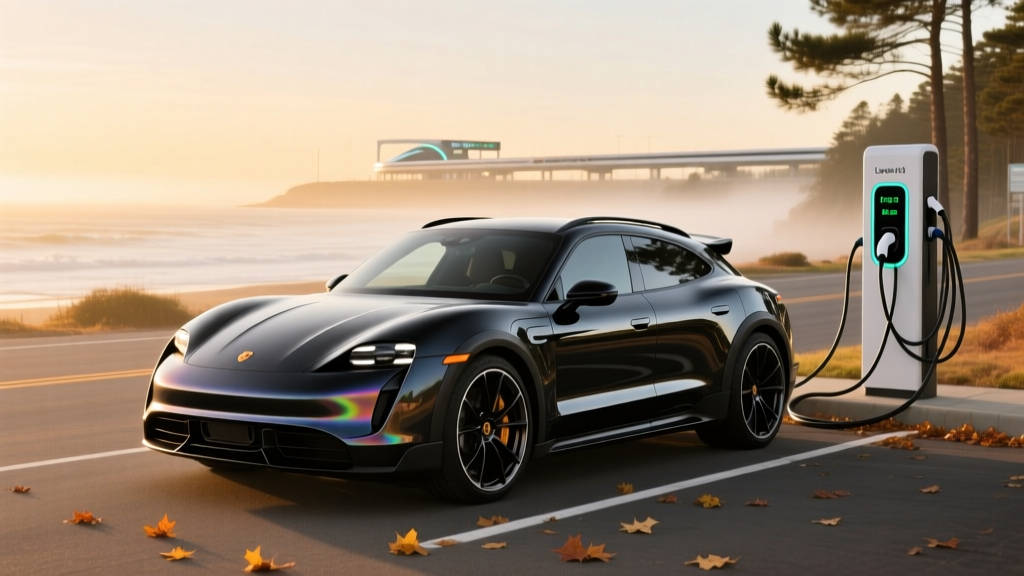
The 2022 Porsche Taycan Cross Turismo occupies a rare space in the EV market: it's a lifted, wagon-style electric performance car that trades the sedan's sleek roofline for cargo practicality and standard all-wheel drive. Built on Porsche's J1 platform with an 800-volt architecture, the Cross Turismo charges faster than nearly any EV from its model year and delivers handling that defies its 5,000+ lb curb weight. But with EPA range figures that lag behind Tesla and Lucid, and pricing that pushes well past six figures, buyers need hard data before writing a check.
This review breaks down the 2022 Taycan Cross Turismo's real-world range, charging behavior, ownership costs, and how the §30D federal tax credit applies — or doesn't — to this model in the current incentive landscape.
2022 Porsche Taycan Cross Turismo: Core Specifications
| Spec | 4 Cross Turismo | 4S Cross Turismo | Turbo Cross Turismo | Turbo S Cross Turismo |
|---|---|---|---|---|
| EPA Range | 215 mi | 227 mi | 223 mi | 222 mi |
| Battery (usable / gross) | 71 kWh / 79.2 kWh (Performance Battery) | 79.2 kWh / 93.4 kWh (Performance Battery Plus) | 79.2 kWh / 93.4 kWh | |
| Chemistry | NMC (Nickel Manganese Cobalt) — LG Energy Solution pouch cells | |||
| Drivetrain | Dual-motor AWD (permanent magnet synchronous) | |||
| Peak Horsepower (Overboost) | 482 hp | 562 hp | 670 hp | 750 hp |
| 0-60 mph | 4.5 sec | 3.9 sec | 3.1 sec | 2.7 sec |
| Max DC Fast Charge | 225 kW | 270 kW | ||
| 10-80% DCFC Time | ~22.5 minutes (under ideal conditions) | |||
| Level 2 AC Charge (onboard) | 9.6 kW standard / 19.2 kW optional | |||
| Efficiency (combined) | 79 MPGe (43 kWh/100mi) | 79 MPGe | 78 MPGe | 78 MPGe |
| Cargo (rear seats up / folded) | 15.7 cu ft / 42.8 cu ft + 3.0 cu ft frunk | |||
| Base MSRP (2022) | $93,700 | $110,300 | $153,500 | $187,600 |
| Battery/Powertrain Warranty | 8 years / 100,000 miles (70% capacity retention) | |||
Real-World Range: What the EPA Number Doesn't Tell You
The J1 platform prioritizes sustained performance and thermal management over efficiency. The Taycan Cross Turismo uses a two-speed transmission on the rear axle — first gear aids launch, second gear optimizes highway cruising — but the car still consumes energy at a rate closer to 38-43 kWh/100 mi depending on conditions. For comparison, the 2022 Tesla Model S Long Range achieves roughly 28 kWh/100 mi and a 405-mile EPA rating.
On a real-world road trip from Los Angeles to Las Vegas (270 miles), a 4S Cross Turismo with the Performance Battery Plus requires at least one DC fast-charge stop, realistically two if you factor in elevation gain, HVAC use, and maintaining a buffer. Porsche's 800-volt architecture makes those stops short, but they are mandatory on routes exceeding ~200 miles.
Source: EPA fueleconomy.gov — 2022 Porsche Taycan Cross Turismo
Charging Performance: The 800-Volt Advantage
The Taycan Cross Turismo's headline charging spec is its 800-volt electrical architecture, which allows it to accept up to 270 kW at compatible DC fast chargers. That translates to roughly 60 miles of range added in under 5 minutes under peak conditions.
| Charging Level | Power / Voltage | Rate | Time / Notes |
|---|---|---|---|
| Level 1 (120V household) | 1.2 kW | ~3 mi/hr | Not practical for daily use; emergency/trickle only |
| Level 2 (240V, 48A) | 9.6 kW (standard) | ~25 mi/hr | Full charge in ~9.5 hours (PB+ battery) |
| Level 2 (240V, 80A, optional) | 19.2 kW | ~50 mi/hr | Full charge in ~5 hours; requires 100A circuit |
| DC Fast Charge (CCS) | 270 kW peak | Up to ~175 mi in 22 min (10-80%) | Peak rate sustained only to ~55% SoC; tapers significantly above 80% |
| DC Fast Charge (50 kW station) | 50 kW | ~130 mi/hr | 10-80% in ~65 minutes |
Charging curve reality check: The 270 kW peak is not sustained across the full 10-80% window. Based on independent testing, the 4S Cross Turismo holds approximately 250-270 kW from roughly 5-25% SoC, then steps down to ~175 kW through 55%, and further tapers to ~100 kW by 70%. The quoted 22.5-minute 10-80% time assumes an Electrify America or equivalent 350 kW-capable CCS station with battery preconditioning active. On a 150 kW EA station, expect 10-80% in roughly 32-35 minutes.
The optional 19.2 kW onboard AC charger is a standout for home charging. With a hardwired wall connector on a dedicated 100-amp circuit, you can fully replenish the 93.4 kWh battery overnight. Most buyers will opt for the standard 9.6 kW charger, which still provides a full charge in under 10 hours — sufficient for any daily commute pattern.
The 2022 Cross Turismo uses a CCS1 connector for DC fast charging in North America. It does not natively support NACS (Tesla Supercharger). Porsche now offers a NACS adapter for newer models, but 2022 owners should verify adapter compatibility and firmware updates before relying on Superchargers.
Performance and Driving Dynamics
Every Cross Turismo trim comes with dual-motor all-wheel drive and adaptive air suspension with Porsche Active Suspension Management (PASM). The air suspension provides up to 1.2 inches of additional ground clearance in "Offroad" mode (available with the Offroad Design Package), making the Cross Turismo genuinely capable on gravel and light trails — a first for the Taycan line.
The Turbo S variant's 2.7-second 0-60 time places it in hypercar territory, and unlike many EVs, the Taycan's two-speed rear transmission and sophisticated thermal management allow it to sustain repeated hard launches without significant power derating. In Car and Driver's testing, the Turbo S Cross Turismo matched its 0-60 claim and delivered consistent quarter-mile times even after back-to-back runs.
Regenerative braking in the Taycan is modest by EV standards — maximum regen is approximately 0.39g, and Porsche does not offer true one-pedal driving. The car coasts when you lift off the accelerator, which some drivers prefer for natural driving feel but which frustrates EV veterans accustomed to Tesla's aggressive regen. Energy recovery is managed automatically, blending regen and friction brakes seamlessly.
Interior, Cargo, and Technology
The Cross Turismo's wagon roofline delivers measurable practicality gains over the Taycan sedan:
- Cargo volume: 15.7 cu ft behind the rear seats (vs. 14.3 cu ft in the sedan), expanding to 42.8 cu ft with the 60/40 split rear seats folded.
- Frunk (front trunk): 3.0 cu ft — enough for a charging cable kit and a small bag.
- Rear headroom: Improved by ~0.9 inches over the sedan thanks to the raised roofline, critical for passengers over 6 feet tall.
- Rear legroom: 32.7 inches — adequate for adults but tighter than a Model S (35.4 in).
The infotainment system runs Porsche Communication Management (PCM) on a 10.9-inch central touchscreen, supplemented by an optional 8.4-inch lower touch panel for climate and handwriting input. A curved 16.8-inch digital instrument cluster replaces traditional gauges. Apple CarPlay is wireless; Android Auto is wired. The system is responsive but menu-heavy — functions like seat heating require multiple taps that rival brands handle with physical buttons.
Driver assistance features include adaptive cruise control with stop-and-go, lane-keeping assist, and night vision with pedestrian detection. This is SAE Level 2 driver assistance — Porsche's InnoDrive system requires hands-on-wheel engagement and does not offer hands-free driving like GM's Super Cruise or Ford's BlueCruise. There is no "autonomous" driving mode.
Pricing, Tax Credits, and Total Cost
| Trim | 2022 Base MSRP | Typical As-Tested Price | Federal §30D Credit Eligible? |
|---|---|---|---|
| 4 Cross Turismo | $93,700 | $102,000-$110,000 | No — exceeds MSRP cap for sedans/wagons ($55,000) |
| 4S Cross Turismo | $110,300 | $125,000-$140,000 | No — exceeds MSRP cap |
| Turbo Cross Turismo | $153,500 | $168,000-$180,000 | No — exceeds MSRP cap |
| Turbo S Cross Turismo | $187,600 | $200,000+ | No — exceeds MSRP cap |
Critical tax credit note: Under current IRS §30D rules, the Taycan Cross Turismo does not qualify for the $7,500 federal EV tax credit. The credit applies a $55,000 MSRP cap for sedans, wagons, and hatchbacks (SUVs and trucks have an $80,000 cap), and every Cross Turismo trim exceeds this threshold significantly. Additionally, buyer income caps ($150,000 single / $300,000 married filing jointly for modified AGI) and battery critical-mineral sourcing requirements further restrict eligibility even for qualifying models. The Cross Turismo's classification as a wagon (not an SUV) is the binding constraint here.
For buyers seeking a Porsche EV with tax credit eligibility, no new Taycan variant qualifies. However, the IRS §30D guidelines should be reviewed with a tax professional, as vehicle classification can occasionally be re-evaluated.
5-year estimated ownership cost (4S Cross Turismo, 15,000 mi/yr):
- Purchase price (as-tested): ~$130,000
- Electricity (national avg $0.16/kWh, 40 kWh/100mi): ~$9,600
- Insurance (national avg for luxury EV): ~$18,000-$22,000
- Maintenance (no oil changes; tire rotation, cabin filter, brake fluid): ~$2,500
- Estimated depreciation (5-year, luxury EV): ~$55,000-$65,000
- Total 5-year cost of ownership: ~$160,000-$175,000
How It Compares: Cross Turismo vs. the Competition
- You prioritize driving dynamics, steering feel, and build quality above all else
- You need 800V fast-charging for frequent road trips
- You want wagon cargo space with genuine off-pavement capability
- Brand prestige and Porsche dealer experience matter to you
- Range is your top priority (Lucid Air Grand Touring: 516 mi EPA; Tesla Model S: 405 mi)
- You want the $7,500 federal tax credit
- You need hands-free highway driving (GM Super Cruise, Ford BlueCruise)
- Budget is under $100,000 (Tesla Model S starts ~$74,990)
The Taycan Cross Turismo's closest rival is the Audi e-tron GT (which shares the J1 platform but offers only a sedan body style) and the Tesla Model S (far more range, less build quality). The Mercedes-Benz EQS SUV offers more interior space and available third-row seating but sacrifices the Porsche's dynamic character. None of these competitors match the Cross Turismo's combination of 270 kW charging, air suspension with off-road mode, and Porsche's steering calibration.
Pros and Cons
- Best-in-class DC fast charging (270 kW, 800V architecture)
- Exceptional driving dynamics — steering, suspension, and brake feel benchmark among EVs
- Repeatable performance with minimal thermal derating
- Wagon cargo versatility with premium build quality
- Optional 19.2 kW AC onboard charger for rapid home replenishment
- Standard AWD on all trims
- EPA range (215-227 mi) trails Tesla Model S, Lucid Air significantly
- No federal tax credit eligibility — MSRP exceeds §30D wagon cap
- Infotainment is menu-heavy; lacks physical climate controls
- Modest regenerative braking; no true one-pedal driving
- CCS-only charging in 2022 (NACS adapter required for Superchargers)
- High insurance premiums typical of $100K+ luxury EVs
Frequently Asked Questions
What is the real-world highway range of the 2022 Taycan Cross Turismo?
Expect 185-200 miles at sustained highway speeds (70-80 mph) in moderate temperatures. The EPA combined rating of 215-227 miles assumes mixed driving. Cold weather (below freezing) without preconditioning drops range to roughly 155-175 miles. Porsche's battery thermal management mitigates some cold-weather loss when preconditioning is active.
How fast does the Cross Turismo charge on DC fast chargers and at home?
On a 350 kW-capable CCS station, the 4S/Turbo/Turbo S variants peak at 270 kW and complete a 10-80% charge in approximately 22.5 minutes. At home on a standard 9.6 kW Level 2 charger, expect a full charge in ~9.5 hours. The optional 19.2 kW onboard charger cuts that to roughly 5 hours but requires a dedicated 100-amp circuit and compatible hardwired EVSE.
Does the 2022 Taycan Cross Turismo qualify for the $7,500 federal EV tax credit?
No. Under current IRS §30D rules, wagons and sedans face a $55,000 MSRP cap, and every Cross Turismo trim starts at $93,700 or above. Even if reclassified as an SUV ($80,000 cap), the base 4 Cross Turismo still exceeds the limit. Buyer income caps and battery sourcing requirements add further restrictions. Consult a tax professional for your specific situation.
Is the Taycan Cross Turismo worth buying over a Tesla Model S or Lucid Air?
It depends on priorities. The Taycan wins on driving dynamics, build quality, charging speed, and brand cachet. The Model S wins on range (405 mi), price (~$74,990 base), and Supercharger network access. The Lucid Air wins on range (up to 516 mi) and interior space. If you value the driving experience and road-trip charging speed over maximum range, the Cross Turismo is arguably the best-driving EV wagon available.
What is the battery warranty and expected degradation?
Porsche covers the high-voltage battery for 8 years or 100,000 miles, guaranteeing at least 70% of original capacity. NMC chemistry in the J1 platform has shown moderate degradation in real-world use — owners report approximately 5-8% capacity loss over the first 50,000 miles, within warranty tolerance. The 800V system's conservative charge management and active thermal conditioning help preserve long-term State of Health (SoH).
Can the 2022 Cross Turismo use Tesla Superchargers?
Not natively. The 2022 model uses CCS1 for DC fast charging. Porsche has introduced a NACS adapter for newer model years, but 2022 owners should contact their dealer to confirm adapter compatibility and any required firmware updates before attempting to use Tesla's Supercharger network.