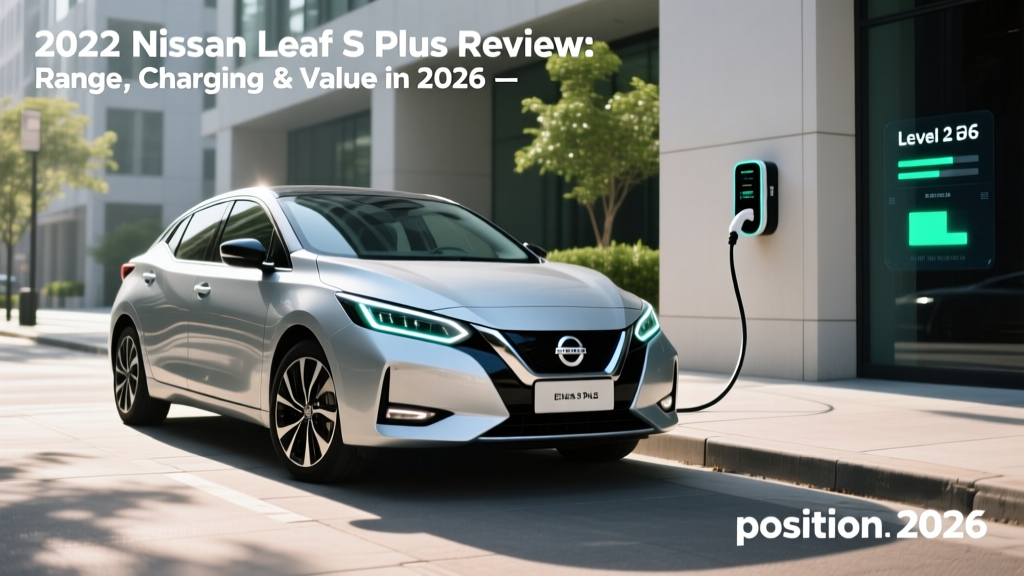
The 2022 Nissan Leaf S Plus occupies an unusual space in the electric-vehicle market. Originally launched as one of the first mass-market EVs in the United States, the Leaf nameplate has aged — and the 2022 S Plus trim represents both the best and the most frustrating version of Nissan's pioneering hatchback. With a 62 kWh battery pack and a 226-mile EPA range estimate, it delivers usable daily range at a price point that, on the used market in 2026, can undercut nearly every competitor. But its CHAdeMO charging connector, passive battery thermal management, and aging interior tech mean buyers need to go in with clear eyes.
This review breaks down every spec that matters to a real buyer: range under actual driving conditions, charging speed and connector limitations, performance, interior dimensions, warranty coverage, and whether the federal used-EV tax credit can make this one of the best bargains in electrified transportation.
2022 Nissan Leaf S Plus: Core Specifications
| Specification | Value |
|---|---|
| EPA Range | 226 miles |
| Battery (usable) | 62 kWh (NMC lithium-ion) |
| Motor Output | 214 hp / 250 lb-ft torque |
| Drivetrain | Front-wheel drive (single motor) |
| 0–60 mph | ~6.9 seconds |
| EPA Efficiency | 111 MPGe combined (30 kWh/100 mi) |
| DC Fast Charge (max) | ~100 kW (CHAdeMO) |
| Level 2 Charge Rate | 6.6 kW onboard charger |
| Cargo Volume | 23.6 cu ft (rear seats up) / 30.0 cu ft (folded) |
| Base MSRP (2022) | $38,225 (incl. destination) |
| Battery Warranty | 8 years / 100,000 miles |
Range and Efficiency: EPA Sticker vs. the Real World
The EPA rates the 2022 Leaf S Plus at 226 miles of combined range. That figure comes from the larger 62 kWh battery pack (Nissan calls it the "Plus" configuration), which uses NMC (nickel manganese cobalt) lithium-ion cells. The standard Leaf S and SV trims use a smaller 40 kWh pack rated at just 149 miles — a significant gap that makes the S Plus the only Leaf variant worth considering for anyone driving beyond short urban commutes.
EPA Estimate: 226 miles combined
City / moderate-speed driving: ~215–235 miles — regenerative braking recovers energy effectively in stop-and-go traffic, sometimes exceeding the EPA combined figure.
Highway (70–75 mph sustained): ~175–195 miles — the Leaf's aerodynamic profile and single-speed reduction gearing mean efficiency drops noticeably at interstate speeds.
Cold weather (below 32°F): ~145–175 miles — the Leaf lacks a heat pump, relying on resistive cabin heating. Expect 25–35% range loss in freezing temperatures, worse if using seat heaters and cabin preheating extensively.
The absence of active liquid battery thermal management is the Leaf's most discussed engineering limitation. Nissan uses passive air cooling, which works adequately in moderate climates but allows the battery to heat up during repeated DC fast-charging sessions or sustained high-speed driving in hot weather. This doesn't immediately damage the pack — the battery management system will throttle charge and discharge rates to protect the cells — but it does mean real-world fast-charging speeds may fall well below the peak 100 kW figure on a hot day or after consecutive charges.
Efficiency is rated at 111 MPGe combined by fueleconomy.gov, which translates to roughly 30 kWh per 100 miles. That's competitive with rivals like the Chevrolet Bolt EUV (113 MPGe) and slightly behind the Hyundai Kona Electric (120 MPGe). In practice, you'll see closer to 27–28 kWh/100 mi in city driving and 33–36 kWh/100 mi at highway speeds.
Charging Speed and the CHAdeMO Problem
Charging is where the 2022 Leaf S Plus demands the most buyer awareness. Nissan adopted the CHAdeMO DC fast-charging standard, while the rest of the North American market has consolidated around CCS (Combined Charging System) and, increasingly, the Tesla NACS connector. This isn't a minor footnote — it directly affects where and how fast you can charge on road trips.
| Charging Level | Power / Connector | Time / Rate |
|---|---|---|
| Level 1 (120V household) | ~1.4 kW (J1772) | ~3–4 miles per hour; 0–100% in ~50+ hours |
| Level 2 (240V home/public) | 6.6 kW (J1772) | ~22 miles per hour; 0–100% in ~9.5 hours |
| DC Fast Charge | ~100 kW peak (CHAdeMO) | 10–80% in ~45 minutes (ideal conditions) |
Let's unpack those numbers. The 6.6 kW onboard charger is adequate for overnight home charging — plug in at 10 PM with a depleted battery and you'll wake up fully charged. Most Leaf S Plus owners install a Level 2 wallbox (typically a 32-amp or 40-amp unit), which delivers the full 6.6 kW the car can accept. Home charging cost at the US average of $0.16/kWh works out to roughly $9.90 for a full 62 kWh charge, or about 4.4 cents per mile — dramatically cheaper than gasoline.
The DC fast-charging situation is more complex. The Leaf S Plus peaks at roughly 100 kW on a CHAdeMO station, but the passive thermal management system means that peak is rarely sustained. In real-world testing, expect the charge curve to taper noticeably after 60–65% state of charge (SoC). A 10–80% session typically takes 40–50 minutes under moderate temperatures, but can stretch to 60+ minutes in hot weather as the battery management system restricts current to prevent overheating. This phenomenon — sometimes called "Rapidgate" in Nissan Leaf forums — was more severe in earlier model years but remains a factor.
Perhaps the bigger concern in 2026 is CHAdeMO infrastructure availability. Electrify America, the largest US DC fast-charging network, uses CCS exclusively. Tesla Superchargers use NACS. CHAdeMO stations still exist — primarily at older EVgo locations and some legacy installations — but the network is shrinking relative to CCS and NACS. If you plan to road-trip frequently, this is a genuine limitation. For a commuter who charges at home 95% of the time, it's far less consequential.
Performance and Driving Dynamics
The S Plus trim uses a 160 kW (214 hp) front-mounted electric motor producing 250 lb-ft of torque. That's a meaningful step up from the standard Leaf's 110 kW (147 hp) motor, and it transforms the car's character. The 0–60 mph time of approximately 6.9 seconds puts it in the same territory as a Volkswagen GTI — not sports-car fast, but genuinely quick for a practical hatchback, and the instant torque delivery makes it feel even brisker in city driving.
Ride quality is compliant and comfortable, tuned more for commuting comfort than canyon carving. The steering is light and precise, and the low center of gravity (thanks to the under-floor battery pack) keeps body roll well-managed. The Leaf S Plus includes Nissan's e-Pedal mode, which provides aggressive regenerative braking that enables one-pedal driving in most urban situations — lift off the accelerator and the car decelerates strongly, often coming to a complete stop without touching the brake pedal.
One area where the Leaf shows its age is in the lack of adaptive cruise control with stop-and-go on the S Plus trim. Nissan's ProPILOT Assist — which combines adaptive cruise control with lane-centering for SAE Level 2 highway driving — is available only on the SL Plus trim. The S Plus does include automatic emergency braking, lane departure warning, blind-spot monitoring, and rear cross-traffic alert as standard safety features.
Interior, Cargo, and Technology
The Leaf's interior was designed in the early 2010s and refreshed incrementally, which means it feels a generation behind rivals in materials and infotainment. The S Plus trim includes:
- 8.0-inch touchscreen infotainment with Apple CarPlay and Android Auto (wired)
- 4-speaker audio system
- Cloth seating surfaces with manual adjustment
- Automatic climate control (single-zone)
- 4.2-inch TFT driver information display in the instrument cluster
Passenger space is generous for a compact hatchback. Front legroom measures 42.1 inches, and rear legroom is 33.5 inches — adequate for adults on shorter trips but tight for taller passengers on long drives. Headroom is excellent front and rear (41.2 / 37.3 inches), thanks to the tall roofline.
Cargo capacity is 23.6 cubic feet behind the rear seats, expanding to 30.0 cubic feet with the 60/40 split rear seats folded. That's competitive with the Chevrolet Bolt EV (16.6 cu ft, though the Bolt EUV offers more) and trails the Hyundai Kona Electric (25.8 cu ft). The cargo floor is relatively high due to the battery pack underneath, and there's no front trunk (frunk) — the space under the hood houses conventional power electronics.
Pricing, Tax Credits, and Used Market Value
The 2022 Nissan Leaf S Plus originally carried an MSRP of $38,225 including destination charges. In 2026, used examples typically trade between $16,000 and $22,000 depending on mileage, condition, and battery health — making this one of the most affordable ways to get over 200 miles of EV range.
The critical financial question is federal tax credit eligibility. The new-vehicle §30D credit of up to $7,500 no longer applies to the Leaf for multiple reasons: it's a 2022 model year, the battery sourcing requirements have tightened, and Nissan has faced challenges meeting the critical-mineral thresholds. However, the used-EV tax credit (officially the Previously-Owned Clean Vehicles Credit under IRC §25E) is where this car shines:
- Credit Amount: 30% of the sale price, up to a maximum of $4,000
- Vehicle Price Cap: Sale price must not exceed $25,000
- Buyer Income Caps: AGI ≤ $75,000 (single) / $112,500 (head of household) / $150,000 (joint)
- Vehicle Age: Must be at least 2 model years old (2022 qualifies in 2024+)
- Dealer Requirement: Must be purchased from a licensed dealer (not private party)
- Battery Requirement: Must have at least 7 kWh battery capacity (Leaf's 62 kWh qualifies)
- First Transfer: Must be the first qualified sale since August 16, 2022 (verify with dealer)
A $20,000 used Leaf S Plus purchased by an eligible buyer could yield a $4,000 credit (30% × $20,000 = $6,000, capped at $4,000), bringing the effective cost to $16,000. As of 2024, this credit can be transferred to the dealer at point of sale as an immediate discount. Confirm current eligibility rules at IRS.gov before purchasing.
| Cost Factor | Estimated Amount |
|---|---|
| Used Market Price (avg.) | $18,000 – $22,000 |
| Used-EV Tax Credit (max, if eligible) | –$4,000 |
| Effective Cost After Credit | $14,000 – $18,000 |
| Annual Charging Cost (12,000 mi/yr, home) | ~$530 |
| Annual Insurance (national avg.) | ~$1,500 – $1,800 |
| Estimated Maintenance/yr | ~$200 – $350 |
Warranty and Battery Longevity
Nissan provides a comprehensive EV warranty package for the 2022 Leaf S Plus:
- Lithium-ion battery capacity: 8 years / 100,000 miles (guarantees the battery will retain at least 66% of original capacity — 9 bars out of 12 on the capacity gauge)
- EV system components: 5 years / 60,000 miles
- Bumper-to-bumper: 3 years / 36,000 miles
- Powertrain: 5 years / 60,000 miles
The 66% capacity retention threshold is notably lower than the industry standard of 70% used by most competitors (including Hyundai, Kia, and Tesla). In practice, Leaf batteries have shown moderate degradation — typically losing 10–15% capacity over the first 5 years in moderate climates. In hot climates (Arizona, Texas, Southern California), degradation can be more pronounced due to the passive thermal management system. If you're buying used in 2026, check the battery health indicator on the dashboard (the 12-bar capacity gauge) and, ideally, use an OBD-II reader with the LeafSpy app to get a precise State of Health (SoH) percentage.
Battery replacement, should it ever be needed out of warranty, typically costs between $6,500 and $9,000 for the 62 kWh pack including labor — a significant expense that buyers should factor into long-term ownership projections.
Pros, Cons, and the Verdict
Pros
- 226-mile EPA range at a bargain used price
- 214 hp motor provides brisk acceleration
- Strong used-EV tax credit eligibility (up to $4,000)
- Comfortable ride quality and excellent visibility
- e-Pedal one-pedal driving is intuitive
- Low running costs (~4.4 cents/mile on home charging)
- Generous headroom and decent cargo space
Cons
- CHAdeMO connector — shrinking DC fast-charge network
- Passive battery cooling limits repeated fast charging
- 10–80% DC charge takes ~45 min (slower than rivals)
- No heat pump — significant cold-weather range loss
- Dated interior materials and infotainment
- ProPILOT Assist not available on S Plus trim
- Battery warranty threshold (66%) below industry norm
- No frunk; cargo floor sits high
Who Should Buy the 2022 Leaf S Plus?
Best for: Budget-conscious commuters in moderate climates who charge primarily at home, drive under 60 miles round-trip daily, and want to minimize their purchase price with the used-EV tax credit. If you live in coastal California, the Pacific Northwest, or the Southeast (outside extreme-heat zones), the Leaf S Plus is a compelling bargain at $14,000–$18,000 after credit.
Look elsewhere if: You need frequent DC fast charging for road trips, live in an extreme-heat climate, need the latest driver-assist technology, or want access to Tesla Superchargers. The Chevrolet Bolt EUV (with CCS and a heat pump option), Hyundai Kona Electric, or a used Tesla Model 3 will serve those use cases better — at a higher price.
Frequently Asked Questions
What is the real-world range of the 2022 Nissan Leaf S Plus?
The EPA rates it at 226 miles combined, but real-world results vary significantly. Expect 215–235 miles in city driving, 175–195 miles at sustained highway speeds, and as low as 145–175 miles in freezing temperatures due to the lack of a heat pump and resistive cabin heating drawing from the traction battery.
How fast does the Leaf S Plus charge at home and on DC fast chargers?
On a Level 2 home charger (240V), the 6.6 kW onboard charger adds about 22 miles of range per hour, fully charging the 62 kWh battery in roughly 9.5 hours. On a CHAdeMO DC fast charger, it peaks around 100 kW but typically takes 40–50 minutes for a 10–80% session due to charge-curve tapering and thermal management throttling.
Does the 2022 Leaf S Plus qualify for any federal tax credit in 2026?
It does not qualify for the new-vehicle §30D credit, but it may qualify for the used-EV credit under IRC §25E — up to $4,000 (30% of sale price) if purchased from a dealer for under $25,000 and the buyer meets income thresholds ($75K single / $150K joint). Eligibility depends on the specific vehicle's transfer history. Verify at IRS.gov before purchasing.
Is the 2022 Leaf S Plus worth buying vs. the Chevrolet Bolt or Kona Electric?
It depends on your priorities. The Leaf S Plus offers more range than the base Bolt EV (259 mi) at a similar used price, but the Bolt uses the CCS connector (far more compatible with public charging networks) and has a liquid-cooled battery. The Kona Electric offers slightly better efficiency and a more modern interior. If charging convenience and road-trip capability matter, the Bolt or Kona is the stronger pick. If you want maximum range per dollar and charge at home, the Leaf S Plus is hard to beat on price.
How long will the 2022 Leaf S Plus battery last?
Nissan warrants the battery for 8 years / 100,000 miles against capacity loss below 66%. Real-world data from Leaf owners suggests typical degradation of 10–15% over 5 years in moderate climates, with faster loss in extreme heat. A well-maintained 2022 Leaf S Plus battery in 2026 should still retain 85–92% of original capacity. Use LeafSpy via OBD-II to check SoH before buying used.
Can I charge the Leaf S Plus at Tesla Superchargers?
No. The Leaf uses a CHAdeMO DC fast-charging connector and a J1772 Level 2 connector. Tesla Superchargers use the NACS connector, and there is currently no widely available CHAdeMO-to-NACS adapter. You can use a J1772 adapter for Tesla Level 2 Destination Chargers, but DC fast charging is limited to CHAdeMO stations.