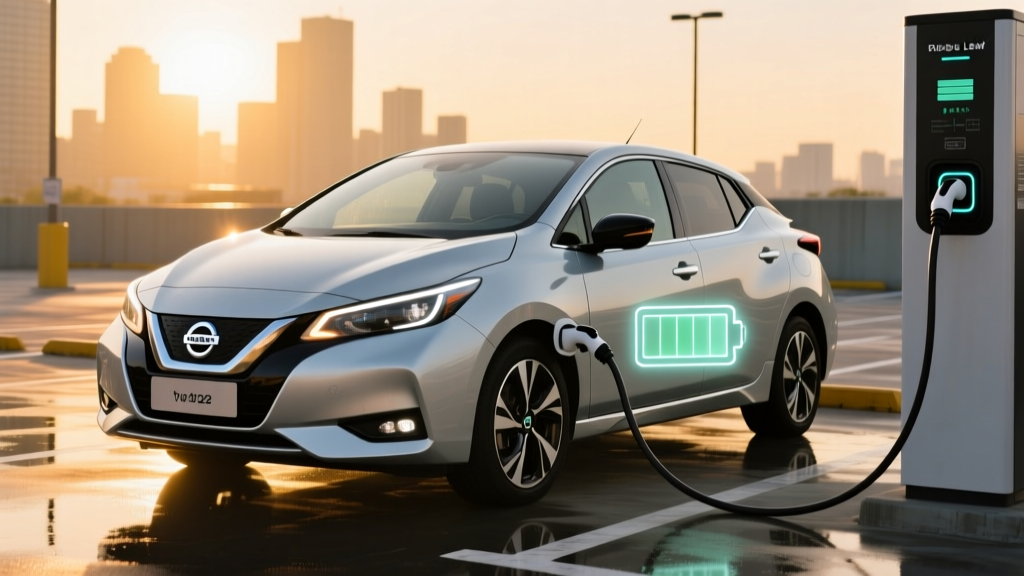
The 2022 Nissan Leaf holds a unique place in electric-vehicle history. As one of the first mass-market EVs ever sold in the United States, it helped prove that battery-electric commuting was viable for everyday drivers. By its 2022 model year, Nissan offered two battery sizes, an updated infotainment system, and standard ProPILOT Assist on higher trims. But the EV market moved fast, and by 2026 the Leaf has been discontinued in North America, replaced in spirit by newer crossovers and the Ariya.
If you're shopping the used-EV market or evaluating a leftover 2022 Leaf still sitting on a dealer lot, this review breaks down exactly what you're getting — EPA range versus real-world expectations, the CHAdeMO charging situation, battery health considerations, and whether the math still works in your favor.
2022 Nissan Leaf Quick Specs at a Glance
| Specification | Leaf S / SV (40 kWh) | Leaf SL PLUS (62 kWh) |
|---|---|---|
| EPA Range | 149 miles | 226 miles (212 mi SL PLUS) |
| Battery (usable) | ~39 kWh, NMC lithium-ion | ~60 kWh, NMC lithium-ion |
| Motor Output | 110 kW (147 hp) | 160 kW (214 hp) |
| 0–60 mph | ~7.9 sec | ~6.5 sec |
| Drivetrain | FWD | FWD |
| DC Fast Charge (max) | ~50 kW (CHAdeMO) | ~100 kW (CHAdeMO) |
| 10–80% DCFC Time | ~40 min | ~45 min |
| Level 2 (240V) Rate | 6.6 kW onboard charger | 6.6 kW onboard charger |
| EPA Efficiency | 111 MPGe (30 kWh/100 mi) | 104 MPGe (32 kWh/100 mi) |
| Cargo Volume | 23.6 cu ft (rear seats up) | 23.6 cu ft (rear seats up) |
| Base MSRP (2022) | $28,375 (S) | $36,395 (SL PLUS) |
| Battery Warranty | 8 yr / 100,000 mi | 8 yr / 100,000 mi |
Sources: EPA Fueleconomy.gov, Nissan USA archived spec sheets.
Range: EPA Sticker vs. Real-World Driving
Leaf S/SV (40 kWh): EPA 149 mi — Expect ~120–135 mi on mixed highway driving; ~100–115 mi in freezing temperatures with cabin heat.
Leaf SL PLUS (62 kWh): EPA 226 mi (212 mi for SL PLUS trim due to larger wheels) — Expect ~185–205 mi highway; ~155–175 mi in cold weather.
Cold-weather range loss of 20–30% is typical for EVs without a heat pump. The 2022 Leaf uses resistive cabin heating, which draws significant energy from the traction battery in winter.
The 2022 Leaf's range story is straightforward: the standard 40 kWh pack is a city commuter's battery, while the 62 kWh PLUS variant stretches into legitimate road-trip territory — barely. With an EPA rating of 226 miles, the SV PLUS can handle a 200-mile round trip in mild weather if you're not pushing 80 mph the entire way.
However, the Leaf lacks active thermal management for its battery pack. Instead of a liquid cooling/heating system, Nissan relies on passive air cooling. This means two things: (1) range drops more noticeably in extreme heat or cold compared to liquid-cooled competitors, and (2) repeated DC fast charging in hot weather can trigger "Rapidgate" — Nissan's battery-protection mode that severely throttles charge speeds to prevent overheating. If you live in Phoenix or frequently fast-charge on summer road trips, this is a real limitation.
For context, the EPA's official testing gives the 40 kWh Leaf an efficiency rating of 111 MPGe combined (30 kWh per 100 miles). That's competitive with other compact EVs. The 62 kWh version rates slightly lower at 104 MPGe combined, largely due to the additional battery mass.
Charging: The CHAdeMO Challenge in 2026
This is where buying a 2022 Leaf in 2026 requires careful thought. The Leaf uses the CHAdeMO DC fast-charging connector — a standard that has lost the format war in North America to CCS and, increasingly, the Tesla NACS connector. Electrify America, the largest U.S. DC fast-charging network, has largely standardized on CCS1 and NACS, with CHAdeMO stalls becoming rare or decommissioned.
| Charging Level | Power (kW) | Miles of Range Added per Hour | Typical Use Case |
|---|---|---|---|
| Level 1 (120V household) | ~1.4 kW | ~4–5 mi/hr | Overnight trickle; emergency top-up |
| Level 2 (240V home/public) | 6.6 kW (onboard max) | ~22–25 mi/hr | Daily home charging; full charge in ~7–9 hrs |
| DC Fast (40 kWh model) | ~50 kW peak | ~150 mi/hr (at peak) | Road-trip stops; 10–80% in ~40 min |
| DC Fast (62 kWh PLUS) | ~100 kW peak | ~250 mi/hr (at peak) | Road-trip stops; 10–80% in ~45 min |
Important distinction — kW vs. kWh: Kilowatts (kW) measure the rate of energy flow (charging power), while kilowatt-hours (kWh) measure total energy stored (battery capacity). A 6.6 kW Level 2 charger filling a 40 kWh battery from empty takes roughly 6 hours — capacity divided by rate.
The Leaf's 6.6 kW onboard AC charger is adequate for overnight home charging. Plug in when you get home, and you'll wake up with a full battery every morning. That's the ideal ownership pattern for this car.
For DC fast charging, the 62 kWh model's 100 kW peak rate is respectable on paper, but real-world charge curves tell a different story. Peak speed is only sustained briefly at low state-of-charge (SoC) and moderate battery temperatures. As the battery fills past 60–70%, the charge rate tapers significantly — a protective measure for the passively cooled pack. Expect average charging speeds closer to 50–65 kW across a 10–80% session on the PLUS model, and roughly 30–40 kW on the standard 40 kWh variant.
If your daily driving is under 100 miles and you can charge at home, the CHAdeMO limitation matters less. But if you plan to road-trip regularly, finding functional CHAdeMO stalls in 2026 requires apps like PlugShare and careful route planning. Some Leaf owners have turned to CHAdeMO-to-CCS adapters, though these add cost and complexity.
Performance and Driving Dynamics
The standard Leaf's 147 horsepower and 236 lb-ft of torque from its front-mounted electric motor deliver adequate city acceleration. The 0–60 mph time of roughly 7.9 seconds won't impress at stoplight drag races, but instant electric torque makes the car feel peppier than that number suggests in urban driving. Merge onto a highway, and you'll have enough power to keep up with traffic without drama.
The PLUS variant's 214 hp and 250 lb-ft drop the 0–60 time to about 6.5 seconds — genuinely quick for a compact hatchback. The extra power makes highway passing confident, and the one-pedal driving mode (Nissan calls it e-Pedal) lets you recapture energy through regenerative braking, reducing brake wear in stop-and-go traffic.
Ride quality is comfortable and compliant, with a soft suspension tuned for city streets rather than canyon carving. The low center of gravity from the floor-mounted battery pack keeps body roll reasonable, but this is not a sporty car. Steering is light and numb — fine for parking lots, less engaging on winding roads. At highway speeds, wind and tire noise are noticeable but not objectionable for the class.
Interior, Cargo, and Technology
Inside, the 2022 Leaf feels like a product of its era — functional but dated compared to newer EVs. The 8-inch touchscreen (standard on SV and above; 7-inch on S trim) runs Nissan's infotainment system with Apple CarPlay and Android Auto. Physical buttons for climate control and volume are a welcome ergonomic choice, even if the screen resolution and response speed lag behind 2026 standards.
Passenger space is generous for a compact hatchback:
- Front legroom: 42.1 inches
- Rear legroom: 33.5 inches
- Front headroom: 41.2 inches
- Rear headroom: 37.3 inches
Cargo volume behind the rear seats measures 23.6 cubic feet — competitive with hatchbacks like the Volkswagen Golf and more practical than many EV sedans. Fold the 60/40-split rear seats, and you get a flat-ish load floor for larger items. There's no frunk (front trunk); the space under the hood is occupied by the motor and power electronics.
On the safety and driver-assistance front, the 2022 Leaf earned strong marks. Nissan's ProPILOT Assist (standard on SV and above) provides SAE Level 2 adaptive cruise control with lane-centering on highways. It's a competent system for reducing fatigue on long drives, but it is not autonomous driving — you must keep your hands on the wheel and eyes on the road at all times. Automatic emergency braking, blind-spot monitoring, and rear cross-traffic alert are standard across all trims. The NHTSA awarded the 2022 Leaf a 5-star overall safety rating.
Pricing, Trims, and Federal Tax Credit Status
When new, the 2022 Leaf was one of the most affordable EVs on the market. Here's what the original MSRP looked like before destination charges:
| Trim | Battery | 2022 Base MSRP | Federal Credit (when new) |
|---|---|---|---|
| S | 40 kWh | $28,375 | Up to $7,500* |
| SV | 40 kWh | $31,675 | Up to $7,500* |
| SV PLUS | 62 kWh | $35,425 | Up to $7,500* |
| SL PLUS | 62 kWh | $36,395 | Up to $7,500* |
*Federal tax credit eligibility depended on IRS §30D rules at time of purchase, including buyer income caps and battery-sourcing requirements that tightened in 2023–2024.
The 2022 Leaf is now eligible for the used-EV federal tax credit under IRS §25E: up to $4,000 or 30% of the sale price (whichever is lower), applied at point of sale through a registered dealer. Requirements include:
- Sale price must be $25,000 or less
- Buyer income caps: $75,000 single / $112,500 head of household / $150,000 joint
- Vehicle must be at least 2 model years old (2022 qualifies in 2026)
- Must purchase through a registered dealer (private-party sales excluded)
- Buyer can claim the credit only once every 3 years
On the used market in early 2026, a 2022 Leaf S with moderate mileage typically lists between $13,000 and $17,000, while a well-equipped SV PLUS or SL PLUS ranges from $17,000 to $22,000. If you qualify for the $4,000 used-EV credit, the effective cost drops meaningfully — a $16,000 Leaf SV becomes roughly $12,000 after the credit, making it one of the cheapest ways into EV ownership available.
Battery Health and Warranty: What to Watch
Nissan provides an 8-year/100,000-mile battery capacity warranty on the 2022 Leaf, guaranteeing that the battery will retain at least 65% of its original capacity (9 bars out of 12 on the dashboard capacity gauge) during the warranty period. If degradation drops below that threshold, Nissan will repair or replace the battery at no cost.
The Leaf's passive air-cooled battery is the main variable in long-term health. Data from fleet operators and owner communities shows that Leafs driven in moderate climates (Pacific Northwest, coastal California) tend to retain capacity well — often losing only 5–10% over the first four years. In hot climates (Arizona, Texas, inland Southern California), degradation can be steeper, with some owners reporting 15–20% capacity loss by year four or five, particularly if the car is frequently DC fast-charged or regularly parked in direct sun at high state-of-charge.
If you're buying a used 2022 Leaf, request a battery health check from a Nissan dealer. The Leaf's dashboard displays a capacity bar indicator (out of 12 bars) that gives a rough real-time estimate of state-of-health (SoH). A 2022 model with 30,000–50,000 miles should still show 11 or 12 bars in most cases. Additionally, third-party tools like LeafSpy can read detailed battery metrics via the OBD-II port, giving you a more precise degradation percentage.
Battery replacement, should it become necessary out of warranty, is the Leaf's biggest financial risk. A new 40 kWh pack replacement runs approximately $6,500–$8,500 at a Nissan dealer, while the 62 kWh pack can exceed $9,000–$12,000. Refurbished packs from salvage sources are sometimes available for less, but they carry their own unknowns.
Pros and Cons: The Honest Assessment
✅ Pros
- Low used-EV pricing — especially after the $4,000 federal credit
- Comfortable ride and spacious hatchback cargo area (23.6 cu ft)
- Standard driver-assist suite including ProPILOT on most trims
- Simple, proven powertrain with few moving parts
- Strong city efficiency at 111 MPGe (40 kWh)
- 5-star NHTSA safety rating
- One-pedal driving with e-Pedal regen mode
❌ Cons
- CHAdeMO connector — shrinking public charging network in 2026
- No active thermal management — vulnerable to heat-related degradation
- Limited DC fast-charge speed (50–100 kW peak) with tapering
- Short range on 40 kWh model (149 mi EPA; ~120 real-world highway)
- Dated interior tech compared to 2024+ EV competitors
- No frunk; no vehicle-to-load (V2L) capability
- Resistive cabin heating reduces winter range significantly
- Discontinued — no future OTA updates or new features
Who Should Buy a 2022 Nissan Leaf in 2026?
Choose the 2022 Leaf if:
• Your daily round-trip commute is under 80 miles (40 kWh) or under 150 miles (PLUS)
• You have reliable home Level 2 charging and rarely need public DC fast chargers
• You live in a moderate climate without extreme summer heat
• You want the lowest possible entry price into EV ownership
• You value a comfortable, practical hatchback over cutting-edge tech
Look elsewhere if:
• You regularly drive more than 200 miles in a day or take frequent road trips
• You live in a hot climate (Arizona, Texas, desert Southwest) where battery degradation accelerates
• You rely on public fast-charging networks — CHAdeMO availability is declining
• You want the latest infotainment, over-the-air updates, or V2L capability
• You need all-wheel drive or towing capacity (the Leaf offers neither)
The 2022 Leaf's best use case in 2026 is as a dedicated commuter and grocery-getter for someone with home charging access. If that describes you, the savings over a newer EV are substantial, and the car's simplicity is a feature, not a bug. The IIHS rated the 2022 Leaf as a Top Safety Pick when equipped with specific headlights, adding confidence for family duty.
For road-trip-heavy buyers, the Hyundai Kona Electric (258 mi EPA, CCS charging), Chevrolet Bolt EUV (247 mi, CCS), or a used Tesla Model 3 (NACS/Supercharger access) are stronger choices despite higher used prices. They offer better charging infrastructure compatibility and liquid-cooled batteries that hold up better over time and across climates.
Frequently Asked Questions
What is the real-world range of the 2022 Nissan Leaf?
The 40 kWh Leaf delivers roughly 120–135 real-world miles in mixed driving and 100–115 miles in freezing weather. The 62 kWh PLUS model achieves about 185–205 miles in mild conditions and 155–175 miles in winter. Highway speeds above 70 mph and aggressive acceleration further reduce these figures.
How fast does the 2022 Leaf charge at home and on DC fast chargers?
At home on a 240V Level 2 charger, the Leaf charges at 6.6 kW, adding about 22–25 miles of range per hour — a full charge takes 7–9 hours overnight. On DC fast chargers, the 40 kWh model peaks around 50 kW (10–80% in ~40 minutes) and the PLUS peaks near 100 kW (10–80% in ~45 minutes), though both taper significantly above 70% SoC.
Does the 2022 Nissan Leaf qualify for any federal tax credit in 2026?
As a new vehicle, the 2022 Leaf is no longer available for the new-EV credit. However, buying one used from a registered dealer in 2026 may qualify you for the used-EV credit under IRS §25E: up to $4,000 or 30% of the sale price (whichever is less), provided the sale price is $25,000 or under and your income falls within the caps ($75K single / $150K joint). Confirm eligibility at IRS.gov before purchasing.
Is the 2022 Leaf worth buying versus competitors like the Bolt or Kona Electric?
It depends on your priorities. The Leaf is typically the cheapest used EV option after the tax credit, and its hatchback practicality is excellent. But the Chevrolet Bolt EUV and Hyundai Kona Electric offer longer range, CCS fast-charging compatibility (better supported by 2026 infrastructure), and liquid-cooled batteries that degrade more slowly. If CHAdeMO charger access is strong in your area and you prioritize lowest cost, the Leaf wins. If you want future-proofing, the Bolt or Kona are safer bets.
What is the biggest risk of buying a used 2022 Leaf?
Battery degradation in hot climates is the primary concern. The passively cooled battery pack is more susceptible to heat-related capacity loss than liquid-cooled competitors. Before buying, check the dashboard capacity bars (12 is ideal) and consider a LeafSpy diagnostic scan. Also verify that CHAdeMO fast chargers are available along your typical routes, as this network is contracting.
Can I charge a 2022 Leaf at a Tesla Supercharger?
Not directly. The Leaf uses CHAdeMO for DC fast charging and J1772 for Level 2 AC. Tesla Superchargers use the NACS connector. While some adapters exist on the market, they are not universally reliable and may void warranty coverage. For Level 2 charging, any J1772-compatible station (including Tesla Wall Connectors with a J1772 adapter) will work.