Quick Verdict: A Stylish City EV With a Hard Range Ceiling
The 2022 Mazda MX-30 EV arrived in the U.S. as a California-only, compliance-style electric subcompact crossover with a deliberately small battery and an EPA-estimated range of just 100 miles. Mazda positioned it as an urban commuter with premium design cues, cork-trimmed interior accents, and a quiet, composed ride. But in a market where rivals routinely deliver 230–300 miles per charge, the MX-30 EV's limited range and modest 50 kW DC fast-charging rate make it a niche proposition — best suited for drivers with short, predictable commutes and reliable home charging access.
This review examines the 2022 Mazda MX-30 EV across every metric that matters to EV buyers: real-world range, charging speed, battery chemistry, efficiency, pricing, tax credit eligibility, and how it stacks up against competitors like the Chevrolet Bolt EV, Nissan Leaf, and Hyundai Kona Electric.
Range, Battery & Real-World Efficiency
| Specification | Value |
|---|---|
| EPA Estimated Range | 100 miles |
| Battery Capacity (Usable) | 35.5 kWh |
| Battery Chemistry | NMC (Nickel Manganese Cobalt) |
| EPA Efficiency (Combined) | 92 MPGe / 36 kWh/100 mi |
| EPA City / Highway | 98 MPGe city / 85 MPGe highway |
| Drivetrain | FWD (single front motor) |
The 35.5 kWh battery pack uses NMC (nickel manganese cobalt) lithium-ion cells — a chemistry that offers higher energy density than LFP (lithium iron phosphate) but requires more careful thermal management and typically benefits from keeping state of charge between 20% and 80% for long-term longevity. Mazda's decision to use such a small pack was intentional: the company argued that a smaller battery reduces manufacturing emissions and resource consumption, positioning the MX-30 as an environmentally conscientious choice for urban drivers who don't need 300 miles of range.
That philosophy is debatable in practice. According to fueleconomy.gov, the MX-30's 92 MPGe combined is respectable but not class-leading — the 2022 Chevrolet Bolt EV achieves 120 MPGe combined with a far more usable 259-mile range. Efficiency alone doesn't compensate for a battery this small when the practical consequence is charging more frequently.
Charging Speed: DC Fast, Level 2 & Home Setup
| Charging Level | Power / Rate | Time / Range Added |
|---|---|---|
| Level 1 (120V household) | ~1.2 kW | ~4 miles per hour; full charge in ~30 hours |
| Level 2 (240V home/public) | 6.6 kW (onboard charger max) | ~22 miles per hour; 0–100% in ~5.5 hours |
| DC Fast Charge (CCS) | 50 kW peak | 10–80% in ~36 minutes |
The MX-30 EV's 50 kW peak DC fast-charging rate is one of its most significant limitations. Most 2022-era competitors — the Hyundai Kona Electric (75 kW), the Kia Niro EV (77 kW), and especially the Chevrolet Bolt EV (55 kW with a poor charging curve but higher capacity) — offer faster or more practical charging. At 50 kW peak, the MX-30 adds roughly 25–30 miles of range in 15 minutes on a fast charger, and the charge curve tapers noticeably above 80% state of charge.
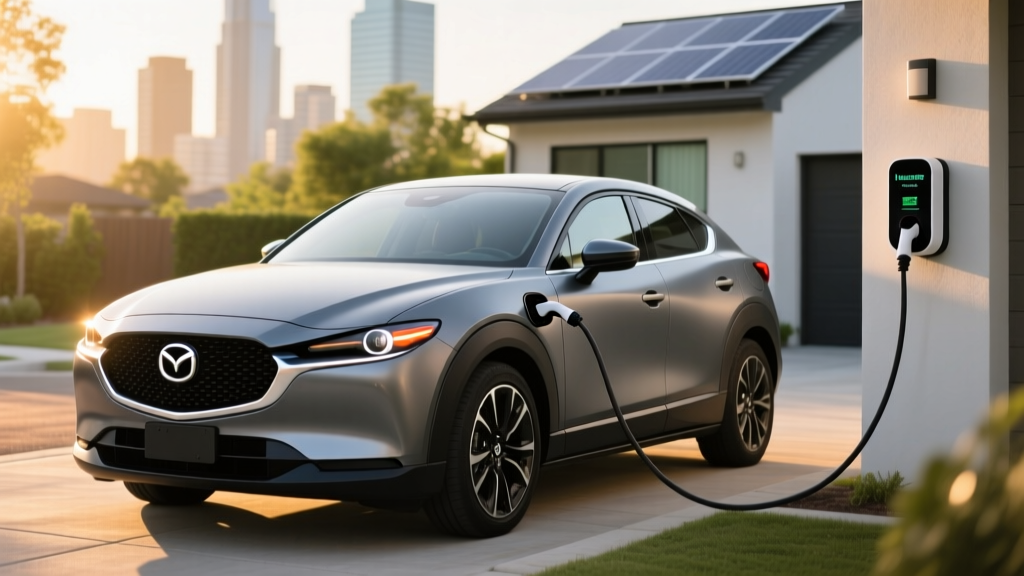
For home charging, the 6.6 kW onboard Level 2 charger is adequate for overnight replenishment. A full charge from empty takes about 5.5 hours on a Level 2 station, which works well for daily commuters who plug in each evening. However, Level 1 (standard 120V outlet) charging is impractical as a primary strategy — at roughly 4 miles of range per hour, recovering a full day's worth of driving takes 10+ hours.
Home installation note: A dedicated 240V/30A circuit with a Level 2 EVSE (such as a ChargePoint Home Flex or Emporia Vue) typically costs $500–$1,500 for equipment plus $800–$2,500 for licensed electrician installation, depending on panel proximity and local permit requirements. Always consult a licensed electrician for final specifications.
Performance, Driving Dynamics & Powertrain
| Metric | Value |
|---|---|
| Horsepower | 143 hp (107 kW) |
| Torque | 200 lb-ft |
| 0–60 mph | ~8.7 seconds |
| Top Speed | ~87 mph (electronically limited) |
| Drivetrain | Front-wheel drive, single motor |
| Regenerative Braking | Adjustable (paddle shifters, multiple levels) |
The MX-30 EV's 143-horsepower electric motor delivers smooth, linear acceleration typical of EVs, but the 8.7-second 0–60 mph time places it well behind competitors like the Bolt EV (6.5 seconds) and the Kona Electric (6.4 seconds). In city driving, the instant torque makes the MX-30 feel peppy off the line, and the low center of gravity from the floor-mounted battery gives it composed handling through corners.
Mazda tuned the regenerative braking system with paddle-shift adjustability, allowing drivers to select from multiple regen levels. However, it does not offer true one-pedal driving that brings the car to a complete stop — you still need the friction brake pedal for final stopping, which is a missed opportunity for EV-native driving feel.
Ride quality is a genuine strength. The MX-30's suspension tuning absorbs bumps with a maturity that exceeds its price class, and cabin noise isolation is excellent. This is where Mazda's premium aspirations show through most clearly.
Interior, Cargo & Technology
| Dimension | Value |
|---|---|
| Front Headroom | 39.1 inches |
| Front Legroom | 42.1 inches |
| Rear Legroom | 33.1 inches |
| Cargo Volume (rear seats up) | 21.0 cu ft |
| Cargo Volume (rear seats folded) | ~45 cu ft (est.) |
| Seating Capacity | 5 passengers |
The interior is where the MX-30 makes its strongest case. Mazda used sustainable materials throughout, including door trim made from recycled plastic bottles and a center console accent crafted from heritage cork (a nod to Mazda's origins as a cork manufacturer in Hiroshima). The floating console design and freestanding 8.8-inch infotainment screen give the cabin a distinctive, upscale feel.
However, the rear seats are tight — 33.1 inches of rear legroom is among the smallest in the subcompact crossover segment, making this a poor choice for families with older children or frequent rear-seat passengers. The cargo area at 21.0 cubic feet is usable but smaller than the Bolt EV (56.8 cu ft behind front seats) and the Kona Electric (45.8 cu ft).
The rear doors use a "freestyle" clamshell design (similar to the BMW i3 or Mazda RX-8), with rear-hinged back doors that open opposite to the front doors. This creates a wide opening when both are open but requires the front door to be opened first to access the rear — an inconvenience in tight parking spaces.
Driver assistance: The MX-30 comes equipped with Mazda's i-Activsense suite, including adaptive cruise control with stop-and-go, lane-keeping assist, blind-spot monitoring, and automatic emergency braking. This is SAE Level 2 driver assistance — the driver must remain fully engaged with hands on the wheel and eyes on the road at all times. It is not autonomous or self-driving.
Pricing, Trims & Federal Tax Credit Eligibility
| Trim | Base MSRP | As-Tested (typical) |
|---|---|---|
| Base | $34,645 | $35,500–$37,000 |
| Premium Plus | $37,655 | $39,000–$41,500 |
The 2022 MX-30 EV launched in two trims, both priced above $34,000 before incentives. The Premium Plus trim adds a head-up display, Bose 12-speaker audio, heated steering wheel, parking sensors, and a panoramic moonroof.
- Maximum credit: Up to $7,500 (based on battery capacity and critical mineral/battery component sourcing)
- MSRP cap: Not applicable for 2022 purchases (caps took effect in 2023 under the Inflation Reduction Act)
- Buyer income cap: Not applicable for 2022 tax year purchases (income limits began in 2023)
- Battery sourcing requirements: Not applicable for 2022 purchases (sourcing rules phased in starting 2023)
- Point-of-sale transfer: Not available for 2022 purchases (began January 2024)
- Claim method: File IRS Form 8936 with your federal tax return
- Caveat: The MX-30's battery sourcing and Mazda's corporate EV credit phase-out status should be verified with a tax professional and the IRS clean vehicle credit page
For 2022 model-year purchases, the tax credit rules were more straightforward than today's complex sourcing and income requirements. However, buyers should verify whether Mazda's specific battery supply chain qualified for the full $7,500, as partial credits were possible depending on cell origin. Consult a tax professional before assuming full credit eligibility.
After a potential $7,500 federal credit, the effective price of the base MX-30 drops to approximately $27,145 — competitive with the Bolt EV and Leaf on price alone, though the range gap remains the central trade-off.
Warranty & Battery Longevity
| Coverage | Term |
|---|---|
| Basic (bumper-to-bumper) | 3 years / 36,000 miles |
| Powertrain | 5 years / 60,000 miles |
| EV Battery | 8 years / 100,000 miles |
| Battery Capacity Threshold | Typically 70% retention (check dealer for exact terms) |
Mazda's 8-year/100,000-mile EV battery warranty is standard for the industry and aligns with federal requirements for emissions-related components. The warranty covers defects and excessive capacity loss, though the exact degradation threshold (typically around 70% state of health) should be confirmed with your dealer at purchase.
With a 35.5 kWh NMC pack, long-term degradation will depend heavily on charging habits. NMC chemistry degrades faster than LFP when routinely charged to 100% or deeply discharged. Best practice: set the charge limit to 80% for daily use and avoid letting the battery sit at very low or very high states of charge for extended periods. Given the MX-30's already limited range, the 20% buffer loss from an 80% daily charge cap reduces usable range to roughly 80 miles — a meaningful sacrifice for battery longevity.
How It Compares: MX-30 EV vs. Key Competitors
| Spec | 2022 Mazda MX-30 EV | 2022 Chevy Bolt EV | 2022 Hyundai Kona Electric | 2022 Nissan Leaf (S Plus) |
|---|---|---|---|---|
| EPA Range | 100 mi | 259 mi | 258 mi | 226 mi |
| Battery (kWh) | 35.5 | 65 | 64 | 62 |
| DC Fast Charge (peak kW) | 50 | 55 | 75 | 100 (CHAdeMO) |
| 0–60 mph | 8.7 sec | 6.5 sec | 6.4 sec | 6.9 sec |
| Base MSRP | $34,645 | $31,995 | $35,295 | $33,470 |
| MPGe (combined) | 92 | 120 | 120 | 108 |
| Cargo (rear seats up) | 21.0 cu ft | 56.8 cu ft (seats folded) | 45.8 cu ft (seats folded) | 23.6 cu ft |
- Your daily commute is under 40 miles round-trip with home charging
- You prioritize interior design, ride comfort, and brand prestige over range
- You want a distinctive, non-ubiquitous EV with sustainable interior materials
- You live in California (the only U.S. market where it was sold)
- You need 200+ miles of range for flexibility or occasional road trips (Bolt EV, Kona Electric)
- You need rear-seat space for children or adults regularly
- You want faster DC charging for public charging stops
- You live outside California
Pros, Cons & Final Ownership Assessment
- Premium interior design with sustainable materials
- Quiet, composed ride quality exceeding its price class
- Standard i-Activsense driver assists (SAE Level 2)
- Unique freestyle clamshell rear doors
- 8-year / 100,000-mile battery warranty
- Lower manufacturing footprint due to small battery
- 100-mile EPA range is the lowest of any 2022 EV sold in the U.S.
- 50 kW DC fast charging is slow by any standard
- California-only availability limits the buyer pool
- Tight rear legroom (33.1 in) and modest cargo space
- Clamshell doors are impractical in tight parking spots
- No one-pedal driving mode
- Price-to-range ratio is among the worst in the segment
The 2022 Mazda MX-30 EV is a thoughtfully designed electric commuter that prioritizes aesthetics and environmental philosophy over practical range. For a single person or couple with a short, predictable commute and guaranteed home charging, it can work — especially if the federal tax credit brings the effective price below $28,000. But the math gets hard to justify when the Chevrolet Bolt EV offers 2.6× the range for less money, or when the Kona Electric delivers similar premium vibes with 258 miles of range.
Mazda discontinued the MX-30 EV in the U.S. after the 2023 model year, making this a used-market-only proposition today. If you're considering one on the pre-owned market, verify battery state of health through a dealer diagnostic report, confirm your home charging setup, and be honest about whether 100 miles of range truly covers your daily needs — including detours, errands, and climate control usage.
Frequently Asked Questions
What is the real-world range of the 2022 Mazda MX-30 EV?
The EPA rates it at 100 miles combined. In real-world driving, expect 80–90 miles on the highway, 90–105 miles in city conditions with regen braking, and as low as 60–70 miles in freezing temperatures. Cold weather significantly impacts a battery this small because cabin heating draws directly from the limited 35.5 kWh pack.
How fast does the MX-30 EV charge at home and on DC fast chargers?
At home on a Level 2 (240V) charger, the 6.6 kW onboard charger delivers a full charge in about 5.5 hours, or roughly 22 miles of range per hour. On a DC fast charger, it peaks at 50 kW, taking approximately 36 minutes to go from 10% to 80% state of charge. This is slower than most competitors and makes public charging stops less practical.
How much does the 2022 MX-30 EV cost after tax credits?
The base MSRP was $34,645. For 2022 purchases, the federal §30D tax credit offered up to $7,500 (verify battery sourcing eligibility with a tax professional). After a full credit, the effective cost drops to approximately $27,145. California buyers may have also qualified for state rebates like CVRP (up to $2,000 for income-eligible buyers). Check IRS.gov for current rules.
Does the 2022 Mazda MX-30 EV qualify for the federal EV tax credit?
For 2022 tax-year purchases, the MX-30 EV was generally eligible for a partial or full federal tax credit under pre-IRA rules, which did not yet include MSRP caps, income limits, or battery-sourcing requirements. However, the exact credit amount depended on battery capacity and the manufacturer's credit phase-out status. Always verify with IRS Form 8936 and a qualified tax professional.
Is the 2022 MX-30 EV worth buying vs. competitors?
It depends entirely on your use case. If you need a stylish, comfortable city commuter with under 40 miles of daily driving and reliable home charging, it can work well — particularly on the used market at a discount. If you need range flexibility, rear-seat space, or faster public charging, the Chevrolet Bolt EV (259 miles, lower price) or Hyundai Kona Electric (258 miles, faster charging) are objectively better choices for most buyers.
Can I still buy a new 2022 Mazda MX-30 EV?
No. Mazda discontinued the MX-30 EV in the U.S. after the 2023 model year. It is available only on the used and certified pre-owned market. Mazda has not announced a direct EV successor for the U.S. market as of early 2026, though the brand has signaled broader electrification plans including PHEVs and new BEV platforms.
What connector does the MX-30 EV use?
The 2022 MX-30 EV uses a CCS1 (Combined Charging System) connector for both Level 2 AC and DC fast charging. It is not compatible with Tesla's NACS connector without an adapter, and as of 2026, Mazda has not issued a NACS retrofit adapter for the MX-30.