Quick Verdict: The Efficiency King of Luxury EVs
If you've been searching for the 2022 Lucid Air Grand Touring 0-60 time, the headline number is 3.0 seconds to 60 mph — blistering for a sedan that also delivers an EPA-estimated 516 miles of range. But the real story isn't just straight-line speed. The Grand Touring's 900-volt architecture, class-leading efficiency (measured in kWh per 100 miles), and 300 kW peak DC fast-charging capability make it one of the most technically accomplished EVs ever built. As of 2026, used 2022 Grand Touring models have become a compelling value proposition on the pre-owned market, though buyers need to understand the tax-credit landscape, real-world range expectations, and ownership costs before signing.
| Spec | Value |
|---|---|
| EPA Range | 516 miles (19" wheels); 451 miles (21" wheels) |
| Battery (Usable) | ~112 kWh, NMC chemistry |
| Drivetrain | Dual-motor AWD |
| Horsepower | 819 hp |
| 0-60 mph | 3.0 seconds |
| Top Speed | 168 mph |
| Max DC Fast Charge | 300 kW (peak) |
| 10-80% DC Charge Time | ~20 minutes (ideal conditions) |
| Level 2 Home Charging | 19.2 kW onboard (up to 80 mi/hr) |
| Efficiency | 131 MPGe combined; 26 kWh/100 mi |
| Cargo Volume | 32 cu ft (trunk + frunk combined) |
| Original MSRP (2022) | $139,000 (before destination) |
| Battery/Powertrain Warranty | 8 years / 100,000 miles |
| Basic Warranty | 4 years / 50,000 miles |
Range and Efficiency: What the EPA Number Doesn't Tell You
The 2022 Lucid Air Grand Touring's EPA-estimated 516 miles (with the standard 19-inch Aero wheels) remains one of the highest range figures of any production EV sold in the United States, per fueleconomy.gov. But as any experienced EV owner knows, the sticker number is a starting point, not a guarantee.
Real-World Range Expectations
EPA Sticker: 516 miles (19" wheels) / 451 miles (21" Dream wheels)
Mixed driving (city + suburban): Expect 460–500 miles in mild weather. The Grand Touring's exceptional efficiency — around 26 kWh per 100 miles — means it extracts more distance per unit of energy than virtually any competitor.
Highway-heavy at 75 mph: Plan for roughly 380–420 miles. Aerodynamic drag hits all EVs hard above 65 mph, but the Air's low 0.20 Cd drag coefficient mitigates this better than most sedans.
Cold weather (below 32°F): Lithium-ion chemistry slows, and cabin heating draws energy. Expect a 20–30% reduction, yielding roughly 300–370 highway miles in freezing temperatures. The Grand Touring's standard heat pump helps, but physics is physics.
Key insight: Even with cold-weather and highway penalties, the Grand Touring's real-world range still exceeds the EPA estimates of most competing luxury EVs, including the Tesla Model S Long Range (405 mi EPA) and the Mercedes EQS 450+ (350 mi EPA).
The usable battery capacity is approximately 112 kWh, using NMC (nickel manganese cobalt) chemistry. Lucid's miniaturized drive units and compact powertrain components allow this massive battery without turning the Air into a crossover. The result is a sedan that can genuinely replace gas for 400+ mile road-trip legs without white-knuckling the charge gauge.
Charging Speed: 900-Volt Architecture Explained
The Air Grand Touring's 900-volt electrical architecture is the backbone of its charging performance. Most EVs in 2022 ran 400V systems; the Air's higher voltage allows faster energy transfer at compatible chargers without requiring extreme current (amps), which reduces heat and cable weight.
| Charging Level | Power (kW) | Miles Added per Hour | Notes |
|---|---|---|---|
| Level 1 (120V household) | ~1.4 kW | ~4–5 mi/hr | Emergency/trickle only |
| Level 2 (240V, 48A) | 11.5 kW | ~40 mi/hr | Standard home charger |
| Level 2 (240V, 80A) | 19.2 kW | ~65–80 mi/hr | Requires high-amperage wall connector + 100A circuit |
| DC Fast Charge (peak) | 300 kW | ~300 mi in 20 min (10-80%) | Requires 350 kW-rated station; curve tapers above 60% |
| DC Fast Charge (typical 150 kW station) | ~150 kW | ~50–60 mi per 10 min | Most common public DCFC speed |
Charging curve reality check: The 300 kW peak is exactly that — a peak. In real-world DC fast charging, the Air Grand Touring sustains roughly 250–280 kW from 10% to approximately 40% state of charge, then gradually tapers. By 60% SoC, you're typically seeing 150–180 kW, and above 80%, speeds drop sharply to protect the battery. A 10–80% session at a 350 kW Electrify America or Tesla Supercharger (with NACS adapter, available from Lucid) takes approximately 20 minutes under ideal conditions — battery preconditioned, warm ambient temperature, and a station delivering its rated output.
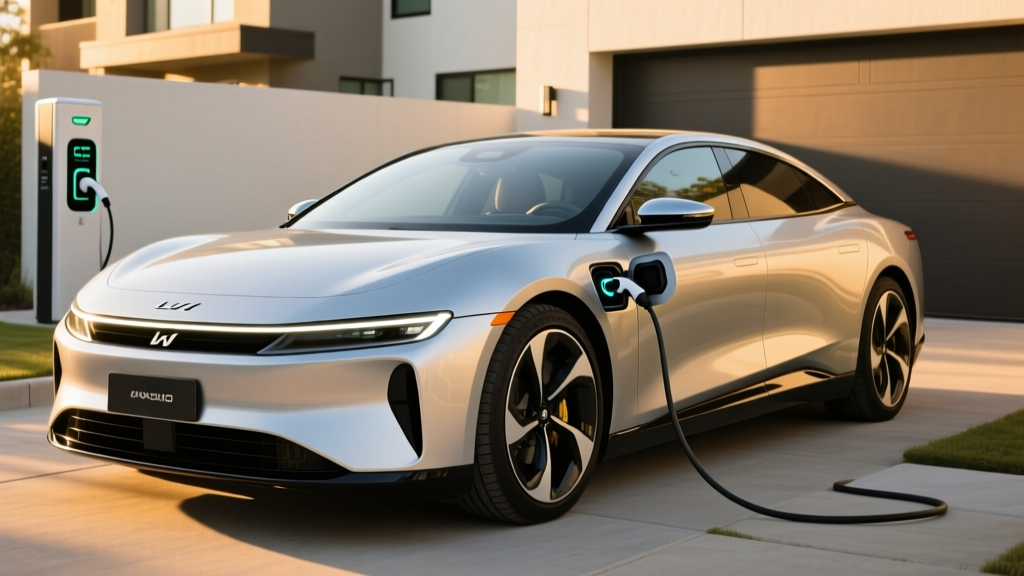
For home charging, the Air's 19.2 kW onboard charger is among the most powerful available. However, extracting that speed requires a hardwired Level 2 station on a dedicated 100-amp circuit — an electrical panel upgrade many homes can't accommodate without a $2,000–$4,000 investment. Most owners install a 48-amp (11.5 kW) Level 2 charger on a 60-amp circuit, which adds roughly 40 miles of range per hour and fully replenishes the 112 kWh battery in about 10–11 hours overnight.
Performance: The 2022 Lucid Air Grand Touring 0-60 Tested
The dual-motor all-wheel-drive powertrain produces 819 horsepower, launching the Grand Touring from 0-60 mph in 3.0 seconds flat. That puts it in supercar territory — roughly on par with a Porsche 911 Carrera S — in a five-seat luxury sedan weighing over 5,000 pounds.
But straight-line acceleration is only part of the picture. The Air's dual permanent-magnet motors deliver instant torque with no gear shifts, making highway merging and passing effortless. The regenerative braking system offers adjustable intensity through the touchscreen, though the Air does not offer true one-pedal driving to a complete stop like some competitors — you'll still use the brake pedal at low speeds.
Ride quality benefits from the standard adaptive air suspension, which adjusts damping in real time and offers selectable ride heights. The Air corners with surprising composure for its weight, though it prioritizes grand-touring comfort over track-day sharpness. If you want the ultimate performance variant, the Air Sapphire (1,234 hp, 0-60 in 1.89 seconds) occupies a different tier entirely — but at over $249,000 original MSRP.
Interior, Tech, and Daily Livability
The Grand Touring's cabin reflects Lucid's "post-luxury" philosophy: minimalist, airy, and material-forward rather than button-heavy. A 34-inch curved glass cockpit display spans the driver zone, integrating the instrument cluster and infotainment without a separate center touchscreen — though a lower retractable panel handles climate controls and secondary functions.
Passenger space: Rear legroom measures approximately 36.6 inches, adequate for adults but tighter than a Mercedes S-Class. The low roofline (a consequence of the skateboard platform and sleek design) means taller rear passengers may find headroom snug.
Cargo: The trunk offers 22.1 cubic feet, and the front trunk (frunk) adds approximately 10 cubic feet, for a combined 32 cu ft — generous for a sedan, though less than crossover competitors like the Tesla Model X or Rivian R1S.
Driver assistance: The Air comes equipped with Lucid's DreamDrive Pro ADAS suite, featuring 32 sensors including lidar, radar, and cameras. It provides adaptive cruise control, lane-centering, automatic emergency braking, and blind-spot monitoring. As of 2026, DreamDrive remains a SAE Level 2 driver-assist system — the driver must remain engaged and hands on or near the wheel at all times. It is not a self-driving system.
Notable drawbacks: The glass canopy roof, while stunning, can create significant solar heat gain in summer — some owners report needing aftermarket tinting. The infotainment system, while visually impressive, has drawn criticism for occasional lag and a learning curve compared to Tesla's more intuitive interface. Lucid has addressed some of these issues via over-the-air (OTA) software updates, but the system still trails the polish of established luxury OEMs.
Pricing, Tax Credits, and Used-Market Value
The 2022 Lucid Air Grand Touring originally carried an MSRP of $139,000 (plus a $1,500 destination charge). The lower Air Pure and Air Touring trims offered reduced range and power at lower prices, while the Air Dream Edition and Sapphire commanded significant premiums.
| Item | Detail |
|---|---|
| Original 2022 MSRP | $139,000 |
| Federal §30D Tax Credit (New) | Not eligible — MSRP exceeds $55,000 sedan cap |
| Used EV Tax Credit (§25E) | Up to $4,000 or 30% of sale price (whichever is less), if buyer income qualifies and sale price ≤ $25,000 |
| 2026 Used Market Estimate | $62,000–$78,000 (depending on mileage, condition, and trim options) |
| Income Cap (§25E Used Credit) | $75K single / $112,500 HOH / $150K joint (MAGI) |
Tax credit reality: When new, the 2022 Grand Touring did not qualify for the $7,500 federal EV tax credit under IRS §30D because its MSRP far exceeded the $55,000 cap for sedans. On the used market in 2026, the IRS §25E Used Clean Vehicle Credit offers up to $4,000 — but only if the sale price is $25,000 or less, which is well below current Grand Touring resale values. In practice, most used Grand Touring buyers will not qualify for any federal tax credit. State-level incentives vary by jurisdiction — check your state's energy office for local rebates.
Ownership Costs: Warranty, Insurance, and Maintenance
Lucid covers the Air's battery and drive units with an 8-year/100,000-mile warranty, with a capacity retention threshold of 70% — meaning if the battery degrades below 70% of original capacity within that window, Lucid will repair or replace it. The basic vehicle warranty is 4 years/50,000 miles.
Insurance: Luxury EVs carry premium insurance costs. Expect annual premiums of $3,500–$5,500 for a Grand Touring, depending on your location, driving record, and coverage levels. This is roughly 30–50% more than a comparably priced gas sedan.
Maintenance: EVs eliminate oil changes, spark plugs, and transmission service. Expect to budget for tire rotations, cabin air filter replacement, brake fluid checks, and wiper fluid. The Air's regenerative braking significantly extends brake pad life — many EV owners go 80,000+ miles before needing pad replacement. Annual maintenance costs typically run $400–$700.
Charging cost: At the U.S. average residential electricity rate of ~$0.16/kWh (as of 2025 EIA data), fully charging the 112 kWh battery at home costs roughly $18. At 26 kWh per 100 miles, that's approximately $0.042 per mile — compared to $0.12–$0.15 per mile for a gas luxury sedan getting 25 mpg at $3.50/gallon. Over 15,000 annual miles, home charging saves roughly $1,200–$1,600 per year versus gasoline.
How It Compares: Grand Touring vs. Key Rivals
Pros
- Best-in-class EPA range (516 mi) — still unmatched by most 2026 EVs
- Exceptional efficiency: 131 MPGe / 26 kWh/100mi
- 300 kW DC fast charging with 900V architecture
- 819 hp dual-motor AWD; 0-60 in 3.0 seconds
- 19.2 kW onboard Level 2 charger (fastest home charging in class)
- Lidar-equipped DreamDrive Pro ADAS suite
- Spacious frunk + trunk (32 cu ft combined)
- Stunning glass canopy roof and minimalist interior
Cons
- No federal tax credit eligibility (new or used, at current resale prices)
- High insurance premiums ($3,500–$5,500/yr)
- Infotainment learning curve; occasional OTA-update quirks
- Glass roof heat gain in hot climates
- Limited service center network vs. Tesla or legacy luxury brands
- Rear headroom tight for tall passengers
- 19.2 kW home charging requires expensive panel upgrade
- Brand longevity and long-term parts availability still unproven
vs. Tesla Model S Long Range (2022): The Model S offers 405 miles EPA, 0-60 in 3.1 seconds, and access to the Supercharger network. It's more affordable used ($45,000–$60,000) and has a more mature service infrastructure, but trails the Air in range, efficiency, and interior material quality.
vs. Mercedes-Benz EQS 450+ (2022): The EQS delivers a quieter, more traditionally luxurious ride and a superior infotainment system (MBUX Hyperscreen). But it manages only 350 miles EPA, charges at a maximum of 200 kW, and costs similarly on the used market.
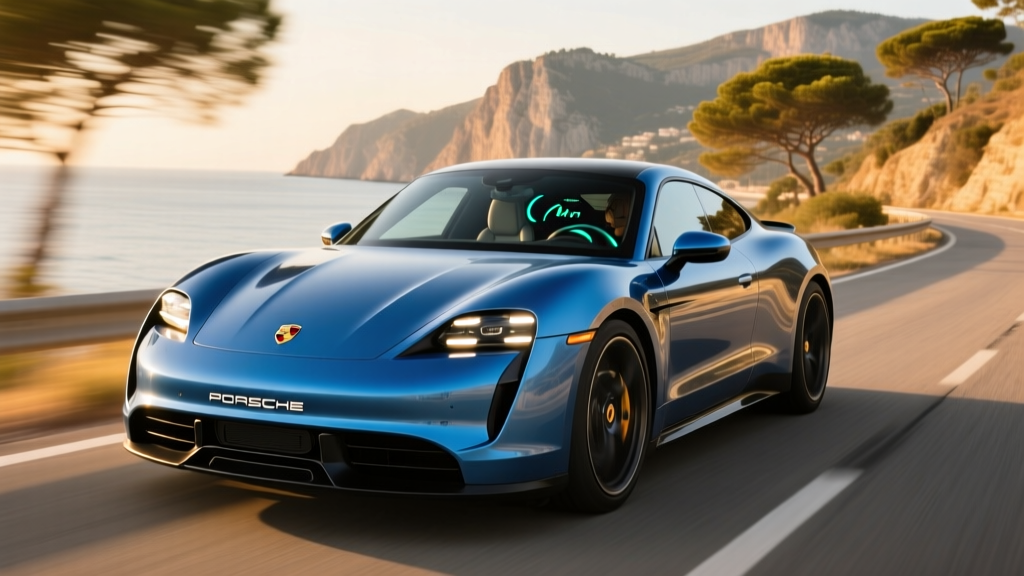
vs. Porsche Taycan 4S (2022): The Taycan is the driver's choice — sharper handling, 800V architecture, and better build quality. But range is just 227–246 miles EPA, and charging, while fast (270 kW peak), can't overcome the smaller battery.
Who Should Buy the 2022 Lucid Air Grand Touring?
Choose the Grand Touring If:
- You regularly drive 300+ miles between charges and want the longest-range EV available
- You value efficiency and technology as much as luxury
- You have access to home Level 2 charging and can invest in a high-amperage installation
- You want supercar-level acceleration in a practical four-door sedan
- You're buying used and can absorb the higher insurance and maintenance costs
Look Elsewhere If:
- You need a third row or SUV cargo space (consider the Rivian R1S or Tesla Model X)
- You want the broadest public charging network (Tesla's Supercharger advantage is real)
- You're on a tighter budget — the Air Touring or Air Pure trims offer similar design at lower cost
- You prioritize infotainment polish over powertrain innovation (Mercedes EQS or BMW i7)
- You live far from a Lucid service center — check coverage maps before committing
Frequently Asked Questions
What is the real-world range of the 2022 Lucid Air Grand Touring?
In mixed driving at moderate temperatures, expect 460–500 miles. Highway driving at 75 mph reduces that to roughly 380–420 miles, and freezing temperatures can drop range by 20–30%. Even with these reductions, the Grand Touring still outdistances most competing luxury EVs at their EPA sticker numbers.
How fast does the 2022 Lucid Air Grand Touring charge?
At a 350 kW DC fast charger with a preconditioned battery, peak charging hits 300 kW, with a 10–80% session taking approximately 20 minutes. At a typical 150 kW public charger, expect 10–80% in roughly 30–35 minutes. Home Level 2 charging at 19.2 kW (80-amp circuit) adds up to 80 miles per hour, but most owners use a 48-amp charger (11.5 kW / ~40 mi/hr).
Does the 2022 Lucid Air Grand Touring qualify for the federal EV tax credit?
No. When sold new, the Grand Touring's $139,000 MSRP exceeded the IRS §30D sedan cap of $55,000. On the used market in 2026, the §25E Used Clean Vehicle Credit requires a sale price of $25,000 or less — far below current Grand Touring resale values of $62,000–$78,000. Consult a tax professional for your specific situation, and check state-level incentive programs separately.
Is the Lucid Air Grand Touring worth buying vs. a Tesla Model S?
If range, efficiency, and interior design are your top priorities, the Air is the stronger vehicle. If you value the Supercharger network, lower used pricing, and a more established service network, the Model S is the pragmatic choice. Both are excellent — the decision hinges on which trade-offs matter to you.
What are the biggest concerns buying a used 2022 Grand Touring in 2026?
Key concerns include Lucid's still-growing service center footprint (check if one is near you), potential infotainment software maturity (verify OTA update history), and insurance costs. On the positive side, the 8-year/100,000-mile battery warranty is likely still active on most 2022 models, and Lucid's powertrain engineering has proven robust in early owner reports.
What battery chemistry does the Grand Touring use, and how long will it last?
The Grand Touring uses NMC (nickel manganese cobalt) lithium-ion cells. NMC offers high energy density — critical for achieving 516 miles in a sedan form factor. Lucid's battery management system and thermal controls are designed to minimize degradation. Industry data on NMC packs suggests 10–15% capacity loss over 150,000–200,000 miles under normal use. The 8-year/100,000-mile warranty guarantees at least 70% capacity retention.
Sources: EPA range and efficiency data via fueleconomy.gov; Lucid Motors official specifications; IRS §30D and §25E credit rules via irs.gov. Tax credit eligibility depends on individual circumstances — consult a qualified tax professional before purchasing.