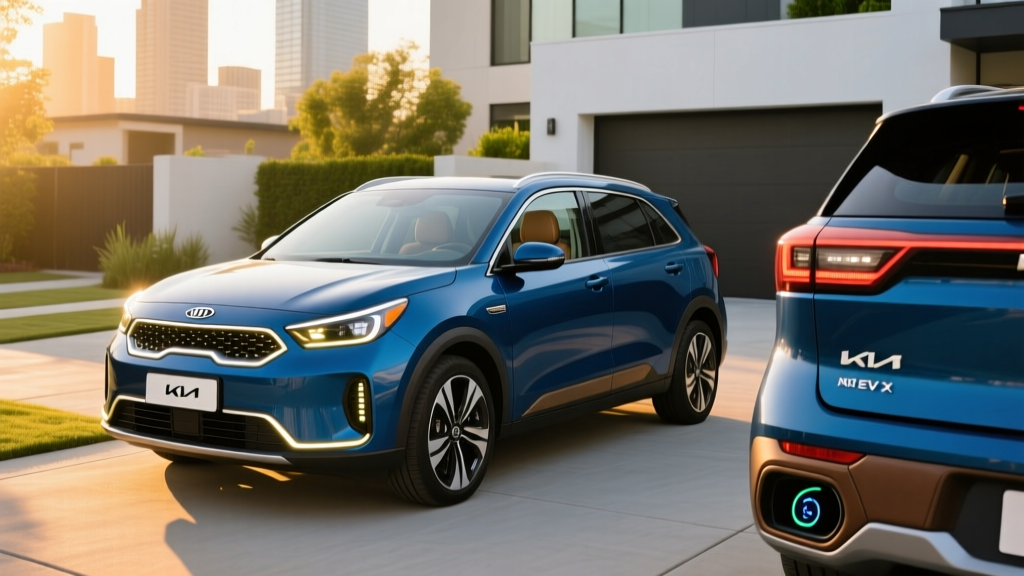
Quick Verdict: The 2022 Kia Niro EV EX as a Used Buy
The 2022 Kia Niro EV EX delivers an EPA-estimated 239 miles of range from a 64 kWh NMC battery, 201 horsepower, and DC fast charging that peaks at 77 kW (10–80% in roughly 45 minutes). On the used market in 2026, expect to pay between $16,000 and $22,000 depending on mileage and condition. It qualifies for the federal used-EV tax credit (up to $4,000 under IRS §25E) if you meet income and price caps. For a daily commuter with Level 2 home charging access, it remains one of the most practical and affordable entry points into EV ownership — but its modest DC charge speed means frequent road-trippers should look elsewhere.
Range, Battery, and Real-World Efficiency
The 2022 Niro EV EX uses a 64 kWh (usable) lithium-ion battery pack with NMC (nickel-manganese-cobalt) chemistry. The EPA rates it at 239 miles of combined range, with a combined efficiency of 112 MPGe — or roughly 28 kWh per 100 miles driven.
EPA Range: 239 miles (combined)
Real-World Expectations:
- City/suburban driving (mild weather): 230–250 mi
- Highway driving at 70–75 mph: 195–215 mi
- Cold weather (below 32°F, mixed driving): 160–185 mi
The Niro EV lacks a heat pump (it uses resistive PTC heating), which contributes to significant range loss in freezing temperatures. If you live in a cold-weather climate, plan for 25–30% winter range reduction.
For context, fueleconomy.gov lists the 2022 Niro EV at 120 MPGe city / 102 MPGe highway. That highway drop is typical for a crossover-shaped EV without active aero or a heat pump. Drivers who commute primarily in stop-and-go traffic will see the best results, as regenerative braking recovers energy that a gas car wastes as heat.
Charging Speeds: Where the Niro EV Shows Its Age
This is the most important section for prospective buyers to understand, because the 2022 Niro EV's DC fast-charging capability lags well behind modern competitors.
| Charging Level | Power / Rate | Time (10–80% or Full) | Miles Added per Hour |
|---|---|---|---|
| Level 1 (120V household) | ~1.2 kW | ~54 hours (0–100%) | ~4 mi/hr |
| Level 2 (240V, 32A) | ~7.2 kW | ~9.5 hours (0–100%) | ~24 mi/hr |
| DC Fast Charge (CCS) | Peak 77 kW | ~45 min (10–80%) | N/A |
The 77 kW peak DC charge rate is the Niro EV's biggest limitation in 2026. Competitors like the Hyundai Ioniq 5 and Tesla Model Y can sustain 150–250 kW on DC fast chargers, cutting 10–80% stops to 18–25 minutes. With the Niro, a road-trip charging stop takes roughly twice as long. The charge curve also tapers sharply above 60% state of charge — you'll see speeds drop to 40–50 kW in the 60–80% range.
For daily ownership, this matters less than you might think. Most EV owners do over 80% of their charging at home on Level 2, where the Niro's 7.2 kW onboard charger replenishes the battery fully overnight. But if you plan to road-trip more than a few times a year, factor in longer stops at Electrify America or EVgo stations along your route.
The 2022 Niro EV uses the CCS1 connector for DC fast charging and J1772 for Level 2 AC. With the industry shift toward NACS (Tesla's connector), CCS adapters are available, and the Electrify America / EVgo networks still widely support CCS natively.
EV vs. Gas: 2022 Niro EV EX Compared to the Niro Hybrid
The closest cross-shop for most buyers is the conventional 2022 Kia Niro Hybrid, which was sold alongside the EV variant. Here's how they stack up with hard numbers:
| Spec | 2022 Niro EV EX | 2022 Niro Hybrid LX |
|---|---|---|
| Powertrain | Battery electric (64 kWh) | 1.6L I4 hybrid |
| Horsepower | 201 hp | 139 hp (combined) |
| 0–60 mph | ~6.8 sec | ~9.3 sec |
| EPA Range / MPG | 239 mi / 112 MPGe | 50 MPG combined |
| Fuel/Energy Cost (15,000 mi/yr) | ~$540 (electricity @ $0.16/kWh) | ~$1,050 (gas @ $3.50/gal) |
| Annual Maintenance | ~$300–400 | ~$700–900 |
| Used Price (2026 est.) | $16,000–$22,000 | $17,000–$21,000 |
The EV variant costs roughly $500 less per year in energy and $400 less in maintenance compared to the hybrid. Over five years of ownership, that's approximately $4,500 in combined savings — enough to offset a slightly higher used purchase price. The EV also delivers substantially more torque (291 lb-ft vs. 195 lb-ft), making it noticeably quicker off the line and in highway merging situations.
The trade-off: the hybrid has 540+ miles of total range and can refuel in five minutes anywhere. If your driving involves long rural stretches with sparse charging infrastructure, the hybrid removes that logistical friction.
Total Cost of Ownership: 5-Year Breakdown
Let's model five years of ownership for a 2022 Niro EV EX purchased at $19,000, driven 15,000 miles per year, with home Level 2 charging at the national average electricity rate.
| Cost Category | Niro EV EX (5 Years) | Niro Hybrid LX (5 Years) |
|---|---|---|
| Purchase Price | $19,000 | $19,000 |
| Federal Used-EV Credit (§25E) | –$4,000 | $0 |
| Net Purchase | $15,000 | $19,000 |
| Energy/Fuel (75,000 mi total) | $2,700 | $5,250 |
| Maintenance (5 years) | $1,750 | $4,000 |
| Insurance (avg. $1,600/yr EV) | $8,000 | $7,000 |
| Estimated Depreciation | –$5,000 | –$5,500 |
| Total 5-Year Cost | ~$22,450 | ~$29,750 |
The used-EV federal tax credit under IRS §25E is a major advantage here. It provides up to $4,000 (or 30% of the sale price, whichever is less) for qualifying used EVs priced at $25,000 or below. Income caps apply: modified AGI must not exceed $75,000 (single), $112,500 (head of household), or $150,000 (joint). The vehicle must be at least two model years old, which the 2022 Niro EV satisfies in 2026. Confirm eligibility with your tax professional before purchase.
Insurance tends to run 10–20% higher on EVs compared to equivalent gas vehicles, primarily due to higher repair costs for battery-adjacent damage. Shop quotes from multiple carriers before committing — GEICO, Progressive, and State Farm all offer competitive EV rates in most states.
What First-Time EV Buyers Must Know
Common Misconceptions — Corrected
| Myth | Fact |
|---|---|
| "The battery will need replacing in a few years." | Kia's battery warranty covers 10 years/100,000 miles and guarantees at least 70% capacity retention. Real-world Niro EV batteries typically retain 88–93% capacity at 60,000 miles. |
| "I need to install expensive home charging equipment." | A basic Level 2 home charger (240V, 32A) costs $500–$800 for the unit, plus $500–$2,000 for professional installation depending on your electrical panel. Total: $1,000–$2,800. Many utility companies offer rebates that offset $200–$500 of this. |
| "239 miles of range isn't enough." | The average American drives 37 miles per day. A 239-mile range covers 95%+ of daily driving for most households with overnight home charging. Road trips require planning but are manageable. |
| "Used EVs are risky because you can't check battery health." | You can request a battery State of Health (SoH) report from a Kia dealer using the OBD-II diagnostic port. Some third-party services (e.g., Recurrent) also provide battery health assessments. |
Home Charging Access: The Make-or-Break Factor
Before purchasing any used EV, honestly assess your charging situation:
- Garage or driveway with a 240V outlet (or panel capacity to add one): Ideal. You'll wake up every morning with a full battery, and public charging becomes a road-trip-only concern.
- Apartment or street parking without charging access: The Niro EV's 77 kW DC fast-charge speed makes exclusive reliance on public charging painful. You'd need 45-minute charging sessions 2–3 times per week. Consider a hybrid instead, or verify that your workplace offers Level 2 charging.
- Access to a standard 120V outlet: Level 1 charging adds roughly 4 miles of range per hour. If you drive under 40 miles per day and can plug in for 12+ hours overnight, this can work — but it's a tight margin with no room for unexpected trips.
Performance, Interior, and Daily Livability
The 201-hp electric motor delivers smooth, linear acceleration. The 0–60 mph time of approximately 6.8 seconds makes it quicker than most compact crossovers, and the instant torque makes city driving and highway on-ramps effortless. There's no transmission — just a single-speed reduction gear — so acceleration is seamless.
Inside, the 2022 Niro EV EX includes an 8-inch touchscreen with Apple CarPlay and Android Auto, heated front seats, a power-adjustable driver's seat, and Kia's suite of ADAS features (forward collision-avoidance assist, lane-keeping assist, blind-spot monitoring). Note that these are SAE Level 1 driver-assist features — they support but do not replace an attentive driver.
Cargo space measures 18.5 cubic feet behind the rear seats and 53.0 cubic feet with the rear seats folded. Unlike some EVs, the Niro EV does not have a front trunk (frunk); the space under the hood is occupied by power electronics.
The Niro EV rides on a relatively soft suspension tuned for comfort over sportiness. Road noise is moderate at highway speeds — noticeable but acceptable for the segment. The low center of gravity from the under-floor battery pack gives it confident cornering for a tall hatchback.
Battery Longevity and Warranty
Kia provides a 10-year/100,000-mile warranty on the high-voltage battery pack, guaranteeing it will retain at least 70% of its original capacity. This warranty is transferable to subsequent owners, which is a significant advantage when buying used.
For a 2022 model in 2026, that means roughly 6 years and 60,000+ miles of remaining factory battery coverage (assuming average mileage). Independent data from fleet operators and EV testing organizations suggests that NMC batteries in thermally managed packs like the Niro EV's typically degrade at 1.5–2.5% per year under normal use. A four-year-old Niro EV with 45,000 miles would be expected to retain approximately 90–94% of its original capacity.
The battery uses active liquid thermal management (cooling and heating), which is critical for longevity in both hot and cold climates. Avoid routinely DC fast-charging to 100% or letting the battery sit at 0% for extended periods — keeping the state of charge between 20–80% for daily use will maximize long-term health.
Decision Framework: Should You Buy the 2022 Niro EV EX?
Buy the 2022 Niro EV EX if:
- You have reliable Level 2 home charging (garage, driveway, or workplace)
- Your daily commute is under 80 miles round-trip
- You take road trips fewer than 4–5 times per year and can plan charging stops
- You qualify for the $4,000 used-EV tax credit (income under the §25E caps)
- You want a practical, comfortable EV under $20,000 net cost
- You value Kia's 10-year/100,000-mile transferable battery warranty
Look elsewhere if:
- You lack home or workplace charging access
- You frequently drive 250+ miles in a single day
- You live in a region with extreme cold (consistent sub-10°F winters) and no garage — consider the Hyundai Ioniq 5 with its heat pump instead
- You need fast DC charging for a busy lifestyle — the 77 kW peak rate will frustrate you on road trips
- You need towing capability (the Niro EV is not rated for towing)
- You need AWD — the Niro EV is front-wheel drive only
Frequently Asked Questions
Does the 2022 Kia Niro EV EX qualify for the $7,500 federal tax credit?
No. The $7,500 credit under IRS §30D applies only to new vehicle purchases. The 2022 Niro EV EX is eligible for the used-EV credit under §25E, which provides up to $4,000 (30% of sale price, capped at $4,000) if the vehicle is sold for $25,000 or less and the buyer meets income limits. This credit can be transferred to the dealer at point of sale as a discount.
How long does it take to charge the Niro EV at home?
On a Level 2 home charger (240V, 32A, ~7.2 kW), a full charge from near-empty takes approximately 9.5 hours. In practice, most owners plug in overnight and never deplete below 20%, so a typical session adds the day's used miles in 1–3 hours.
Is the 2022 Niro EV reliable?
The Niro EV has a strong reliability track record. The electric powertrain has far fewer moving parts than a gas vehicle — no oil changes, no transmission fluid, no spark plugs, no exhaust system. Kia's 10-year/100,000-mile powertrain and battery warranty provides long-term peace of mind. IIHS gave the 2022 Niro top marks in crashworthiness testing.
What's the difference between kW and kWh on this car?
kWh (kilowatt-hours) measures the battery's energy capacity — think of it as the "tank size." The Niro EV has a 64 kWh battery. kW (kilowatts) measures the rate of power delivery or charging — think of it as the "flow rate." The Niro charges at up to 77 kW on DC fast chargers and its motor produces 150 kW (201 hp) of power.
Can I road-trip in the Niro EV?
Yes, with planning. The 239-mile EPA range covers most legs between DC fast-charging stations on major U.S. corridors. Expect 45-minute charging stops (10–80%) at CCS stations. Use apps like PlugShare or A Better Routeplanner to map charger locations along your route. In winter, add a 25% range buffer to your planning.
Should I get a battery health check before buying used?
Absolutely. Ask the seller to have a Kia dealer run a battery State of Health (SoH) diagnostic. This takes about 30 minutes and reports the battery's current capacity as a percentage of its original capacity. A healthy four-year-old Niro EV should show 90%+ SoH. If it's below 80%, the battery may be approaching the warranty replacement threshold (70%), and you should negotiate the price accordingly or walk away.