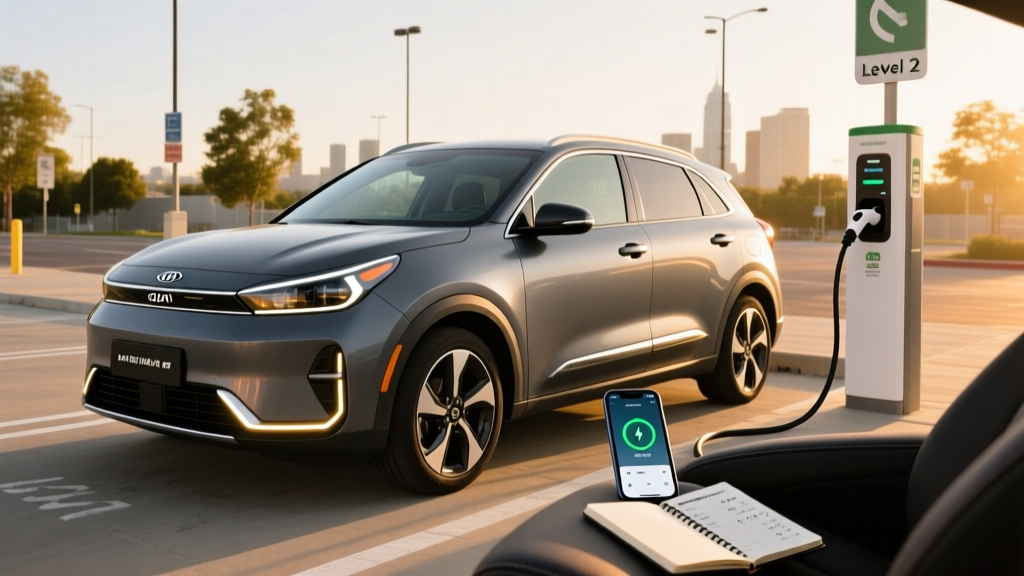
Quick Answer: The 2022 Kia Niro EV EX Premium is one of the best-value used compact electric crossovers available in 2026. With an EPA-estimated 239 miles of range, a 64 kWh NMC battery, and peak DC fast charging at 77 kW, it prioritizes daily practicality over headline-grabbing specs. Expect to pay between $18,000 and $24,000 on the used market depending on mileage and condition. Federal used-EV tax credits (§25E) may reduce that by up to $4,000 if you qualify. Real-world highway range drops to roughly 200–215 miles; cold-weather range can fall to 170–185 miles.
What You're Actually Getting: 2022 Kia Niro EV EX Premium Specs
The EX Premium was the top trim for the 2022 model year, and it came loaded. Before we get into ownership economics, here's the spec sheet you need to evaluate this car against alternatives:
| Specification | 2022 Kia Niro EV EX Premium |
|---|---|
| EPA Range | 239 miles |
| Real-World Range (highway, 70 mph) | ~200–215 miles |
| Real-World Range (cold weather, 30°F) | ~170–185 miles |
| Battery Capacity (usable) | 64 kWh (NMC chemistry) |
| Peak DC Fast Charge Rate | 77 kW (CCS1 connector) |
| 10–80% DC Fast Charge Time | ~54 minutes |
| Level 2 Charge Rate | 7.2 kW (adds ~25 mi/hr) |
| Motor Output | 201 hp / 291 lb-ft torque |
| 0–60 mph | ~7.5 seconds |
| EPA Efficiency | 112 MPGe combined (30 kWh/100mi) |
| Cargo Volume | 18.5 cu ft (rear seats up) / 53.0 cu ft (folded) |
| Battery/Powertrain Warranty | 10 years / 100,000 miles (from original in-service date) |
| Original MSRP (EX Premium) | $44,650 (before incentives) |
What the EX Premium trim added over the base EX: LED headlights and fog lights, a power sunroof, heated and ventilated front seats, a heated steering wheel, a Harman Kardon premium audio system, a wireless phone charger, and a 10.25-inch navigation display with UVO Link connected services. It also included the full suite of Kia Drive Wise ADAS features — adaptive cruise control with stop-and-go, lane-keeping assist, blind-spot monitoring, and rear cross-traffic alert.
A critical note on the battery warranty: Kia's 10-year/100,000-mile powertrain warranty is transferable to subsequent owners, but it typically reduces to a 5-year/60,000-mile limited warranty on the second-hand market depending on dealer certification status. Always verify remaining warranty coverage with a Kia dealer using the VIN before purchasing. The battery capacity retention threshold under warranty is generally 70% of original capacity.
Real-World Range vs. the EPA Sticker: What to Actually Expect
The EPA's 239-mile estimate for the 2022 Niro EV is based on a standardized mixed driving cycle. In practice, your mileage will vary — sometimes significantly — based on three factors you should model before buying:
Highway driving at sustained speed: At 70–75 mph on flat terrain in moderate temperatures (60–80°F), expect roughly 200–215 miles before you need to charge. The Niro EV's relatively boxy crossover shape creates more aerodynamic drag than a sleek sedan, and EVs lose efficiency disproportionately at highway speeds because there's no multi-gear transmission to optimize the motor's RPM range.
Cold-weather impact: Lithium-ion batteries lose efficiency in cold temperatures, and cabin heating draws heavily from the traction battery. The 2022 Niro EV uses a resistive PTC heater rather than a heat pump, which is a meaningful efficiency penalty. In temperatures around 20–30°F, plan on 170–185 miles of usable range. If your winter commute is 80 miles round-trip, you'll still have a comfortable buffer — but a 200-mile winter road trip will require a charge stop.
City and suburban driving: This is where the Niro EV shines. Regenerative braking recaptures energy in stop-and-go traffic, and the 291 lb-ft of instant torque makes it genuinely quick off the line. In mixed suburban driving at moderate speeds, many owners report matching or even slightly exceeding the 239-mile EPA figure.
Range Reality Check: EPA 239 mi | Highway (70 mph): ~200–215 mi | Cold weather (30°F): ~170–185 mi | City/suburban: ~230–250 mi. Plan your trips around the lowest number in your climate, not the sticker.
Charging Speed: The Niro EV's Most Honest Limitation
If there's one spec that defines the ownership experience of the 2022 Kia Niro EV, it's the DC fast-charging rate. The peak rate of 77 kW is modest by 2026 standards, when competitors like the Hyundai Ioniq 5 and Tesla Model Y routinely charge at 150–250 kW. Here's what that means in practice:
| Charging Level | Power (kW) | Miles Added per Hour | Typical Use Case |
|---|---|---|---|
| Level 1 (120V household outlet) | 1.2–1.4 kW | ~4–5 miles | Emergency/overnight trickle |
| Level 2 (240V home/public) | 7.2 kW | ~25 miles | Daily home charging (~9 hrs for full) |
| DC Fast Charging (public) | Up to 77 kW peak | ~150 mi/hr (at peak) | Road trips (10–80% in ~54 min) |
Understanding the charge curve: The 77 kW figure is a peak rate the battery can accept at a low state of charge (around 10–30% SoC) under ideal thermal conditions. As the battery fills, the charging rate tapers to protect the cells — above 80% SoC, speeds drop to roughly 30–40 kW. This is why we quote 10–80% times rather than 0–100%: the last 20% takes nearly as long as the first 60%.
What this means for road trips: On a 400-mile journey, you'll likely need two charge stops of roughly 40–50 minutes each (charging from ~15% to ~80%). That's noticeably longer than the 20–25 minute stops a Hyundai Ioniq 5 owner would experience. If you take road trips more than a few times per year, this is a genuine trade-off to weigh.
For daily home charging: The 7.2 kW Level 2 rate is perfectly adequate. Plug in when you get home, and a full charge takes about 9 hours — easily overnight. If you drive 40–60 miles per day, you'll replenish that in 2–3 hours on a Level 2 home charger. A Level 2 home charger installation typically costs $500–$2,000 depending on your electrical panel's proximity to the charging location.
Cost Breakdown: Niro EV vs. a Comparable Gas Crossover
The strongest argument for a used 2022 Niro EV is the total cost of ownership. Let's compare it against a typical gas-powered compact crossover — the 2022 Kia Sportage (2.5L FWD, EPA 28 MPG combined) — over a 5-year ownership period assuming 12,000 miles per year.
| Cost Category | 2022 Niro EV EX Premium (Used) | 2022 Sportage 2.5L FWD (Used) |
|---|---|---|
| Purchase Price (avg. used, 2026) | $21,000 | $20,000 |
| Federal Used-EV Tax Credit (§25E) | Up to −$4,000 | $0 |
| Effective Purchase Price | $17,000 | $20,000 |
| Fuel/Energy (5 yrs, 60k miles) | $2,700 (home charging @ $0.14/kWh) | $7,500 (@ $3.50/gal, 28 MPG) |
| Maintenance (5 yrs) | ~$1,200 (tires, cabin filter, fluid top-offs) | ~$3,500 (oil, filters, brakes, spark plugs) |
| Insurance (5 yrs, avg.) | ~$8,500 | ~$7,200 |
| 5-Year Total Cost | ~$29,400 | ~$38,200 |
Key takeaways from this comparison:
- Energy savings are massive: Home charging at $0.14/kWh (national average) costs roughly $0.042 per mile. Gasoline at $3.50/gallon in a 28 MPG vehicle costs $0.125 per mile — nearly 3× more. Over 60,000 miles, that's a $4,800 fuel savings.
- Maintenance is minimal: No oil changes, no spark plugs, no transmission fluid, and regenerative braking extends brake pad life significantly (many EV owners go 80,000+ miles on original pads).
- Insurance is higher: EV insurance premiums run 10–20% higher on average due to higher repair costs for battery and powertrain components. Shop quotes from multiple carriers before purchasing.
- The §25E used-EV credit matters: Under IRS §25E rules, you may qualify for up to $4,000 (30% of sale price, capped at $4,000) if the vehicle sells for $25,000 or less, your income is below $75,000 (single) / $150,000 (joint), and you purchase from a licensed dealer. This credit is available through 2032.
Common Misconceptions About the 2022 Niro EV
| Myth | Fact |
|---|---|
| "The battery will need expensive replacement soon." | NMC batteries in the Niro EV degrade slowly. Most 2022 models still retain 90–95% of original capacity at 40,000–60,000 miles. A full replacement (if ever needed) costs roughly $8,000–$12,000, but the 10-year/100,000-mile warranty often covers premature degradation below 70%. |
| "You can't take it on road trips." | You can — it just takes planning. The CCS1 connector gives access to Electrify America, EVgo, and (with adapters) some Tesla Supercharger stations. Budget 45–55 minutes per stop on long drives. |
| "It qualifies for the $7,500 federal tax credit." | The §30D new-vehicle credit no longer applies to a 2022 model purchased used. However, the §25E used-EV credit can provide up to $4,000 if you meet income and price requirements. |
| "I need to install an expensive home charger." | A basic Level 2 charger costs $300–$600, and installation runs $500–$1,500 if your panel has capacity. Total: often under $2,000. If you drive under 40 miles/day, even a standard 120V outlet can work (adding ~40 miles overnight). |
| "It charges at Tesla Superchargers natively." | The 2022 Niro EV uses a CCS1 connector, not NACS. As of 2026, some Tesla Supercharger stations offer CCS-equipped stalls or Magic Dock adapters, but coverage is not universal. Check the Tesla app for CCS availability at your local Superchargers. |
EV vs. Gas vs. Hybrid: Which Niro Actually Makes Sense for You?
Kia offered the 2022 Niro in three powertrains: the standard hybrid (HEV), the plug-in hybrid (PHEV), and the full electric (EV). Here's how they compare and who each one serves best:
| Spec | 2022 Niro EV | 2022 Niro PHEV | 2022 Niro HEV |
|---|---|---|---|
| EPA Range / MPGe | 239 mi / 112 MPGe | 26 mi electric + 46 MPG gas | 50 MPG combined |
| Fuel Cost per Mile (avg.) | $0.042 (home charging) | $0.04–$0.08 (depends on plug-in rate) | $0.07 (gas only) |
| Home Charging Needed? | Strongly recommended | Recommended for EV-mode benefit | No |
| Road-Trip Convenience | Charge stops required (~50 min each) | Gas stops (5 min), seamless | Gas stops (5 min), seamless |
| Used Price (2026 avg.) | $18,000–$24,000 | $17,000–$22,000 | $15,000–$19,000 |
The EV is the lowest operating-cost option if you have reliable home charging and your daily driving stays within ~150 miles round-trip. The PHEV is the compromise play: electric for short commutes, gas for road trips, no range anxiety. The HEV is the simplest choice if you lack home charging access or regularly drive long distances in areas with sparse charging infrastructure.
Decision Framework: Should You Buy the 2022 Niro EV EX Premium?
Buy it if:
- You have access to Level 2 home charging (garage, driveway, or workplace)
- Your daily commute is under 120 miles round-trip
- You take road trips of 300+ miles fewer than 4–5 times per year
- You want the lowest per-mile operating cost in a practical crossover
- You value a fully loaded cabin (EX Premium's ventilated seats, Harman Kardon audio, sunroof) at a used-EV price
- You live in a moderate or warm climate (cold-weather range loss is more significant here due to the lack of a heat pump)
Look elsewhere if:
- You rely exclusively on public DC fast charging — the 77 kW peak rate makes road trips slow and frequent public charging frustrating
- You regularly drive 300+ miles in a single day — consider a Niro PHEV or a longer-range EV like a used Tesla Model Y (330 mi EPA) or Hyundai Ioniq 5 (303 mi EPA, 230 kW charging)
- You live in a region with harsh winters and limited charging infrastructure — the PTC heater and cold-weather range loss will test your patience
- You need AWD — the Niro EV is front-wheel drive only
What First-Time EV Buyers Must Know Before Purchasing
If the 2022 Niro EV EX Premium is your first electric vehicle, here are the practical realities no spec sheet will tell you:
Home charging is non-negotiable for a good experience. The vast majority of EV charging — roughly 80–90% of all electrons — happens at home. If you can install a 240V Level 2 charger (a NEMA 14-50 outlet or hardwired station), you'll wake up every morning with a full "tank." If you live in an apartment without charging access, the Niro EV's modest DC fast-charge rate will make public-charging dependence painful. Solve the home-charging problem first, then buy the car.
Preconditioning matters. The Niro EV allows you to precondition the battery and cabin while plugged in — warming or cooling the car using grid power rather than battery power. Use this feature every winter morning. It preserves range and improves regenerative braking performance, which is limited when the battery is cold.
Tires wear faster on EVs. The Niro EV weighs roughly 3,800 lbs and delivers instant torque, both of which accelerate tire wear. Expect to replace tires every 30,000–40,000 miles rather than the 50,000+ miles typical of a gas crossover. Budget for EV-rated tires with low rolling resistance to preserve range.
Check the battery State of Health (SoH) before buying. Ask the seller or dealer for a battery health report. Some Kia dealers can pull this via the OBD-II port. A 2022 model with 40,000 miles should show 92–96% SoH. Anything below 88% warrants further investigation or a price reduction.
Understand the charging connector landscape. The 2022 Niro EV uses a CCS1 connector. As of 2026, the industry is transitioning toward NACS (the Tesla-standard connector). While Electrify America and other CCS networks remain widely available, new installations increasingly feature NACS. You may eventually want a CCS-to-NACS adapter (approximately $200–$250) to access the growing Tesla Supercharger network.
Frequently Asked Questions
Does the 2022 Kia Niro EV qualify for any tax credits in 2026?
Not the $7,500 §30D new-vehicle credit — that applied only when the car was sold new. However, the §25E used clean vehicle credit can provide up to $4,000 (30% of the sale price, capped at $4,000) if you buy from a licensed dealer for $25,000 or less, and your modified adjusted gross income is below $75,000 (single filer), $112,500 (head of household), or $150,000 (joint). Consult a tax professional for your specific situation.
How long will the battery last?
Based on degradation data from similar 64 kWh NMC packs in Hyundai/Kia vehicles, expect roughly 2–3% capacity loss per year under normal use. At 10 years and 100,000 miles, most packs retain 80–88% of original capacity. The battery warranty covers defects and capacity loss below 70% for 10 years / 100,000 miles from the original in-service date — verify remaining coverage with a Kia dealer.
Can I tow with the 2022 Niro EV?
Kia does not rate the Niro EV for towing in the US market. If you need towing capability, look at the Hyundai Ioniq 5 (up to 2,300 lbs with trailer brakes) or the Ford Mustang Mach-E.
Is the Niro EV EX Premium a good car for a family?
For a family of two to three with younger children, yes — the rear seat fits two car seats, and the 18.5 cu ft cargo area handles strollers and groceries. For families of four or five with older kids, the Niro's compact dimensions will feel tight on long trips. Consider the EV6 or Ioniq 5 for more interior volume.
What's the cheapest way to charge at home?
Install a 240V NEMA 14-50 outlet ($200–$500 for an electrician, depending on panel proximity) and use the Kia-supplied portable charger or an aftermarket Level 2 unit like a Emporia Vue or ChargePoint Home Flex ($350–$600). Total setup: $550–$1,100 in most cases. Charge during off-peak utility hours for the lowest per-kWh rate — many utilities offer EV-specific time-of-use plans with rates as low as $0.06–$0.09/kWh overnight.