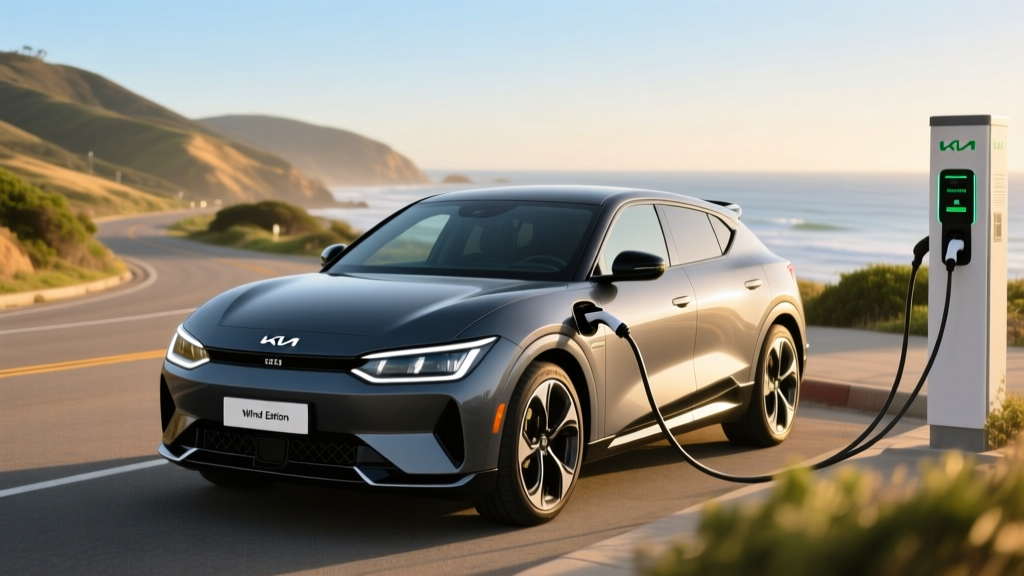
The 2022 Kia EV6 Wind arrived as the mid-tier sweet spot in Kia's first dedicated electric crossover, sitting between the base Light and the high-performance GT-Line. Built on the Hyundai Motor Group's E-GMP platform with an 800-volt architecture, the EV6 Wind promised something rare in 2022: sports-sedan charging speeds in a practical family hatchback. Now that this model year has been on the road for several years, we have enough real-world data to separate the spec-sheet optimism from daily-ownership reality.
If you're shopping for a used 2022 EV6 Wind or evaluating how it holds up against newer rivals, this review covers exactly what you need: verified range data, charging performance across networks, battery chemistry implications, and whether the federal tax credit still applies.
2022 Kia EV6 Wind: Core Specifications
| Specification | 2022 Kia EV6 Wind (RWD) | 2022 Kia EV6 Wind (AWD) |
|---|---|---|
| EPA Range | 310 miles | 274 miles |
| Battery (Usable) | 77.8 kWh | 77.8 kWh |
| Battery Chemistry | NMC (Nickel Manganese Cobalt) | NMC (Nickel Manganese Cobalt) |
| Drivetrain | Rear-Wheel Drive (single motor) | Dual-Motor AWD |
| Horsepower | 225 hp | 320 hp |
| Torque | 258 lb-ft | 446 lb-ft |
| 0–60 mph | 7.2 seconds | 5.1 seconds |
| MPGe (Combined) | 134 MPGe | 117 MPGe |
| Efficiency | 26 kWh/100 mi | 29 kWh/100 mi |
| Max DC Fast Charge | 235 kW (peak) | 235 kW (peak) |
| Level 2 Charge Rate | 10.9 kW | 10.9 kW |
| Cargo Volume (rear seats up) | 24.4 cu ft | 24.4 cu ft |
| Cargo Volume (rear seats folded) | 50.2 cu ft | 50.2 cu ft |
| Frunk | 0.7 cu ft (RWD) / 1.8 cu ft (AWD) | 1.8 cu ft |
| Rear Legroom | 39.4 inches | 39.4 inches |
| Base MSRP (2022) | $51,200 | $55,900 |
| Battery/Powertrain Warranty | 10 years / 100,000 miles | 10 years / 100,000 miles |
Sources: EPA fueleconomy.gov, Kia Motors America press materials.
Real-World Range: What the EPA Number Doesn't Tell You
RWD Wind: EPA 310 mi — Expect 270–290 mi on highway trips at 70 mph; 230–260 mi in freezing temperatures (below 32°F).
AWD Wind: EPA 274 mi — Expect 235–255 mi highway; 200–225 mi in freezing conditions.
The EV6's heat pump (standard on Wind and above) mitigates cold-weather losses better than many competitors, but NMC chemistry still suffers 15–20% range reduction in sustained sub-freezing driving.
The 310-mile EPA rating on the RWD Wind placed it among the top tier of 2022 EVs, trailing only the Lucid Air and select Tesla configurations. But the EPA combined cycle blends city and highway driving with favorable assumptions. On a sustained 70-mph highway run in moderate temperatures (65–75°F), independent testing by outlets like Edmunds and Car and Driver consistently returned 270–290 miles for the RWD Wind before the battery buffer kicked in.
The AWD model's 274-mile EPA figure reflects the energy penalty of the front motor and added weight. In practice, AWD owners doing mostly highway driving should plan for roughly 240 miles of usable range between charges — adequate for most commutes but requiring strategic stops on road trips exceeding 200 miles one-way.
Cold weather is the great equalizer. The EV6 Wind's standard heat pump is a genuine advantage over vehicles without one (the base Light trim lacked it), but physics wins: expect 15–20% range loss in sustained sub-freezing driving. That drops the RWD to roughly 245–260 miles and the AWD to about 220–235 miles in winter conditions. Preconditioning the battery while plugged in recovers some of this loss.
Charging Performance: The 800-Volt Advantage
The EV6's E-GMP platform supports 800-volt DC fast charging, a feature shared with the Hyundai Ioniq 5 and Porsche Taycan but rare in the mainstream EV market in 2022. This translates to a peak charge rate of 235 kW on compatible 350 kW chargers — but peak is not sustained.
| Charging Level | Power / Rate | Speed (Approx.) | Notes |
|---|---|---|---|
| Level 1 (120V household) | ~1.4 kW | ~4 mi/hr | Emergency/trickle only |
| Level 2 (240V home) | 10.9 kW | ~36 mi/hr | Full charge in ~8.5 hours (0–100%) |
| DC Fast (350 kW station) | 235 kW peak | 10–80% in ~18 min | Sustained ~180 kW to 55%, then taper |
| DC Fast (150 kW station) | ~130 kW sustained | 10–80% in ~28 min | More common at Electrify America, EVgo |
| DC Fast (50 kW CHAdeMO/CCS) | 50 kW | 10–80% in ~70 min | Avoid for road trips if possible |
The headline 10–80% time of 18 minutes is achievable, but only at a 350 kW charger with the battery preconditioned (the EV6 does this automatically when you navigate to a DC fast charger in the infotainment system). The charge curve is aggressive: the EV6 sustains roughly 220–235 kW from 10% to about 40% state of charge, then gradually tapers to ~150 kW by 60%, and drops sharply above 80% to protect the NMC cells.
At a more common 150 kW station, expect 10–80% in roughly 25–30 minutes. This is still competitive with most 2024-era EVs, a testament to the E-GMP platform's forward-looking architecture.
For home charging, the onboard 10.9 kW charger means a full Level 2 session (using a 48-amp hardwired charger on a 60-amp circuit) adds about 36 miles per hour. A typical overnight charge from 20% to 80% takes about 4.5 hours — easily within a standard sleep window.
kW vs. kWh refresher: kW (kilowatts) measures the rate of charging — like water pressure from a hose. kWh (kilowatt-hours) measures the battery's total capacity — like the size of the tank. The EV6 Wind has a 77.8 kWh battery and can accept up to 235 kW of charging power.
Performance and Driving Dynamics
The RWD Wind's 225 hp and 7.2-second 0–60 time won't win drag races, but the instant torque delivery makes it feel quicker than the numbers suggest in city driving. Highway passing is confident, and the low center of gravity (battery pack under the floor) gives the EV6 a planted, sedan-like feel despite its crossover ride height.
The AWD Wind bumps output to 320 hp and 446 lb-ft of torque, dropping the 0–60 to 5.1 seconds. This is quick enough to satisfy most enthusiasts without the insurance and efficiency penalties of the 576-hp GT model. The dual-motor system can disconnect the front motor under light loads to save energy — a feature Kia calls "disconnector AWD."
Regenerative braking offers four levels selectable via steering-wheel paddles, from coasting (Level 0) to near one-pedal driving (Level 3). The i-Pedal mode enables full one-pedal operation, bringing the EV6 to a complete stop without touching the brake pedal. Brake feel is among the best in the EV segment — a common complaint in electric cars is mushy regen-to-friction blending, but Kia tuned this well.
Interior, Tech, and Practicality
The Wind trim's interior is where the EV6 punches above its price class. Dual 12.3-inch curved displays (instrument cluster and infotainment) sit behind a two-spoke steering wheel, and the center console features a rotary dial shifter and a configurable touch-panel climate/media strip. Wireless Apple CarPlay and Android Auto are standard.
The flat floor (thanks to the dedicated EV platform) creates genuinely usable rear-seat space. With 39.4 inches of rear legroom, the EV6 Wind fits adults comfortably — a notable advantage over the Ford Mustang Mach-E's tighter rear quarters. The 24.4 cubic feet of cargo space behind the rear seats is modest for a crossover (the Tesla Model Y offers 30.2 cu ft), but folding the 60/40 split rear seats opens up 50.2 cu ft.
The frunk (front trunk) is disappointingly small: 0.7 cu ft on RWD models and 1.8 cu ft on AWD. It holds a charging cable and a small bag, but don't plan on storing groceries up front.
The Wind trim includes Highway Driving Assist 2 (HDA2), which combines adaptive cruise control with lane-centering and automatic lane changes when you activate the turn signal. This is an SAE Level 2 driver-assistance system — you must keep your hands on the wheel and eyes on the road at all times. It is not autonomous driving.
Pricing, Trims, and Federal Tax Credit Eligibility
When new, the 2022 EV6 Wind started at $51,200 for RWD and $55,900 for AWD (including destination). The Light trim began at $41,400, while the GT-Line started at $56,400. Today, used 2022 EV6 Wind models typically trade between $28,000 and $38,000 depending on mileage, condition, and drivetrain.
| Scenario | RWD Wind | AWD Wind |
|---|---|---|
| Original 2022 MSRP | $51,200 | $55,900 |
| Used Market (2026 est.) | $28,000–$35,000 | $32,000–$38,000 |
| Used EV Tax Credit (§25E, max) | Up to $4,000 (30% of sale price, capped) | Up to $4,000 |
| Est. Price After Used Credit | $24,000–$31,000 | $28,000–$34,000 |
Important tax credit note: The §30D new-vehicle credit (up to $7,500) is no longer applicable to 2022 models purchased used. However, the §25E used-EV credit may apply: it provides 30% of the sale price, up to $4,000, for qualifying used EVs sold by a dealer for $25,000 or less. Income caps apply ($75,000 single / $150,000 joint filers). Always verify current eligibility on IRS.gov and consult a tax professional before claiming.
The 2022 EV6 Wind originally qualified for the full $7,500 §30D credit when purchased new, as Kia sourced sufficient critical minerals and battery components at the time. However, sourcing requirements have tightened annually since 2023, and this is irrelevant for used purchases today.
Pros and Cons: The Honest Verdict
- Class-leading DC fast charging (235 kW peak, 18 min 10–80%)
- 310-mile EPA range on RWD is excellent for the class
- 10-year/100,000-mile battery and powertrain warranty
- Flat floor and generous rear legroom (39.4 in)
- Heat pump standard on Wind trim (better cold-weather range)
- Vehicle-to-load (V2L) capability — power devices from the car
- Strong build quality and materials for the price
- Tiny frunk (0.7–1.8 cu ft) is nearly useless
- Cargo space (24.4 cu ft) trails Model Y and Ioniq 5
- Infotainment touch-panel climate strip is finicky
- AWD range penalty is steep (274 mi EPA vs. 310 RWD)
- Some early 2022 models had ICCU (charge controller) recalls
- Used prices still elevated relative to newer Ioniq 5 deals
Who Should Buy the 2022 Kia EV6 Wind?
- Commuters with home charging: The 310-mile RWD range means most drivers charge once or twice a week. The 10.9 kW Level 2 rate ensures a full overnight top-up.
- Road-trip-capable families: The 18-minute DC fast charge at 350 kW stations keeps highway stops short. HDA2 reduces fatigue on long drives.
- Cold-climate buyers: The standard heat pump and NMC chemistry with active thermal management make the EV6 Wind one of the better cold-weather EVs in its price range.
- You need maximum cargo volume (look at the Tesla Model Y or Hyundai Ioniq 5).
- You want the lowest-cost entry into EVs (a used Chevrolet Bolt EV is $15,000–$20,000).
- You can't access DC fast charging at all — the EV6's strengths shine on the road, not just in the garage.
2022 Kia EV6 Wind vs. Key Competitors
| 2022 Kia EV6 Wind RWD | 2022 Hyundai Ioniq 5 SEL | 2022 Tesla Model Y LR | 2022 Ford Mach-E Premium RWD | |
|---|---|---|---|---|
| EPA Range | 310 mi | 303 mi | 330 mi | 300 mi |
| Battery | 77.8 kWh NMC | 77.4 kWh NMC | ~75 kWh NMC | 91 kWh NMC |
| Peak DC Charge | 235 kW | 235 kW | ~250 kW | ~150 kW |
| 10–80% DC | ~18 min | ~18 min | ~20 min | ~38 min |
| Rear Legroom | 39.4 in | 39.4 in | 41.8 in | 38.9 in |
| Cargo (seats up) | 24.4 cu ft | 27.2 cu ft | 30.2 cu ft | 29.7 cu ft |
| 0–60 mph | 7.2 sec | 7.4 sec | 4.8 sec | 6.1 sec |
| Warranty | 10yr/100k mi | 10yr/100k mi | 8yr/120k mi | 8yr/100k mi |
The EV6 Wind and Ioniq 5 SEL are mechanical twins (same E-GMP platform), so the decision comes down to styling preference and interior layout. The Tesla Model Y wins on cargo and Supercharger network access (though Kia now supports NACS adapters for Tesla Superchargers as of 2025). The Mach-E trails on charging speed, a significant disadvantage for road-trippers.
Battery Longevity and Warranty
Kia backs the EV6's NMC battery pack with a 10-year/100,000-mile warranty covering defects and capacity loss below 70% of original capacity. This is among the best in the industry, matching Hyundai and exceeding Tesla's 8-year/120,000-mile coverage.
NMC (Nickel Manganese Cobalt) chemistry offers higher energy density than LFP (Lithium Iron Phosphate), which is why the EV6 achieves 310 miles in a relatively compact package. However, NMC cells are more sensitive to sustained high states of charge and extreme heat. Best practices for long-term health:
- Set the charge limit to 80% for daily driving (use the car's built-in charge-limit setting)
- Charge to 100% only before long road trips
- Avoid leaving the car at 100% SoC in hot weather for extended periods
- Use DC fast charging when needed — the thermal management system protects the pack — but don't rely on it exclusively
Early data from high-mileage EV6 owners (60,000+ miles) shows degradation in the 5–8% range, which is typical for NMC packs with active liquid cooling. At that rate, a 310-mile EV6 would still deliver ~285–295 miles of range after 100,000 miles.
Frequently Asked Questions
What is the real-world range of the 2022 Kia EV6 Wind?
The RWD Wind is EPA-rated at 310 miles; expect 270–290 miles on highway trips at 70 mph and 230–260 miles in freezing weather. The AWD Wind is EPA-rated at 274 miles; expect 235–255 highway and 200–225 in the cold. The standard heat pump helps, but NMC chemistry still loses 15–20% in sustained sub-freezing driving.
How fast does the 2022 EV6 Wind charge?
On a 350 kW DC fast charger with battery preconditioning, the EV6 Wind peaks at 235 kW and charges from 10–80% in approximately 18 minutes. On a 150 kW charger, expect 10–80% in about 25–30 minutes. At home on a Level 2 (240V, 48-amp) charger, it adds roughly 36 miles per hour and fully charges in about 8.5 hours.
How much does a used 2022 Kia EV6 Wind cost in 2026?
Used 2022 EV6 Wind models typically sell for $28,000–$35,000 (RWD) and $32,000–$38,000 (AWD). If you find one priced at $25,000 or below from a dealer, you may qualify for the §25E used-EV tax credit (up to $4,000, with income caps of $75,000 single / $150,000 joint). Verify on IRS.gov before relying on the credit.
Does the 2022 Kia EV6 Wind qualify for the federal EV tax credit?
The §30D new-vehicle credit no longer applies to used purchases. However, the §25E used-EV credit may provide up to $4,000 (30% of sale price) if the car is sold by a dealer for $25,000 or less and you meet income requirements. Battery sourcing rules do not apply to the used credit, but the vehicle must be at least two model years old and purchased from a licensed dealer. Always consult a tax professional.
Is the 2022 EV6 Wind worth buying vs. the Ioniq 5 or Model Y?
If you value fast charging, a 10-year warranty, and a distinctive design, the EV6 Wind is an excellent used-EV buy. Choose the Ioniq 5 if you prefer more cargo space (27.2 vs. 24.4 cu ft) and a slightly more practical interior. Choose the Model Y if cargo volume and Supercharger access (without an adapter) are top priorities — but expect a firmer ride, less rear-seat comfort, and only an 8-year battery warranty.
Does the EV6 Wind support Tesla Superchargers?
Starting in 2025, Kia EV6 owners can use Tesla's NACS-equipped Supercharger network with a Kia-approved CCS-to-NACS adapter. The EV6's native port is CCS1. Always use the manufacturer-approved adapter to avoid warranty issues.
What was the ICCU recall on early 2022 EV6 models?
Some early-build 2022 EV6 vehicles were subject to a recall for the Integrated Charging Control Unit (ICCU), which could fail and prevent the 12V auxiliary battery from charging, potentially causing a loss of drive power. If you're buying a used 2022 EV6, confirm with the seller or a Kia dealer that the ICCU recall (NHTSA recall 22V-581 or subsequent service campaigns) has been addressed. Check the VIN at nhtsa.gov/recalls.
Editorial note: This review reflects 2022 model-year specifications and 2026 used-market pricing. Tax credit rules change frequently — always verify current eligibility at IRS.gov. Range and charging figures are based on EPA estimates, manufacturer data, and aggregated real-world owner reports. Individual results vary based on driving style, temperature, terrain, and battery condition.