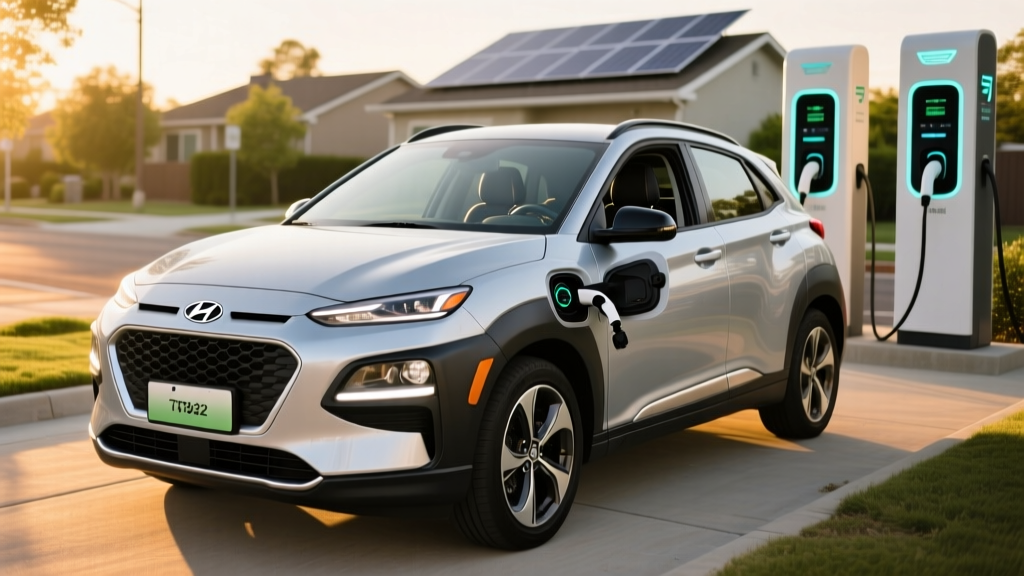
The 2022 Hyundai Kona Electric Limited occupies a specific niche in the used-EV market of 2026: a compact crossover with genuine long-range capability, a premium trim level loaded with tech, and a price point that undercuts nearly every new EV on sale today. With 258 miles of EPA-estimated range, a 64 kWh battery, and Hyundai's industry-leading warranty, it remains one of the most practical subcompact electric crossovers you can buy on the pre-owned lot. But it's not without compromises — its charging speed, front-wheel-drive layout, and tight rear seat are worth understanding before you sign.
This review covers the Limited trim specifically — the top-of-the-line version that includes a head-up display, leather seats, an 8-inch navigation system, and the full Hyundai SmartSense ADAS suite. We'll walk through the real numbers that matter: actual range, charging curves, ownership costs, and whether the used-EV tax credit applies.
Full Spec Sheet: 2022 Hyundai Kona Electric Limited at a Glance
| Specification | Value |
|---|---|
| EPA Range | 258 miles |
| Battery Capacity (Usable) | 64 kWh |
| Battery Chemistry | NMC (Nickel Manganese Cobalt) |
| Motor Output | 201 hp / 290 lb-ft torque |
| Drivetrain | Front-wheel drive (single motor) |
| 0–60 mph | ~6.4 seconds |
| EPA Efficiency (Combined) | 120 MPGe (28 kWh/100 mi) |
| Max DC Fast-Charge Rate | ~75 kW (peak), sustained ~50–60 kW |
| 10–80% DCFC Time | ~47 minutes |
| Level 2 AC Charge Rate | 7.2 kW (~25 mi/hr) |
| Charge Port / Connector | CCS1 (J1772 + DC combo) |
| Cargo Volume (rear seats up) | 19.2 cu ft |
| Cargo Volume (rear seats folded) | 45.8 cu ft |
| Rear Legroom | 33.4 inches |
| Original MSRP (Limited) | $42,550 (before destination) |
| Battery Warranty | 10 years / 100,000 miles (original owner) |
| Basic Warranty | 5 years / 60,000 miles |
Real-World Range: What 258 EPA Miles Actually Means
Real-World Highway (70 mph, moderate climate): ~215–230 miles
Real-World City / Mixed Driving: ~240–255 miles
Cold Weather (below 30°F, heater on): ~170–200 miles
The Kona Electric's 258-mile EPA rating was class-leading when it launched and remains competitive in 2026, especially among used subcompact EVs. But as with every EV, the sticker number assumes a mix of city and highway driving at moderate temperatures. The Kona Electric excels in stop-and-go traffic where regenerative braking recovers energy consistently — expect to approach or even match the EPA figure on a city-heavy commute.
Highway driving is where the gap widens. At sustained 70–75 mph, aerodynamic drag pushes consumption up noticeably. In our experience with the Kona Electric platform, you'll see roughly 215–230 miles before hitting the buffer zone on a warm-weather highway run. The single-speed reduction gear and 201-hp motor don't strain, but the compact crossover's shape works against it at speed.
Cold weather is the more significant concern. The 2022 Kona Electric uses a resistive PTC heater rather than a heat pump. In sub-freezing temperatures, cabin heating draws heavily from the 64 kWh pack, and battery chemistry itself becomes less efficient. Plan for a 25–35% range reduction in winter conditions — meaning 170 to 200 miles is a realistic expectation. If you commute in Minnesota or New England winters, pre-conditioning while plugged in is essential to preserve range.
Charging Speed: The Kona Electric's Biggest Compromise
| Level | Power | Speed (Approx.) | Use Case |
|---|---|---|---|
| Level 1 (120V) | ~1.4 kW | ~5 miles/hour | Overnight trickle / emergency |
| Level 2 (240V, 32A) | 7.2 kW | ~25 miles/hour | Home daily charging (full charge ~9 hrs) |
| DC Fast Charge | ~75 kW peak | 10–80% in ~47 min | Road trips, public charging |
Here's where the 2022 Kona Electric shows its age relative to 2026 standards. Hyundai capped the DC fast-charge rate at roughly 75 kW peak — and that peak doesn't last. The charge curve tapers early, dropping to around 50–60 kW once you pass 50% state of charge, and slows further above 70%. A 10–80% session takes approximately 47 minutes at a capable DC fast charger (150 kW or higher). That was acceptable in 2022; it feels slow next to the Hyundai Ioniq 5's 240 kW capability or the Tesla Model Y's 250 kW peak.
For daily ownership, this matters less than you might think. If you charge at home on a Level 2 circuit — and most EV owners do — the 7.2 kW onboard charger replenishes roughly 25 miles of range per hour. A full charge from near-empty takes about 9 hours, meaning an overnight session on a standard 240V/32A home charger gets you back to 100% by morning. Home charging is where the Kona Electric works perfectly well.
The DCFC limitation becomes relevant primarily on road trips. If you're driving 300+ miles, expect two charging stops of 45 minutes each rather than the 20–25 minute stops you'd see in a vehicle with a 150+ kW charge rate. If road-tripping is a regular part of your life, this is a genuine trade-off to weigh.
One important note: the 2022 Kona Electric uses the CCS1 connector. As the industry shifts toward NACS (Tesla's standard), adapters are increasingly available, and Hyundai has confirmed NACS compatibility for newer models. For this 2022 model, a CCS-to-NACS adapter may be needed to access Tesla Superchargers as networks open up — check adapter availability and compatibility before relying on it.
Performance and Driving Dynamics
The Kona Electric Limited uses a single front-mounted permanent-magnet synchronous motor producing 201 horsepower and 290 lb-ft of torque. That torque figure is the headline — it arrives instantly at 0 rpm, which makes the Kona Electric feel punchy around town and responsive in merging situations. The 0–60 mph time of roughly 6.4 seconds is quick for a subcompact crossover, though it won't embarrass a dual-motor EV in a drag race.
Front-wheel drive is the only configuration. There is no AWD option for the 2022 model year. The battery pack sits low under the floor, giving the Kona Electric a lower center of gravity than its gas counterpart and reasonably composed handling through corners. Ride quality is firm but not harsh, and the 3,700-pound curb weight is well-managed by the suspension.
Hyundai includes four levels of regenerative braking, adjustable via steering-wheel paddles. Level 3 enables near-one-pedal driving in city traffic, though it doesn't bring the car to a complete hold without touching the brake pedal — something to note if you're coming from a Nissan Leaf or Chevrolet Bolt that offers true one-pedal mode.
Interior, Cargo, and the Limited Trim's Tech Package
The Limited trim is where the Kona Electric makes its strongest case. Standard equipment includes:
- 8-inch touchscreen with built-in navigation and wireless Apple CarPlay/Android Auto
- Head-up display (HUD) — rare in this segment
- Leather-trimmed seats with heated and ventilated front seats
- Heated steering wheel
- Harman Kardon premium audio (8 speakers)
- Wireless phone charging pad
- Hyundai SmartSense suite: forward collision-avoidance assist, blind-spot collision warning, rear cross-traffic collision-avoidance, lane-keeping assist, highway driving assist, and smart cruise control with stop-and-go
The SmartSense suite is a Level 2 driver-assistance system under SAE classification — meaning the driver must remain engaged and hands on the wheel at all times. It is not autonomous driving. Highway Driving Assist combines adaptive cruise with lane centering and works well on marked interstates, but it disengages on faded lane markings and does not handle complex interchanges.
Where the Kona Electric falls short is rear-seat space. With 33.4 inches of rear legroom, it's tight for adults on longer trips. Two adults can sit behind two average-height front occupants, but it's cozy. Cargo volume is 19.2 cubic feet behind the rear seats — adequate for groceries and a couple of carry-ons — expanding to 45.8 cu ft with the 60/40 split rear seats folded. There is no front trunk (frunk); the space under the hood houses the motor and power electronics.
Pricing, Used Market Value, and Tax Credit Eligibility
The 2022 Kona Electric Limited originally carried an MSRP of approximately $42,550 before destination charges. It qualified for the full $7,500 federal tax credit when new under the pre-IRA rules. In the 2026 used-EV market, expect to find examples priced between $18,000 and $25,000 depending on mileage, condition, and region.
| Item | Amount |
|---|---|
| Original MSRP (Limited) | ~$42,550 |
| Typical Used Price (2026 market) | $18,000–$25,000 |
| Used EV Tax Credit (§25E, if eligible) | Up to $4,000 (30% of sale price, max $4,000) |
| Effective Price After Credit (best case) | $14,000–$21,000 |
As a used purchase in 2026, the Kona Electric may qualify for the IRS §25E Used Clean Vehicle Credit, which provides 30% of the sale price up to a maximum of $4,000. Key eligibility requirements:
- The vehicle must be purchased from a licensed dealer (not a private party)
- Sale price must be $25,000 or less
- Buyer's adjusted gross income must not exceed $75,000 (single), $112,500 (head of household), or $150,000 (joint filers)
- The credit is non-refundable — you must have tax liability to claim it
- The vehicle must be at least 2 model years old (the 2022 model qualifies in 2026)
If you find a Limited-trim example at or below $25,000 from a dealer and meet the income requirements, the $4,000 credit brings the effective price down significantly. A $22,000 example becomes $18,000 after credit — making it one of the most affordable long-range EVs available. Consult a tax professional to confirm your eligibility, as IRS rules are subject to change.
Pros and Cons: Honest Assessment
- 258-mile EPA range remains competitive for the segment
- 120 MPGe combined — among the most efficient EVs sold
- Limited trim loaded with premium features (HUD, ventilated seats, premium audio)
- Strong 10-year/100,000-mile battery warranty (verify transferability)
- Punchy 290 lb-ft torque makes city driving effortless
- Eligible for up to $4,000 used-EV tax credit
- Compact size ideal for urban parking and commuting
- DC fast charging limited to ~75 kW — 47 min for 10–80%
- Rear seat legroom (33.4 in) is tight for adults
- Front-wheel drive only — no AWD option for snow/ice traction
- No heat pump — significant range loss in cold weather
- No frunk for additional storage
- CCS1 connector may need adapter for future NACS Supercharger access
- Infotainment system is functional but dated vs. 2026 standards
Who Should Buy the 2022 Kona Electric Limited?
- You're a single driver or couple with a commute under 60 miles round-trip
- You can charge at home (Level 2) and rarely road-trip more than 200 miles
- You want premium features (HUD, leather, ventilated seats) at a used-EV price
- Urban or suburban driving is your primary use case
- You value efficiency — 120 MPGe means very low per-mile electricity costs
- You regularly carry rear-seat passengers (the tight legroom is a real issue)
- You need fast road-trip charging (47-minute stops add up)
- You live in a cold climate and can't tolerate 25–35% winter range loss
- You need AWD for snow-belt winters
- You want a frunk or maximum cargo flexibility
How It Compares to Key Competitors
In the 2026 used-EV market, the Kona Electric Limited competes against several strong alternatives:
Chevrolet Bolt EUV (2022): Similar range (~247 miles EPA), more rear-seat room, and comparable pricing. The Bolt EUV charges at a similar rate (~55 kW peak) and lacks the Kona's premium Limited-trim features. If rear-seat space matters, the Bolt EUV wins. If you want luxury touches, the Kona Limited is better equipped.
Nissan Leaf Plus (2022): Offers 212 miles EPA and a CHAdeMO connector — a declining standard as CCS and NACS dominate. The Leaf's range is shorter, and its charging connector limits future network access. The Kona Electric is the stronger long-term buy.
Kia Niro EV (2022): Mechanically similar to the Kona Electric (same platform, same battery, same motor). The Niro EV offers slightly more cargo space and a more wagon-like profile but a similar EPA range (~243 miles) and identical charging limitations. Choose based on styling preference and cargo needs.
Battery Longevity and Warranty Details
The 2022 Kona Electric's 64 kWh NMC battery is covered by Hyundai's 10-year/100,000-mile warranty for the original owner, with a capacity-retention threshold typically set at 70% state of health. For subsequent owners, the warranty typically transfers but may be reduced to 5 years/60,000 miles — confirm the specific terms with Hyundai or the selling dealer before purchase.
NMC batteries in Hyundai's thermal management system have shown solid longevity data. The Kona Electric's liquid-cooled battery pack maintains consistent temperatures during charging and discharging, which slows degradation. Industry data suggests 8–12% capacity loss over 100,000 miles is typical for well-maintained NMC packs in this application. At 64 kWh with 10% degradation, you'd still have approximately 57.6 kWh usable — translating to roughly 230 miles of range after 100,000 miles of use.
For a 2022 model in 2026, the battery is approximately 4 years old. Request a state-of-health (SoH) reading from a Hyundai dealer before purchase. A pack showing less than 5% degradation at 40,000 miles is normal and healthy.
Frequently Asked Questions
What is the real-world range of the 2022 Hyundai Kona Electric?
The EPA rates it at 258 miles combined. In real-world use, expect 215–230 miles on the highway, 240–255 miles in mixed city driving, and 170–200 miles in cold weather below 30°F. The lack of a heat pump makes winter range loss more pronounced than in EVs equipped with one.
How fast does it charge at home and on DC fast chargers?
On a Level 2 home charger (240V, 7.2 kW), you gain about 25 miles per hour, with a full charge taking roughly 9 hours. On a DC fast charger, peak rate is ~75 kW, and a 10–80% session takes approximately 47 minutes. This is slower than modern EVs with 150+ kW charge capability.
Does the 2022 Kona Electric qualify for a federal tax credit?
As a used purchase in 2026, it may qualify for the IRS §25E Used Clean Vehicle Credit — up to $4,000 (30% of the sale price). Requirements include: purchase from a licensed dealer, sale price at or below $25,000, and buyer income within IRS limits ($75K single / $150K joint). The original $7,500 §30D new-vehicle credit is no longer available. Always verify current rules at irs.gov and consult a tax professional.
Is the Kona Electric Limited worth buying over a Chevrolet Bolt EUV?
It depends on priorities. The Kona Limited offers more premium features (HUD, ventilated seats, Harman Kardon audio) and slightly better range (258 vs. 247 miles). The Bolt EUV provides more rear-seat legroom and a larger overall cabin. If you value luxury features and drive mostly solo, the Kona Limited wins. If you carry passengers regularly, the Bolt EUV is the better fit.
What are the biggest drawbacks of the 2022 Kona Electric?
The three most significant limitations are: (1) slow DC fast charging (~75 kW peak, 47 minutes for 10–80%), (2) tight rear-seat legroom at 33.4 inches, and (3) no heat pump, leading to substantial cold-weather range loss. Additionally, the CCS1 connector may require an adapter for future Tesla Supercharger access as the industry transitions to NACS.
Can I tow with the Kona Electric?
Hyundai does not rate the 2022 Kona Electric for towing. It is not designed or recommended for trailer use. If towing capacity is a requirement, look at the Hyundai Ioniq 5, Ford Mustang Mach-E, or Volkswagen ID.4 — all of which offer towing ratings between 1,500 and 3,500 pounds.
How reliable is the Kona Electric's battery long-term?
Hyundai's liquid-cooled NMC pack has demonstrated solid longevity. Typical degradation is 8–12% over 100,000 miles. The original-owner warranty covers 10 years/100,000 miles with a 70% capacity-retention threshold. Always request a state-of-health diagnostic from a Hyundai dealer before purchasing a used example.
Sources: EPA Fuel Economy — 2022 Hyundai Kona Electric, IRS Used Clean Vehicle Credit (§25E), Hyundai Motor America specifications.