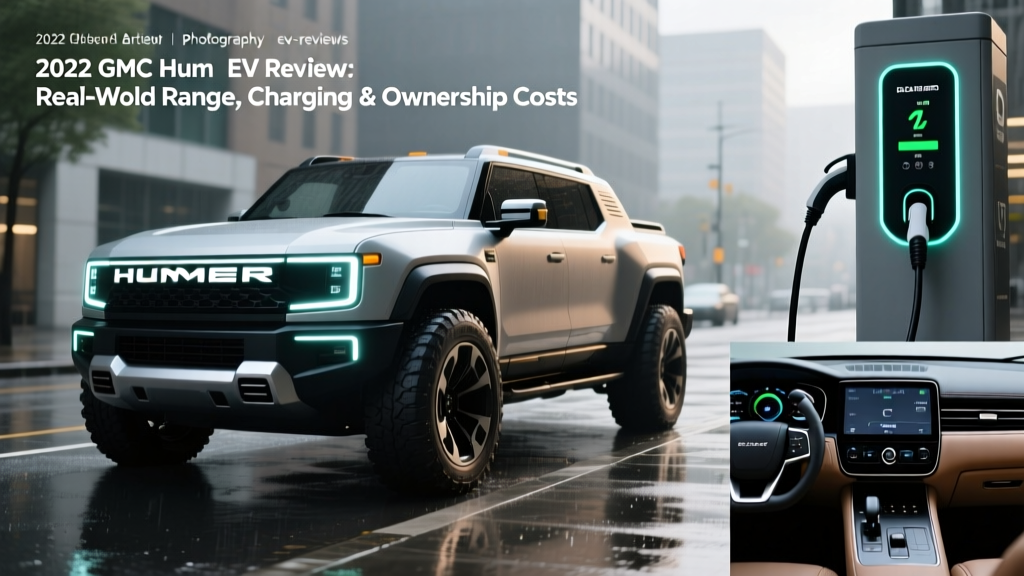
The 2022 GMC Hummer EV Pickup arrived as GM's electric halo — a 9,000-pound, three-motor supertruck that promised to redefine what a battery-electric vehicle could be. Built on GM's Ultium platform, the Edition 1 launch model delivered over 1,000 horsepower and a sub-3-second 0-60 time, wrapped in a package that could crab-walk diagonally and remove its roof panels. But beyond the spectacle, how does this electric behemoth perform as a daily-driven EV? We break down the real-world range, charging behavior, ownership economics, and whether the 2022 GMC Hummer EV still holds up in an increasingly competitive electric truck market.
Range and Efficiency: What the EPA Says vs. What You'll Actually Get
Real-World Expectation: 250–280 miles at sustained highway speeds (70+ mph); 200–230 miles in cold weather (below 32°F) with cabin heating. City driving with regenerative braking can approach or slightly exceed the EPA figure.
The 2022 Hummer EV's 329-mile EPA rating is impressive on paper, but context matters enormously. This truck carries a massive 212 kWh usable battery pack — the largest in any production passenger vehicle at launch. That enormous capacity is necessary because the Hummer EV is also extraordinarily heavy (over 9,000 lbs curb weight) and aerodynamically blunt.
Efficiency, measured in MPGe by the EPA, comes in at 47 MPGe combined. In more useful terms, the Hummer EV consumes roughly 67 kWh per 100 miles — roughly three times the energy per mile of a Tesla Model Y. This is the tradeoff for the capability and mass.
In real-world highway testing at 75 mph, expect range to drop to approximately 250–280 miles due to aerodynamic drag penalties that scale exponentially at higher speeds. Cold weather compounds this further: lithium-ion batteries lose efficiency in low temperatures, and cabin heating draws heavily from the pack. Without a heat pump (the 2022 model uses resistive heating), winter range can dip to 200–230 miles in freezing conditions. If you're planning a 300-mile winter road trip, plan a charging stop.
Battery and Platform: Ultium Under the Skin
| Specification | Detail |
|---|---|
| Battery Chemistry | NMC (Nickel Manganese Cobalt) — Ultium platform |
| Total Battery Capacity | ~246 kWh (gross) |
| Usable Battery Capacity | ~212 kWh |
| Battery Architecture | 800V nominal (double-layer pack, 24 modules) |
| Battery Warranty | 8 years / 100,000 miles |
| Drivetrain | Tri-motor AWD (1 front, 2 rear) |
| Horsepower | 1,000 hp (Edition 1 with Watts to Freedom mode) |
| Torque | 1,200 lb-ft |
| 0–60 mph | ~3.0 seconds (Edition 1, WTF mode) |
| EPA Range | 329 miles |
| Efficiency | 47 MPGe combined / ~67 kWh/100mi |
| Curb Weight | ~9,046 lbs |
| Towing Capacity | 7,500 lbs (Edition 1); up to 11,500 lbs on later trims with Max Tow package |
The Ultium platform's NMC chemistry prioritizes energy density — essential for fitting over 200 kWh of usable capacity into a vehicle. The pack uses a double-layer arrangement of 24 modules, essentially stacking two battery layers. This contributes to the Hummer EV's height but also enables the 800V architecture that makes ultra-fast charging possible.
GM's battery warranty covers 8 years or 100,000 miles against defects and excessive degradation (typically defined as falling below 60–70% of original capacity, per GMC's warranty documentation). Given the massive pack size, even 10% degradation leaves you with roughly 190 kWh usable — still more than most EVs start with.
Charging Speed: DC Fast Charging and Home Setup
| Charging Level | Power / Rate | Time or Miles Added |
|---|---|---|
| Level 1 (120V household) | ~1.4 kW | ~2 miles per hour — not practical for this vehicle |
| Level 2 (240V, 48A) | 11.5 kW | ~16 miles per hour; full charge in ~18–20 hours |
| Level 2 (240V, 80A — optional) | 19.2 kW | ~27 miles per hour; full charge in ~11 hours |
| DC Fast Charge (peak) | Up to 350 kW | 10–80% in approximately 35–40 minutes |
| DC Fast Charge (sustained avg) | ~200–250 kW avg | Adds ~100 miles in ~15 minutes at peak |
The 2022 Hummer EV supports DC fast charging at up to 350 kW on compatible CCS stations (such as Electrify America's 350 kW dispensers). However, as with all EVs, peak rate is not sustained rate. The charging curve is aggressive early — pulling 300+ kW in the 10–30% state of charge range — then tapers progressively. Expect a 10–80% session to take roughly 35–40 minutes at a 350 kW station, and closer to 50–60 minutes at a 150 kW charger.
At home, the onboard charger accepts up to 19.2 kW on Level 2 (with the dual-level charge cord on a 100A circuit). More realistically, most home installations on a 60A circuit deliver 48A/11.5 kW, adding about 16 miles of range per hour. With a 212 kWh pack, a full Level 2 charge from empty takes roughly 18–20 hours — meaning you'll want to plug in nightly rather than waiting until the battery is depleted.
One important note: the Hummer EV's charge port is located on the driver-side front fender, which affects how you orient the truck at public chargers. The CCS connector is standard; this truck does not have a native NACS (Tesla) port, so a CCS-to-NACS adapter is needed for Supercharger access where GM's Supercharger integration has been enabled.
Performance and Driving Dynamics
The Watts to Freedom (WTF) launch mode drops the air suspension, activates haptic feedback in the seat, plays dramatic sound effects, and unleashes the full 1,000 hp and 1,200 lb-ft of torque. The result: a 9,000-pound truck hits 60 mph in approximately 3.0 seconds. It's genuinely startling the first time you experience it.
Beyond straight-line speed, the three-motor setup enables torque vectoring across the rear axle, and the available four-wheel steering system (which GMC calls CrabWalk) lets the rear wheels turn up to 10 degrees — either in phase with the front wheels for tighter highway lane changes, or in opposition for diagonal movement at low speeds. It's a party trick, but also genuinely useful on tight off-road trails.
The adaptive air suspension provides up to 15.9 inches of ground clearance in Extract Mode (raising the truck nearly 6 inches), making the Hummer EV surprisingly capable off-road. Approach, departure, and breakover angles are competitive with purpose-built off-roaders. However, the sheer width (over 96 inches with mirrors) and weight make tight trails challenging.
Interior, Tech, and Cargo
The 2022 Hummer EV's cabin is dominated by a 13.4-inch infotainment touchscreen running GM's latest Ultifi software platform, paired with a 12.3-inch driver instrument cluster. The interface supports wireless Apple CarPlay and Android Auto, over-the-air updates, and detailed energy-flow displays that show real-time power distribution across the three motors.
Driver-assistance features include GM's Super Cruise — a hands-free driving system rated at SAE Level 2 — which operates on over 400,000 miles of mapped highways in the US and Canada. Super Cruise uses a driver-facing camera to monitor attention and requires you to remain alert; it is not autonomous driving. The system handles steering, acceleration, and braking on compatible divided highways and is among the most refined Level 2 systems available.
Cargo capacity includes a 5-foot bed with a powered multi-pro tailgate, plus a front trunk (frunk) that is modest in size due to the massive front motor and HVAC equipment. Rear-seat legroom is generous at approximately 43 inches, fitting full-size adults comfortably. The Infinity Roof features removable transparent panels that stow in the frunk, giving an open-air experience.
| Dimension | Measurement |
|---|---|
| Bed Length | 5 feet (Edition 1) |
| Rear Legroom | ~43.4 inches |
| Front Headroom | ~42.5 inches |
| Frunk Volume | Modest — fits roof panels and small cargo |
| Ground Clearance (max, Extract Mode) | 15.9 inches |
Pricing, Trims, and Federal Tax Credit Eligibility
The 2022 GMC Hummer EV launched exclusively as the Edition 1 trim, priced at a base MSRP of $112,595 (including destination). Fully loaded with available packages, as-tested prices exceeded $120,000. Later model years introduced the EV2X, EV3X, and EV2 trims at lower price points, but the 2022 model year was Edition 1 only.
| Cost Factor | Amount |
|---|---|
| Base MSRP (Edition 1) | $112,595 |
| As-Tested (with options) | ~$120,000–$125,000 |
| Federal §30D Tax Credit (max) | Up to $7,500 (subject to eligibility) |
| Effective Price After Max Credit | ~$105,095 |
Federal tax credit eligibility requires careful attention. Under IRS §30D rules, the Hummer EV Pickup qualifies under the truck MSRP cap of $80,000 — however, the Edition 1's $112,595 MSRP exceeds this cap, meaning it does not qualify for the $7,500 federal credit. This is a critical point that catches many buyers off guard. Lower-priced trims introduced in subsequent model years (EV2 at ~$80,000) were structured to fall within the cap.
Additional §30D requirements include buyer income limits ($300,000 joint / $150,000 single for new vehicles), battery component and critical mineral sourcing thresholds (which increase annually), and the vehicle must be assembled in North America (the Hummer EV is built in Detroit-Hamtramck/Factory Zero, so this requirement is met). Always verify current-year rules on IRS.gov or consult a tax professional before purchasing.
Ownership Costs: What to Budget Beyond the Sticker
Electricity costs for the Hummer EV are significant relative to smaller EVs, given its 67 kWh/100mi consumption. At the US average residential electricity rate of ~$0.16/kWh, charging at home costs roughly $10.70 per 100 miles. DC fast charging at $0.40–$0.50/kWh pushes that to $27–$34 per 100 miles on road trips. For comparison, a gas truck getting 17 MPG at $3.50/gallon costs about $20.60 per 100 miles — meaning home-charged Hummer EV miles are cheaper, but public fast-charging miles can actually cost more than gas.
Insurance premiums for the Hummer EV are notably high due to its price, weight, and repair costs. Expect annual premiums in the $3,500–$5,000 range depending on your profile and location. Tire replacement is another ownership reality: the 35-inch Goodyear Wrangler Territory MT tires are expensive, and the truck's weight and torque accelerate wear. Budget $2,000–$3,000 for a set of replacements every 30,000–40,000 miles.
On the positive side, there are no oil changes, no transmission fluid, no spark plugs, and regenerative braking significantly extends brake pad life. GM's 8-year/100,000-mile battery and powertrain warranty provides substantial peace of mind for the most expensive components.
Pros and Cons
- 1,000 hp and 3.0-second 0–60 — genuinely supercar-level acceleration in a truck
- 329-mile EPA range from a massive 212 kWh pack
- Up to 350 kW DC fast charging capability
- Super Cruise hands-free highway driving (Level 2)
- CrabWalk and four-wheel steering for unique maneuverability
- Adaptive air suspension with Extract Mode for serious off-road clearance
- Removable Infinity Roof panels
- Built at Factory Zero in Detroit — North American assembly
- Edition 1 MSRP of $112,595 exceeds the §30D tax credit truck cap — no $7,500 credit
- 47 MPGe / 67 kWh per 100mi — extremely high energy consumption
- Over 9,000 lbs curb weight — hard on tires and brakes
- Real-world highway range drops to ~250–280 miles
- No heat pump — cold-weather range loss is significant
- 5-foot bed is short for a full-size truck
- Insurance premiums are steep ($3,500–$5,000/yr)
- CCS port requires adapter for Tesla Supercharger access
Who Should Buy the 2022 GMC Hummer EV?
Look elsewhere if: You need a work truck with an 8-foot bed, you want to minimize energy costs, you need the federal tax credit to make the math work, or you regularly drive 300+ miles in cold weather without charging infrastructure. Consider the Ford F-150 Lightning (lower price, tax-credit eligible trims), Rivian R1T (more refined, smaller footprint), or Chevrolet Silverado EV (larger bed options, lower trims within tax credit cap).
Frequently Asked Questions
What is the real-world range of the 2022 GMC Hummer EV?
The EPA rates it at 329 miles, but real-world highway driving at 70+ mph typically yields 250–280 miles. In freezing temperatures, expect 200–230 miles due to battery inefficiency and resistive cabin heating. City driving with regenerative braking can approach the EPA figure.
How fast does the Hummer EV charge at home and on the road?
On DC fast chargers, it peaks at 350 kW and charges from 10–80% in roughly 35–40 minutes. At home on a 240V/48A Level 2 charger, it adds about 16 miles per hour, requiring 18–20 hours for a full charge. The optional 19.2 kW onboard charger (80A circuit) cuts that to about 11 hours.
Does the 2022 Hummer EV Edition 1 qualify for the $7,500 federal tax credit?
No. The Edition 1's MSRP of $112,595 exceeds the §30D truck cap of $80,000. Lower-priced trims introduced in later model years were positioned to qualify, but the 2022 Edition 1 does not meet the MSRP requirement. Always check current rules at IRS.gov.
Is the Hummer EV worth buying versus the Ford F-150 Lightning or Rivian R1T?
It depends on priorities. The Hummer EV wins on raw power (1,000 hp vs. 580 hp for the Lightning), unique features (CrabWalk, Extract Mode), and battery capacity. The F-150 Lightning wins on price (starting ~$55,000 for eligible trims), practicality (5.5-foot bed, more conventional dimensions), and tax credit eligibility. The Rivian R1T offers a more refined driving experience in a smaller, more efficient package with a quad-motor option. The Hummer EV is the choice for maximum spectacle and capability; the Lightning and R1T are more practical daily drivers.
How much does it cost to charge a Hummer EV?
At home (~$0.16/kWh), a full charge costs roughly $34 for 212 kWh, providing about 329 miles. That's approximately $10.70 per 100 miles. At public DC fast chargers ($0.40–$0.50/kWh), the same charge costs $85–$106, or $27–$34 per 100 miles.
What is the battery warranty on the Hummer EV?
GM covers the Ultium battery pack and electric powertrain for 8 years or 100,000 miles, whichever comes first. This covers defects and excessive capacity degradation.
Can the Hummer EV tow, and how does towing affect range?
The Edition 1 is rated for 7,500 lbs of towing capacity (later trims with the Max Tow package reach 11,500 lbs). Towing at or near capacity will dramatically reduce range — expect a 40–60% reduction depending on trailer weight, aerodynamics, and terrain. A 329-mile range could drop to 130–200 miles while towing heavy.