Quick Verdict: A Purpose-Built Electric Work Van
The 2022 Ford E-Transit was never designed to win drag races or conquer cross-country road trips. It was engineered to solve a very specific problem: last-mile delivery and urban commercial routes where daily mileage stays under 100 miles and depot charging is available. With an EPA-estimated 126 miles of range, a 68 kWh usable battery, and up to 3,880 pounds of payload capacity, it slots into fleet operations with minimal disruption to existing workflows — especially for businesses already running gasoline Transit vans.
For owner-operators and small fleet managers, the E-Transit's value proposition hinges on total cost of ownership. Electricity costs a fraction of gasoline per mile, maintenance drops dramatically without an internal combustion engine, and the available federal commercial EV tax credit (IRC §45W) can offset up to $7,500 of the purchase price. But range limitations, modest DC fast-charging speeds, and a starting MSRP above $45,000 mean this van demands honest route analysis before purchase.
Range & Efficiency: The 126-Mile Reality Check
EPA Estimated: 126 miles (low-roof cargo van, cut at 65 mph)
Real-World City/Delivery Route: 100–115 miles (frequent stops, regen-friendly, low average speeds)
Real-World Highway (65–70 mph): 85–95 miles (aerodynamic drag dominates at speed)
Cold Weather (below 32°F): 75–90 miles (battery chemistry resistance + cabin heating draw)
Loaded to Max Payload: Subtract 10–15% from above estimates
The E-Transit's EPA-rated 126 miles is measured on a combined city/highway cycle that doesn't reflect how most commercial vans are actually driven. In stop-and-go urban delivery use, regenerative braking recovers significant energy, and average speeds stay low — which can actually push real-world range close to the EPA sticker. But highway driving at 70 mph tells a different story. The E-Transit's slab-sided aerodynamics create substantial drag, and efficiency drops sharply above 55 mph.
The 68 kWh usable battery pack uses NMC (nickel manganese cobalt) lithium-ion chemistry, which offers good energy density but is more sensitive to extreme temperatures than LFP. Ford equips the E-Transit with a liquid thermal management system that preconditions the battery during charging and active driving, but cold-weather range loss of 25–35% is typical for this chemistry class. Fleet operators in northern climates should spec their routes around a 90-mile usable range buffer in winter.
Efficiency comes in at approximately 2.0 kWh/mile (roughly 67 MPGe combined), which is competitive for a full-size commercial van but far from the 3–4 miles/kWh you'd see in a passenger EV. At a national average commercial electricity rate of $0.14/kWh, that works out to roughly $0.28/mile in energy cost — about one-third the fuel cost of a gasoline Transit at 14 MPG and $3.80/gallon.
Charging: Depot-Friendly, Road-Trip-Limited
| Level | Max Rate | Time (0–100% or 10–80%) | Miles Added/Hour |
|---|---|---|---|
| Level 1 (120V) | ~1.4 kW | ~48 hours (0–100%) | ~2–3 mi/hr |
| Level 2 (240V AC) | 10.5 kW (48A) | ~8 hours (0–100%) | ~18–21 mi/hr |
| DC Fast Charge (CCS) | 115 kW peak | ~45 min (10–80%) | N/A (curve-dependent) |
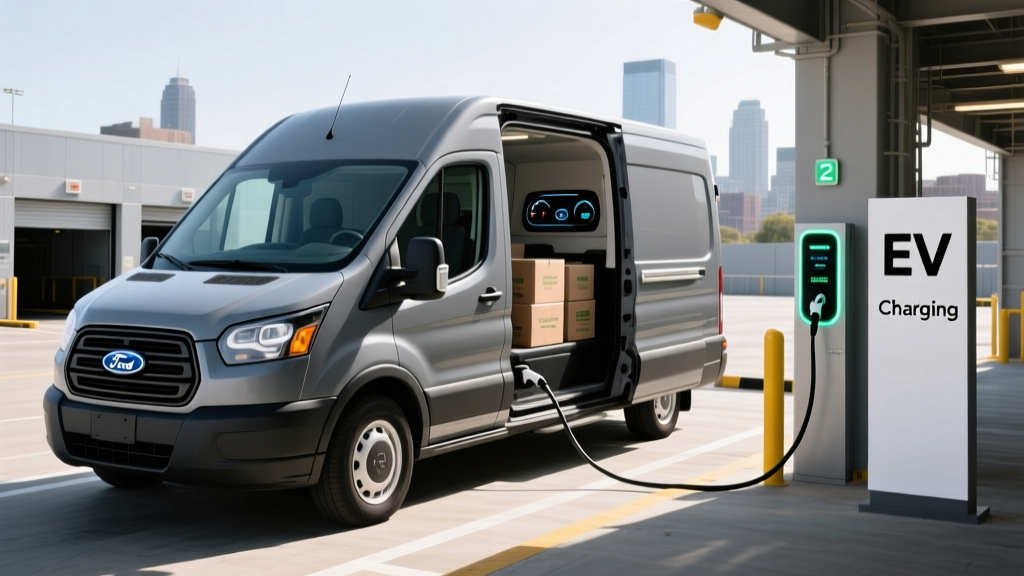
The E-Transit was designed around depot charging, and that's where it shines. A 10.5 kW onboard AC charger fills the 68 kWh pack from empty in roughly 8 hours — perfect for overnight top-ups on a commercial Level 2 station. Ford offers the Ford Pro charging ecosystem, which includes site assessment, ChargePoint or EVBox hardware procurement, and fleet management software integration. For a 10-van depot, expect installation costs of $3,000–$6,000 per charger including electrical upgrades, plus the $600–$1,200 hardware cost per unit.
DC fast charging tops out at 115 kW via the CCS connector. That's modest by 2026 passenger EV standards (where 250–350 kW is common), but it's functional for the E-Transit's use case. The 10–80% charge takes approximately 45 minutes, with the charge curve tapering noticeably above 60% state of charge. This isn't a vehicle you'd rely on for mid-route DC fast charging during a busy delivery day — the downtime cuts into productivity. The E-Transit works best when it leaves the depot fully charged and returns to charge overnight.
One practical note: the CCS port is located on the driver's side front fender, which requires specific parking orientation at public chargers. Fleet depot layouts should account for cable reach and vehicle positioning.
Performance, Payload & Driving Dynamics
| Spec | Value |
|---|---|
| Drivetrain | Rear-wheel drive (single motor) |
| Horsepower | 266 hp (198 kW) |
| Torque | 317 lb-ft |
| 0–60 mph | ~9.0 seconds (unloaded) |
| Top Speed | 75 mph (electronically limited) |
| Max Payload (low-roof cargo) | 3,880 lbs |
| Cargo Volume (low-roof, 148" WB) | 246.7 cu ft |
| GVWR | 9,500 lbs |
| Towing | Not rated for towing |
The single rear-mounted electric motor delivers 266 horsepower and 317 lb-ft of torque, available instantly from zero RPM. That instant torque makes the E-Transit feel surprisingly responsive around town — it pulls away from stoplights with authority even when loaded. The 0–60 mph time of roughly 9 seconds (unloaded) is hardly quick, but commercial van buyers rarely prioritize acceleration. What matters is drivability in traffic, and the E-Transit's single-speed transmission and regenerative braking make it far easier to drive than a gasoline Transit with a 6-speed automatic hunting for gears.
Ford made a deliberate engineering choice to keep the battery pack under the floor, preserving the same cargo dimensions as the gasoline Transit. That means the E-Transit accepts the same upfit equipment — shelving, ladder racks, bulkheads, refrigeration units — without modification. The 246.7 cubic feet of cargo volume (in the most popular low-roof, 148-inch wheelbase configuration) is identical to its ICE sibling. Payload capacity of 3,880 pounds is lower than the gasoline Transit's 4,000+ pounds due to the battery pack's weight, but it covers most parcel delivery, plumbing, and electrical contractor use cases.
Ride quality is firm but controlled, as expected for a commercial vehicle with a solid rear axle. The low center of gravity from the floor-mounted battery reduces body roll compared to the gasoline Transit. Noise levels are dramatically lower — no engine drone, no transmission shifts — which reduces driver fatigue over a 10-hour delivery shift.
Pricing, Tax Credits & Total Cost of Ownership
| Configuration | Base MSRP | After Federal Credit* |
|---|---|---|
| T-150 Low Roof Cargo (130" WB) | $45,495 | ~$37,995 |
| T-250 Low Roof Cargo (148" WB) | $47,135 | ~$39,635 |
| T-350 High Roof Cargo (148" WB) | $50,495 | ~$42,995 |
| T-350 HD High Roof Cutaway | $49,595 | ~$42,095 |
| T-350 Crew Van (7-passenger) | $52,590 | ~$45,090 |
*Federal credit figures assume eligibility. See tax credit section below for requirements.
The 2022 E-Transit launched with a base MSRP of $45,495 for the T-150 low-roof cargo van, rising to over $52,000 for crew van and extended wheelbase configurations. Add destination charges ($1,795), popular options like the 12-inch SYNC 4 touchscreen, adaptive cruise control, and a limited-slip differential, and a well-equipped T-250 typically stickers around $50,000–$54,000.
For commercial buyers, the relevant federal incentive is the IRC §45W Commercial Clean Vehicle Credit, not the consumer-facing §30D credit. Under §45W, businesses can claim up to $7,500 for qualified commercial EVs with a GVWR under 14,000 pounds. Key requirements include:
- The vehicle must be acquired for use or lease by a business (not personal use)
- Must be manufactured by a qualified OEM (Ford qualifies)
- Battery capacity must be at least 7 kWh (E-Transit's 68 kWh easily clears this)
- Must be assembled in North America (the E-Transit is built in Claycomo, Missouri)
- The credit is non-refundable — it reduces tax liability but won't generate a refund beyond zero
Unlike the consumer §30D credit, the §45W commercial credit has no MSRP cap, no buyer income cap, and no critical minerals sourcing requirement. This makes it far more straightforward for fleet buyers. However, businesses with no tax liability cannot benefit — consult a tax professional to confirm eligibility.
5-Year Total Cost of Ownership (Fleet Scenario, 15,000 mi/yr)
| Cost Category | E-Transit (EV) | Gas Transit (3.5L V6) |
|---|---|---|
| Fuel/Energy (5 yr) | $10,500 | $27,143 |
| Maintenance (5 yr) | $3,200 | $7,500 |
| Depreciation (est.) | $18,000 | $14,000 |
| Tax Credit Offset | –$7,500 | $0 |
| Net 5-Year Operating Cost | ~$24,200 | ~$48,643 |
Energy and maintenance savings are substantial — roughly $21,000 over five years at 75,000 total miles. Higher EV depreciation partially offsets this, but the net operating cost advantage still favors the E-Transit by approximately $24,000 over five years, making the payback period roughly 2–3 years depending on local electricity rates and route mileage.
Tech, Safety & Driver Assistance
The E-Transit comes standard with a 4-inch productivity screen, but the available 12-inch SYNC 4 touchscreen (standard on higher trims) is the one to spec. It supports wireless Apple CarPlay and Android Auto, over-the-air updates via Ford Power-Up, and the Ford Pro Telematics fleet management platform. The telematics system tracks vehicle location, battery state of charge, charging events, driver behavior, and geofencing alerts — essential for multi-vehicle fleet oversight.
Standard driver-assistance features include:
- Pre-Collision Assist with Automatic Emergency Braking (AEB)
- Lane-Keeping System with lane-departure warning
- Rear-view camera
- Auto high-beam headlamps
Available upgrades include adaptive cruise control with stop-and-go, blind-spot monitoring with trailer coverage, and a 360-degree camera system. These are SAE Level 2 driver-assist features — the driver must remain fully engaged at all times. This is not a self-driving vehicle.
A standout feature is Pro Power Onboard, available as a 2.0 kW or 7.2 kW mobile generator system. It provides 120V and 240V outlets in the cargo area, allowing the E-Transit to power job-site tools, lighting, and equipment directly from the traction battery. For contractors, this eliminates the need for a separate gasoline generator — a significant practical advantage.
Warranty & Long-Term Reliability
Ford backs the E-Transit with a comprehensive warranty package tailored for commercial duty cycles:
- Battery: 8 years / 100,000 miles (whichever comes first), covering capacity loss below 70% of original
- Electric Powertrain Components: 5 years / 60,000 miles
- Bumper-to-Bumper: 3 years / 36,000 miles
- Corrosation Perforation: 5 years / unlimited miles
- Roadside Assistance: 5 years / 60,000 miles
The 70% capacity retention threshold on the battery warranty is industry-standard for commercial EVs. NMC chemistry in the E-Transit is expected to retain approximately 85–90% of original capacity after 100,000 miles of typical daily cycling (one full charge-discharge per day). Fleet operators running two shifts per day with mid-day DC fast charging will see faster degradation — potentially reaching the 70% threshold around 120,000–140,000 miles. Battery replacement cost, should it be needed out of warranty, is estimated at $15,000–$22,000 including labor based on current Ford commercial parts pricing.
Pros, Cons & Who Should Buy the E-Transit
- Identical cargo dimensions to gas Transit — same upfits work
- ~$0.28/mile energy cost vs ~$0.52/mile for gasoline
- Pro Power Onboard eliminates job-site generator
- Dramatically lower maintenance (no oil, filters, exhaust, spark plugs)
- Smooth, quiet driving reduces operator fatigue
- Ford Pro ecosystem with telematics and managed charging
- North American assembly (Missouri) — §45W credit eligible
- 126-mile EPA range limits route flexibility
- 115 kW DC fast charge is slow by 2026 standards (45 min 10–80%)
- Not rated for towing
- Higher upfront cost than gas Transit (~$10,000+ premium)
- Top speed limited to 75 mph
- Cold-weather range loss of 25–35%
- No AWD option — RWD only
- Depot charging infrastructure required ($3K–$6K per stall)
- Fleet operators with predictable sub-100-mile daily routes
- Last-mile delivery businesses (Amazon DSPs, FedEx Ground contractors, local couriers)
- Urban tradespeople (plumbers, electricians, HVAC) with a home base for overnight charging
- Companies seeking to reduce Scope 1 emissions for ESG reporting
- Contractors who need mobile job-site power via Pro Power Onboard
- Long-haul or inter-city route operators (range insufficient)
- Businesses without access to overnight depot or home charging
- Operators in extreme cold climates without route-margin flexibility
- Anyone needing towing capability
E-Transit vs. the Competition
The 2022 E-Transit's competitive set is narrow — the full-size electric commercial van market has few players:
- Mercedes-Benz eSprinter: Offers slightly more range (~150 miles EPA in later model years), but at a higher price point (~$55,000+). Better DC fast charging (up to 115 kW similar). Stronger brand cachet but smaller dealer network in the US.
- Rivian EDV (Amazon delivery van): Not available to the general public — built exclusively for Amazon's delivery fleet. More advanced tech but not purchasable.
- BrightDrop Zevo 600: Larger, heavier, aimed at higher-volume parcel delivery. Higher price, different vehicle class.
- Gasoline Ford Transit: The default alternative. ~$10,000 cheaper upfront, 300+ mile range, but $0.52/mile fuel cost and higher maintenance.
For most US-based fleet buyers, the E-Transit is the most accessible and best-supported electric commercial van available, backed by Ford's extensive commercial dealer network and the Ford Pro service infrastructure.
Frequently Asked Questions
What is the real-world range of the 2022 Ford E-Transit?
The EPA rates it at 126 miles combined. In real-world urban delivery use with frequent stops and regenerative braking, expect 100–115 miles. Highway driving at 65–70 mph drops that to 85–95 miles. Cold weather (below freezing) further reduces range by 25–35%, so plan routes around 75–90 miles in winter conditions.
How fast does the E-Transit charge at home and on the road?
At a depot or home Level 2 charger (10.5 kW / 48 amps), a full 0–100% charge takes about 8 hours — ideal for overnight. On a DC fast charger, it peaks at 115 kW and charges from 10–80% in roughly 45 minutes. The charge curve tapers above 60% SoC, so the last 20% takes disproportionately longer.
Does the 2022 E-Transit qualify for the federal EV tax credit?
For commercial/business use, yes — it qualifies for the IRC §45W Commercial Clean Vehicle Credit of up to $7,500. This credit has no MSRP cap, no buyer income cap, and no battery-sourcing restrictions. However, it is non-refundable, meaning you need sufficient tax liability to absorb it. Personal-use buyers would fall under §30D rules, which have MSRP caps ($80,000 for vans), income limits, and battery sourcing requirements — consult a tax professional.
Is the E-Transit worth buying vs. a gasoline Transit?
If your daily routes stay under 100 miles and you have overnight charging access, the math strongly favors the E-Transit. Over five years and 75,000 miles, energy and maintenance savings of ~$21,000 offset the higher purchase price and slightly higher depreciation. The payback period is typically 2–3 years. If your routes regularly exceed 120 miles or you lack charging infrastructure, stick with the gasoline Transit.
Can the E-Transit tow a trailer?
No. Ford does not rate the E-Transit for towing. The vehicle is designed exclusively for cargo and passenger transport within its GVWR of 9,500 pounds.
What happens if the battery degrades below 70%?
Ford's 8-year/100,000-mile battery warranty covers capacity loss below 70% of original. If degradation crosses that threshold within the warranty period, Ford will repair or replace the battery at no cost. Out of warranty, a replacement battery pack costs an estimated $15,000–$22,000 including labor.