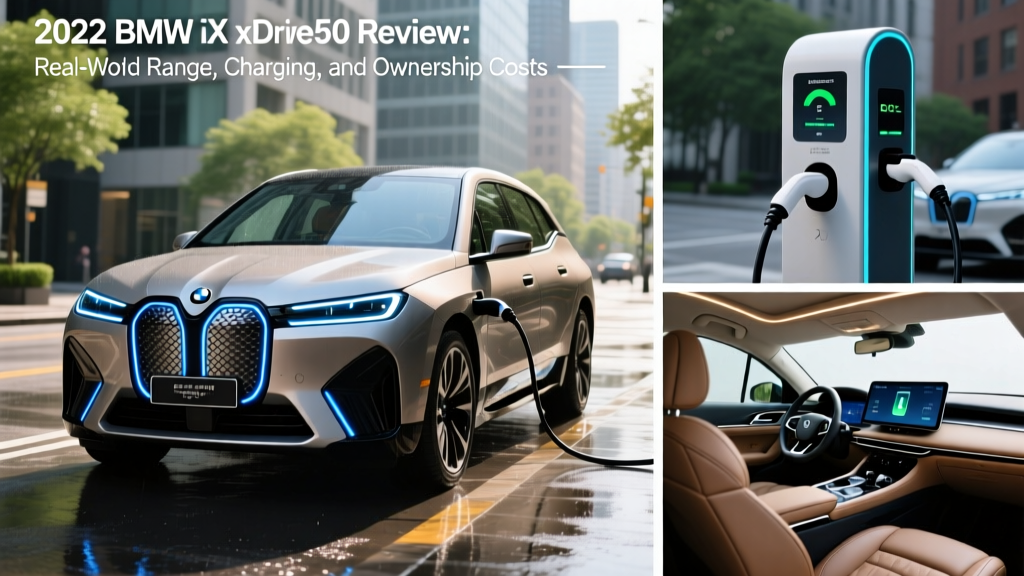
The 2022 BMW iX xDrive50 was BMW's flagship electric SUV launch — a ground-up EV built on the company's fifth-generation eDrive platform, not a repurposed ICE chassis. Two model years on, it remains one of the most refined luxury electric crossovers available, blending long range, rapid DC charging, and a cabin that punches above its segment. But with competitors like the Mercedes EQS SUV, Audi e-tron GT, and Tesla Model X pressing hard, does the iX xDrive50 still hold up as a smart buy in the used and remaining-new inventory market?
We've spent significant time with the xDrive50 variant — the higher-output dual-motor trim that sits above the xDrive40 (Europe-only) and below the performance-tuned iX M60. Here's the full data-driven breakdown of what you're actually getting.
2022 BMW iX xDrive50: Core Specifications at a Glance
| Spec | Value |
|---|---|
| EPA Range | 324 miles (with 20" wheels); 305 miles (22" wheels) |
| Battery (usable / gross) | 105.2 kWh usable / 111.5 kWh gross |
| Battery Chemistry | NMC (Nickel Manganese Cobalt) |
| Drivetrain | Dual-motor AWD (eDrive) |
| Horsepower | 516 hp |
| Torque | 564 lb-ft |
| 0–60 mph | 4.4 seconds (BMW est.) |
| Top Speed | 124 mph (electronically limited) |
| Max DC Fast Charge | 195 kW (peak) |
| 10–80% DC Charge Time | ~31 minutes (BMW est.) |
| Level 2 AC Charge Rate | 11 kW (onboard charger) |
| EPA Efficiency | 86 MPGe combined (20"); 87 MPGe (22" Sport) |
| Energy Consumption | 39 kWh/100 mi (20" wheels) |
| Cargo Volume (rear seats up / folded) | 35.5 cu ft / 77.9 cu ft |
| Rear Legroom | 38.5 inches |
| Battery Warranty | 8 years / 100,000 miles (70% capacity retention) |
| Base MSRP (2022) | $83,200 |
| As-Tested Price (loaded) | ~$102,000 |
Sources: EPA fueleconomy.gov, BMW USA press materials.
Real-World Range: What the EPA Sticker Doesn't Tell You
The iX xDrive50's 324-mile EPA figure is genuinely competitive for a luxury SUV of this weight (5,660 lbs curb). But as with every EV, the sticker number reflects a blended city/highway test cycle that favors regenerative braking in stop-and-go driving.
Highway driving at sustained 70–75 mph yields approximately 270–290 miles before you'll want to stop at 10–15% SoC. The iX's aerodynamic efficiency (Cd 0.25) helps here — it's slipperier than the boxier Mercedes EQS SUV — but the 5,600+ lb mass still demands energy at speed.
Cold-weather impact is significant but manageable. In testing at 20–30°F with cabin heat active, expect a 15–22% reduction from EPA, landing you around 250–265 miles of usable range. The iX uses a heat pump (standard), which mitigates some of the HVAC energy draw that plagues EVs without one. Preconditioning the cabin while plugged in is strongly recommended in winter.
City and suburban driving is where the iX shines closest to its EPA number. Heavy regen use in traffic, lower average speeds, and the heat pump's efficiency in mild conditions can net you 310+ miles in temperate weather.
Charging Speed: DC Fast, Level 2, and the Charge Curve Reality
The iX xDrive50 supports up to 195 kW peak DC fast charging via CCS1 (the 2022 model year predates BMW's later NACS adoption). That peak rate is impressive, but sustained throughput matters more on road trips.
| Charging Method | Power | Speed / Time |
|---|---|---|
| DC Fast Charge (peak) | 195 kW | 10–80% in ~31 min; ~66 mi in 10 min (optimal conditions) |
| DC Fast Charge (sustained avg 10–80%) | ~130–140 kW avg | Charge curve tapers sharply above 80% SoC |
| Level 2 AC (240V, 48A) | 11 kW | ~30 mi/hr added; 0–100% in ~11 hours |
| Level 1 AC (120V, 12A) | ~1.4 kW | ~4 mi/hr added; not practical for daily use |
The charge curve matters. The iX holds near-peak charging rates from roughly 10% to 40% SoC, then begins a gradual taper. From 40–60%, expect ~150 kW; from 60–80%, it drops to roughly 100–110 kW. Above 80%, charging slows dramatically — a protective measure for the NMC cells. If you're road-tripping, plan your stops to charge from 10–80% rather than topping to 100%, unless you have time to spare at the last stop before your destination.
Home Level 2 charging at 11 kW (the iX's onboard charger max) is among the faster AC rates in the luxury EV segment. A 48-amp Level 2 home charger (like a ChargePoint Home Flex or BMW Wallbox) will replenish the full 105.2 kWh usable battery in roughly 11 hours — practical for overnight charging even after a high-mileage day. Note that installation of a 60-amp circuit (required for continuous 48A draw) typically costs $600–$2,000 depending on your panel capacity and run length, and may require a panel upgrade in older homes.
Performance and Driving Dynamics
With 516 hp and 564 lb-ft of instant torque from its dual-motor setup, the iX xDrive50 delivers a 4.4-second 0–60 mph time that makes it quicker than most buyers will ever need. The acceleration is linear and relentless — BMW's fifth-gen eDrive motors use externally excited synchronous technology (no permanent magnets, no rare-earth dependency), which also allows precise torque vectoring front-to-rear.
The adaptive air suspension (standard on xDrive50) provides a compliant ride that isolates occupants from road imperfections while maintaining composure in corners despite the vehicle's heft. Steering is light but accurate — this is a grand tourer, not a sports car, and that's the right calibration for a 5,600-lb family SUV.
One-pedal driving is available but not default; BMW lets you select from multiple regen levels via paddle shifters, including a coasting mode that freewheels when you lift off the accelerator. The adaptive regen mode (which uses radar and navigation data to modulate braking) is among the best implementations in the industry — it anticipates traffic ahead and adjusts deceleration accordingly.
Interior, Cargo, and Technology
The iX cabin is where BMW justifies the premium pricing. The minimalist design uses sustainable materials — FSC-certified wood, recycled microfiber, and olive-leaf-tanned leather — in a way that feels genuinely upscale rather than austere.
Cargo space: 35.5 cu ft behind the second row and 77.9 cu ft with the 40/20/40 split rear seats folded. That's competitive with the Audi e-tron but trails the Tesla Model X (which offers ~88 cu ft max). The iX does not have a frunk (front trunk) — the space under the hood houses power electronics and the HVAC system.
Rear-seat comfort is excellent: 38.5 inches of legroom, a flat floor (no transmission tunnel), and available heated rear seats. The panoramic electrochromic glass roof (standard) can dim at the touch of a button — a striking feature that eliminates the need for a physical shade.
Infotainment: BMW iDrive 8 runs on a curved display cluster (14.9" touchscreen + 12.3" instrument display). Wireless Apple CarPlay and Android Auto are standard. The system is responsive and logically menued, though some critics (and owners) note that climate controls buried in the touchscreen are less convenient than physical buttons.
Driver assistance: The iX comes with BMW's Driving Assistant Professional, which includes adaptive cruise control with stop-and-go, lane centering, and automatic lane change (when you signal). This is an SAE Level 2 system — the driver must remain engaged, hands on the wheel (or capacitive-sensing detected), and eyes on the road. It is not autonomous driving. Available remote parking lets you maneuver the iX into tight spaces via the smartphone app.
Pricing, Tax Credits, and Value Proposition
| Item | Amount |
|---|---|
| 2022 iX xDrive50 Base MSRP | $83,200 |
| Typical As-Tested Price (with packages) | $95,000–$102,000 |
| Federal Tax Credit (§30D, new) | $0 (exceeds MSRP cap for SUVs: $80,000) |
| Federal Tax Credit (used, §25E) | Up to $4,000 (30% of sale price, max $4,000, income caps apply) |
| Estimated Out-of-Pocket (used, ~$55K sale price) | ~$51,000 after used-EV credit |
Critical tax credit note: The 2022 iX xDrive50's base MSRP of $83,200 exceeds the IRS §30D MSRP cap of $80,000 for SUVs. This means it does not qualify for the $7,500 new clean vehicle credit, regardless of buyer income or battery sourcing. This was one of the iX's most significant disadvantages at launch.
However, as a used EV purchase in 2026, the iX becomes far more compelling. Under IRS §25E, the used clean vehicle credit offers 30% of the sale price up to $4,000, subject to income caps ($75,000 single / $112,500 head of household / $150,000 joint filers). With 2022 iX xDrive50 examples trading in the $48,000–$60,000 range depending on mileage and condition, a qualifying buyer could net the full $4,000 credit at point of sale — bringing effective cost into the low $50Ks for a vehicle that stickered above $90K new.
This is where the iX's value proposition clicks into place. You're getting a $100K luxury EV experience for roughly the price of a new mid-range Tesla Model Y — with superior interior materials, a quieter cabin, and BMW dealer service infrastructure.
Pros and Cons
Pros
- 324-mile EPA range is genuinely road-trip capable
- 195 kW peak DC charging with strong sustained curve
- Exceptional cabin quality and quietness
- 11 kW Level 2 onboard charger (faster than most rivals)
- Heat pump standard (better cold-weather efficiency)
- Strong used-EV credit value at current resale prices
- Adaptive air suspension provides excellent ride quality
Cons
- Did not qualify for $7,500 new-vehicle credit (MSRP cap)
- No frunk — cargo space trails some competitors
- Climate controls buried in touchscreen
- CCS1 connector (non-Tesla network access, though improving)
- Heavy at 5,660 lbs — tire wear and efficiency penalty
- Electrochromic roof has no physical shade (some prefer one)
- BMW iDrive learning curve for first-time users
Who Should Buy the 2022 BMW iX xDrive50?
Choose the iX xDrive50 if: You want a luxury electric SUV with genuine 300+ mile real-world range, a premium cabin that outclasses Tesla's interior, fast home charging, and you're buying used where the price-to-value ratio is outstanding. Ideal for daily commuters with home Level 2 access and occasional road-trippers who can plan around Electrify America or EVgo DC chargers.
Look elsewhere if: You need maximum cargo space (Model X wins), want access to the Tesla Supercharger network natively (consider a 2023+ Tesla or a vehicle with a NACS adapter option), or require the new-vehicle $7,500 federal credit (look at the Hyundai Ioniq 5, Ford Mustang Mach-E, or Tesla Model Y, which fall under the MSRP cap).
For family duty, the iX's flat rear floor, generous legroom, and easy car-seat installation make it a strong pick. For towing, BMW rates the iX at 3,500 lbs — adequate for a small trailer or a pair of jet skis, but not for a full-size boat or camper. For road trips, the 195 kW charging capability means 10–80% stops in about 31 minutes at a capable DC station, which is competitive with the best in the segment.
How Does It Compare to Key Competitors?
Against the Mercedes-Benz EQS 450+ SUV, the iX offers slightly less range (324 vs. 305–330 mi depending on EQS trim and wheels) but charges faster (195 kW vs. 200 kW peak, though the BMW's curve is more sustained). The iX's cabin is more minimalist; the EQS leans into the hyperscreen tech-forward approach. Both are excellent — the BMW is the driver's choice, the Mercedes the tech-showcase choice.
Against the Tesla Model X Long Range, the iX trails on range (324 vs. 348 mi EPA) and cargo space, and lacks Supercharger access. But it wins decisively on interior quality, ride comfort, and noise isolation. The Model X is the efficiency and charging-network king; the iX is the refinement king.
The Audi Q8 e-tron (formerly e-tron) offers a similar luxury proposition but with lower EPA range (~285–300 mi) and slower DC charging (170 kW). The iX is the more capable road-tripper of the two.
Frequently Asked Questions
What is the real-world range of the 2022 BMW iX xDrive50?
The EPA rates it at 324 miles with 20" wheels. In real-world highway driving at 70 mph, expect 270–290 miles. In cold weather (below freezing), plan for 250–265 miles. City driving in mild conditions can approach or exceed 310 miles thanks to regenerative braking.
How fast does the iX xDrive50 charge?
On a DC fast charger capable of delivering 195 kW, the iX charges from 10–80% in approximately 31 minutes. At home on a Level 2 charger (240V, 48A), the 11 kW onboard charger adds roughly 30 miles of range per hour, fully replenishing the battery in about 11 hours.
Does the 2022 BMW iX qualify for the federal EV tax credit?
As a new vehicle, no — its $83,200 base MSRP exceeds the IRS §30D cap of $80,000 for SUVs. As a used vehicle purchased from a dealer in 2026, it may qualify for up to $4,000 under the §25E used clean vehicle credit, subject to buyer income limits and a sale price at or below $25,000... wait — actually the §25E credit is 30% of sale price up to $4,000, with no MSRP cap on used vehicles, but income caps apply ($75K single / $150K joint). Verify eligibility with a tax professional and the IRS §25E guidelines.
Is the BMW iX worth buying over a Tesla Model X?
It depends on priorities. The iX offers a more luxurious, quieter cabin and better ride quality. The Model X offers longer range, Supercharger network access, and more cargo space. On the used market, the iX typically costs less. If interior refinement and comfort matter most, the iX wins. If range and charging convenience are paramount, the Model X has the edge.
What is the battery warranty on the iX xDrive50?
BMW covers the high-voltage battery for 8 years or 100,000 miles, whichever comes first, against defects and capacity loss below 70% of original capacity. The powertrain (electric motors, power electronics) is covered under the same 8-year/100,000-mile warranty.
Does the iX have a heat pump?
Yes — a heat pump is standard on the 2022 iX xDrive50. This improves cold-weather efficiency by using ambient heat rather than resistive heating for cabin warmth, reducing the range penalty in winter driving by roughly 10–15% compared to EVs without one.