Quick Verdict: The 2022 BMW i3 as a Used EV in 2026
The 2022 BMW i3 holds a strange distinction: it was the final model year of BMW's pioneering carbon-fiber city EV, discontinued after nearly a decade of production. For 2026 buyers shopping the used market, that discontinuation cuts two ways. On one hand, you get a uniquely constructed, genuinely fun-to-drive urban commuter with premium materials that still feel modern. On the other, you're buying into a platform with limited DC fast-charging capability, modest range by today's standards, and parts availability questions as the model ages.
If your daily commute stays under 100 miles round-trip, you have reliable home Level 2 charging, and you value driving dynamics over highway road-trip practicality, the 2022 i3 remains one of the most engaging used EVs available. If you need 250+ miles of range or frequent DC fast chargers on long trips, look elsewhere.
| Spec | Value |
|---|---|
| EPA Range | 153 miles |
| Battery (Usable) | 37.9 kWh (42.2 kWh gross) |
| Battery Chemistry | NMC (Nickel Manganese Cobalt) |
| DC Fast Charge (Peak) | 50 kW (CCS) |
| 10–80% DC Charge | ~36 minutes |
| Level 2 Charge Rate | 7.4 kW (~25 mi/hr) |
| Motor Output | 170 hp / 184 lb-ft torque |
| Drivetrain | Rear-wheel drive (single motor) |
| 0–60 mph | 6.9 seconds |
| EPA Efficiency | 113 MPGe combined (30 kWh/100 mi) |
| Cargo Volume | 15.1 cu ft (rear seats up) |
| Battery Warranty (Original) | 8 years / 100,000 miles |
| Original MSRP (Base) | $44,450 |
Range and Efficiency: EPA vs. the Real World
The 2022 BMW i3 carries an EPA-estimated 153 miles of range from its 42.2 kWh gross (37.9 kWh usable) battery pack. That figure reflects the 120 Ah battery variant — the only version sold for the 2022 model year after BMW phased out the older 94 Ah pack.
EPA Sticker: 153 miles
City/commuter driving (mild weather): 145–160 miles — the i3's regen and low weight help in stop-and-go traffic.
Highway driving (70 mph, mild weather): 115–130 miles — the boxy shape and narrow eco-tires create drag at speed.
Cold weather (below 32°F, mixed driving): 95–115 miles — expect 25–35% range loss, consistent with NMC chemistry and the i3's resistive cabin heater (no heat pump).
The absence of a heat pump is the i3's biggest cold-weather liability. BMW opted for resistive cabin heating, which draws heavily from the traction battery. Preconditioning while plugged in is essential in winter — it warms the cabin and battery using grid power rather than consuming range.
Efficiency is rated at 113 MPGe combined, or roughly 30 kWh per 100 miles. That's respectable for a vehicle of its era, though newer platforms like the Hyundai Kona Electric (120 MPGe) and Chevrolet Bolt EUV (115 MPGe) edge it out slightly. The i3's lightweight carbon-fiber-reinforced plastic (CFRP) body helps — at roughly 2,960 pounds, it's significantly lighter than most modern EVs.
Charging Speed: DC Fast and Home Level 2
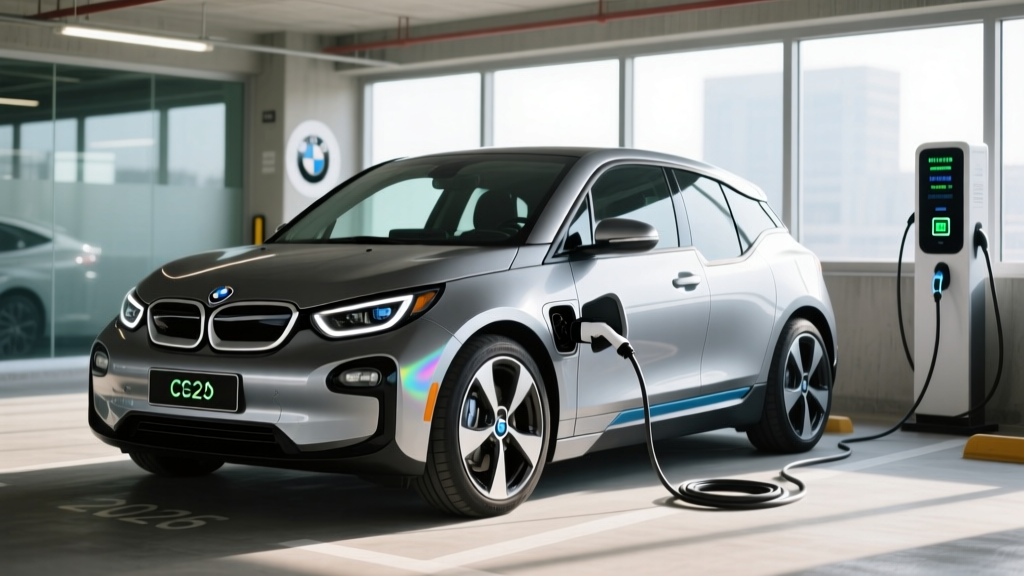
Charging is where the 2022 i3 shows its age most clearly. The 50 kW peak DC fast-charging rate was adequate in 2014 when the i3 launched, but it falls well behind modern competitors that accept 150–350 kW.
| Charge Level | Power (kW) | Speed | Notes |
|---|---|---|---|
| Level 1 (120V household) | ~1.4 kW | ~5 miles/hour | Full charge in ~27 hours; emergency use only |
| Level 2 (240V, 32A) | 7.4 kW | ~25 miles/hour | Full charge in ~5.5 hours; standard home setup |
| DC Fast Charge (CCS) | 50 kW peak | 10–80% in ~36 min | Tapers sharply above 80%; add 15+ min for 80–100% |
The 50 kW DC rate means a 10–80% session takes roughly 36 minutes. The charge curve is relatively flat up to about 65% state of charge, then tapers progressively. Above 80%, charging slows dramatically — plan on an additional 15–20 minutes if you need a full battery.
At home on a Level 2 charger (7.4 kW), the i3 replenishes about 25 miles of range per hour, reaching a full charge from near-empty in approximately 5.5 hours. That's fine for overnight charging and one of the benefits of a smaller battery — it fills up quickly on a standard 240V home setup without requiring a 48-amp or 80-amp circuit.
One practical note: the 2022 i3 uses a CCS1 connector for DC fast charging. As of 2026, CCS remains widely supported at Electrify America, EVgo, and most non-Tesla networks, though the industry is shifting toward NACS (Tesla's connector). CCS adapters for NACS-equipped chargers are available, but confirm compatibility at your regular stations.
Performance, Drivetrain, and Driving Impressions
The 2022 i3 uses a single rear-mounted electric motor producing 170 horsepower and 184 lb-ft of torque. BMW quotes a 0–60 mph time of 6.9 seconds — brisk for city merging but not sports-sedan territory. The instant torque delivery makes the i3 feel quicker than the number suggests in urban driving, where 0–30 mph sprints happen with genuine urgency.
The rear-wheel-drive layout and near 50/50 weight distribution (thanks to the battery mounted low in the aluminum chassis) give the i3 handling characteristics that most EVs can't match. It's genuinely fun on a twisty road, with precise steering and minimal body roll. The narrow 155/70R19 eco-tires limit ultimate grip, but they're key to the car's impressive efficiency.
The i3 offers strong one-pedal driving through its aggressive regenerative braking mode. Lift off the accelerator and the car decelerates briskly — most city driving can be done without touching the brake pedal. BMW was an early adopter of this behavior, and it remains well-calibrated in the 2022 model.
What the i3 does not do well is highway cruising. Wind noise becomes noticeable above 70 mph, the ride gets choppy over expansion joints (short wheelbase effect), and the range drops quickly at sustained high speeds. This is a city car that can handle the highway when needed — not a road-trip machine.
Interior, Cargo, and Technology
The i3's interior was genuinely innovative at launch and still holds up. BMW used sustainable materials throughout: eucalyptus wood trim, recycled plastic dash panels, and available wool-blend upholstery. The open-pore wood and exposed CFRP door sills give the cabin a loft-like, airy quality that no competitor has replicated.
Practical space is the trade-off. The rear seats are best suited for children or short trips — legroom is tight at 31.9 inches, and the rear-hinged "coach doors" (suicide doors) require the front doors to open first, which is awkward in tight parking spots. Cargo volume is 15.1 cubic feet behind the rear seats, expanding to 34.8 cubic feet with the rear seatbacks folded. That's enough for a week's groceries but not furniture-hauling territory.
The infotainment system runs BMW's iDrive 6.0 on a 10.25-inch display — not the latest iDrive 8 found in newer BMWs, but still responsive with a physical rotary controller that many drivers prefer over touchscreens. Apple CarPlay and Android Auto are supported, though wireless CarPlay may require a software update depending on the vehicle's production date.
Driver assistance is limited by modern standards: forward collision warning, automatic emergency braking, lane departure warning, and adaptive cruise control are available (often in the Technology + Driving Assistance Package). There is no hands-free driving capability — this is firmly SAE Level 1 automation. Parking sensors and a rearview camera are standard.
Pricing, Trims, and Federal Tax Credit Eligibility
The 2022 BMW i3 was offered in a single trim level — simply badged "i3" — with the option to add the Range Extender (REx) variant, which includes a small 2-cylinder gasoline generator. The REx was discontinued in most markets after 2021, making pure-electric 2022 models the norm.
| Category | Amount |
|---|---|
| Original MSRP (Base) | $44,450 |
| Original MSRP (as-tested, with packages) | $49,000–$53,000 |
| Typical Used Price (2026, 25k–40k miles) | $22,000–$29,000 |
| Federal §30D New EV Credit (original purchase) | Up to $7,500 (if eligible at time of purchase) |
| Federal §25E Used EV Credit (2026 purchase) | Up to $4,000 (30% of sale price, capped) |
Important tax credit note for 2026 buyers: Since the 2022 i3 is now purchased as a used vehicle, the original §30D new EV credit no longer applies. Instead, buyers may qualify for the §25E Used Clean Vehicle Credit, which provides 30% of the sale price up to a maximum of $4,000. Eligibility requires:
- The vehicle must be purchased from a licensed dealer (private-party sales don't qualify)
- Sale price must be $25,000 or less
- Buyer income must not exceed $75,000 (single), $112,500 (head of household), or $150,000 (joint)
- The vehicle must be at least two model years old (2022 models qualify in 2026)
- The credit can be transferred to the dealer at point of sale for an immediate price reduction
This means a 2022 i3 priced at $24,500 from a qualifying dealer could net a $4,000 credit, bringing the effective cost to around $20,500 — exceptional value for a carbon-fiber BMW EV. However, if the dealer prices the vehicle above $25,000, the credit is lost entirely. Shop carefully and confirm dealer participation in the point-of-sale transfer program.
Battery Warranty, Longevity, and Degradation
BMW originally warranted the i3's high-voltage battery for 8 years or 100,000 miles, whichever comes first, against defects and capacity loss below 70% of original capacity. For a 2022 model, that factory warranty extends through the 2030 model year — meaning a 2026 buyer still has approximately four years of battery coverage remaining.
The i3's NMC battery has shown solid long-term durability in owner reports. Real-world degradation data from high-mileage i3 owners suggests approximately 8–12% capacity loss over the first 80,000 miles, which is within the normal range for liquid-cooled NMC packs. The i3's thermal management system actively heats and cools the battery, which helps preserve longevity compared to passively cooled competitors like the early Nissan Leaf.
If the battery does need replacement out of warranty, expect a cost between $8,000 and $14,000 for a refurbished pack from BMW or a third-party specialist. Full new-pack replacement from BMW has historically been quoted above $16,000, though prices vary by region and availability. This is a meaningful risk factor for high-mileage used purchases.
Pros, Cons, and Who Should Buy
- Lightweight CFRP construction delivers engaging, nimble handling
- Premium, sustainable interior materials that age well
- Strong one-pedal driving and smooth city manners
- Remaining factory battery warranty through 2030
- Used pricing + §25E credit can bring cost below $21,000
- Quick 5.5-hour Level 2 home charge (small battery advantage)
- 153-mile EPA range limits road-trip practicality
- 50 kW DC fast charging is slow by 2026 standards
- No heat pump — significant cold-weather range penalty
- Rear coach doors are impractical in tight spaces
- Limited rear-seat legroom and modest cargo volume
- Discontinued model — long-term parts availability is uncertain
- Older iDrive 6.0 infotainment vs. current BMW systems
Best suited for: Urban commuters with home charging who drive under 100 miles daily, value driving engagement, and want a premium badge at a used-EV price point. The i3 is an excellent second car for a two-car household where another vehicle handles road trips.
Not ideal for: Single-car households needing highway range, families requiring rear-seat space, drivers in extreme cold climates, or anyone who relies on DC fast charging for daily needs.
2022 BMW i3 vs. Key Used-EV Competitors
At the $22,000–$29,000 used price point in 2026, the i3 competes with several strong alternatives:
- Chevrolet Bolt EV/EUV (2022): 259-mile EPA range, 55 kW DC charging, significantly more cargo room. Less engaging to drive, but far more practical. The Bolt is the range-and-value pick.
- Nissan Leaf Plus (2022): 212-mile EPA range, CHAdeMO connector (declining network support), passive battery cooling. A risky long-term bet due to cooling limitations and connector obsolescence.
- Hyundai Kona Electric (2022): 258-mile EPA range, 75 kW DC charging, better rear-seat space. A more well-rounded commuter, though less distinctive in design and materials.
- Mini Cooper SE (2022): 114-mile EPA range, 50 kW DC charging, similar fun factor. Even less range than the i3, but cheaper on the used market. Choose the Mini if range needs are truly minimal.
The i3 wins on driving dynamics, interior quality, and uniqueness. It loses on range, charging speed, and practicality to the Bolt and Kona. Your priority list determines the right call.
Frequently Asked Questions
What is the real-world range of the 2022 BMW i3?
Expect 145–160 miles in mild-weather city driving, 115–130 miles on the highway, and as little as 95–115 miles in freezing temperatures. The EPA rates it at 153 miles, but the lack of a heat pump and the boxy aerodynamic profile mean real-world results vary significantly with conditions.
How fast does the 2022 i3 charge?
On a DC fast charger, it peaks at 50 kW, taking about 36 minutes from 10–80%. At home on a Level 2 (240V) charger, it draws 7.4 kW and adds roughly 25 miles per hour, reaching a full charge in about 5.5 hours. Level 1 (120V) trickle charging adds only about 5 miles per hour.
Does the 2022 BMW i3 qualify for any EV tax credit in 2026?
Not the new-vehicle §30D credit — that applied at original purchase. However, buying a used 2022 i3 from a licensed dealer for $25,000 or less may qualify you for the §25E Used Clean Vehicle Credit: 30% of the sale price, up to $4,000, subject to buyer income caps ($75K single / $150K joint). Confirm eligibility with your tax professional and the dealer's point-of-sale transfer capability.
Is the 2022 i3 worth buying vs. a used Chevy Bolt or Kona Electric?
If you prioritize driving engagement, premium materials, and BMW build quality — and your daily driving stays under 100 miles — the i3 is a compelling choice, especially with the used-EV credit. If you need more range, more cargo space, or faster DC charging, the Bolt EV/EUV or Kona Electric are more practical picks at similar used prices.
How long will the 2022 i3's battery last?
BMW's NMC pack is liquid-cooled and has shown approximately 8–12% degradation over 80,000 miles in owner reports. The original 8-year/100,000-mile battery warranty (against drops below 70% capacity) remains active through 2030. With proper care — avoiding frequent 100% charges and extreme heat exposure — the battery should deliver usable range well past 120,000 miles.
Can I take the 2022 i3 on road trips?
Technically yes, but it requires planning. The 153-mile range and 50 kW charging speed mean stops every 90–110 miles and 35+ minute charge sessions. It's doable for occasional 300-mile trips with patience, but the i3 is not optimized for frequent long-distance travel. A second vehicle or rental is the practical solution for road trips.
What should I inspect when buying a used 2022 i3?
Check the battery state of health (SoH) through the iDrive menu or a BMW dealer diagnostic — aim for 90%+ on a 2022 model with under 40,000 miles. Inspect the CFRP body panels for cracks (repairs require specialists). Verify the charging port and CCS connector for corrosion or damage. Confirm remaining warranty status through BMW's customer service with the VIN.