Quick Verdict: A Super Sedan With Real EV Credentials
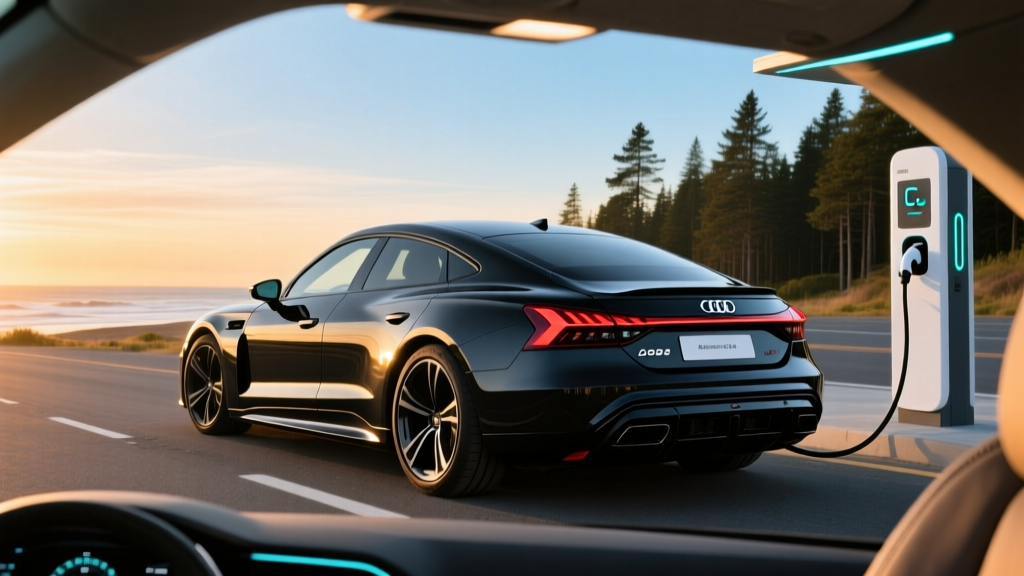
The 2022 Audi RS e-tron GT remains one of the most compelling performance sedans in the electric segment — a 637-horsepower grand tourer built on the same J1 Performance Platform that underpins the Porsche Taycan. With a 93.4 kWh battery pack, 270 kW peak DC fast-charging, and Audi's signature interior craftsmanship, it targets buyers who want supercar acceleration without sacrificing daily usability. But at a base MSRP of $139,900, with real-world range falling short of its EPA sticker, the RS e-tron GT demands careful consideration against rivals like the Taycan Turbo S and Tesla Model S Plaid.
| Spec | Value |
|---|---|
| EPA Range | 232 miles |
| Battery (Usable) | 83.7 kWh of 93.4 kWh gross, NMC |
| Drivetrain | Dual-motor AWD with 2-speed rear transmission |
| Horsepower (Boost) | 637 hp / 612 lb-ft (Launch Control) |
| 0–60 mph | 3.1 seconds |
| Top Speed | 155 mph |
| EPA Efficiency | 79 MPGe combined (43 kWh/100 mi) |
| Max DC Fast Charge | 270 kW (peak) |
| 10–80% DCFC Time | ~23 minutes |
| Level 2 Charge Rate | 9.6 kW (onboard charger, 240V) |
| Cargo Volume | 9.2 cu ft (rear trunk) + 3.2 cu ft (frunk) |
| Base MSRP | $139,900 |
| Battery/Powertrain Warranty | 8 years / 100,000 miles |
Range and Efficiency: The EPA Number vs. Reality
The EPA rates the 2022 Audi RS e-tron GT at 232 miles of combined range. That figure comes from an 83.7 kWh usable battery (93.4 kWh gross capacity) using nickel-manganese-cobalt (NMC) chemistry — chosen for its high energy density and ability to sustain the high discharge rates the RS demands.
Real-World Range Expectations
EPA sticker: 232 miles combined
Highway driving (75 mph, mild weather): Expect 195–215 miles. The RS e-tron GT's low, aerodynamic body helps, but its wide 275-section rear tires and dual-motor drivetrain impose a highway efficiency penalty.
City/mixed commuting: 220–235 miles — regenerative braking recovers meaningful energy in stop-and-go traffic.
Cold weather (below 32°F): 165–190 miles. The liquid-cooled battery with heat pump helps, but NMC chemistry loses 15–25% of capacity in deep cold without preconditioning.
Efficiency is rated at 79 MPGe combined, translating to 43 kWh per 100 miles. That's reasonable for a 5,139-pound performance sedan, though the Porsche Taycan Turbo (84 MPGe) and Tesla Model S Long Range (120 MPGe) both extract more miles per kilowatt-hour. According to fueleconomy.gov, the RS e-tron GT's efficiency places it in the middle of the luxury performance EV pack.
Charging Speed: 270 kW Peak and the 800-Volt Advantage
The RS e-tron GT's 800-volt architecture is its charging trump card. At a compatible 350 kW DC fast charger (Electrify America, Ionity, or similar), the car can accept up to 270 kW of peak power — one of the highest rates available in its model year.
| Level | Power | Speed (Approx.) | Typical Use |
|---|---|---|---|
| Level 1 (120V) | 1.2 kW | ~3 mi/hr | Emergency/trickle |
| Level 2 (240V) | 9.6 kW | ~25 mi/hr | Home overnight |
| DC Fast Charge | 270 kW (peak) | 10–80% in ~23 min | Road trips |
A full 10–80% session takes roughly 23 minutes under ideal conditions. However, as with all EVs, the charge curve tapers significantly above 80% to protect the NMC cells. Charging from 80–100% can add another 25–35 minutes — so plan your stops around 80% unless you truly need a full pack.
The onboard Level 2 charger is rated at 9.6 kW. On a home 240V/40A circuit (like a ChargePoint Home Flex or Wallbox Pulsar Plus), a full recharge from 10% takes about 9.5 hours. A 48A circuit can slightly reduce that time. If you're installing a home Level 2 station, budget $800–$2,500 for equipment and licensed electrician labor — and note that older homes may need a 200A panel upgrade ($1,500–$3,000) to support continuous 40A+ draws.
The RS e-tron GT uses the CCS1 connector standard. With Audi's announcement to adopt NACS (Tesla's connector) for future models, current CCS owners will likely rely on adapters for Tesla Supercharger access — check Audi's official guidance for compatibility updates.
Performance: 637 Horsepower and a 2-Speed Rear Axle
The dual-motor all-wheel-drive system produces 590 hp in standard driving and 637 hp with Launch Control engaged (a 2.5-second overboost). The 0–60 mph sprint clocks in at 3.1 seconds, with the quarter-mile arriving in approximately 11.3 seconds at 123 mph.
What separates the RS e-tron GT from many EV rivals is its 2-speed transmission on the rear axle. First gear provides explosive off-the-line acceleration; second gear optimizes high-speed efficiency. This engineering choice gives the RS a more natural, progressive power delivery compared to single-reduction EVs that feel breathless past 100 mph.
Adaptive air suspension with Audi's RS-tuned damping lowers the car by 10 mm in Dynamic mode and offers adjustable ride height. Rear-axle steering (optional on the standard e-tron GT, standard on the RS) tightens the turning circle and improves high-speed stability. Carbon-ceramic brakes (a $9,000 option) provide fade-free stopping power during repeated hard use — though the standard steel rotors are more than adequate for street duty.
Interior, Cargo, and Technology
Audi's interior quality is on full display: standard Valcona leather with honeycomb stitching, a 12.3-inch Virtual Cockit Plus driver display, and a 10.1-inch MMI touchscreen with wireless Apple CarPlay and Android Auto. The flat-floor architecture creates generous front legroom (41.3 inches), though the sloping roofline limits rear headroom to 36.5 inches — tall passengers will notice.
Cargo space is the RS e-tron GT's most obvious compromise:
- Rear trunk: 9.2 cubic feet (a conventional sedan trunk, not a hatchback)
- Front trunk (frunk): 3.2 cubic feet (enough for a charging cable bag and small duffel)
- Total: 12.4 cubic feet — significantly less than the Tesla Model S (28 cu ft hatchback + 3.1 cu ft frunk)
Driver assistance comes via Audi's Adaptive Cruise Assist with Traffic Jam Guidance (SAE Level 2), lane-keeping, intersection assist, and a 360-degree camera system. This is not autonomous driving — the driver must keep hands on the wheel and eyes on the road at all times. Audi does not currently offer a hands-free highway driving system comparable to GM's Super Cruise or Ford's BlueCruise.
Pricing, Tax Credits, and Total Cost of Ownership
The 2022 Audi RS e-tron GT launched at a base MSRP of $139,900, with well-equipped examples reaching $155,000–$165,000 after options (carbon-ceramic brakes, carbon exterior package, Bang & Olufsen audio, Executive rear seating).
| Item | Amount |
|---|---|
| Base MSRP | $139,900 |
| Typical as-tested (with options) | $148,000–$160,000 |
| Federal §30D Tax Credit (new, 2022) | Up to $7,500 (if eligible) |
| Effective price after max credit | ~$132,400–$152,500 |
IRS §30D Federal Tax Credit Eligibility (2026 rules for new vehicles): The full $7,500 credit requires the vehicle to meet battery component and critical mineral sourcing thresholds, the buyer's AGI must not exceed $150,000 (single) / $300,000 (joint), and the vehicle MSRP must be under $80,000 for sedans. The RS e-tron GT's MSRP of $139,900 exceeds the $80,000 sedan cap, making it ineligible for the new-vehicle federal credit under current IRS §30D rules. Always verify eligibility with a tax professional before purchase.
For used purchases, the used EV credit (up to $4,000 or 30% of sale price, whichever is lower) may apply if the used sale price is $25,000 or less — unlikely for a 2022 RS e-tron GT given current depreciation curves. Check Kelley Blue Book for current resale values.
Estimated 5-Year Ownership Costs:
- Electricity (15,000 mi/yr at $0.14/kWh): ~$4,515 total
- Equivalent gasoline car (22 MPG at $3.50/gal): ~$11,932 total
- Fuel savings vs. gas: ~$7,400 over 5 years
- Insurance: Expect $3,500–$5,000/year (performance EVs carry high premiums)
- Maintenance: Minimal — no oil changes, reduced brake wear from regen. Budget $500–$800/year for cabin filters, tire rotation, fluid top-offs.
How It Stacks Up Against Key Competitors
| Spec | Audi RS e-tron GT | Porsche Taycan Turbo S | Tesla Model S Plaid |
|---|---|---|---|
| EPA Range | 232 mi | 222 mi | 396 mi |
| 0–60 mph | 3.1 sec | 2.6 sec | 1.99 sec |
| Horsepower | 637 hp | 750 hp | 1,020 hp |
| Max DC Charge | 270 kW | 270 kW | 250 kW |
| Cargo | 12.4 cu ft | 14.3 cu ft | 28 + 3.1 cu ft |
| Base MSRP | $139,900 | $187,600 | $108,490 |
| Federal Credit (New) | Not eligible (MSRP cap) | Not eligible (MSRP cap) | Not eligible (MSRP cap) |
The RS e-tron GT sits between the Taycan Turbo S and Model S Plaid in both price and performance. It's slower and has less range than the Plaid, and less power than the Turbo S — but its ride quality, interior materials, and grand-touring character are arguably the best balanced of the three. The Tesla wins on range and cargo practicality; the Porsche wins on track capability; the Audi wins on everyday livability and understated luxury.
Warranty and Battery Longevity
Audi covers the RS e-tron GT's battery pack and electric powertrain for 8 years or 100,000 miles, whichever comes first. The warranty guarantees the battery will retain at least 70% of its original capacity during that period. The limited vehicle warranty is 4 years / 50,000 miles, with 4 years of complimentary scheduled maintenance.
NMC chemistry in the 800V J1 platform has demonstrated strong longevity data from the Porsche Taycan (which shares the architecture): most owners report less than 5% degradation over the first 50,000 miles when following recommended charging practices (avoiding prolonged 100% SoC storage, minimizing repeated 100% DC fast charges). Audi's thermal management system actively cools and heats the battery to keep cells within the optimal 25–40°C window, which is the single most important factor in long-term battery health.
Pros
- 270 kW DC fast charging — among the fastest in its class
- 800V architecture enables sustained high-power charging
- Superb ride quality with adaptive air suspension
- Refined, quiet cabin with premium materials
- 2-speed rear transmission for progressive power delivery
- Standard rear-axle steering for agility
Cons
- Only 232 miles EPA range — less than rivals
- 12.4 cu ft total cargo is impractical for families
- No hands-free driving assist (Level 2 only, hands-on)
- MSRP exceeds $80K sedan cap — no federal tax credit for new buyers
- Rear seats are tight for tall adults
- High insurance premiums for a performance EV
Who Should Buy the 2022 Audi RS e-tron GT?
This EV is best for: Enthusiast drivers who prioritize build quality, ride refinement, and charging speed over maximum range. It's a grand tourer — ideal for 200-mile weekend drives with a single fast-charge stop, daily commuting in comfort, and owners who value understated design over Tesla's tech-first approach.
Look elsewhere if: You need family-hauling cargo space (consider the Rivian R1S or BMW iX), you want 350+ miles of range (Tesla Model S, Lucid Air), or you're budget-sensitive and want federal tax credit eligibility (BMW i4, Hyundai Ioniq 5, Tesla Model 3).
Choose the RS e-tron GT if:
- You value Audi/Porsche build quality and 800V charging architecture
- You primarily drive 150 miles or fewer per day with home charging
- You want a luxury performance sedan that doesn't shout "tech bro"
Choose a competitor if:
- Range is your top priority → Tesla Model S or Lucid Air
- You need cargo versatility → Porsche Taycan Cross Turismo or Tesla Model S
- You want the fastest possible EV → Tesla Model S Plaid
Frequently Asked Questions
What is the real-world range of the 2022 Audi RS e-tron GT?
The EPA rates it at 232 miles combined. In real-world highway driving at 75 mph, expect 195–215 miles. In cold weather below freezing, range can drop to 165–190 miles. City driving with regenerative braking can return close to the EPA figure.
How fast does the RS e-tron GT charge?
At a 350 kW DC fast charger, it peaks at 270 kW and charges from 10–80% in approximately 23 minutes. At home on a Level 2 (240V, 40A) charger, it adds about 25 miles per hour, with a full recharge taking roughly 9.5 hours.
Does the 2022 Audi RS e-tron GT qualify for the federal EV tax credit?
For new-vehicle purchases under current IRS §30D rules, no — the $139,900 base MSRP exceeds the $80,000 sedan cap. Used purchases are unlikely to qualify for the $4,000 used-EV credit since resale prices remain well above the $25,000 sale-price threshold. Always consult a tax professional for your specific situation.
Is it worth buying vs. the Porsche Taycan Turbo S or Tesla Model S Plaid?
The RS e-tron GT occupies a distinct middle ground: less extreme than the Taycan Turbo S on a track, less tech-heavy than the Model S Plaid, but arguably the best daily-driver balance of ride comfort, charging speed, and understated luxury. If you want the best grand-touring experience and don't need 350+ miles of range, it's a compelling choice.
What are the biggest drawbacks?
Limited cargo space (12.4 cu ft total), below-average range for the price class (232 mi EPA), no hands-free driving system, ineligibility for the federal tax credit, and tight rear-seat headroom for taller passengers.
What is the battery warranty?
Audi provides 8 years or 100,000 miles of battery and powertrain coverage, guaranteeing at least 70% capacity retention. The vehicle limited warranty is 4 years / 50,000 miles.