Quick Verdict: A Luxury EV Grand Tourer That Still Holds Up
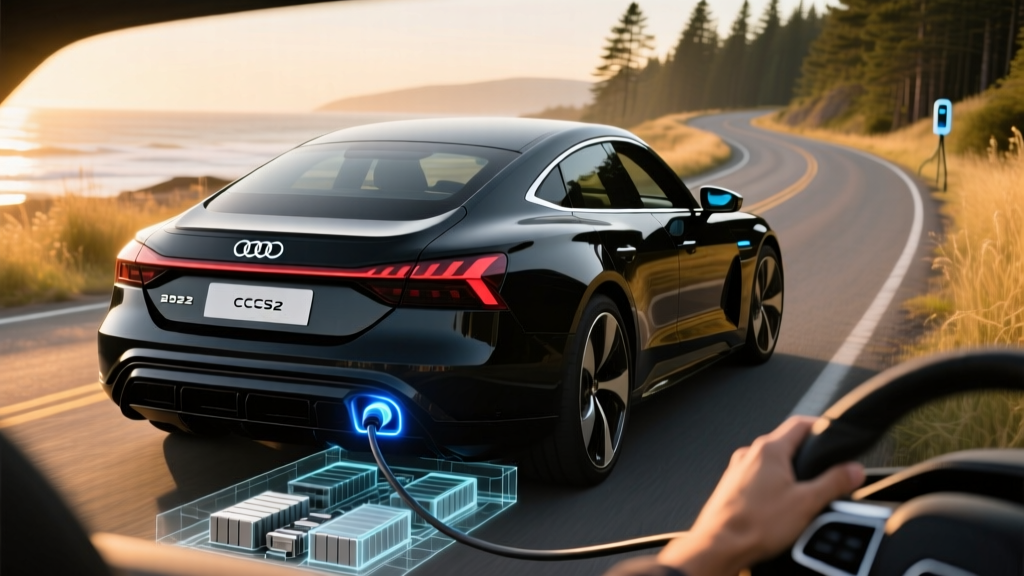
The 2022 Audi e-tron GT shares its J1 Performance Platform with the Porsche Taycan, but Audi tuned it for a distinctly different mission: effortless grand touring rather than track-day heroics. In 2026, it remains one of the most refined electric sedans on the used market, with blistering 800-volt charging architecture, a whisper-quiet cabin, and build quality that justifies its premium pricing. The trade-off is range — the EPA's 238-mile estimate trails rivals like the Tesla Model S and Lucid Air by a wide margin, and real-world highway driving trims that further.
If you're evaluating a 2022 e-tron GT today, whether from a certified pre-owned lot or private sale, this review covers every number that matters: actual range, charging behavior, ownership costs, and whether the federal used-EV credit can bring the price within reach.
Range and Efficiency: EPA Numbers vs. the Real World
Real-World Expectation: ~200–220 miles highway at 70 mph; ~170–190 miles in freezing weather with climate control active. City driving with regenerative braking can approach or slightly exceed the EPA figure.
The e-tron GT's 83.7 kWh usable battery (93.4 kWh gross, NMC lithium-ion chemistry) delivers an EPA-estimated 238 miles in the Premium Plus trim with 19-inch aero wheels. Step up to the 20-inch or 21-inch wheels on higher trims, and that figure drops to approximately 232 miles. The RS e-tron GT, with its more powerful dual-motor setup, is rated at 232 miles.
Efficiency lands at 82 MPGe combined (roughly 41 kWh/100 miles) according to fueleconomy.gov. That's competitive with the Porsche Taycan 4S but trails the Tesla Model S Long Range (124 MPGe) and Lucid Air (131 MPGe) significantly. The 800-volt architecture prioritizes charge speed over raw efficiency — a deliberate engineering choice.
In practical terms, plan for roughly 200 miles of comfortable range on a road trip before needing a charge stop. In cold weather (below 32°F), lithium-ion chemistry and cabin heating can reduce range by 20–30%, bringing usable highway range to around 170 miles. The standard heat pump helps mitigate this compared to resistive heating systems, but physics is physics.
Charging: 800-Volt Architecture Means Serious Speed
| Charging Level | Power (kW) | Connector | Speed / Time |
|---|---|---|---|
| Level 1 (120V) | ~1.4 kW | J1772 | ~4 miles per hour |
| Level 2 (240V) | 9.6 kW (onboard charger limited to 9.6 kW; supports up to 11 kW with optional charger) | J1772 | ~28–32 miles per hour; 0–100% in ~9.5 hours |
| DC Fast Charge | Up to 270 kW peak | CCS1 | 10–80% in ~23 minutes; 5–80% in ~22.5 min (Audi claim) |
The e-tron GT's standout feature is its 800-volt electrical architecture, which it shares with the Taycan and Hyundai Ioniq 5. This enables a peak DC fast-charge rate of 270 kW — among the fastest of any production EV from this era. At a 350 kW Electrify America or Ionity station, the e-tron GT can add roughly 60 miles of range in under 5 minutes when starting from a low state of charge.
However, the charge curve matters more than peak kW. The e-tron GT sustains above 150 kW up to roughly 55% state of charge, then tapers progressively. From 80% to 100%, charging slows dramatically to protect the NMC cells — expect that final 20% to take as long as the first 60%. For road trips, the 10–80% time of approximately 23 minutes is the number that counts, and it's genuinely excellent.
At home on a Level 2 circuit, the standard 9.6 kW onboard charger replenishes the battery at roughly 28–32 miles of range per hour. A full charge from empty takes about 9.5 hours — fine for overnight charging. Audi offered an optional 11 kW onboard charger that slightly reduces this. Either way, you'll want a 48-amp or 60-amp dedicated Level 2 circuit installed by a licensed electrician for optimal home charging.
Performance and Driving Dynamics
| Spec | e-tron GT Premium Plus / Prestige | RS e-tron GT |
|---|---|---|
| Powertrain | Dual-motor AWD (quattro) | Dual-motor AWD (quattro) with rear 2-speed gearbox |
| Horsepower | 469 hp (522 hp with launch control) | 590 hp (637 hp with launch control) |
| Torque | 464 lb-ft | 612 lb-ft |
| 0–60 mph | 3.9 seconds | 3.1 seconds |
| Top Speed | 152 mph | 155 mph |
| Battery (usable) | 83.7 kWh (NMC) | 83.7 kWh (NMC) |
| EPA Range | 238 miles (19" wheels) | 232 miles |
| MPGe (combined) | 82 MPGe | 79 MPGe |
Both versions of the e-tron GT use a dual-motor all-wheel-drive system with a rear-mounted two-speed transmission — a first gear for explosive launches and a second gear for efficient highway cruising. The standard e-tron GT produces 469 hp (522 hp during 2.5-second launch control bursts), while the RS model jumps to 590 hp (637 hp with launch control).
The 0–60 mph time of 3.9 seconds for the standard GT and 3.1 seconds for the RS are genuinely quick, but the character is what sets this car apart. Unlike some EVs that feel frantic, the e-tron GT delivers its acceleration with the composed, surge-like thrust of a high-end grand tourer. The air suspension, rear-axle steering (optional on Prestige, standard on RS), and low center of gravity make it remarkably agile for a 5,139-pound sedan.
Regenerative braking is driver-selectable via steering-wheel paddles, offering three levels of deceleration plus an auto mode that uses radar and navigation data to adjust regen based on traffic and upcoming curves. It does not offer true one-pedal driving to a full stop like a Nissan Leaf or Tesla — you'll still use the brake pedal at low speeds.
Interior, Cargo, and Technology
The e-tron GT's cabin is unmistakably Audi: precise panel gaps, available Nappa leather, open-pore wood trim, and a flat-floor architecture that creates generous front legroom (41.5 inches). Rear legroom measures 32.4 inches — adequate for adults on shorter trips but tighter than a Mercedes EQS or BMW i5. The center rear seat is best left to children due to the transmission tunnel hump (a legacy of the J1 platform's packaging).
Cargo space is the e-tron GT's most practical weakness. The rear trunk offers 9.2 cubic feet, and the front trunk (frunk) adds 3.2 cubic feet — for a total of 12.4 cubic feet. That's sports-car territory, not sedan territory. Compare that to the Tesla Model S (28 cu ft rear) or Lucid Air (32 cu ft combined). If you regularly carry luggage for road trips or need family cargo capacity, this is a meaningful compromise.
Technology highlights include:
- 10.1-inch MMI touchscreen with wireless Apple CarPlay and Android Auto
- 12.3-inch Virtual Cockit Plus digital instrument cluster
- Available Bang & Olufsen 3D premium audio (710 watts, 16 speakers)
- Audi Pre Sense Basic and Pre Sense Front (forward collision warning, automatic emergency braking)
- Adaptive cruise assist with lane guidance (SAE Level 2 driver assistance — driver must remain engaged)
- Available head-up display, surround-view cameras, and night vision assistant
Pricing, Trims, and Tax Credit Eligibility
| Trim | Original MSRP | Key Features |
|---|---|---|
| Premium Plus | $102,400 | 19" wheels, leather, adaptive air suspension, matrix LED headlights |
| Prestige | $107,100 | Adds: head-up display, B&O audio, rear-axle steering, night vision |
| RS e-tron GT | $139,900 | 637 hp launch, RS sport suspension, carbon-fiber trim, Alcantara |
On the used market in 2026, expect to find a 2022 e-tron GT Premium Plus in the $48,000–$58,000 range depending on mileage and condition, with RS models commanding $65,000–$80,000. Depreciation has been significant — a benefit for second-hand buyers.
Federal Used-EV Tax Credit (§25E)
Because the 2022 e-tron GT is now purchased as a used vehicle, the relevant incentive is the Previously Owned Clean Vehicle Credit (IRS §25E), not the new-vehicle §30D credit. Key rules per irs.gov:
- Credit amount: 30% of the sale price, up to a maximum of $4,000
- Vehicle price cap: Sale price must be $25,000 or less to qualify
- Income caps: Modified AGI must not exceed $75,000 (single), $112,500 (head of household), or $150,000 (joint)
- Vehicle requirements: Must be at least 2 model years old, purchased from a licensed dealer, battery capacity ≥ 7 kWh
- Point-of-sale transfer: Available — the credit can be applied as a down-payment reduction at the dealership
Reality check: With used 2022 e-tron GT prices well above $25,000, this vehicle does not currently qualify for the §25E used-EV credit. The price cap is the barrier. If you're shopping for an e-tron GT, you'll be paying the full market price without federal incentive assistance. Some states may offer separate incentives — check your state energy office or DSIRE database for local programs.
Warranty and Long-Term Battery Outlook
Audi provides a standard limited warranty of 4 years/50,000 miles and a powertrain warranty of 4 years/50,000 miles. The high-voltage battery is covered for 8 years or 100,000 miles (whichever comes first) against defects and excessive capacity loss. Audi defines excessive degradation as falling below 70% of original usable capacity within the warranty period — a threshold consistent with most luxury EV makers.
The e-tron GT uses NMC (nickel manganese cobalt) chemistry, which offers high energy density but is more sensitive to sustained high states of charge than LFP (lithium iron phosphate). Best practices for longevity include:
- Set daily charge limit to 80% for routine driving
- Avoid leaving the car at 100% SoC for extended periods
- Use DC fast charging sparingly — rely on Level 2 home charging for daily top-ups
- Precondition the battery (via the MMI or myAudi app) before fast charging in cold weather
Given that the earliest 2022 models are now four years old, early battery health data from European and North American owners suggests degradation in the 3–6% range — well within normal expectations. The J1 platform's liquid thermal management system appears to be doing its job effectively.
Who the 2022 e-tron GT Is For — And Who Should Look Elsewhere
- Class-leading 270 kW DC fast charging (10–80% in ~23 min)
- Exceptional build quality, cabin refinement, and ride comfort
- Strong performance: 3.9s 0–60 (standard), 3.1s (RS)
- 800V architecture future-proofs for high-speed charging networks
- Air suspension and rear-axle steering deliver superb handling
- Significant used-market depreciation benefits second-hand buyers
- EPA range of 238 miles trails rivals (Model S: 405 mi, Lucid Air: 516 mi)
- Tiny cargo space: 12.4 cu ft total (trunk + frunk)
- Rear seat legroom is tight at 32.4 inches
- Infotainment system feels dated compared to 2024+ competitors
- No hands-free highway driving feature (Level 2 only)
- Does not qualify for federal used-EV credit due to price cap
- CCS1 connector requires adapter for Tesla Supercharger access
Buy the 2022 Audi e-tron GT if: You prioritize luxury build quality, fast charging, and grand-touring comfort over maximum range. You have reliable home Level 2 charging. You mostly drive 150 miles or fewer per day and take occasional road trips where 270 kW DC charging makes stops brief. You're buying used and want a $100,000+ EV experience at half the original price.
Look elsewhere if: You need 300+ miles of range for long commutes or frequent road trips through charging deserts. You regularly carry rear-seat passengers or cargo. You want hands-free highway driving. You need the latest infotainment technology.
2022 e-tron GT vs. Key Competitors (Used Market, 2026)
| Spec | Audi e-tron GT | Tesla Model S LR | Porsche Taycan 4S | Lucid Air Pure |
|---|---|---|---|---|
| EPA Range | 238 mi | 405 mi | 227 mi | 410 mi |
| Battery (usable) | 83.7 kWh | ~100 kWh | 79.2 kWh | 88 kWh |
| Peak DC Charge | 270 kW | 250 kW | 270 kW | 220 kW |
| 10–80% DCFC | ~23 min | ~30 min | ~23 min | ~25 min |
| 0–60 mph | 3.9 sec | 3.1 sec | 3.8 sec | 3.5 sec |
| Cargo (total) | 12.4 cu ft | 28 cu ft | 14.3 cu ft | 32 cu ft |
| Used Price (est.) | $48K–$58K | $52K–$65K | $55K–$70K | $55K–$68K |
The Taycan 4S is the closest sibling — same platform, similar charging, slightly less range. The Model S wins on range, cargo, and Supercharger network access. The Lucid Air dominates on efficiency and interior space. The e-tron GT's edge is cabin refinement, ride quality, and the intangible sense of Audi craftsmanship.
Frequently Asked Questions
What is the real-world range of the 2022 Audi e-tron GT?
Expect approximately 200–220 miles on the highway at 70 mph in moderate temperatures, and 170–190 miles in freezing conditions. City driving with regenerative braking can approach the EPA's 238-mile estimate. Range varies significantly with wheel size, driving style, and climate control usage.
How fast does the 2022 e-tron GT charge at home and on the road?
At home on a Level 2 (240V) charger, the e-tron GT charges at up to 9.6 kW, adding roughly 28–32 miles of range per hour and reaching a full charge in about 9.5 hours. On a DC fast charger, it peaks at 270 kW and charges from 10–80% in approximately 23 minutes at a 350 kW-capable station. Actual charge speed depends on battery temperature and state of charge — preconditioning via the myAudi app before arriving at a charger maximizes speed.
Does the 2022 Audi e-tron GT qualify for any federal EV tax credit?
Not the new-vehicle §30D credit (that applied only at original purchase). As a used vehicle, it could theoretically qualify for the §25E Previously Owned Clean Vehicle Credit, but the $25,000 sale price cap makes it ineligible at current market prices of $48,000+. State-level incentives may still apply depending on your jurisdiction — consult your state energy office or a tax professional.
Is the 2022 Audi e-tron GT worth buying in 2026 versus competitors?
It depends on priorities. If cabin quality, ride comfort, and ultra-fast DC charging are your top criteria, the e-tron GT is outstanding — especially at its depreciated used price. If range and cargo space matter more, the Tesla Model S Long Range or Lucid Air Pure are stronger choices. The Porsche Taycan 4S is nearly identical mechanically but trades Audi's comfort focus for slightly sportier dynamics.
Can I charge the e-tron GT at Tesla Superchargers?
The 2022 e-tron GT uses the CCS1 connector. Tesla has opened select Supercharger stations to non-Tesla EVs via the Magic Dock (a built-in CCS1 adapter at the stall), and you can also use a Tesla-approved CCS1 adapter (sold separately). However, not all Supercharger locations support non-Tesla vehicles, and charging speeds may be limited. The Electrify America and EVgo networks remain the most reliable high-speed options for CCS1-equipped vehicles.
What is the battery replacement cost if it fails out of warranty?
Out-of-warranty high-voltage battery replacement for the e-tron GT is estimated at $20,000–$30,000 based on current J1-platform service pricing. However, early data shows degradation of only 3–6% over four years, suggesting most batteries will retain well above the 70% warranty threshold for the vehicle's useful life. The 8-year/100,000-mile battery warranty still covers many 2022 models through 2030.