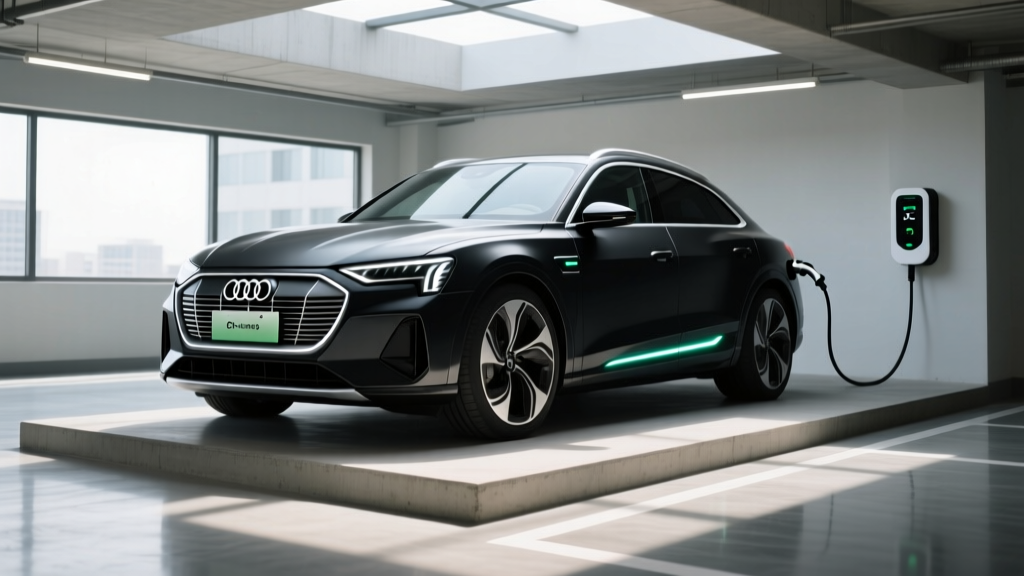
The 2022 Audi e-tron S arrived as the performance variant of Audi's first dedicated electric SUV, promising sports-sedan acceleration in a luxury crossover package. With a tri-motor all-wheel-drive layout, adaptive air suspension, and Audi's signature build quality, it targets buyers who want EV performance without sacrificing refinement. But with EPA-estimated range trailing key competitors and a starting price north of $85,000, does the e-tron S deliver enough to justify its premium?
This review breaks down the real-world range, charging behavior, ownership economics, and tax-credit eligibility of the 2022 Audi e-tron S — the data points that matter most when shopping for a used luxury EV in 2026.
2022 Audi e-tron S: Key Specifications at a Glance
| Attribute | Value |
|---|---|
| EPA-estimated range | 208 miles (SUV), 212 miles (Sportback) |
| Battery capacity (usable) | 86.5 kWh (95 kWh gross) |
| Battery chemistry | NMC (nickel manganese cobalt) |
| Drivetrain | Tri-motor AWD (1 front, 2 rear) |
| Horsepower (Boost mode) | 496 hp / 718 lb-ft torque |
| 0–60 mph | 4.5 seconds |
| Max DC fast-charge rate | 150 kW (peak) |
| 10–80% DC charge time | ~30 minutes |
| Level 2 home charging | 11.5 kW (~21 miles/hr) |
| EPA efficiency | 73 MPGe combined / 46 kWh/100 mi |
| Cargo volume (rear seats up) | 28.5 cu ft (SUV) |
| Cargo volume (rear seats folded) | 57.0 cu ft (SUV) |
| Base MSRP (2022) | $85,895 (Premium Plus) |
| Battery/powertrain warranty | 8 years / 100,000 miles |
Real-World Range: What to Actually Expect
EPA sticker: 208 miles (SUV) / 212 miles (Sportback)
Real-world highway (70 mph, moderate temps): ~175–190 miles
Real-world city/mixed driving: ~195–210 miles
Cold-weather (below 32°F, cabin heat on): ~145–165 miles
The e-tron S sacrifices range for performance. Its tri-motor setup, wider 285-section rear tires, and sport-tuned calibration all increase rolling resistance and energy consumption compared to the standard dual-motor e-tron (EPA 222 miles). The 86.5 kWh usable battery capacity is generous, but at 46 kWh/100 miles combined, this is one of the least efficient luxury EVs in its class.
In highway-heavy driving at sustained speeds above 70 mph, expect the e-tron S to consume energy at roughly 50–54 kWh/100 miles, bringing practical range down to around 175 miles. Cold weather compounds this: without a heat pump (the 2022 e-tron S uses resistive PTC heating), cabin warmth draws heavily from the pack, cutting range by 25–30% in sub-freezing conditions.
For daily commuting under 80 miles round-trip with home charging, this range is manageable. For road trips, you'll be stopping every 150–170 miles to maintain a comfort buffer — something to weigh against competitors like the BMW iX xDrive50 (EPA 324 miles) or Tesla Model X Long Range (EPA 348 miles).
Charging Speed and Behavior: DC Fast and Home Level 2
| Charging Level | Power (kW) | Speed (miles/hr added) | Notes |
|---|---|---|---|
| Level 1 (120V household) | 1.4 kW | ~3 mi/hr | Emergency/trickle only |
| Level 2 (240V, 48A) | 11.5 kW | ~21 mi/hr | Full charge in ~9.5 hours |
| DC Fast Charge (CCS) | 150 kW peak | Up to ~320 mi/hr (peak) | 10–80% in ~30 min |
The e-tron S uses a CCS1 connector for DC fast charging and accepts up to 150 kW peak. Audi's thermal management system is one of the best in the industry for sustaining charge rates: the e-tron can hold close to 130–150 kW from 10% to about 70% State of Charge before tapering. This means the 10–80% time of roughly 30 minutes is realistic at a properly rated 150+ kW Electrify America or EVgo station — not just a peak figure.
Above 80% SoC, the charge curve tapers sharply to protect the NMC cells, dropping below 50 kW and eventually to under 20 kW near 100%. For road trips, plan to charge to 80% and go; the final 20% adds 25+ minutes for only ~40 extra miles.
At home on a Level 2 wallbox (240V, 48-amp circuit), the 11.5 kW onboard charger replenishes the 86.5 kWh usable pack in about 9.5 hours from near-empty. Most owners charging overnight from 30–80% will need only 4–5 hours. A NEMA 14-50 outlet installation typically costs $500–$1,500 depending on panel proximity, based on DOT/EPA charging guidance.
Performance and Driving Dynamics
The tri-motor layout is the e-tron S's headline feature. One asynchronous motor on the front axle and two on the rear axle deliver 496 hp and 718 lb-ft of torque in Boost mode (activated via launch control or dynamic driving mode). Standard output is 429 hp. The result is a 4.5-second 0–60 mph time — quick, though not class-leading against the Tesla Model X Plaid (2.5 seconds) or even the BMW iX M60 (3.6 seconds).
Where the e-tron S differentiates is in torque vectoring. The twin rear motors can send torque independently to each rear wheel, creating a rear-biased, almost playful character unusual for an Audi SUV. The standard adaptive air suspension drops the ride height by 0.6 inches in Dynamic mode, stiffening damping and sharpening throttle response.
Regenerative braking is adjustable via steering-wheel paddles across three levels, but Audi does not offer true one-pedal driving (the car creeps at stop unless you hold the brake). The brake-by-wire pedal feel is among the most natural in any EV — a frequent complaint in competitors is absent here.
Pricing, Trims, and Federal Tax Credit Eligibility
| Trim | 2022 MSRP | As-Tested (typical options) | §30D Credit Eligibility (new in 2022) |
|---|---|---|---|
| Premium Plus (SUV) | $85,895 | $88,000–$92,000 | Not eligible (MSRP cap $80,000 for SUVs) |
| Prestige (SUV) | $91,095 | $95,000–$102,000 | Not eligible (MSRP cap $80,000 for SUVs) |
| Premium Plus (Sportback) | $88,395 | $90,000–$95,000 | Not eligible (MSRP cap $80,000 for SUVs) |
| Prestige (Sportback) | $93,595 | $96,000–$104,000 | Not eligible (MSRP cap $80,000 for SUVs) |
Federal tax credit verdict: The 2022 Audi e-tron S did not qualify for the $7,500 IRS §30D federal EV tax credit when purchased new. Under the Inflation Reduction Act rules (effective 2023 onward), SUVs face an $80,000 MSRP cap, and every e-tron S trim exceeds this. Buyer income caps ($300,000 joint / $150,000 single) and battery critical-mineral sourcing requirements further restrict eligibility for many luxury EVs.
Used EV credit (IRC §25E): If purchasing a 2022 e-tron S as a used vehicle in 2026, you may qualify for up to $4,000 (30% of sale price, capped) under the used clean vehicle credit. Requirements include: sale price at or below $25,000, buyer income under $150,000 (joint) or $75,000 (single), purchase from a licensed dealer, and the vehicle must be at least two model years old. Given current used e-tron S pricing ($45,000–$60,000 depending on mileage), most listings exceed the $25,000 sale-price cap — making this credit difficult to capture for this specific model.
Interior, Technology, and Daily Usability
The e-tron S cabin is a strong suit. Audi's triple-screen MMI layout (12.3-inch Virtual Cockit, 10.1-inch upper infotainment, 8.6-inch lower climate/handwriting panel) is visually impressive and responsive, though the lower screen's haptic-touch buttons require more attention than physical knobs while driving.
Standard equipment on the Premium Plus trim includes:
- Matrix-design LED headlights with dynamic turn signals
- 16-way power-adjustable sport front seats with massage
- Bang & Olufsen 3D premium audio (16 speakers)
- Audi adaptive cruise assist with lane guidance (SAE Level 2)
- Surround-view camera with 3D rendering
- Head-up display (Prestige trim)
Passenger space is comfortable for four adults, with 38.1 inches of rear legroom. Cargo volume at 28.5 cu ft (rear seats up) and 57.0 cu ft (folded) trails the BMW iX (35.5 / 77.9 cu ft) and Tesla Model X (37.1 / 72.3 cu ft). There is no front trunk (frunk); the space under the hood houses power electronics.
Driver-assist note: Audi adaptive cruise assist is an SAE Level 2 system. It combines adaptive cruise control and lane-centering but requires continuous driver supervision — hands on the wheel, eyes on the road. It is not self-driving and does not handle complex urban intersections, construction zones, or unmapped roads autonomously.
Pros and Cons: The Honest Assessment
Pros
- Tri-motor torque vectoring delivers genuinely engaging rear-biased handling
- Excellent DC charge-curve sustainability (holds ~130–150 kW to 70% SoC)
- Best-in-class brake pedal feel (natural, progressive, no grabby regen)
- Quiet, well-isolated cabin with premium material quality
- Adaptive air suspension balances comfort and sport effectively
- Strong build quality and reliability record (fewer complaints than rivals)
Cons
- EPA 208-mile range is 100+ miles behind key competitors
- Efficiency at 46 kWh/100 mi is poor — expensive to charge on long trips
- No heat pump (PTC heating) worsens cold-weather range significantly
- CCS1 connector limits access to Tesla Supercharger network (adapter needed)
- No frunk; cargo volume trails rivals
- Did not qualify for §30D new-vehicle tax credit; used credit unlikely due to price cap
- Infotainment dual-touchscreen requires more eyes-off-road time than knob-based systems
How the e-tron S Stacks Up Against Competitors
For buyers cross-shopping the 2022 Audi e-tron S on the used market in 2026, here is how it compares on the metrics that matter:
| Spec | Audi e-tron S | BMW iX xDrive50 | Tesla Model X LR | Mercedes EQS 450 SUV |
|---|---|---|---|---|
| EPA range | 208 mi | 324 mi | 348 mi | 305 mi |
| Battery (usable) | 86.5 kWh | 105.2 kWh | 100 kWh | 108.4 kWh |
| 0–60 mph | 4.5 sec | 4.4 sec | 3.8 sec | 5.3 sec |
| DC fast charge (peak) | 150 kW | 195 kW | 250 kW | 200 kW |
| Cargo (seats up) | 28.5 cu ft | 35.5 cu ft | 37.1 cu ft | 22.0 cu ft |
| Efficiency | 46 kWh/100mi | 42 kWh/100mi | 33 kWh/100mi | 43 kWh/100mi |
| Approx. used price (2026) | $45K–$58K | $52K–$68K | $58K–$75K | $55K–$70K |
The e-tron S is the clear range underdog. Its advantage lies in driving dynamics (torque vectoring), build quality, and depreciation — it has depreciated more steeply than the Tesla or BMW, making it a relative value play on the used market if range is not your top priority.
Who Should Buy the 2022 Audi e-tron S?
Choose the e-tron S if:
- You commute under 80 miles daily and charge at home overnight
- You prioritize driving engagement and chassis dynamics over maximum range
- You value Audi's build quality, cabin isolation, and dealer service network
- You find a well-maintained used example in the $45K–$52K range
- You rarely take road trips exceeding 300 miles in a single day
Look elsewhere if:
- You need 300+ miles of range for frequent long-distance travel
- You live in a cold climate where the lack of a heat pump will cut range severely
- You want access to the Tesla Supercharger network without an adapter
- Cargo space is a priority (families with strollers, gear, dogs)
- You want to maximize tax-credit savings on your EV purchase
Frequently Asked Questions
What is the real-world range of the 2022 Audi e-tron S?
Expect approximately 175–190 miles at highway speeds (70 mph) in moderate temperatures, and 195–210 miles in mixed city driving. In cold weather below freezing, range drops to roughly 145–165 miles due to the resistive PTC heating system. The EPA-estimated 208 miles is achievable only under ideal, low-speed conditions.
How fast does the e-tron S charge at home and on the road?
On DC fast charging (CCS1), the e-tron S peaks at 150 kW and charges from 10–80% in about 30 minutes. Its charge-curve sustainability is a standout — it holds near-peak rates to 70% SoC. At home on Level 2 (240V, 48A), it charges at 11.5 kW, adding roughly 21 miles of range per hour, or a full charge in about 9.5 hours.
Does the 2022 Audi e-tron S qualify for the federal EV tax credit?
No, not as a new vehicle — all trims exceeded the $80,000 MSRP cap for SUVs under IRS §30D rules. As a used purchase in 2026, the IRC §25E used-EV credit (up to $4,000) requires a sale price at or below $25,000, which nearly all e-tron S listings exceed. Consult a tax professional for your specific situation.
Is the e-tron S worth buying vs. the BMW iX or Tesla Model X?
It depends on priorities. The e-tron S offers the best driving dynamics and build quality at the lowest used-market price in this segment. However, the BMW iX xDrive50 provides 56% more range (324 vs. 208 miles), faster charging (195 kW), and more cargo space. The Tesla Model X wins on range, Supercharger access, and acceleration. The e-tron S is the enthusiast's choice for daily driving, not the road-tripper's.
What is the battery warranty on the 2022 e-tron S?
Audi covers the high-voltage battery and electric powertrain for 8 years or 100,000 miles, whichever comes first. The warranty guarantees the battery will retain at least 70% of its original capacity during that period. For a 2022 model in 2026, approximately 4 years and 50,000+ miles of factory battery coverage typically remain, depending on the vehicle's in-service date and odometer.
Can the e-tron S use Tesla Superchargers?
Not natively. The 2022 e-tron S uses the CCS1 connector. Tesla's Supercharger network has begun opening to non-Tesla EVs at select locations with a built-in CCS cable (Magic Dock), and third-party CCS-to-NACS adapters exist, but compatibility and safety vary. Check fueleconomy.gov and your adapter manufacturer's guidance before relying on one for regular use.
Sources: EPA fuel economy data via fueleconomy.gov, Audi USA press specifications, IRS clean vehicle credit guidance at irs.gov.