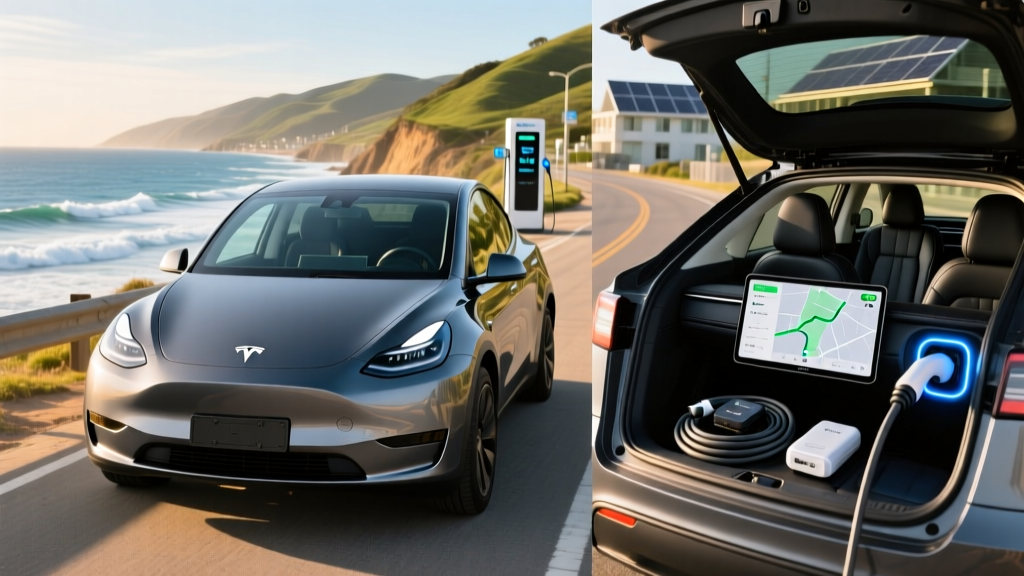
The 2021 Tesla Model Y Long Range remains one of the most sought-after vehicles on the used EV market in 2026. With an EPA-estimated 326 miles of range, dual-motor all-wheel drive, and access to the Supercharger network, it set the template that nearly every compact electric SUV launched since has tried to match. But five years after it rolled off the Fremont line, how does a 2021 Model Y stack up for a second or third owner today?
This review covers real-world range, battery health expectations, charging speeds, ownership economics, and whether a five-year-old Model Y still qualifies for federal incentives. If you're shopping the used market, these are the numbers that matter.
2021 Model Y Specs at a Glance
| Specification | Long Range AWD | Performance |
|---|---|---|
| EPA Range | 326 miles | 303 miles |
| Battery (usable) | ~75 kWh (NMC) | ~75 kWh (NMC) |
| MPGe (combined) | 121 MPGe | 111 MPGe |
| kWh/100 mi | 28 | 30 |
| 0–60 mph | 4.8 sec | 3.5 sec |
| Horsepower | ~384 hp | ~456 hp |
| Drivetrain | Dual-motor AWD | Dual-motor AWD |
| Peak DC Charge Rate | 250 kW | 250 kW |
| 10–80% DC Charge | ~27 min | ~27 min |
| Level 2 Charge Rate | 11.5 kW (~44 mi/hr) | 11.5 kW (~44 mi/hr) |
| Cargo Volume (rear seats up) | 30.2 cu ft | 30.2 cu ft |
| Cargo Volume (seats folded) | 76.2 cu ft | 76.2 cu ft |
| Battery Warranty (original) | 8 yr / 120,000 mi | 8 yr / 120,000 mi |
| Original MSRP | $49,990 | $59,990 |
Sources: EPA Fuel Economy, Tesla Owner's Manual (2021 Model Y).
Real-World Range: What the EPA Sticker Doesn't Tell You
Real-World Expectation: 270–295 miles in mixed driving; 240–260 miles sustained highway at 70+ mph; 200–230 miles in sub-30°F winter conditions.
The 326-mile EPA figure was best-in-class when the 2021 Model Y launched, and it remains competitive in 2026. But EPA testing uses relatively low average speeds and includes generous regenerative braking recovery. On a 70 mph interstate run in moderate weather (65–75°F), expect to use roughly 30–32 kWh/100 mi, which nets about 245–260 miles from a full charge.
Cold weather is the bigger variable. Tesla's heat pump — standard on the 2021 Model Y — was an industry first for mass-market EVs and significantly reduces cabin-heating energy draw compared to resistive heaters. Even so, at 20°F, lithium-ion internal resistance increases and battery buffering reduces usable capacity. Plan for 20–30% range reduction in deep winter. Preconditioning the battery while plugged in (via scheduled departure in the Tesla app) recovers some of this loss.
For a five-year-old pack, factor in degradation. Most 2021 Model Y NMC batteries show 5–10% capacity loss at 60,000–80,000 miles, based on fleet data aggregated by Recurrent. A Long Range that started at 326 miles EPA may deliver 295–310 miles at full charge today — before environmental adjustments.
Charging Speed: DC Fast, Level 2, and the Curve Reality
The 2021 Model Y supports V3 Supercharging at up to 250 kW peak, using the proprietary Tesla connector (NACS). In 2026, Tesla has opened the Supercharger network to non-Tesla EVs via Magic Dock adapters at select stations, but Tesla owners still enjoy seamless plug-and-charge integration.
| Charging Level | Power | Speed | Notes |
|---|---|---|---|
| Level 1 (120V) | ~1.4 kW | ~4–5 mi/hr | Emergency/trickle only |
| Level 2 (240V, 48A) | 11.5 kW | ~44 mi/hr | Home Wall Connector; full charge in ~8 hr |
| Level 2 (240V, 32A) | 7.7 kW | ~30 mi/hr | Mobile Connector on NEMA 14-50 |
| DC Fast (V3 Supercharger) | 250 kW peak | 10–80% in ~27 min | Sustained rate averages ~150 kW |
| DC Fast (CCS adapter) | Up to 150 kW | 10–80% in ~38 min | Requires Tesla CCS Combo adapter |
The charge curve matters more than peak kW. The 250 kW figure is a peak, not a sustained rate. The Model Y's NMC pack hits 250 kW only between roughly 10–25% state of charge (SoC). From 25–50%, it steps down to approximately 175 kW; from 50–80%, it tapers further to 75–100 kW. This is why the 10–80% time is ~27 minutes rather than the ~18 minutes that a flat 250 kW rate would theoretically deliver.
For practical road-trip planning, Tesla's built-in navigation with battery preconditioning is a genuine advantage. When you route to a Supercharger, the car warms the battery to optimal temperature, enabling the car to hit peak charge rate faster upon arrival. Without preconditioning — for example, at a non-Tesla DC fast charger — you may see peak rates limited to 150–175 kW for the first several minutes.
For home charging, a Tesla Wall Connector on a 60A circuit (48A continuous) delivers 11.5 kW, adding roughly 44 miles of range per hour. Most owners charging overnight from 20–80% need only 4–5 hours. If your electrical panel supports only a 40A circuit (32A continuous), you'll get 7.7 kW — still adequate for daily needs, adding ~30 mi/hr.
Performance and Driving Dynamics
The 2021 Model Y Long Range AWD uses a dual-motor setup: a permanent-magnet synchronous motor on the rear axle and an induction motor up front (which can freewheel to reduce drag when AWD traction isn't needed). Combined output is approximately 384 hp, with a 4.8-second 0–60 mph time — brisk for a family crossover.
The Performance trim bumps output to ~456 hp and drops the 0–60 to 3.5 seconds, though at a 23-mile range penalty (303 vs. 326 EPA miles). Performance models also received a lowered suspension, 21-inch Überturbine wheels, and larger brakes.
Ride quality on the 2021 Model Y is firm. Tesla improved the suspension tuning over the 2020 launch-year cars, but it's still noticeably stiffer than a Hyundai Ioniq 5 or Ford Mustang Mach-E. Road noise is moderate — improved over early 2020 builds with added acoustic glass, but not luxury-quiet. The low center of gravity (battery pack under the floor) keeps body roll minimal in corners.
Regenerative braking is strong and consistent. The 2021 Model Y was still configurable between "Standard" and "Low" regen modes — a feature Tesla later removed in 2022+ models, making one-pedal driving the default. If you prefer a coasting feel, the 2021 model year gives you that option.
Interior, Tech, and Driver Assistance
The 2021 Model Y interior is minimalist to a fault. A single 15-inch landscape touchscreen handles all infotainment, climate, and vehicle controls. There is no instrument cluster, no head-up display, and no physical buttons beyond the steering-wheel scroll wheels and hazard-light switch. This is polarizing — some owners love the simplicity, others find the lack of physical HVAC controls frustrating.
Build quality on 2021 Fremont-built Model Ys improved over 2020 examples but still fell short of German luxury benchmarks. Panel gaps, paint inconsistencies, and interior trim alignment were common owner complaints. The "wood" dashboard trim is real (open-pore walnut on some builds), a differentiator from the 2022+ refresh that switched to a textile material.
Autopilot and FSD (Supervised): All 2021 Model Ys shipped with Tesla's HW3 computer and basic Autopilot (Traffic-Aware Cruise Control + Autosteer). Full Self-Driving (FSD) was available as a $10,000 purchase or $199/month subscription add-on.
In practice, FSD (Supervised) handles most highway driving competently and has improved substantially through over-the-air updates since 2021. City-street performance varies widely by geography and scenario complexity. It remains a driver-assistance convenience, not a replacement for an alert human behind the wheel.
Cargo, Passenger Space, and Practicality
The Model Y's hatchback design is its practicality ace. With 30.2 cubic feet behind the second row and 76.2 cubic feet with the rear seats folded, it out-cargoes most compact SUV competitors — and the front trunk (frunk) adds another 4.1 cubic feet for charging cables or a small bag.
Second-row legroom measures 41.6 inches, generous for the segment. Headroom is ample at 37.7 inches, thanks to the full glass roof (which has no shade — a frequent complaint in hot climates). The optional third row, available on some 2021 Long Range builds, is strictly for small children and reduces cargo space significantly. Most buyers should skip it.
Towing capacity is rated at 3,500 pounds when properly equipped — adequate for a light utility trailer or a pair of dirt bikes, but not a full-size camping trailer.
Pricing and Federal Tax Credit Eligibility (2026)
As a used vehicle in 2026, the 2021 Model Y is no longer eligible for the new-vehicle §30D credit. However, it may qualify for the Used Clean Vehicle Credit (§25E), which provides up to $4,000 (or 30% of the sale price, whichever is lower) for qualifying pre-owned EVs.
- Sale price must be $25,000 or less
- Buyer AGI must not exceed: $75,000 (single), $112,500 (head of household), $150,000 (joint)
- Vehicle must be at least 2 model years old (2021 qualifies in 2026)
- Must purchase from a licensed dealer (private-party sales excluded)
- Vehicle must have a battery capacity of at least 7 kWh
- Claimed once per vehicle VIN — check if a prior owner already claimed it
- Credit is non-refundable (can reduce tax liability to zero, but no refund beyond that)
Source: IRS §25E. Verify eligibility with a tax professional — rules may change.
| Scenario | Estimated Price |
|---|---|
| Used 2021 Model Y LR (dealer, avg. mileage ~55k) | $23,000–$28,000 |
| After §25E credit (if eligible, max $4,000) | $19,000–$24,000 |
| Used 2021 Model Y Performance (avg. mileage ~45k) | $26,000–$32,000 |
| After §25E credit (if eligible and price ≤$25k) | $22,000–$25,000 |
Used Model Y prices have settled considerably from pandemic-era peaks. Long Range models with 50,000–70,000 miles commonly list between $23,000 and $28,000 at franchise dealers in early 2026, with Performance trims commanding a $3,000–$5,000 premium. The $25,000 sale-price cap for the §25E credit means many Long Range examples will qualify, while Performance models may push above the threshold.
Pros and Cons of a Used 2021 Model Y
Pros
- 326-mile EPA range still competitive in 2026
- Tesla Supercharger network — most reliable DC fast-charging ecosystem
- Over-the-air updates continue adding features years after purchase
- Strong regenerative braking with configurable modes
- Class-leading cargo volume for the compact EV SUV segment
- Heat pump standard — better cold-weather efficiency than resistive-heater EVs
- Eligible for up to $4,000 used-EV credit (if price and income qualify)
Cons
- Fremont build quality inconsistent — inspect panel gaps and paint carefully
- Firm ride quality; road noise above average for the price class
- No physical buttons — all controls through touchscreen
- Glass roof lacks a shade — cabin heat soak in summer
- FSD purchase does not transfer reliably between private-party owners
- Insurance costs remain above segment average
- 2021 lacks the refreshed interior and suspension of 2023+ Juniper models
Who Should Buy a 2021 Model Y in 2026?
- You want a proven, long-range family EV with the best DC fast-charging network
- Your daily commute is under 60 miles round-trip and you can charge at home
- You take 2–4 road trips per year and value Supercharger convenience
- You find a well-maintained example under $25,000 and qualify for the §25E credit
- Ride comfort and interior refinement are top priorities (look at the Ioniq 5 or Mach-E)
- You need a physical button interface or a traditional instrument cluster
- You want the latest battery chemistry (LFP for longevity or 800V architecture for faster charging)
The 2021 Model Y's strongest 2026 value proposition is the combination of range, Supercharger access, and a depreciated price that makes it one of the most affordable long-range EVs on the used market. For a family that needs a do-everything electric vehicle and can charge at home, it remains an outstanding choice — provided you inspect the build quality and battery health carefully before purchase.
Frequently Asked Questions
What is the real-world range of the 2021 Tesla Model Y?
The EPA rates the 2021 Model Y Long Range at 326 miles. In real-world mixed driving at moderate temperatures, expect 270–295 miles. Sustained highway driving at 70+ mph drops that to 240–260 miles, and sub-30°F winter conditions can reduce range to 200–230 miles. Account for 5–10% additional loss from battery degradation on a five-year-old pack.
How fast does the 2021 Model Y charge?
On a V3 Supercharger, the 2021 Model Y peaks at 250 kW and charges from 10–80% in approximately 27 minutes. The average sustained rate is closer to 150 kW due to the charge curve taper above 50% SoC. At home on a Level 2 Wall Connector (11.5 kW), a full charge takes about 8 hours. On a standard NEMA 14-50 outlet with the Mobile Connector (7.7 kW), expect roughly 10 hours.
Does the 2021 Model Y qualify for a federal tax credit?
Not the new-vehicle §30D credit — that applies only to new purchases. However, the 2021 Model Y may qualify for the §25E Used Clean Vehicle Credit, worth up to $4,000. Requirements include a sale price of $25,000 or less, purchase from a licensed dealer, buyer income below thresholds ($75K single / $150K joint), and the VIN must not have had the credit claimed previously. Verify with the IRS and a tax professional.
What battery chemistry does the 2021 Model Y use?
The 2021 Model Y Long Range and Performance both use NMC (nickel-manganese-cobalt) lithium-ion cells in a ~75 kWh usable pack, sourced primarily from Panasonic (2170 cells). Tesla began introducing LFP (lithium iron phosphate) batteries in Standard Range Model Ys in late 2021/2022, but the Long Range and Performance trims for the 2021 model year remained NMC.
Is a used 2021 Model Y worth buying vs. competitors?
Against the 2021–2022 Ford Mustang Mach-E (EPA 230–314 mi, CCS charging) and Hyundai Ioniq 5 (EPA 220–303 mi, 800V architecture), the Model Y wins on Supercharger network reliability, cargo space, and software ecosystem. The Mach-E offers a more traditional driving feel and a physical gauge cluster. The Ioniq 5 charges faster on compatible 350 kW chargers (10–80% in ~18 min) and has a more comfortable ride. If Supercharger access matters most to you, the Model Y is the clear pick.
What should I check before buying a used 2021 Model Y?
Request the battery health report from Tesla Service (or check State of Health via the car's energy graph). Inspect panel gaps, paint quality, and door/window seal alignment — Fremont build quality was variable. Confirm whether FSD was purchased and whether the license transfers with the vehicle (it typically does on Tesla-to-Tesla resales but not always on private-party transfers). Check for open recalls on NHTSA.gov using the VIN. Verify the 8-year/120,000-mile battery warranty remaining based on the original in-service date.