The 2021 Tesla Model Y remains one of the most sought-after used electric SUVs in 2026. Buyers are drawn to its blend of crossover practicality, access to the Supercharger network, and over-the-air updates that keep older vehicles current. But the 2021 Tesla Model Y interior — with its minimalist dashboard, single 15-inch touchscreen, and controversial lack of physical buttons — is what truly defines the ownership experience. This review examines the cabin in detail while covering the powertrain specs, charging performance, and ownership economics you need to evaluate one on the used market today.
2021 Model Y Interior: Design, Materials, and Space
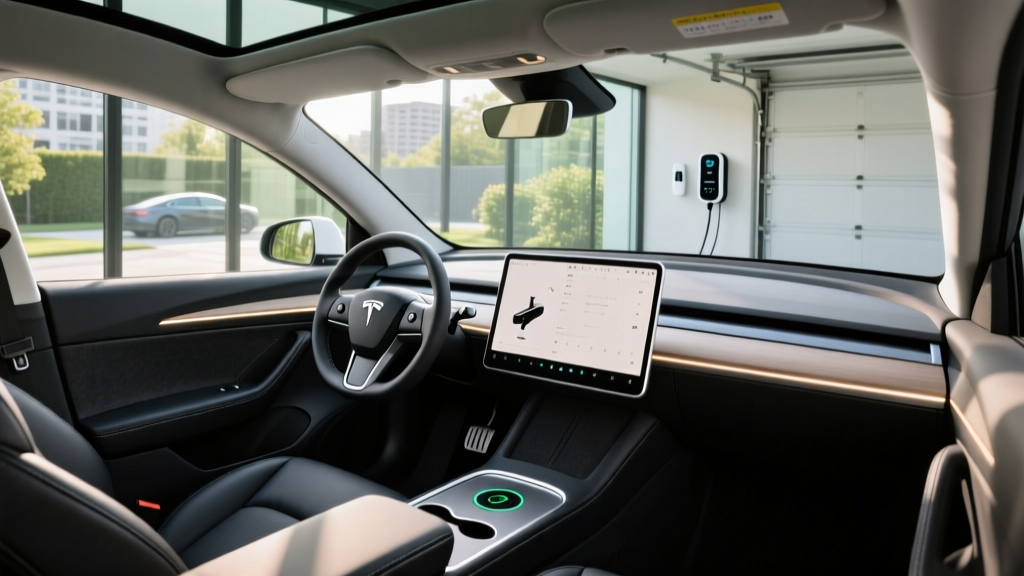
Tesla stripped the 2021 Model Y cabin down to its barest essentials. There is no instrument cluster behind the steering wheel, no center console buttons, and no traditional gauge readouts. Every vehicle function — from climate control and mirror adjustment to glovebox release and speedometer — routes through the 15-inch landscape-oriented touchscreen.
The dashboard is a single piece of wood trim (on early 2021 builds) or a matte black/silver finish (on later builds) that spans the full width. Air vents are hidden in a thin horizontal gap between the upper and lower dash panels, creating a clean, uninterrupted surface. The steering wheel is a flat-bottom design with two scroll wheels and two buttons — that's it.
Passenger Space and Cargo Dimensions
Despite the compact footprint (187.0 inches long, 75.6 inches wide), the Model Y's dedicated EV platform — with the battery pack under the floor — creates a flat surface and generous interior volume.
| Measurement | Specification |
|---|---|
| Front headroom | 41.0 in |
| Rear headroom | 37.7 in |
| Front legroom | 41.8 in |
| Rear legroom | 35.2 in |
| Cargo behind rear seats | 30.2 cu ft |
| Cargo with rear seats folded | 76.2 cu ft |
| Front trunk (frunk) | 4.1 cu ft |
| Seating capacity | 5 standard (optional 7 with third row) |
The optional third row (available only on Long Range AWD) is best suited for small children — adults will find the 26.5 inches of third-row legroom cramped for anything beyond short trips. With all rows in use, cargo space behind the third row drops to just 12.7 cu ft.
Interior Drawbacks Owners Report
The 2021 Model Y interior isn't without criticism. The most common complaints in owner forums and NHTSA feedback include:
- Panel gaps and trim alignment — Early 2021 Fremont-built units had inconsistent door and dashboard panel gaps. Tesla improved this through the year, but inspect any used example carefully.
- Road and wind noise — The frameless windows and large glass roof transmit more highway noise than competitors like the Ford Mustang Mach-E or Hyundai Ioniq 5. Some owners have added aftermarket sound deadening.
- No physical climate controls — Adjusting fan speed or temperature requires tapping the screen or using voice commands. This is a safety and convenience friction point for new EV adopters.
- Synthetic leather durability — The "vegan leather" (polyurethane) seats hold up reasonably well, but some 2021 examples show creasing on the driver's bolster at 40,000+ miles.
Range, Battery, and Real-World Efficiency
The 2021 Model Y was sold in three main configurations, each with different range and battery specs:
| Trim | EPA Range | Battery (usable) | Chemistry | Drivetrain | MPGe (combined) |
|---|---|---|---|---|---|
| Standard Range RWD | 244 mi | ~60 kWh | NMC (2170 cells) | Rear-Wheel Drive | 127 MPGe |
| Long Range AWD | 326 mi | ~75 kWh | NMC (2170 cells) | Dual-Motor AWD | 121 MPGe |
| Performance AWD | 303 mi | ~75 kWh | NMC (2170 cells) | Dual-Motor AWD | 117 MPGe |
All 2021 Model Y variants use NMC (nickel manganese cobalt) chemistry in Tesla's 2170 cylindrical cell format. Note: Tesla did not introduce LFP (lithium iron phosphate) batteries into the Model Y until the 2022 Standard Range refresh. If you see a used Model Y advertised as "LFP," verify the model year — a 2021 will not have one.
The EPA estimates above reflect mixed driving. In real-world highway testing at 70-75 mph, expect the Long Range AWD to deliver approximately 270-285 miles before needing a charge. In cold weather (below 32°F), range drops 20-30% due to battery resistance and cabin heating demands — plan for 220-250 miles of usable range on winter road trips. The Standard Range RWD is best kept as a commuter vehicle; its ~200-mile real-world highway range makes road trips stressful.
Efficiency is a Model Y strong suit. The Long Range AWD consumes roughly 28 kWh per 100 miles in mixed driving — competitive with the Ioniq 5 and significantly better than the Ford Mustang Mach-E Extended Range (34 kWh/100 mi). This efficiency translates directly to lower charging costs and more miles per charging session.
Charging Performance: DC Fast and Home Level 2
Charging speed is where the 2021 Model Y's age shows compared to 2024+ EVs with 800V architectures, but it remains practical for most owners.
| Charging Level | Long Range / Performance | Standard Range |
|---|---|---|
| DC Fast Charge (peak) | 250 kW (CCS via Supercharger V3) | 170 kW |
| 10-80% DC time | ~27 minutes | ~30 minutes |
| Level 2 home (max onboard charger) | 11.5 kW (48A) | 11.5 kW (48A) |
| Miles per hour (Level 2, 240V/48A) | ~44 mi/hr | ~44 mi/hr |
| Connector (2021 delivery) | Tesla proprietary (NACS) | Tesla proprietary (NACS) |
The 2021 Model Y was delivered with Tesla's proprietary connector (now standardized as NACS). In 2026, this is an advantage: the Model Y has native access to the full Tesla Supercharger network without adapters. Tesla opened Superchargers to non-Tesla EVs via the Magic Dock adapter, but Tesla-connector vehicles still enjoy the most seamless plug-and-charge experience.
On a V3 Supercharger (250 kW), the Long Range and Performance models peak at 250 kW only at low state of charge (typically 5-15%). The charge curve tapers significantly above 50% SoC and drops sharply past 80%. The 27-minute 10-80% time is realistic, but a full 10-100% session can take 45-50 minutes. Plan your road-trip stops around the 10-80% sweet spot.
For home charging, the 11.5 kW onboard charger is excellent. A NEMA 14-50 outlet (240V/50A circuit) or a hardwired Tesla Wall Connector delivers roughly 44 miles of range per hour of charging. An overnight 8-hour session adds ~350 miles — more than enough for any daily commute. Installation typically costs $500-$1,500 depending on panel proximity and local permitting; a 200A panel upgrade adds $1,500-$3,000 if needed.
Performance and Driving Dynamics
| Trim | 0-60 mph | Horsepower | Torque | Top Speed |
|---|---|---|---|---|
| Standard Range RWD | 5.3 sec | ~311 hp | ~295 lb-ft | 135 mph |
| Long Range AWD | 4.8 sec | ~384 hp | ~376 lb-ft | 135 mph |
| Performance AWD | 3.5 sec | ~456 hp | ~497 lb-ft | 155 mph |
Even the base Standard Range RWD delivers brisk acceleration that outpaces most gas-powered compact SUVs. The dual-motor AWD system on Long Range and Performance trims provides confident all-weather traction — torque vectoring between front and rear motors happens in milliseconds, and stability in rain and light snow is excellent.
The ride quality is firm. Tesla tuned the Model Y's suspension for responsiveness over comfort, and you will feel sharp bumps and expansion joints more than in a Mach-E or Ioniq 5. The 2021 refresh improved this slightly over the 2020 launch model, but it remains a sporty-riding crossover, not a luxury cruiser.
The Performance trim's 3.5-second 0-60 time is genuine supercar territory, and Track Mode allows adjustable torque distribution and regenerative braking intensity for closed-course driving. However, the Performance's 21-inch Überturbine wheels reduce range by roughly 23 miles versus the 19-inch Long Range wheels — a meaningful trade-off for daily drivers.
Pricing, Tax Credits, and Used-Market Value
Since the 2021 Model Y is only available on the used market in 2026, the new-car MSRP is relevant only for depreciation context. Here's what the original pricing looked like and what you'll pay today:
| Trim | Original MSRP (2021) | 2026 Used Price Range (est.) |
|---|---|---|
| Standard Range RWD | $41,990 | $22,000 - $27,000 |
| Long Range AWD | $49,990 | $27,000 - $34,000 |
| Performance AWD | $59,990 | $32,000 - $39,000 |
Prices vary significantly based on mileage, condition, Autopilot/FSD package inclusion, and color. Low-mileage Long Range examples with Full Self-Driving (FSD) capability command a premium, though FSD's resale value has softened as Tesla shifted to subscription-based access.
Federal Tax Credit on a Used 2021 Model Y
Under IRS §25E (the Used Clean Vehicle Credit), you may qualify for up to $4,000 (30% of the sale price, capped at $4,000) when purchasing a used 2021 Model Y from a licensed dealer. Key eligibility rules for 2026:
- Sale price cap: The dealer sale price must be $25,000 or less. This means only Standard Range RWD and some higher-mileage Long Range examples will qualify.
- Income limits: Modified adjusted gross income (MAGI) must not exceed $75,000 (single), $112,500 (head of household), or $150,000 (joint filers).
- Dealer requirement: The sale must be processed through a registered dealer who reports the transaction to the IRS. Private-party sales do not qualify.
- Vehicle age: The vehicle must be at least two model years old (a 2021 model qualifies in 2026).
- First transfer: The credit applies only to the first qualified sale of the vehicle after August 16, 2022. If the specific VIN has already been claimed under §25E, it cannot be claimed again.
This is a critical distinction from the new-vehicle §30D credit: the used-EV credit is $4,000 max, not $7,500, and the $25,000 price cap eliminates most Long Range and all Performance examples. Verify the vehicle's credit history with the selling dealer and consult a tax professional before finalizing your purchase.
Tech, Safety, and Driver Assistance
The 2021 Model Y's technology suite remains competitive in 2026 thanks to Tesla's over-the-air (OTA) update pipeline. Key features include:
- 15-inch touchscreen with navigation, streaming media (Netflix, YouTube, Spotify), gaming, and a full web browser
- Tesla Autopilot (standard) — adaptive cruise control and lane-centering on highways
- Full Self-Driving Capability (optional, $10,000-$12,000 add-on in 2021) — adds Navigate on Autopilot, Auto Lane Change, Smart Summon, and traffic light/stop sign recognition
- Sentry Mode — cameras record surroundings when parked, with motion-triggered alerts
- Dog Mode / Camp Mode / Party Mode — climate and entertainment presets for specific use cases
- Phone-as-key — Bluetooth proximity unlocks and starts the vehicle; no fob needed
- OTA software updates — new features, UI improvements, and efficiency tweaks delivered wirelessly
Despite the "Full Self-Driving" branding, Tesla Autopilot and FSD (Supervised) are SAE Level 2 driver-assistance systems. The driver must remain fully engaged, hands on or near the wheel, and eyes on the road at all times. These systems do not make the Model Y a self-driving vehicle. Only Level 4 services like Waymo operate without a human driver in geofenced areas.
Safety ratings for the 2021 Model Y are strong. The NHTSA awarded it a 5-Star Overall Safety Rating, and the IIHS named it a Top Safety Pick+ (the highest honor) when equipped with the standard LED headlights. The rigid battery pack structure contributes to excellent crash-test performance, particularly in side-impact and rollover scenarios.
Warranty and Long-Term Ownership
| Coverage | Term |
|---|---|
| Basic vehicle warranty | 4 years / 50,000 miles |
| Battery & drive unit (Long Range/Performance) | 8 years / 120,000 miles |
| Battery & drive unit (Standard Range) | 8 years / 100,000 miles |
| Battery capacity retention guarantee | Minimum 70% over warranty term |
For a 2021 model purchased in 2026, the basic 4-year/50,000-mile bumper-to-bumper warranty has expired on nearly all examples. However, the battery and drive unit warranty — the most expensive components to replace — remains active for most vehicles. A 2021 Model Y with 50,000 miles still has roughly 3 years and 70,000 miles of battery coverage remaining.
Tesla's NMC 2170 battery packs have demonstrated strong longevity. Industry data and owner-reported State of Health (SoH) figures suggest typical degradation of 8-12% over the first 100,000 miles. A well-maintained 2021 Model Y with 60,000 miles should still retain roughly 90-93% of its original capacity. To preserve battery health, Tesla recommends daily charging to 80-90% for NMC packs (unlike LFP packs, which can be charged to 100% regularly).
Out-of-warranty battery replacement costs for a 2021 Model Y range from $12,000 to $16,000 including labor, depending on whether a new or remanufactured pack is used. This is a significant expense, but the 8-year warranty provides substantial protection for most used buyers.
Who Should Buy a 2021 Tesla Model Y?
- Tech-forward commuters who value OTA updates, Supercharger access, and minimal maintenance
- Small families needing 30+ cu ft of cargo and the safety of a 5-star NHTSA-rated vehicle
- Road-trip enthusiasts willing to plan around Supercharger stops (the network remains the most reliable in North America)
- Cold-climate drivers who benefit from the Model Y's heat pump (standard on 2021 models) and AWD traction
- You prefer physical buttons and traditional controls over a touchscreen-only interface
- Ride comfort and cabin quietness are top priorities (consider the Ioniq 5 or Mach-E)
- You need more than 76 cu ft of cargo (the Hyundai Ioniq 5 offers comparable space with a more conventional interior)
- You want a brand-new vehicle with full warranty coverage and the latest 800V fast-charging architecture
Frequently Asked Questions
What is the real-world range of the 2021 Tesla Model Y?
The EPA rates the Long Range AWD at 326 miles, but expect 270-285 miles on the highway at 70-75 mph. In cold weather below freezing, plan for 220-250 miles. The Standard Range RWD delivers roughly 200-215 real-world highway miles. The Performance trim falls between the two at approximately 255-270 highway miles.
How fast does the 2021 Model Y charge?
On a Tesla V3 Supercharger (250 kW), the Long Range and Performance models charge from 10-80% in approximately 27 minutes, with peak rates only at low SoC. At home on a 240V/48A Level 2 charger, you'll add about 44 miles of range per hour, fully replenishing the battery overnight. The Standard Range peaks at 170 kW DC and takes about 30 minutes for 10-80%.
Does a used 2021 Model Y qualify for the federal EV tax credit?
It may qualify for the used-EV credit (§25E) of up to $4,000 — not the new-vehicle §30D credit of $7,500. Eligibility requires a dealer sale price of $25,000 or less, buyer income below IRS thresholds ($75K single / $150K joint), and purchase through a registered dealer. Most Long Range and all Performance examples exceed the $25,000 price cap, so this credit primarily applies to Standard Range RWD and higher-mileage Long Range units. Consult a tax professional and verify the VIN hasn't previously been claimed.
Is the 2021 Model Y worth buying vs. competitors?
Against the Ford Mustang Mach-E, Hyundai Ioniq 5, and Volkswagen ID.4 on the used market, the 2021 Model Y wins on Supercharger network access, efficiency (28 kWh/100 mi vs. 30-34 for competitors), cargo volume (76.2 cu ft), and OTA update longevity. It loses on ride comfort, interior noise, physical controls, and 800V fast-charging capability (which the Ioniq 5 offers). If reliable fast charging on road trips is your priority, the Model Y's Supercharger advantage is difficult to beat.
What are the biggest pros and cons of the 2021 Model Y?
Pros: Supercharger network access, class-leading efficiency and cargo space, strong safety ratings, excellent OTA update pipeline, brisk performance across all trims, heat pump for cold-weather efficiency, low running costs.
Cons: No physical buttons or instrument cluster, firm ride quality, noticeable road/wind noise, early-2021 panel gap inconsistencies, basic warranty expired on most examples, 400V architecture limits peak charge speed vs. newer 800V EVs, FSD package adds cost without delivering true autonomy.
How long will the 2021 Model Y battery last?
Tesla's NMC 2170 battery packs are designed for 300,000-500,000 miles of service life based on degradation curve projections. Real-world owner data at 100,000 miles shows 8-12% capacity loss, meaning a 326-mile Long Range would retain approximately 287-300 miles of range at that mileage. The 8-year/120,000-mile battery warranty guarantees at least 70% capacity retention. To maximize longevity, charge to 80-90% daily and avoid frequent DC fast charging above 80%.