Ford's first dedicated electric crossover arrived with a bold badge and a lot to prove. Five years later, the 2021 Mustang Mach-E has settled into the used-EV market as one of the most compelling options for buyers who want a practical, tech-forward electric SUV without paying new-car premiums. With EPA range stretching up to 305 miles, available all-wheel drive, and a spacious cabin, it remains competitive against newer rivals. But how does a 2021 model hold up in 2026 — and does it qualify for the used-EV federal tax credit?
This review breaks down every number that matters: real-world range expectations, DC fast-charging curves, battery degradation patterns, current used pricing, and the specific IRS rules governing the §25E used-EV credit. If you're shopping a pre-owned Mach-E, here's the data you need.
2021 Mustang Mach-E Quick Specs at a Glance
| Specification | Select (RWD) | Premium (AWD Ext. Range) | GT (AWD) |
|---|---|---|---|
| EPA Range | 230 mi | 270 mi | 270 mi (GT: 260 mi w/ GT1 wheels) |
| Usable Battery | 68 kWh (Standard) | 88 kWh (Extended) | 88 kWh (Extended) |
| Battery Chemistry | NMC (LG) | NMC (LG) | NMC (LG) |
| Horsepower | 266 hp | 346 hp | 480 hp (GT Perf: 480 hp / 634 lb-ft) |
| 0-60 mph | ~6.1 sec | ~5.1 sec | ~3.5 sec (GT Perf Ed.) |
| Drivetrain | RWD (single motor) | AWD (dual motor) | AWD (dual motor) |
| Max DC Fast Charge | 115 kW | 150 kW | 150 kW |
| 10-80% DC Time | ~38 min | ~45 min | ~45 min |
| EPA Efficiency | 101 MPGe (33 kWh/100mi) | 93 MPGe (36 kWh/100mi) | 90 MPGe (37 kWh/100mi) |
| Original Base MSRP | $43,995 | $52,000 | $61,000 |
| 2026 Used Price Range (est.) | $21,000-$27,000 | $27,000-$35,000 | $33,000-$42,000 |
Real-World Range: What the EPA Number Doesn't Tell You
EPA Sticker: 270 miles
Real-World Highway (70-75 mph, mild weather): ~235-250 miles
Real-World City/Mixed (moderate climate): ~255-270 miles
Cold-Weather Highway (below 32°F): ~195-220 miles (18-27% loss)
Cold-Weather City with Heat Pump Active: ~225-245 miles
The 2021 Mach-E's EPA range numbers were competitive at launch and remain respectable today. The Extended Range battery pack (88 kWh usable, NMC chemistry supplied by LG) powers the longest-range configurations to that 270-mile figure. The Standard Range pack (68 kWh usable) tops out at 230 miles with RWD — adequate for commuting but tight for road trips.
According to EPA data on fueleconomy.gov, the Premium AWD Extended Range achieves 93 MPGe combined, or 36 kWh per 100 miles. In practice, highway efficiency drops to roughly 38-42 kWh/100mi at sustained 75 mph speeds, which is where the range shortfall materializes. The Mach-E lacks a dedicated heat pump in the 2021 model year — it uses resistive cabin heating — so cold-weather range loss is more pronounced than in rivals like the Hyundai Ioniq 5 or Tesla Model Y.
For a five-year-old battery, expect approximately 5-10% degradation from original capacity depending on charging habits and climate. Most 2021 Mach-Es will still deliver 240-260 miles of real-world mixed driving on the Extended Range pack, which is livable for most daily routines and weekend trips with planned charging stops.
Charging Speed: DC Fast, Level 2, and the Curve Reality
Charging speed is where the 2021 Mach-E shows its age compared to 800V-architecture rivals. The Extended Range models peak at 150 kW on DC fast chargers, while Standard Range models are limited to 115 kW. Neither is slow, but neither is class-leading in 2026.
| Charging Level | Power / Rate | Miles Added per Hour | Notes |
|---|---|---|---|
| Level 1 (120V household) | ~1.2 kW | ~3 mi/hr | Emergency/trickle only |
| Level 2 (240V home, 48A) | 10.5 kW | ~28 mi/hr (ER) / ~22 mi/hr (SR) | Ford Mobile Charger or Wall Connector |
| DC Fast (Std. Range) | Peak 115 kW | ~190 mi/hr (at peak) | 10-80% in ~38 minutes |
| DC Fast (Ext. Range) | Peak 150 kW | ~240 mi/hr (at peak) | 10-80% in ~45 minutes |
The critical detail here is the charging curve. The 150 kW peak on Extended Range models is sustained only between roughly 15-40% State of Charge. After 50% SoC, the rate tapers to approximately 100 kW, and above 70% it drops further to around 60-70 kW. This means that while Ford advertises "10-80% in 45 minutes," the second half of that session is significantly slower than the first. On a road trip, you'll add roughly 140-160 miles of range in the first 20 minutes, then diminishing returns after that.
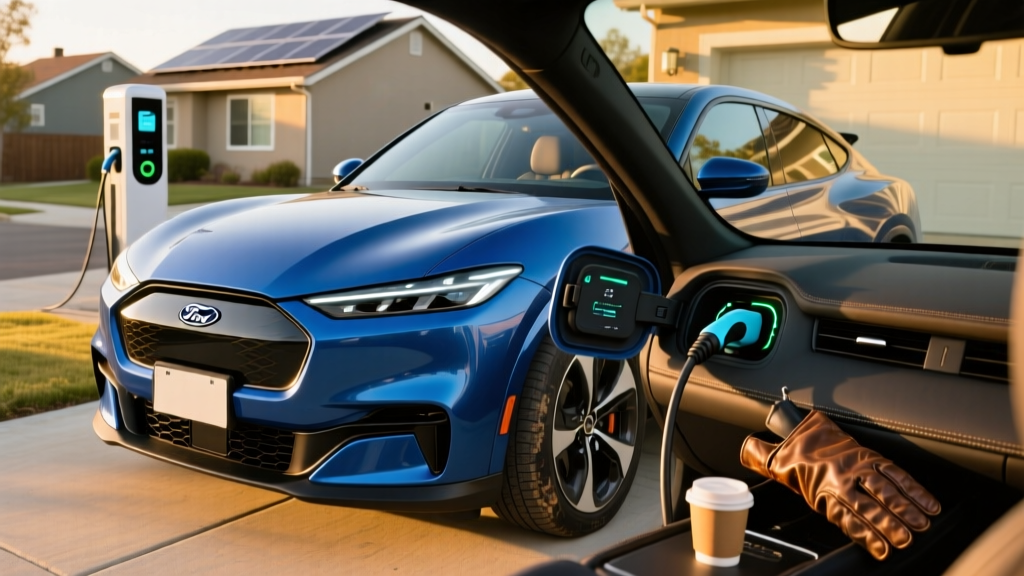
At home on a 48-amp Level 2 circuit (requiring a 60-amp breaker), the Mach-E recovers a full charge overnight in roughly 8.5 hours for the Extended Range pack. Ford's included Mobile Power Cord handles both 120V and 240V, though dedicated wall units from ChargePoint or Emporia provide faster, more reliable daily charging. Budget $500-$1,500 for professional Level 2 installation depending on your electrical panel's capacity and proximity to the parking spot.
The 2021 Mach-E ships with a CCS1 connector. As of 2026, Ford provides a complimentary NACS adapter for Mach-E owners, granting access to Tesla's Supercharger network — a significant advantage for road-trip charging reliability. Verify adapter availability and compatibility with the specific vehicle's VIN through Ford's owner portal.
Performance and Driving Dynamics
The Mach-E's performance range is broad. The base Select RWD delivers 266 hp and a 6.1-second 0-60 time — quick for daily driving, unremarkable by EV standards. The Premium AWD Extended Range bumps output to 346 hp and drops the sprint to about 5.1 seconds, which is where most buyers find the sweet spot of range and acceleration.
The GT variant is the headline act: 480 hp and, in Performance Edition trim, 634 lb-ft of torque with a 3.5-second 0-60. That puts it in sports-car territory. However, the GT sacrifices roughly 10-15 miles of range and commands a significant price premium on the used market.
All 2021 Mach-Es feature regenerative braking with a true one-pedal driving mode that can bring the car to a complete stop. The steering is well-weighted for an EV crossover, and the low center of gravity keeps body roll controlled. Ride quality is firm but compliant — this is tuned more for composure than plushness. Towing capacity is limited to 1,500 pounds (with the optional tow package on AWD models), so this is not a hauler.
Interior, Cargo, and Daily Practicality
The Mach-E's cabin was a departure from Ford's traditional design language in 2021, and it still feels modern. The portrait-oriented 15.5-inch touchscreen dominates the center stack, running Ford's SYNC 4A system. Wireless Apple CarPlay and Android Auto are standard. The digital instrument cluster is compact and focused on essential driving data — range, speed, driver-assist status.
Interior dimensions remain practical for a family of four:
- Front legroom: 43.3 inches
- Rear legroom: 38.9 inches
- Cargo behind rear seats: 29.7 cu ft
- Cargo with rear seats folded: 59.7 cu ft
- Front trunk (frunk): 4.7 cu ft (drainable — useful for wet gear or tailgating)
The frunk is a genuine advantage over competitors that lack one. The drainable design means you can use it as an ice chest at events. Rear seat space accommodates adults comfortably on longer trips, though the panoramic glass roof (standard on Premium and GT) slightly reduces headroom compared to the base roof.
Federal Tax Credit Eligibility for Used Buyers
The 2021 Mach-E was originally eligible for the full $7,500 new-EV federal tax credit under §30D. However, that credit is no longer available for new purchases of this model year. Instead, used buyers should look at the §25E Previously Owned Clean Vehicle Credit, which offers up to $4,000 (or 30% of the sale price, whichever is less).
- Sale price must be $25,000 or less
- Buyer income caps: $75,000 (single), $112,500 (head of household), $150,000 (joint)
- Vehicle must be at least 2 model years old (2021 qualifies in 2026)
- Must purchase from a licensed dealer (private-party sales do not qualify)
- Credit is 30% of sale price, up to $4,000 maximum
- Can only be claimed once per vehicle (check if prior owner used it)
- Point-of-sale transfer available — reduces purchase price at the dealership
In practical terms, a 2021 Mach-E Select RWD selling for $23,000 from a dealer could net the buyer a $4,000 credit (30% of $23,000 = $6,900, capped at $4,000), bringing the effective cost to $19,000. That's exceptional value for a 230-mile EV crossover. Higher-trim models selling above $25,000 do not qualify for §25E, which creates a strong incentive to negotiate toward that threshold.
Warranty and Battery Longevity
Ford backs the 2021 Mach-E's high-voltage battery and electric powertrain with an 8-year / 100,000-mile warranty (whichever comes first), covering defects and capacity loss below 70% of original capacity. For a 2021 model in 2026, that means approximately 3 years and varying mileage of factory coverage remaining — a meaningful safety net.
The NMC chemistry in the Mach-E has proven reasonably durable. Based on fleet data and owner reports, most 2021 Extended Range packs show 5-10% degradation at the five-year mark, translating to roughly 245-260 miles of real-world range remaining. Ford's battery management system maintains a generous buffer (approximately 7-8 kWh of the 98 kWh gross capacity is reserved and inaccessible), which protects long-term health at the cost of some usable capacity.
Standard coverage includes 3 years / 36,000 miles bumper-to-bumper and 5 years / 60,000 miles for the powertrain (non-EV components). If purchasing used, verify the remaining warranty via Ford's warranty lookup tool using the VIN.
Pros, Cons, and the Competitive Picture
- Up to 270 mi EPA range (Extended Range)
- Spacious cabin with useful frunk
- Strong performance across trims (3.5s GT)
- NACS adapter access to Supercharger network
- Over-the-air updates continue improving the car
- §25E credit eligibility under $25K
- Remaining battery warranty coverage
- No heat pump (2021) — cold-weather range loss
- 150 kW peak DC charging trails newer 800V rivals
- Charging curve tapers significantly above 50% SoC
- Original build-quality inconsistencies on early units
- GT trims priced above §25E $25K cap
- 1,500-lb towing limit is restrictive
- Some reported 12V battery drain issues in early builds
Against the Tesla Model Y (2021), the Mach-E offers a more conventional cabin layout, better build quality in most cases, and comparable range — but the Model Y's Supercharger-native advantage and slightly faster charging remain relevant. The Hyundai Ioniq 5 (introduced for 2022) surpasses the Mach-E in charging speed thanks to its 800V architecture, but a 2021 Mach-E can be had for significantly less on the used market. The Volkswagen ID.4 (2021) offers similar range and space but trails in performance and infotainment responsiveness.
Who Should Buy the 2021 Mach-E in 2026?
Look elsewhere if: You regularly drive in sub-freezing climates (the lack of a heat pump hurts), need frequent 300+ mile road trips without stopping, require towing beyond 1,500 lbs, or want the fastest possible DC charging for highway travel.
Frequently Asked Questions
What is the real-world range of the 2021 Mustang Mach-E?
The Extended Range AWD delivers approximately 235-250 miles on the highway and 255-270 miles in mixed city driving in moderate temperatures. In cold weather (below 32°F), expect 195-245 miles depending on driving style and cabin heating use. The Standard Range RWD delivers roughly 195-215 miles real-world.
How fast does the 2021 Mach-E charge at home and on DC fast chargers?
On a 48-amp Level 2 home charger (240V), the Extended Range pack charges at 10.5 kW, adding about 28 miles per hour — a full charge takes roughly 8.5 hours. On DC fast chargers, Extended Range models peak at 150 kW (10-80% in about 45 minutes), while Standard Range models peak at 115 kW (10-80% in about 38 minutes). Expect significant tapering above 50% SoC.
Does the 2021 Mach-E qualify for a federal tax credit in 2026?
Not the new-vehicle §30D credit. However, it can qualify for the §25E used-EV credit of up to $4,000 if purchased from a dealer for $25,000 or less, and the buyer meets income caps ($75K single / $150K joint). The vehicle must be at least 2 model years old, which a 2021 model satisfies in 2026. Verify current rules at irs.gov and consult a tax professional.
Is the 2021 Mach-E worth buying over newer EVs?
At used prices of $21,000-$35,000 (depending on trim and mileage), the 2021 Mach-E offers strong value — especially Extended Range models that land under the $25,000 §25E threshold. It trails newer 800V vehicles in charging speed and lacks a heat pump, but delivers competitive range, practical space, strong tech, and remaining battery warranty. For buyers with home charging and moderate daily needs, it's one of the best used-EV values in 2026.
What should I check before buying a used 2021 Mach-E?
Request a battery health report from Ford (State of Health percentage), verify remaining warranty coverage via VIN, check for any outstanding recalls or OTA update completion, inspect for early-build panel gap issues, and confirm the NACS adapter is available for the vehicle. A pre-purchase inspection at a Ford EV-certified dealer is strongly recommended.