Five years after it rolled off the Fremont line, the 2021 Tesla Model 3 remains one of the most common EVs on the road and one of the most searched on the used market. With new EV prices climbing and the IRS §25E used-vehicle credit making older models more accessible, the 2021 Model 3 sits in a sweet spot: depreciated enough to be affordable, modern enough to still feel current. But does its real-world range hold up? How does its charging stack up against newer rivals? And what battery chemistry did you actually get depending on trim? This review dissects the 2021 Model 3 with the numbers, caveats, and ownership realities buyers need.
2021 Model 3 Quick Specs at a Glance
| Spec | Standard Range Plus | Long Range AWD | Performance |
|---|---|---|---|
| EPA Range | 263 mi | 353 mi | 315 mi |
| Battery (usable) | ~50 kWh (LFP) | ~75 kWh (NMC) | ~75 kWh (NMC) |
| Drivetrain | RWD, single motor | AWD, dual motor | AWD, dual motor |
| 0-60 mph | 5.3 sec | 4.2 sec | 3.1 sec |
| Horsepower | ~283 hp | ~346 hp | ~450 hp |
| Top Speed | 140 mph | 145 mph | 162 mph |
| Peak DC Fast Charge | 170 kW | 250 kW | 250 kW |
| Level 2 Charge Rate | 11.5 kW (44 mi/hr) | 11.5 kW (44 mi/hr) | 11.5 kW (44 mi/hr) |
| MPGe (combined) | 142 MPGe | 134 MPGe | 125 MPGe |
| EPA Efficiency | 24 kWh/100 mi | 25 kWh/100 mi | 27 kWh/100 mi |
| Cargo Volume | 23 cu ft (trunk + frunk combined) | ||
| Original MSRP | $37,990 | $46,990 | $55,990 |
Sources: EPA / fueleconomy.gov, Tesla 2021 press materials.
Real-World Range: What the EPA Sticker Doesn't Tell You
The 2021 Model 3 lineup uses two distinct battery chemistries, and this is critical for used buyers to understand:
- Standard Range Plus: Tesla shifted many 2021 SR+ units to LFP (lithium iron phosphate) chemistry, supplied by CATL. LFP cells tolerate regular 100% charging without accelerated degradation — Tesla actually recommends charging to 100% at least weekly for LFP packs to keep the BMS calibrated.
- Long Range & Performance: These trims use NMC (nickel manganese cobalt) chemistry from Panasonic. NMC offers higher energy density (hence the 353-mile range) but prefers daily charging limits of 80-90% for longevity, reserving 100% for road trips.
In our experience and consistent with EPA test data, the Long Range's 353-mile figure is achievable in mild city/suburban driving at 35-55 mph. Push it to sustained 75 mph interstate cruising and expect 280-300 miles before the buffer runs out. Add cold weather (below freezing) and a cold-soaked battery, and 240-260 miles is realistic. The Model 3's heat pump (standard on 2021 refresh models) helps mitigate cabin-heating energy draw compared to resistive heaters, giving it an edge over some competitors in winter efficiency.
Charging Speed: DC Fast, Level 2, and the Curve Reality
Charging is where the 2021 Model 3 still holds its own against newer competition, thanks largely to Tesla's Supercharger network access — a significant advantage over CCS-only vehicles that still face spotty public infrastructure in many regions.
| Charging Level | Power / Rate | Miles Added per Hour | Notes |
|---|---|---|---|
| Level 1 (120V household) | ~1.4 kW | ~5 mi/hr | Emergency/trickle only |
| Level 2 (240V home, 48A) | 11.5 kW | ~44 mi/hr | Full charge overnight (~8-9 hrs for LR) |
| Level 2 (240V, 32A Mobile Connector) | 7.7 kW | ~30 mi/hr | Common with NEMA 14-50 adapter |
| DC Fast (V3 Supercharger) | Peak 250 kW (LR/Perf) Peak 170 kW (SR+) | ~1,000 mi/hr at peak | 10-80% in ~25-30 min (LR) |
Charge curve reality: The Long Range and Performance trims peak at 250 kW on a V3 Supercharger, but that rate only holds roughly between 10-30% State of Charge (SoC). From 30-60%, expect ~150-180 kW. Above 80%, the rate tapers sharply to protect the battery — charging from 80-100% can add another 20-25 minutes. This is normal for all lithium-ion EVs, not a Model 3 weakness, but it means road-trip strategy should target 10-80% charges rather than topping off.
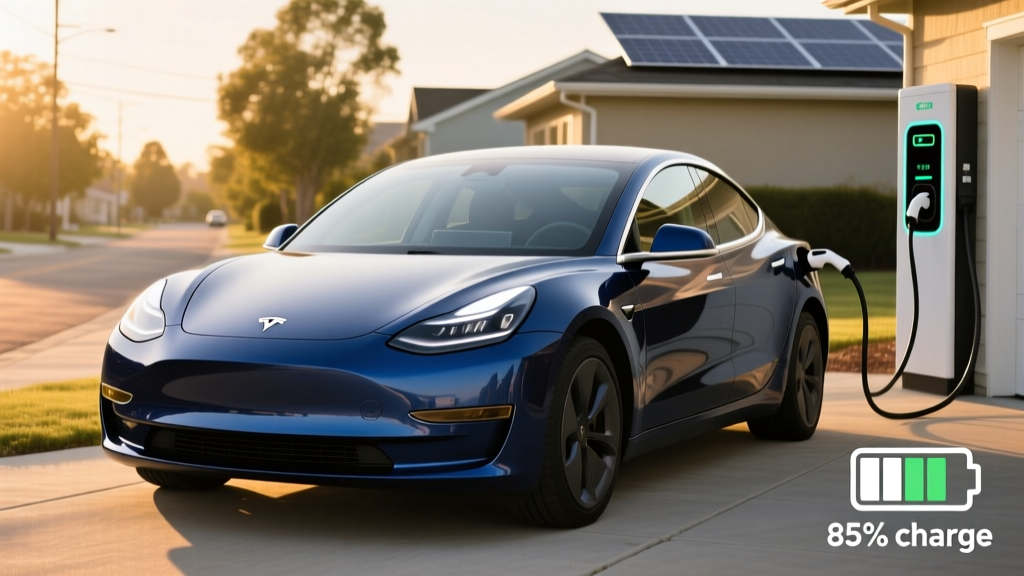
Home charging at 11.5 kW (48 amps on a 60-amp circuit) is the practical sweet spot. A full Long Range charge from near-empty takes roughly 8-9 hours, meaning most owners wake up to a full battery every morning. Installation costs for a dedicated Level 2 circuit typically range from $500-$2,000 depending on panel proximity and local permitting; consult a licensed electrician for your specific setup.
Performance, Ride, and Daily Drivability
Even the base Standard Range Plus hits 0-60 mph in 5.3 seconds — quicker than most gas-powered compact sedans. The Long Range drops that to 4.2 seconds with dual-motor AWD providing excellent traction in rain and snow. The Performance trim's 3.1-second sprint remains supercar territory, and its Track Mode (included in 2021) offers adjustable regen, stability control, and torque distribution for closed-course driving.
Ride quality on the 2021 Model 3 improved over earlier years with revised suspension tuning, but it's still firm by luxury-sedan standards. Road noise is noticeable above 65 mph — a common critique. The 15-inch center touchscreen handles virtually all vehicle controls, including climate, mirrors, and glovebox release. This minimalism appeals to some and frustrates others; there are no physical buttons for common adjustments.
Cargo and passenger space: The Model 3 offers 23 cubic feet of combined cargo volume (15.6 cu ft trunk + 7.4 cu ft frunk). Rear legroom measures 35.2 inches — adequate for adults on shorter trips but tighter than a Toyota Camry or Hyundai Ioniq 5. The glass roof creates an airy cabin but offers no shade option beyond the tint itself, which can make the interior warm in summer sun.
Tech, Driver Assistance, and What It Can't Do
The 2021 Model 3 comes standard with Tesla's Basic Autopilot — adaptive cruise control and lane-centering assist. The optional Full Self-Driving (FSD) package ($10,000 at the time, or $199/month) added Navigate on Autopilot, auto lane-change, Smart Summon, and traffic-light/stop-sign recognition.
The 2021 Model 3's infotainment runs Tesla's proprietary OS, which receives over-the-air (OTA) updates that have continued through 2026, adding features and refinements years after purchase. The built-in navigation, Spotify/Apple Music integration, and Sentry Mode (dashcam-based security recording) remain competitive. However, the 2021 model predates Tesla's Ryzen-based MCU4 hardware, so the infotainment processor (Intel Atom-based MCU3) is slower than what's in 2022+ models — noticeable in map rendering and app load times.
Pricing, Used Market Value, and Tax Credit Eligibility
As a used vehicle in 2026, the 2021 Model 3's value proposition has shifted significantly from its original MSRP:
| Trim | 2021 MSRP | 2026 Est. Used Price | Potential §25E Used Credit |
|---|---|---|---|
| Standard Range Plus | $37,990 | $18,000-$22,000 | Up to $4,000 (30% of sale price) |
| Long Range AWD | $46,990 | $24,000-$29,000 | Up to $4,000 |
| Performance | $55,990 | $27,000-$33,000 | Up to $4,000 |
IRS §25E Used Clean Vehicle Credit: Because the 2021 Model 3 is purchased used, it qualifies for the §25E credit — not the §30D new-vehicle credit. The §25E credit provides up to $4,000 or 30% of the sale price (whichever is lower), applied at point of sale. Key eligibility requirements per IRS guidelines:
- Sale price must be $25,000 or less (this eliminates most Performance-trim listings)
- Buyer AGI must not exceed: $75,000 (single), $112,500 (head of household), $150,000 (joint)
- Vehicle must be at least 2 model years old (2021 qualifies in 2026)
- Must purchase from a licensed dealer (private-party sales do not qualify)
- Credit is non-refundable and can only be claimed once per vehicle (check the VIN's history)
Always confirm eligibility with a tax professional. Rules may change, and income/sourcing requirements apply.
Warranty, Battery Longevity, and Maintenance
Tesla's warranty for the 2021 Model 3 covers:
- Basic vehicle: 4 years / 50,000 miles
- Battery & drive unit: 8 years / 100,000 miles (SR+) or 8 years / 120,000 miles (LR/Performance), with minimum 70% capacity retention guaranteed
For a 2021 model purchased in 2026, the basic warranty has expired, but the battery/drive unit warranty still has 3-5 years of coverage remaining depending on mileage. This is a significant safety net.
Real-world battery degradation data from high-mileage Model 3 owners shows NMC packs losing approximately 5-8% capacity in the first 50,000 miles, then leveling off. LFP packs in the SR+ tend to degrade even more slowly (3-5%), though they start with less total capacity. A full battery replacement outside warranty currently runs $12,000-$16,000 at Tesla service centers — rare but worth knowing.
Maintenance costs are minimal: cabin air filter replacement (~$50-80 every 2 years), tire rotation, wiper fluid, and brake fluid checks. Regenerative braking preserves brake pads, often lasting 100,000+ miles. Expect annual insurance premiums of $1,800-$2,800 depending on location and driving record — higher than average for the segment, a known Tesla ownership cost.
How the 2021 Model 3 Compares to Key Rivals
| Metric | 2021 Tesla Model 3 LR | 2021 Hyundai Ioniq 5 | 2021 Ford Mustang Mach-E | 2022 BMW i4 eDrive40 |
|---|---|---|---|---|
| EPA Range | 353 mi | 303 mi | 300 mi (ER) | 301 mi |
| Peak DC Charge | 250 kW | 235 kW | 150 kW | 205 kW |
| Charging Network | Supercharger (native) | CCS (NACS adapter avail.) | CCS (NACS adapter avail.) | CCS (NACS adapter avail.) |
| Used Price (2026) | $24-29K | $22-27K | $23-28K | $30-36K |
| Rear Seat Space | 35.2" legroom | 39.4" legroom | 38.8" legroom | 34.7" legroom |
The Model 3's range and Supercharger access remain its strongest differentiators. The Ioniq 5 and Mach-E offer noticeably roomier rear seats and more conventional interiors with physical controls. The Mach-E's 150 kW peak charge rate is a clear weakness on road trips. If rear-seat comfort or cargo versatility matters, the Ioniq 5 or Mach-E win; if range, charging speed, and software are priorities, the Model 3 still leads.
Pros, Cons, and Who Should Buy the 2021 Model 3
Pros
- Class-leading EPA range (353 mi, Long Range)
- Supercharger network access — still the most reliable DC network
- 250 kW peak charging (10-80% in ~25-30 min)
- OTA updates keep software current years later
- Strong performance even in base trim
- Minimal maintenance costs
- §25E used credit can drop effective price below $20K (SR+)
Cons
- Cramped rear seat vs. crossovers and Ioniq 5
- No physical buttons — everything through the touchscreen
- Road noise at highway speeds
- Insurance premiums above segment average
- MCU3 infotainment processor showing its age vs. newer hardware
- Basic warranty expired on 2021 models
- Glass roof lacks retractable shade
Who the 2021 Model 3 Suits Best
Ideal for: Solo commuters, couples without children, tech-forward buyers who value software and charging infrastructure, road-trippers who want Supercharger reliability, and buyers seeking the lowest cost-per-mile EV under $30K.
Look elsewhere if: You regularly carry rear-seat passengers, prefer physical climate/volume controls, need hatchback cargo flexibility (consider the Model Y or Ioniq 5), or want the newest driver-assist hardware (Tesla's HW4 camera suite arrived in 2023+ models).
Frequently Asked Questions
What is the real-world range of the 2021 Model 3?
The Long Range AWD delivers ~270-300 miles at highway speeds in mild weather and ~230-260 miles in freezing temperatures. The Standard Range Plus realistically achieves ~190-210 highway miles. City driving at moderate speeds can approach or slightly exceed the EPA estimate.
How fast does the 2021 Model 3 charge?
On a V3 Supercharger, the Long Range and Performance peak at 250 kW, charging from 10-80% in approximately 25-30 minutes. The SR+ peaks at 170 kW (10-80% in ~30-35 min). At home on a 48-amp Level 2 circuit, all trims charge at 11.5 kW, adding ~44 miles of range per hour.
Does the 2021 Model 3 qualify for a federal tax credit?
As a used purchase, it qualifies for the IRS §25E Used Clean Vehicle Credit — up to $4,000 or 30% of the sale price, whichever is less. The vehicle must sell for $25,000 or less from a licensed dealer, and buyer income caps apply ($75K single / $150K joint). It does not qualify for the §30D new-vehicle credit. Consult a tax professional for your specific situation.
Is the 2021 Model 3 still worth buying in 2026?
Yes — particularly the Long Range AWD, which offers 353 miles of EPA range, 250 kW charging, and Supercharger access at a used price of $24-29K (potentially $20-25K after the §25E credit). Its main compromises — tight rear seat, touchscreen-only controls, road noise — are unchanged from when it was new. If those don't bother you, it remains one of the best value-per-mile EVs available.
What battery chemistry does the 2021 Model 3 have?
The Standard Range Plus uses LFP (lithium iron phosphate) — durable, slower-degrading, and safe to charge to 100% regularly. The Long Range and Performance use NMC (nickel manganese cobalt) — higher energy density but best kept at 80-90% daily. Check the vehicle's charge settings screen: if it recommends charging to 100%, it's LFP.
How long will the battery last?
Tesla warranties the battery for 8 years / 100,000-120,000 miles (trim-dependent) with a minimum 70% capacity retention. Real-world data from high-mileage Model 3 fleets suggests NMC packs retain ~90-93% capacity at 50,000 miles and ~85-88% at 100,000 miles. LFP packs degrade even more slowly. Many Model 3 batteries are projected to outlast 200,000 miles before falling below 70% capacity.