Quick Verdict: The Urban EV That Knows Its Lane
The 2021 Mini Cooper SE Hardtop (officially the Mini Electric in some markets) was never designed to win a range contest. With an EPA-estimated 114 miles and a 32.6 kWh battery, it occupies a very specific niche: a premium city runabout with go-kart handling, unmistakable styling, and enough electric punch to make stoplight-to-stoplight driving genuinely fun. Five years after its US debut, the 2021 Mini SE Hardtop remains a compelling used-EV proposition for urban commuters who charge at home and rarely need more than 80 real-world miles between plug-ins.
Mini discontinued the 3-door Hardtop SE in the US after the 2023 model year, replacing it with the next-generation Mini Cooper Electric (J01 platform) for 2025. That means every 2021 Mini SE you encounter today is a used vehicle — and that changes the value proposition significantly, especially with the IRS used-EV tax credit still in play for qualifying buyers.
| Spec | Value |
|---|---|
| EPA Range | 114 miles |
| Battery (gross / usable) | 32.6 kWh / 28.9 kWh |
| Battery Chemistry | NMC (Nickel Manganese Cobalt) |
| Motor / Drivetrain | Single front motor / FWD |
| Horsepower / Torque | 181 hp / 199 lb-ft |
| 0–60 mph | 6.5 seconds (manufacturer) |
| Top Speed | 93 mph (electronically limited) |
| EPA Efficiency | 110 MPGe combined (31 kWh/100 mi) |
| Max DC Fast Charge | 50 kW (CCS) |
| Level 2 AC Charge Rate | 7.4 kW |
| Cargo Volume (rear seats up / down) | 8.7 / 24.0 cu ft |
| Curb Weight | 3,176 lbs |
| Original Base MSRP | $29,900 (before incentives) |
| Battery Warranty (original) | 8 years / 100,000 miles |
Range and Efficiency: What 114 EPA Miles Means in the Real World
EPA Estimated Range: 114 miles
Real-World Expectation: 85–100 miles highway (70+ mph), 100–115 miles mixed city driving, and as low as 70–80 miles in freezing temperatures with cabin heat running.
The 2021 Mini SE's 114-mile EPA figure is among the lowest of any modern EV sold in the US, and that demands honest framing. The usable battery capacity is approximately 28.9 kWh (Mini reserves roughly 3.7 kWh as a buffer to protect long-term cell health). That's roughly one-third the capacity of a Tesla Model Y Long Range — and it shows.
In our experience and consistent with third-party testing from outlets like fueleconomy.gov, the Mini SE returns its best efficiency in stop-and-go city driving where regenerative braking recovers energy aggressively. The adjustable regen system (three levels plus a coasting mode) lets drivers maximize one-pedal driving in traffic, pushing real-world city range close to the EPA sticker.
Highway driving is where the Mini SE loses ground. At 75 mph, aerodynamic drag and the lack of a heat pump (the 2021 model uses resistive PTC heating) eat into range quickly. Expect roughly 85–100 miles on a warm-weather highway run. In sub-freezing conditions, the resistive cabin heater draws significant power from the traction battery — plan for 70–80 miles of usable range on a brutal January commute. Preconditioning the cabin and battery while still plugged in at home is essential to preserving range in cold weather.
Efficiency is rated at 110 MPGe combined, which translates to 31 kWh per 100 miles. That's respectable for the car's weight class but trails more efficient platforms like the Hyundai Kona Electric (120 MPGe) and Chevrolet Bolt EV (118 MPGe) from the same era.
Charging Speed: DC Fast, Level 2, and the 50 kW Ceiling
The 2021 Mini SE uses a CCS1 connector for DC fast charging and a standard J1772 inlet for AC Level 1 and Level 2 charging. Here's what the numbers look like across all three charging levels:
| Charging Level | Power / Rate | Miles Added per Hour | Notes |
|---|---|---|---|
| Level 1 (120V household) | ~1.4 kW | ~4–5 mi/hr | Emergency/top-up only; full charge in ~20+ hrs |
| Level 2 (240V home/public) | 7.4 kW | ~25–28 mi/hr | Full 0–100% in ~4 hours |
| DC Fast Charge (CCS) | 50 kW peak | ~130–150 mi/hr (at peak) | 10–80% in ~35 minutes |
The 50 kW limitation matters. The Mini SE's peak DC charge rate of 50 kW was modest when new and feels increasingly dated as 150–350 kW chargers proliferate. On a 50 kW station, the car charges from 10% to 80% in approximately 35 minutes. The charge curve is relatively flat to about 60% state of charge, then tapers noticeably above 80% — standard behavior for NMC cells, but the low peak rate means even the taper phase doesn't add much time.
For home charging, a 7.4 kW Level 2 wallbox (requiring a 40-amp circuit on a 50-amp breaker) replenishes the battery from empty to full in roughly four hours. Given the small battery, overnight Level 2 charging is more than adequate — most owners will plug in at 40–50% state of charge and wake up to a full battery in well under three hours. A licensed electrician should evaluate your panel capacity before installing a Level 2 circuit, especially in older homes where a 200-amp panel upgrade may be necessary.
The Mini SE does not support Tesla Supercharger access natively. With a NACS-to-CCS adapter (available from third parties, though compatibility varies), some CCS-equipped EVs can use Superchargers — but check Mini/adapter manufacturer guidance before attempting this on a 2021 SE.
Performance and Driving Dynamics
Where the 2021 Mini SE Hardtop genuinely shines is driving engagement. The front-mounted electric motor produces 181 horsepower and 199 lb-ft of torque, delivered instantly from zero RPM. The 6.5-second 0–60 mph time doesn't sound extraordinary on paper, but the immediate torque response makes the car feel quicker in urban and suburban driving than the number suggests.
The battery pack sits low in the chassis (under the rear seats and center tunnel, in the space originally designed for the exhaust system and fuel tank on the F56 platform), giving the SE a low center of gravity and near-ideal weight distribution. Mini's trademark go-kart handling translates well to the electric variant — the steering is sharp, body roll is minimal, and the FWD traction is adequate for the power on offer.
The electronically limited 93 mph top speed is a deliberate efficiency measure. Higher speeds would drain the small battery rapidly, so Mini capped velocity to preserve what range exists. For a city-focused EV, this is a reasonable tradeoff, but it makes the SE less suitable for high-speed autobahn-style driving.
Drive modes include Sport, Mid, and Green, plus a Green+ setting that limits climate control and throttle response for maximum range preservation. The regen braking system's multiple levels (adjustable via steering-wheel paddles) allow everything from aggressive one-pedal deceleration to free-coasting for hypermiling.
Interior, Technology, and Practicality
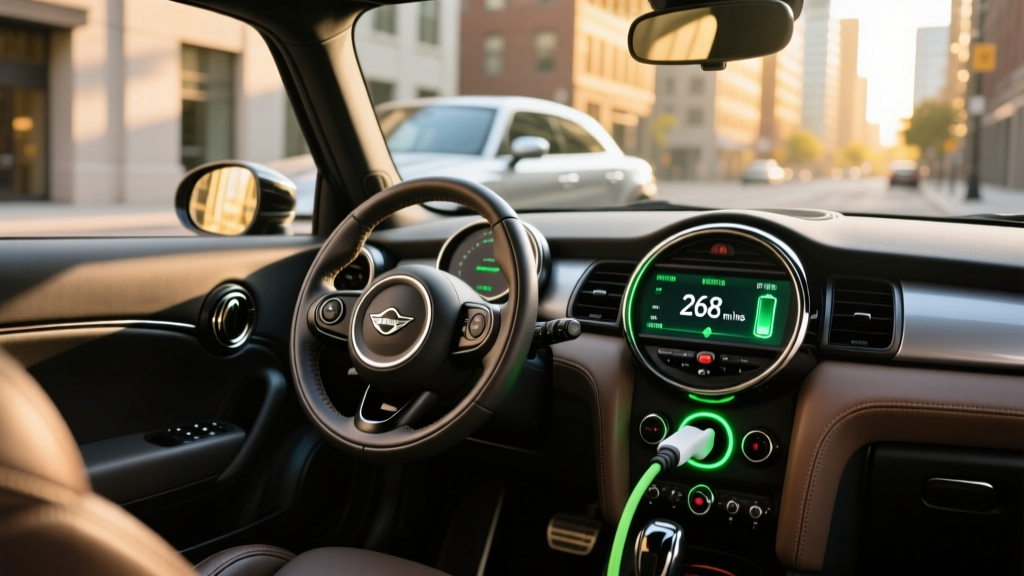
The 2021 Mini SE Hardtop uses the F56-generation interior, which means a circular central display (8.8 inches), a digital instrument cluster with EV-specific readouts (power consumption, regen, range), and Mini Connected infotainment with Apple CarPlay (wireless) and Android Auto (wired on 2021 models). The interior build quality is above its price class — soft-touch materials, toggle-style switches, and the signature circular air vents give it a premium, distinctive feel that few EVs at this price point match.
Driver assistance technology on the 2021 SE includes forward collision warning with automatic emergency braking, lane departure warning, and a head-up display on higher trims. Notably absent: adaptive cruise control, lane-keeping assist, and any form of hands-free driving. This is SAE Level 0–1 driver assistance — basic safety aids, not autonomous or semi-autonomous capability.
Practicality is the SE's weakest point. The 3-door Hardtop body style means rear-seat access is awkward, and rear legroom is just 30.9 inches — tight for adults on anything beyond short trips. Cargo volume behind the rear seats is 8.7 cubic feet, expanding to 24.0 cubic feet with the 50/50 split rear seats folded. That's enough for groceries and a weekend bag but not competitive with the Chevrolet Bolt EUV (16.3 cu ft cargo) or Hyundai Kona Electric (19.2 cu ft). There is no front trunk (frunk); the space under the hood is occupied by the electric motor and power electronics.
Available trims for the 2021 model year included the Signature ($29,900), Iconic ($33,900), and a limited-run trim. The Iconic added a panoramic sunroof, head-up display, Harman Kardon premium audio, and leather upholstery. Even fully loaded, the SE's original MSRP stayed below the $55,000 IRS cap for new-vehicle tax credit eligibility — though that's relevant only for the original purchasers.
Pricing, Depreciation, and Used-EV Tax Credit Eligibility
Because Mini discontinued the SE Hardtop in the US after 2023, every 2021 model is now a used vehicle. As of early 2026, clean examples of the 2021 Mini SE Hardtop typically trade between $15,000 and $21,000 depending on mileage, condition, trim level, and market. Higher-mileage Signature trims can dip below $14,000 at auction, while low-mileage Iconic trims command premiums above $22,000 from specialty dealers.
Depreciation has been steeper than average for EVs of this era, largely because the 114-mile range limits the buyer pool. If your use case fits, that depreciation is your gain — you're getting a premium-built, fun-to-drive EV at a fraction of its original MSRP.
Does the 2021 Mini SE Qualify for the Federal Used-EV Tax Credit?
Under IRS §25E (the previously owned clean vehicle credit), qualifying buyers can claim up to $4,000 or 30% of the sale price (whichever is less) when purchasing a used EV from a licensed dealer. For a $16,000 Mini SE, the maximum credit would be $4,000. For a $10,000 example, it would be $3,000 (30% of sale price).
Key eligibility requirements per IRS guidelines:
- Sale price cap: The vehicle must sell for $25,000 or less
- Buyer income limits: Modified AGI cannot exceed $75,000 (single), $112,500 (head of household), or $150,000 (joint)
- Dealer sale required: Private-party sales do not qualify
- Vehicle age: Must be at least 2 model years old (a 2021 model qualifies in 2026)
- First transfer since new: The credit can only be claimed once per vehicle after its original sale — verify the specific VIN hasn't already been claimed
- No prior credit: You cannot have claimed the used-EV credit in the 3 years before your purchase date
The credit can be transferred to the dealer at point of sale (reducing your purchase price directly) or claimed on your tax return. Consult a tax professional to confirm your specific eligibility — income limits, prior credit claims, and VIN history all affect qualification.
Battery Longevity, Warranty, and Replacement Considerations
The 2021 Mini SE uses an NMC (nickel manganese cobalt) lithium-ion battery pack supplied by CATL. The gross capacity is 32.6 kWh with approximately 28.9 kWh usable — Mini's conservative buffer strategy protects the cells from deep discharge and full-charge stress, which aids long-term health.
Original battery warranty coverage is 8 years or 100,000 miles (whichever comes first), guaranteeing that the battery will retain at least 70% of its original capacity. For a 2021 model, that warranty remains active through the 2029 model year or until the odometer hits 100,000 miles — meaning most 2021 Mini SE buyers in 2026 still have 3+ years of factory battery coverage remaining.
NMC degradation data from similar BMW Group battery packs (the Mini SE shares its powertrain architecture with the BMW i3s) suggests typical capacity loss of 8–12% over the first five years under normal use. Owners who primarily charge at Level 2, avoid frequent DC fast charging, and don't habitually charge to 100% or discharge below 10% will see less degradation. A battery replacement, should it be needed out of warranty, typically runs $8,000–$12,000 including labor at a Mini dealer — though third-party refurbishment options may emerge as these vehicles age.
Who Should Buy the 2021 Mini SE Hardtop — and Who Shouldn't
Pros
- Engaging, go-kart handling with instant EV torque
- Premium interior quality above its used price point
- Low home charging cost (small battery = fast, cheap fills)
- Strong residual warranty coverage through ~2029
- Eligible for up to $4,000 used-EV federal tax credit
- Distinctive styling — nothing else looks like a Mini
Cons
- 114-mile EPA range limits use to commuting and city driving
- 50 kW DC fast charging is slow by 2026 standards
- Cramped rear seats and limited cargo space
- No heat pump — cold-weather range suffers significantly
- 3-door body style limits practicality
- No adaptive cruise control or advanced driver assists
Choose the 2021 Mini SE Hardtop if: You need a fun, premium city commuter; you have reliable home Level 2 charging; your daily round-trip commute is under 60 miles; you rarely carry rear-seat passengers; and you want an EV under $20,000 after tax credits.
Look elsewhere if: You need 200+ miles of range for road trips, you regularly carry adults in the back seat, you live in a cold climate without garage parking, or you need DC fast charging for apartment/condo living without home charging access.
Competitor Comparison: Mini SE vs. Bolt EV vs. Kona Electric
| Spec | 2021 Mini SE | 2021 Chevy Bolt EV | 2021 Hyundai Kona Electric |
|---|---|---|---|
| EPA Range | 114 mi | 259 mi | 258 mi |
| Battery (usable) | 28.9 kWh | 65 kWh | 64 kWh |
| DC Fast Charge | 50 kW | 55 kW | 75 kW |
| 0–60 mph | 6.5 sec | 6.5 sec | 6.4 sec |
| Cargo (seats up) | 8.7 cu ft | 16.9 cu ft | 19.2 cu ft |
| Typical Used Price (2026) | $15K–$21K | $14K–$19K | $16K–$22K |
| Max Used-EV Credit | Up to $4,000 | Up to $4,000 | Up to $4,000 |
The Bolt EV and Kona Electric both offer more than double the Mini SE's range, significantly more cargo space, and similar or faster DC charging — often at comparable or lower used prices. If range and practicality are your primary concerns, either is the more rational choice. The Mini SE's advantage is driving dynamics, interior quality, and brand cachet. It's an emotional pick, not a spreadsheet pick — and there's nothing wrong with that if your lifestyle supports it.
Frequently Asked Questions
What is the real-world range of the 2021 Mini SE Hardtop?
Expect 85–100 miles on the highway in warm weather, 100–115 miles in mixed city driving, and as low as 70–80 miles in freezing conditions with the heater running. The EPA sticker says 114 miles, but your mileage will vary significantly based on speed, temperature, and terrain.
How fast does the 2021 Mini SE charge?
On a DC fast charger, it peaks at 50 kW, reaching 10–80% in approximately 35 minutes. At home on a Level 2 (240V, 7.4 kW) charger, a full charge takes about 4 hours. Level 1 (120V) trickle charging adds roughly 4–5 miles per hour — suitable only for overnight top-ups.
How much does a 2021 Mini SE cost after the used-EV tax credit?
With typical used prices of $15,000–$21,000 and a potential $4,000 federal credit (for qualifying buyers purchasing from a dealer at or below $25,000), effective cost can range from $11,000 to $17,000. State incentives may stack on top — check your local DMV or energy office for current programs.
Is the 2021 Mini SE worth buying versus a Chevy Bolt or Hyundai Kona Electric?
If you prioritize driving fun, premium interior quality, and compact dimensions for tight urban parking — and your commute fits within ~80 real-world miles — the Mini SE is a compelling and unique choice. If you need range versatility, cargo space, or rear-seat room, the Bolt EV or Kona Electric are more practical at similar used prices.
Does the 2021 Mini SE qualify for the federal EV tax credit?
Not the new-vehicle §30D credit (that expired for the original buyer). However, it may qualify for the IRS §25E used clean vehicle credit of up to $4,000, subject to buyer income limits, a $25,000 sale price cap, dealer-sale requirement, and VIN eligibility. See IRS.gov for current rules and consult a tax professional.
How long will the 2021 Mini SE battery last?
The original battery warranty covers 8 years/100,000 miles (through ~2029 for a 2021 model), guaranteeing at least 70% capacity retention. Based on NMC degradation data from similar BMW Group packs, expect 8–12% capacity loss over the first five years with normal charging habits. Many owners report minimal degradation with Level 2 home charging and 20–80% state-of-charge discipline.
Can the 2021 Mini SE use Tesla Superchargers?
Not natively. The Mini SE uses a CCS1 connector, while Tesla Superchargers use NACS (North American Charging Standard). Some CCS vehicles can access Superchargers via third-party NACS-to-CCS adapters, but compatibility is not guaranteed — verify with the adapter manufacturer and Mini before purchasing one.