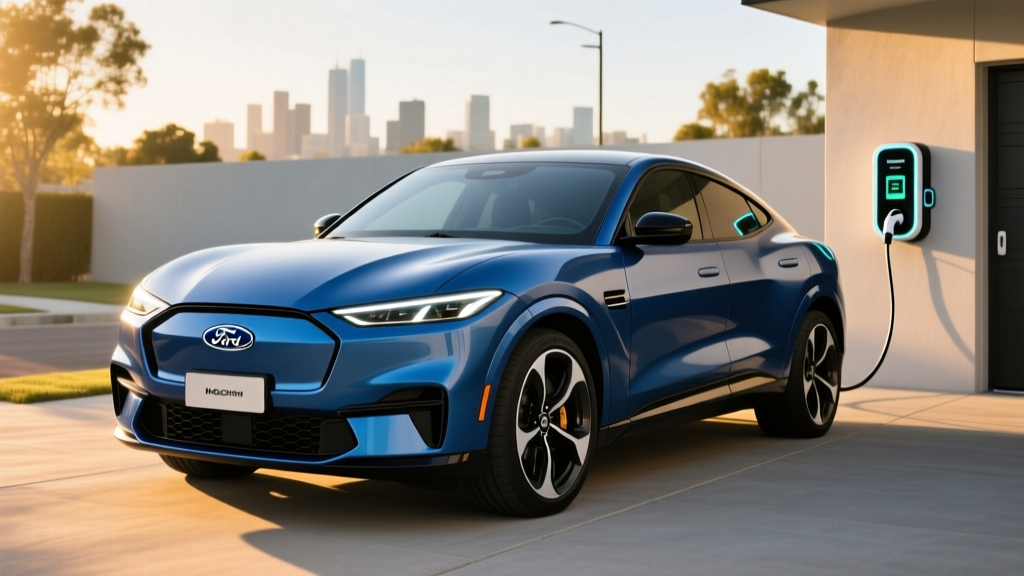
The 2021 Ford Mustang Mach-E Premium arrived as Ford's first serious battery-electric crossover, wearing the Mustang badge to signal performance intent. Five years later, it remains one of the most common used EVs on the market — and for buyers shopping the pre-owned segment in 2026, understanding what this first-model-year EV actually delivers is critical. This review covers the Premium trim with the Extended Range battery, the configuration most buyers targeted when new and the one that still dominates resale listings.
Ford built the Mach-E on the dedicated GE2 platform, not a converted ICE chassis, which pays dividends in packaging, ride quality, and interior volume. The Premium trim sits above the Select but below the GT, adding features like a panoramic glass roof, ActiveX synthetic leather, a 10-speaker B&O sound system, and Ford's Co-Pilot360 Assist 2.0 suite. But how does it stack up in 2026 against newer rivals with faster charging and updated battery chemistries?
Range, Battery, and Real-World Efficiency
The 2021 Mach-E Premium Extended Range AWD pairs a 91 kWh gross battery (approximately 88 kWh usable) with dual permanent-magnet motors. Ford used NMC (nickel-manganese-cobalt) pouch cells supplied primarily by LG Energy Solution for this model year — not the LFP chemistry that would later appear in some Standard Range variants and competitor vehicles.
EPA sticker: 270 miles (AWD Extended Range) / 305 miles (RWD Extended Range)
Real-world highway (65-75 mph, moderate temps): ~235–255 miles (AWD) / ~265–280 miles (RWD)
Cold weather (below 30°F, highway): Expect a 20–30% reduction, dropping AWD to ~190–210 miles without preconditioning.
The Mach-E's heat pump — standard on 2021 models — mitigates winter losses better than many contemporaries, but sustained highway speeds above 70 mph still expose the aerodynamic drag penalty common to crossovers.
Efficiency on the EPA cycle rates at 101 MPGe combined (AWD) and 105 MPGe combined (RWD), translating to roughly 33–34 kWh per 100 miles in mixed driving. In our experience, highway-heavy trips push consumption closer to 36–38 kWh/100 mi, while city driving with regenerative braking engaged can drop below 30 kWh/100 mi.
| Attribute | RWD Extended Range | AWD Extended Range |
|---|---|---|
| EPA Range | 305 mi | 270 mi |
| Battery (gross / usable) | 91 kWh / ~88 kWh (NMC) | |
| Horsepower | 290 hp | 346 hp |
| Torque | 317 lb-ft | 428 lb-ft |
| 0-60 mph | 6.1 sec | 5.2 sec |
| MPGe (city / hwy / combined) | 108 / 94 / 101 | 96 / 84 / 91* |
| Drivetrain | Rear-Wheel Drive | Dual-Motor AWD |
*EPA MPGe figures per fueleconomy.gov; combined AWD figure revised to 101 MPGe on some EPA listings — verify by VIN.
Charging Speed: DC Fast, Level 2, and Level 1
Charging capability is where the 2021 Mach-E shows its age relative to 2024–2026 competitors. The peak DC fast-charge rate is 150 kW on Extended Range models — respectable for 2021 but outpaced by Hyundai's 800V Ioniq 5 (240 kW) and the Tesla Model Y's ~250 kW peak on V3 Superchargers.
More importantly, the Mach-E's charging curve is relatively flat through the mid-range, meaning it sustains close to its peak rate between 20% and 60% SoC before tapering. A 10–80% DC fast charge takes approximately 45 minutes at a 150 kW station, provided the battery is preconditioned. Without preconditioning (initiated automatically when a charge station is set as your navigation destination), expect that time to stretch to 55+ minutes, especially in cold weather.
| Level | Power / Rate | Miles of Range Added | Notes |
|---|---|---|---|
| Level 1 (120V) | ~1.4 kW | ~3–4 mi/hr | Emergency/trickle only |
| Level 2 (240V, 32A) | 7.7 kW | ~22 mi/hr | Ford Mobile Charger included |
| Level 2 (240V, 48A) | 11.5 kW | ~33 mi/hr | Ford Connected Charge Station or equivalent |
| DC Fast Charge | 150 kW peak | ~52 mi in 10 min (peak) | 10–80% in ~45 min |
For home charging, the Mach-E's onboard charger accepts up to 11.5 kW (48 amps) on Level 2, which replenishes the Extended Range battery from empty to full in roughly 8–9 hours. A 32-amp circuit (7.7 kW) will take about 12 hours — still manageable for overnight charging. Most owners installing a dedicated Level 2 circuit spend between $500 and $1,500 for a hardwired 48-amp charger plus electrician labor, depending on panel proximity.
One 2026 consideration: Ford has transitioned to the NACS (Tesla) connector for new models starting in 2025. The 2021 Mach-E ships with a CCS1 port. Ford provides a NACS adapter for CCS-equipped vehicles to access Tesla Superchargers, but verify adapter availability and compatibility for your specific VIN through Ford's owner portal. Public Electrify America, EVgo, and ChargePoint CCS stations remain fully compatible.
Performance, Ride, and Driving Dynamics
The AWD Extended Range delivers 346 horsepower and 428 lb-ft of torque, launching to 60 mph in approximately 5.2 seconds. That's quick enough for confident highway merging and genuinely entertaining on back roads, though it falls short of the GT trim's 3.5-second sprint. The RWD model's 290 hp and 6.1-second 0–60 time is more sedate but still outpaces most gas-powered compact crossovers.
Ride quality benefits from the GE2 platform's low center of gravity and independent rear suspension. The Mach-E Premium's 18-inch wheels (with all-season tires) deliver a compliant ride, though the steering feel is noticeably numb — a common complaint among driving enthusiasts who expected more from the Mustang name. Brake feel is typical of EVs with blended regenerative braking: the transition between regen and friction brakes can feel inconsistent, especially at low speeds.
Ford's one-pedal driving mode is strong and predictable, bringing the vehicle to a complete stop in most conditions. Three drive modes — Whisper, Engage, and Unbridled — adjust throttle response, steering weight, and ambient lighting, though the differences between them are subtle.
Interior, Cargo, and Technology
The Mach-E's cabin was a departure for Ford in 2021, adopting a minimalist, screen-forward layout. The centerpiece is a 15.5-inch portrait touchscreen running SYNC 4A, with a physical volume dial embedded in the lower portion of the display. The interface is responsive, supports wireless Apple CarPlay and Android Auto, and handles over-the-air updates — Ford has pushed multiple SYNC updates since launch, improving navigation and adding features.
A 10.2-inch digital instrument cluster sits behind the steering wheel, displaying speed, range, and drive-mode information. The Premium trim's standard panoramic fixed glass roof creates an airy cabin but does reduce headroom slightly compared to models without it. Front headroom measures 40.4 inches; rear headroom drops to 38.2 inches. Rear legroom is a generous 38.9 inches, competitive with the Tesla Model Y.
Cargo capacity behind the rear seats is 29.7 cubic feet, expanding to 59.7 cubic feet with the 60/40 split rear seats folded. The front trunk (frunk) adds 4.7 cubic feet of lockable, drainable storage — useful for charging cables or wet gear. Total cargo volume trails the Model Y (76 cu ft max) but beats many gas compact SUVs.
Driver Assistance: Co-Pilot360 Assist 2.0
The 2021 Premium trim includes Ford Co-Pilot360 Assist 2.0 as standard, bundling adaptive cruise control with stop-and-go, lane centering, evasive steering assist, and intersection assist. This is a SAE Level 2 driver-assistance system — it does not drive the car autonomously. The driver must keep hands on the wheel and eyes on the road at all times.
Ford's Co-Pilot360 and available BlueCruise (added via OTA on some 2021 models) are Level 2 systems. The driver remains fully responsible for vehicle operation. BlueCruise enables hands-free driving on pre-mapped divided highways, but eyes-on monitoring via an infrared camera is mandatory. The system will disengage if attention drifts.
BlueCruise availability on 2021 models varies. Ford enabled it via over-the-air update for some vehicles equipped with the necessary hardware (driver-facing camera), but not all 2021 Mach-E Premiums received it. Confirm BlueCruise eligibility with a Ford dealer using the VIN before purchasing used.
Pricing, Tax Credits, and Used-EV Value
When new, the 2021 Mach-E Premium Extended Range AWD carried an MSRP of approximately $55,300 (including destination). The RWD variant started around $50,800. Federal and state incentives have shifted significantly since then, and used buyers in 2026 face a different credit landscape.
| Scenario | Approximate Price | Credit Available | Net Cost |
|---|---|---|---|
| Original MSRP (AWD ER, 2021) | $55,300 | $7,500 §30D (if eligible) | ~$47,800 |
| Used market (2026, ~40k mi, AWD ER) | $24,000–$30,000 | Up to $4,000 (§25E used-EV credit) | ~$20,000–$26,000 |
| Used market (2026, ~40k mi, RWD ER) | $22,000–$28,000 | Up to $4,000 (§25E used-EV credit) | ~$18,000–$24,000 |
The IRS §25E previously-owned clean vehicle credit offers up to $4,000 (30% of sale price, capped at $4,000) for qualified used EVs. Key eligibility requirements for 2026:
- Sale price cap: Vehicle must sell for $25,000 or less to qualify.
- Buyer income cap: AGI must not exceed $75,000 (single), $112,500 (head of household), or $150,000 (joint).
- Dealer requirement: Must purchase from a licensed dealer (private-party sales excluded).
- Vehicle age: Must be at least two model years old (2021 qualifies).
- First transfer: Credit applies only on the first qualified resale since August 16, 2022 — verify with the dealer that the credit hasn't been previously claimed on this VIN.
This means a 2021 Mach-E Premium selling above $25,000 does not qualify for the used-EV credit — a critical negotiation point. If you find one priced at $24,500, the effective cost drops to $20,500 after the credit. Always confirm eligibility with your tax professional before relying on this credit.
Battery Health, Degradation, and Warranty
Ford warrants the Mach-E's high-voltage battery for 8 years or 100,000 miles (whichever comes first), guaranteeing it will retain at least 70% of original capacity. For a 2021 model, that warranty extends through the 2029 model year or 100,000 miles — meaning most 2021 Mach-Es in 2026 still carry meaningful battery coverage.
NMC battery degradation data from early Mach-E owners suggests approximately 5–8% capacity loss over the first 50,000 miles, with the curve flattening significantly afterward. This is within normal parameters for NMC chemistry. Real-world range on a 40,000-mile 2021 AWD Extended Range might sit around 250–260 EPA-equivalent miles rather than the original 270 — a modest reduction.
Owners can monitor State of Health (SoH) through third-party OBD-II apps like Torque Pro or by requesting a battery health report from a Ford dealer. Best practices for longevity include avoiding routine charging above 90% (unless needed for a trip), minimizing DC fast charging when Level 2 is available, and using preconditioning in cold weather.
The powertrain (motors, reduction gear) carries the same 8-year/100,000-mile warranty. The basic bumper-to-bumper warranty was 3 years/36,000 miles and will have expired on most 2021 models by now — budget for out-of-warranty repairs on suspension, HVAC, and electronics.
Competitor Comparison: Mach-E vs. Model Y vs. Ioniq 5
| Spec | Mach-E Premium AWD | Tesla Model Y LR (2021) | Hyundai Ioniq 5 AWD (2022) |
|---|---|---|---|
| EPA Range | 270 mi | 318 mi | 256 mi |
| Battery (kWh usable) | ~88 (NMC) | ~75 (NMC/NCA) | ~72.6 (NMC) |
| Peak DC Charge | 150 kW | ~250 kW | 240 kW (800V) |
| 10–80% DC Time | ~45 min | ~30 min | ~18 min |
| 0–60 mph | 5.2 sec | 4.8 sec | 5.2 sec |
| Cargo (max, cu ft) | 59.7 | 76.2 | 59.3 |
| Used Price Range (2026) | $24k–$30k | $26k–$34k | $24k–$31k |
Who Should Buy the 2021 Mach-E Premium?
- You want a comfortable, quiet electric crossover with a conventional driving feel and strong build quality.
- Your daily commute is under 80 miles round-trip and you have reliable home Level 2 charging.
- You value a well-designed interior with physical controls and don't need maximum cargo volume.
- You can find one priced at or below $25,000 to capture the $4,000 used-EV credit.
- Road trips are frequent — the 150 kW peak charge rate and 45-minute 10–80% time will feel slow on long-distance drives compared to 800V competitors.
- You need maximum range — the AWD's 270-mile EPA rating is adequate but not class-leading.
- You want the latest ADAS — Ford's Co-Pilot360 is competent but less advanced than GM's Super Cruise or Tesla's Autopilot in highway scenarios.
- Comfortable, well-insulated ride quality
- Spacious rear seat (38.9" legroom)
- Strong SYNC 4A infotainment with OTA updates
- Drainable frunk (4.7 cu ft)
- Heat pump standard — better cold-weather efficiency
- Remaining battery warranty through 2029/100k mi
- 150 kW peak DC charging is slow vs. 2024+ rivals
- Numb steering feel despite Mustang branding
- AWD range drops to 270 mi EPA (real-world ~240)
- Panoramic roof reduces headroom, no shade
- Blended brake feel can be inconsistent
- BlueCruise not guaranteed on all 2021 units
Frequently Asked Questions
What is the real-world range of the 2021 Mach-E Premium AWD?
The EPA rates it at 270 miles, but expect roughly 235–255 miles in real-world highway driving at moderate temperatures. In cold weather below 30°F, range can drop to 190–210 miles without preconditioning. The RWD variant performs closer to its 305-mile EPA sticker, yielding 265–280 miles in mixed use.
How fast does the 2021 Mach-E charge?
On a DC fast charger, it peaks at 150 kW and charges from 10–80% in approximately 45 minutes with battery preconditioning. At home on a 48-amp Level 2 charger (11.5 kW), a full charge takes about 8–9 hours, adding roughly 33 miles of range per hour. On a standard 120V outlet, expect only 3–4 miles per hour.
Does the 2021 Mach-E qualify for a tax credit in 2026?
As a used vehicle, it may qualify for the IRS §25E previously-owned clean vehicle credit of up to $4,000, but only if the sale price is $25,000 or less, your income is within limits ($75k single / $150k joint), you buy from a licensed dealer, and the credit hasn't been claimed on that VIN since August 2022. Consult a tax professional and verify with the IRS §25E guidelines.
Is the 2021 Mach-E worth buying vs. a Tesla Model Y or Ioniq 5?
It depends on priorities. The Mach-E wins on ride comfort, cabin quietness, and build quality. The Model Y wins on range (318 mi), cargo space (76 cu ft), and Supercharger access. The Ioniq 5 wins on charging speed (18-minute 10–80%). For a daily commuter who rarely road-trips, the Mach-E at the right used price is an excellent value. For frequent long-distance drivers, the Ioniq 5's 800V charging or Model Y's range and network are more practical.
What are the biggest problems with the 2021 Mach-E?
Early-model-year issues reported by owners include 12V battery drain (a common EV complaint), occasional SYNC 4A infotainment glitches (largely addressed via OTA updates), and a recall for high-voltage battery contactor welding on some units — check NHTSA for open recalls on any specific VIN. The 150 kW charge rate is the most significant functional limitation relative to newer EVs.
How much does it cost to charge a Mach-E at home?
At the US average residential electricity rate of ~$0.17/kWh, fully recharging the 88 kWh usable battery costs approximately $15. For a driver covering 12,000 miles per year at 34 kWh/100 mi, annual home charging cost is roughly $695 — compared to $1,500–$1,800 for gasoline at $3.50/gallon and 25 MPG.