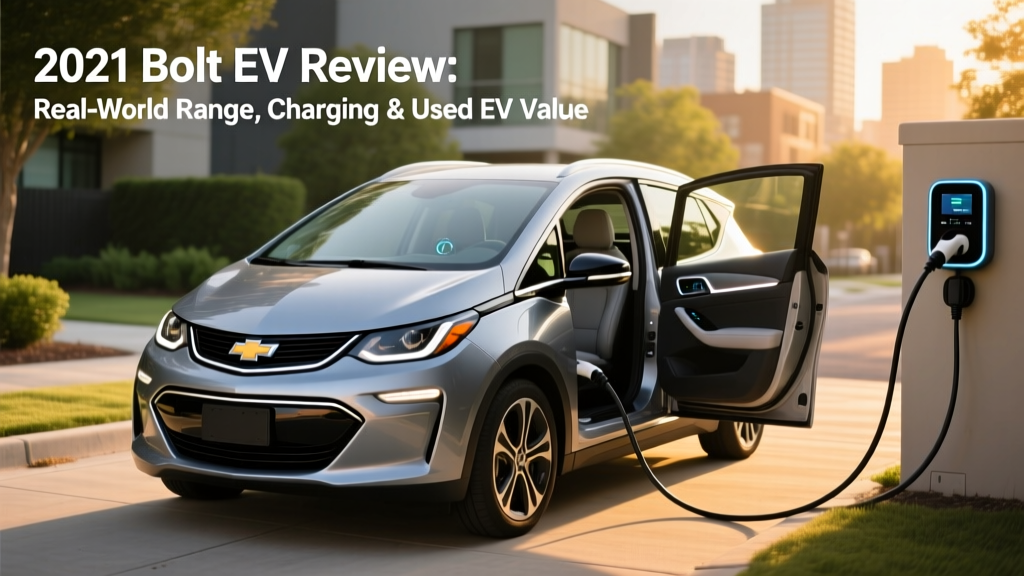
The 2021 Chevrolet Bolt EV remains one of the most accessible entry points into long-range electric ownership on the used market. Originally priced from $36,500, it delivered a then-class-leading 259 miles of EPA-estimated range — a figure that still holds up well against newer budget EVs. With production of the original Bolt platform ending after the 2023 model year, the 2021 Bolt EV now trades exclusively on the used market, where it has become a prime candidate for the federal used-EV tax credit.
This review breaks down what you need to know before buying a used 2021 Bolt EV in 2026: real-world range expectations, charging realities, battery health considerations, and whether it still makes sense against newer competition.
2021 Bolt EV: Key Specifications at a Glance
| Spec | Value |
|---|---|
| EPA Range | 259 miles |
| Battery (usable) | 66 kWh (NMC lithium-ion) |
| Efficiency | 120 MPGe combined / 28 kWh/100 mi |
| Motor | 200 hp / 266 lb-ft torque, FWD |
| 0–60 mph | 6.5 seconds |
| DC Fast Charge (peak) | 55 kW (CCS1) |
| DC 10–80% Time | ~60 minutes |
| Level 2 Charge Rate | 11.5 kW (39 mi/hr) |
| Cargo Volume | 16.9 cu ft (rear seats up) / 56.6 cu ft (folded) |
| Rear Legroom | 36.5 inches |
| Original Base MSRP | $36,500 (LT) / $41,600 (Premier) |
| Battery Warranty | 8 years / 100,000 miles |
Range & Efficiency: EPA vs. the Real World
The 2021 Bolt EV's 259-mile EPA range was a standout when it launched, beating the Nissan Leaf Plus (226 mi) and rivaling the Hyundai Kona Electric (258 mi). Chevrolet achieved this with a relatively compact 66 kWh battery paired with a highly efficient powertrain — the Bolt returns 120 MPGe combined, or about 28 kWh per 100 miles driven.
- City/commuter driving (mild weather): 250–270 miles — regenerative braking in stop-and-go traffic helps the Bolt exceed or match its EPA rating.
- Highway cruising (70 mph, mild): 210–235 miles — the Bolt's boxy shape and lack of a heat pump hurt sustained highway efficiency.
- Cold weather (below 32°F): 170–200 miles — expect 25–35% range loss in freezing temperatures. The 2021 Bolt lacks a heat pump, relying on resistive cabin heating that draws heavily from the battery.
The absence of a heat pump is the Bolt EV's biggest cold-weather weakness. Competitors like the Hyundai Kona Electric and later Ioniq 5 use heat pumps to scavenge waste heat from the powertrain, reducing cabin-heating energy draw. Bolt owners in northern climates should budget for meaningful range compression in winter and precondition the battery while plugged in to mitigate losses.
According to fueleconomy.gov, the 2021 Bolt EV achieves 131 MPGe city and 109 MPGe highway, reflecting its city-driving advantage through regen braking.
Charging Speed: The Bolt's Persistent Limitation
Charging is where the 2021 Bolt EV shows its age most clearly. The DC fast-charging system peaks at just 55 kW — a figure that was modest in 2021 and looks increasingly dated in 2026, when competitors routinely accept 150–250+ kW.
| Charging Level | Power | Speed | Use Case |
|---|---|---|---|
| Level 1 (120V outlet) | 1.2 kW | ~4 mi/hr | Emergency/trickle only |
| Level 2 (240V home) | 11.5 kW | ~39 mi/hr | Daily home charging — full charge in ~7 hours |
| DC Fast Charge (CCS1) | 55 kW peak | ~100 mi in 30 min | Road trips — expect 10–80% in ~60 minutes |
At 55 kW peak, a 10–80% DC fast charge takes approximately 60 minutes. The charge curve is relatively flat — the Bolt sustains close to its peak rate through most of the session, which is a silver lining. But the low ceiling means road trips require longer stops and more planning than in vehicles like the Hyundai Ioniq 5 (which charges 10–80% in about 18 minutes on a 350 kW station).
The Bolt uses a CCS1 connector, which remains widely supported across Electrify America, EVgo, and ChargePoint networks. However, as the industry shifts toward NACS (Tesla's connector), CCS1 stations will continue to operate but may see less investment over time. Adapters are available for Tesla Supercharger access where CCS-equipped Superchargers exist.
Home charging is the Bolt's sweet spot. The 11.5 kW onboard charger is generous for this class — a full charge from empty takes about 7 hours on a 48-amp Level 2 circuit. Most owners will plug in overnight and wake up to a full battery every morning, making the slow DC charging irrelevant for daily use.
Performance & Driving Dynamics
The 2021 Bolt EV is motivated by a single front-mounted permanent-magnet motor producing 200 horsepower and 266 lb-ft of torque. Power is sent exclusively to the front wheels — no all-wheel-drive option was offered.
The 0–60 mph time of 6.5 seconds is genuinely quick for a subcompact hatchback and makes merging and passing effortless. Instant electric torque gives the Bolt a punchy, responsive feel around town that belies its 3,563-pound curb weight. The low center of gravity from the under-floor battery pack keeps body roll well-controlled through corners.
Ride quality is firm but composed, and the steering is light and direct. The Bolt's one-pedal driving mode (activated via a steering-wheel paddle) is one of the best implementations in the industry — it allows complete stops without touching the brake pedal and makes city driving remarkably relaxing.
Where the Bolt falls short is high-speed refinement. Wind and tire noise become noticeable above 65 mph, and the suspension transmits sharper bumps into the cabin more than you'd expect in a $36,000+ vehicle.
Interior, Tech & Cargo Space
Inside, the 2021 Bolt EV is functional but shows its budget origins. The 10.2-inch touchscreen infotainment system supports wireless Apple CarPlay and Android Auto — a welcome feature that eliminates cable clutter. The digital instrument cluster is clear and customizable, showing range, energy flow, and regen levels.
Key technology features include:
- 10.2-inch touchscreen with wireless Apple CarPlay/Android Auto
- Chevrolet Safety Assist suite (automatic emergency braking, lane-keeping assist, following-distance indicator, front pedestrian braking)
- Adaptive cruise control (available on Premier trim)
- Surround-view camera (Premier trim)
- Heated front seats and steering wheel (standard on Premier, available on LT)
Cargo space is a genuine strength. The Bolt offers 16.9 cubic feet behind the rear seats — more than the Hyundai Kona Electric (16.0 cu ft) and significantly more than the Mini Cooper SE (7.3 cu ft). Fold the rear seats and you get 56.6 cubic feet, enough for a week's worth of camping gear or a large furniture-store haul.
Rear-seat legroom measures 36.5 inches, adequate for adults on shorter trips but snug for taller passengers on longer journeys. Headroom is generous thanks to the hatchback roofline.
Pricing, Tax Credits & Used-EV Value
The 2021 Bolt EV was sold in two trims:
| Trim | Original MSRP | Typical 2026 Used Price | Used-EV Credit Potential |
|---|---|---|---|
| LT (base) | $36,500 | $14,000–$18,000 | Up to $4,000 (§25E) |
| Premier | $41,600 | $16,000–$21,000 | Up to $4,000 (§25E) |
Federal used-EV tax credit (§25E): The 2021 Bolt EV is eligible for the federal used clean vehicle credit, which provides up to $4,000 (30% of the sale price, capped at $4,000). Key requirements per IRS.gov:
- Sale price must be $25,000 or less (most 2021 Bolt EVs qualify at current used prices)
- Buyer income caps: $75,000 single / $112,500 head of household / $150,000 married filing jointly
- Vehicle must be at least two model years old (the 2021 model qualifies)
- Must purchase from a licensed dealer (private-party sales do not qualify)
- Credit is non-refundable — you must have tax liability to benefit, unless transferred at point of sale
At a $16,000 used price with the full $4,000 credit applied, a 2021 Bolt EV LT can effectively cost as little as $12,000 — making it one of the cheapest ways to access a 250+ mile EV in 2026. Consult a tax professional to confirm your eligibility.
Original §30D new-vehicle credit note: When sold new, the Bolt EV qualified for the full $7,500 federal tax credit. This credit applied only to original purchasers and is no longer available for new Bolt EVs (production ended after 2023). The §25E used credit is the current pathway.
Battery Health, Degradation & Warranty
The 2021 Bolt EV uses a 66 kWh NMC (nickel-manganese-cobalt) lithium-ion battery pack manufactured by LG Energy Solution. This is the same chemistry used in most long-range EVs of its era, offering high energy density at the cost of slightly faster degradation compared to LFP (lithium iron phosphate) chemistry.
Battery recall context: The 2021 Bolt EV was affected by a major battery recall due to manufacturing defects in certain LG cells that posed a fire risk. General Motors replaced affected battery packs with new units. Before purchasing a used 2021 Bolt EV, verify with the selling dealer that the recall repair was completed — request documentation showing the replacement pack installation. A Bolt with a new post-recall battery is actually in better shape than one that narrowly avoided the issue.
GM's battery warranty covers 8 years or 100,000 miles (whichever comes first), guaranteeing at least 60% capacity retention. For a 2021 model, this warranty extends through at least 2029. Real-world degradation data from Bolt owners suggests typical capacity loss of 5–8% over the first 60,000 miles under normal use — well within warranty coverage. Replacement packs, if needed outside warranty, have been quoted in the $14,000–$16,000 range, though this is rarely necessary.
To maximize battery longevity, avoid routinely charging to 100% (the Bolt's "Target Charge Level" setting lets you cap at 80–90% for daily use) and minimize DC fast charging when Level 2 is available.
2021 Bolt EV vs. Key Competitors
- 259-mile EPA range at a sub-$18K used price
- Strong cargo volume (16.9 cu ft) for the class
- Excellent one-pedal driving implementation
- Wireless Apple CarPlay/Android Auto
- Eligible for up to $4,000 used-EV tax credit
- 11.5 kW Level 2 charging is fast for overnight top-ups
- 55 kW DC fast charging is slow for road trips
- No heat pump — significant cold-weather range loss
- Interior materials feel budget-tier
- No AWD option
- CCS1 connector in a shifting-NACS landscape
- Recall history requires verification before purchase
vs. 2021 Hyundai Kona Electric: The Kona Electric offers nearly identical range (258 mi EPA) and similar pricing on the used market. It charges slightly faster (up to 64 kW DC) and includes a heat pump on some trims, but offers less cargo space (16.0 cu ft). Pick the Bolt for cargo; pick the Kona for slightly better DC charging.
vs. 2021 Nissan Leaf Plus: The Leaf Plus delivers 226 miles of range and uses the CHAdeMO DC connector, which has far less public infrastructure support than CCS. The Leaf is a weaker buy in 2026 unless priced significantly lower.
vs. newer budget EVs (2024–2026): Vehicles like the Chevrolet Equinox EV (starting ~$33,000 new) and Hyundai Ioniq 5 offer dramatically faster charging and modern platforms, but at 2–3× the used Bolt's price. The Bolt wins on pure value; newer EVs win on charging speed and tech.
Who Should Buy the 2021 Bolt EV?
Buy the 2021 Bolt EV if:
- You need an affordable daily commuter with 250+ miles of range and can charge at home
- Your budget is under $20,000 and you want maximum range per dollar
- You qualify for the §25E used-EV credit and want to reduce effective cost further
- You prioritize cargo space in a compact EV hatchback
- Your driving is primarily city/suburban with occasional highway trips under 150 miles
Look elsewhere if:
- You road-trip frequently and need fast DC charging (consider an Ioniq 5 or Model 3)
- You live in a cold climate and need a heat pump for winter range preservation
- You need AWD for snow or performance driving
- You want the latest infotainment and ADAS technology
Frequently Asked Questions
What is the real-world range of the 2021 Bolt EV?
In mild-weather city driving, expect 250–270 miles. Highway cruising at 70 mph drops this to 210–235 miles. In freezing temperatures, plan for 170–200 miles due to the lack of a heat pump. The 259-mile EPA rating is achievable in mixed suburban driving at moderate speeds.
How fast does the 2021 Bolt EV charge?
On DC fast charging, the Bolt peaks at 55 kW, taking about 60 minutes for a 10–80% charge. At home on a Level 2 (240V) charger, it accepts up to 11.5 kW, adding roughly 39 miles of range per hour and fully charging in about 7 hours. Level 1 (120V) trickle charging adds about 4 miles per hour.
How much does a used 2021 Bolt EV cost after tax credits?
Used 2021 Bolt EVs typically sell for $14,000–$21,000 depending on trim, mileage, and condition. If you qualify for the §25E used-EV credit (income caps apply, sale price must be under $25,000), you can reduce your cost by up to $4,000, bringing an LT model to an effective price as low as $10,000–$14,000.
Does the 2021 Bolt EV qualify for any federal tax credit?
The original $7,500 §30D new-vehicle credit is no longer available since the Bolt is no longer sold new. However, it qualifies for the §25E used clean vehicle credit — up to $4,000 (30% of sale price) if purchased from a licensed dealer for $25,000 or less, subject to buyer income limits. See IRS.gov for current rules.
Is the 2021 Bolt EV a reliable used EV buy?
Yes — with one critical caveat. The Bolt EV was subject to a battery recall due to fire risk in certain LG-manufactured cells. GM replaced affected packs with new units. Before purchasing, confirm the recall repair was completed and request documentation. A Bolt with a post-recall replacement battery is a strong, reliable choice with warranty coverage extending through at least 2029.
Is the 2021 Bolt EV worth buying vs. newer EVs?
For budget-conscious buyers who charge at home and drive primarily in the city, the 2021 Bolt EV offers unbeatable value — 259 miles of range for under $18,000 (potentially under $14,000 after the tax credit). Its main weakness is slow DC fast charging, which makes road trips less convenient. If you road-trip often or live in extreme cold, invest in a newer EV with faster charging and a heat pump.