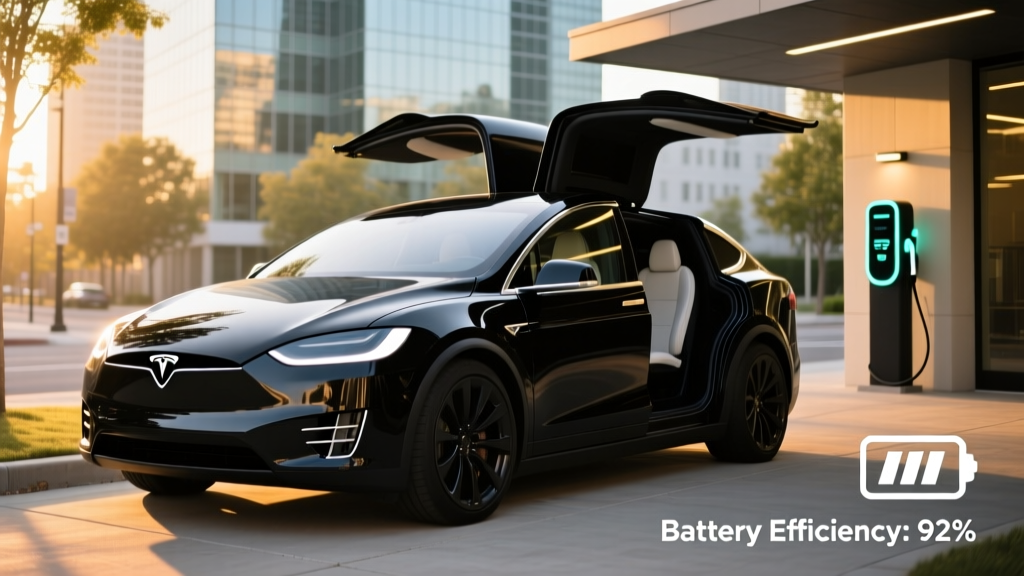
The 2020 Tesla Model X occupies a strange space in the used electric-vehicle market. It is a three-row luxury SUV with falcon-wing rear doors, a 100 kWh battery, and access to Tesla's Supercharger network — yet it predates the 2021 "Palladium" refresh that brought the yoke steering wheel, horizontal touchscreen, and rear-seat entertainment display. For 2026 buyers hunting a used family EV hauler, the pre-refresh Model X offers serious capability at a depreciated price, but it also carries legacy hardware quirks you need to understand before signing a check.
This review breaks down the real-world range, charging behavior, ownership costs, and federal tax-credit eligibility of the 2020 Model X from the vantage point of today's used-EV market.
2020 Tesla Model X: Quick Verdict
The 2020 Model X is best understood as a high-capacity, high-comfort electric family hauler from Tesla's pre-minimalist era. You get a physical steering wheel, a vertically oriented 17-inch touchscreen, genuine third-row usability, and up to 325 miles of EPA-rated range in Long Range trim. The trade-offs are a heavier, less efficient platform than the refreshed model, older MCU2 infotainment hardware, and a battery pack that, at six years old, will show measurable degradation.
If you can find a well-maintained example with strong State of Health (SoH) and you qualify for the used-EV tax credit, this remains one of the most capable three-row EVs on the secondary market.
Specs at a Glance: 2020 Tesla Model X
| Attribute | Long Range Plus | Performance (Raven) |
|---|---|---|
| EPA Range | 325 mi | 305 mi |
| Battery (usable) | ~100 kWh (NMC) | ~100 kWh (NMC) |
| Drivetrain | Dual-Motor AWD | Dual-Motor AWD |
| Horsepower | ~518 hp | ~778 hp (Ludicrous) |
| 0–60 mph | 4.6 sec | 2.7 sec (Ludicrous) |
| Peak DC Charge Rate | 250 kW (V3 Supercharger) | 250 kW (V3 Supercharger) |
| 10–80% DC Fast Charge | ~40 min | ~40 min |
| Level 2 Home Charge | 11.5 kW (~34 mi/hr) | 11.5 kW (~34 mi/hr) |
| MPGe (combined) | 101 MPGe | 96 MPGe |
| Efficiency | 33 kWh/100 mi | 35 kWh/100 mi |
| Cargo (behind 3rd row) | 21.8 cu ft | 21.8 cu ft |
| Cargo (all rows folded) | 81.5 cu ft | 81.5 cu ft |
| Towing Capacity | 5,000 lb | 5,000 lb |
| Battery Warranty (original) | 8 yr / 150,000 mi | 8 yr / 150,000 mi |
| Original MSRP | ~$84,990 | ~$104,990 |
Sources: EPA fueleconomy.gov, Tesla 2020 Model X owner's manual.
Real-World Range: What the EPA Sticker Doesn't Tell You
EPA sticker: 325 miles
Real-world highway (70 mph, mild weather): ~270–290 miles
Real-world mixed city/highway: ~285–310 miles
Cold-weather (below 32°F, highway): ~220–250 miles
Degradation adjustment (6-yr-old pack, ~8–12% loss): subtract 25–40 miles from all figures above
The 100 kWh NMC (nickel-manganese-cobalt) battery in the 2020 Model X was one of the largest packs Tesla ever shipped in a production vehicle. That raw capacity is the reason the Long Range Plus achieved a then-impressive 325-mile EPA rating. However, the Model X's 5,185-pound curb weight, tall profile, and 0.25 drag coefficient mean highway efficiency suffers significantly compared to the sedan-platform Model S.
In real-world testing at sustained 70 mph speeds in moderate temperatures (65–75°F), expect roughly 270–290 miles before hitting a low-State-of-Charge warning. The car's trip computer tends to be optimistic at the start of a drive — trust the energy graph, not the projected range number.
Cold weather compounds the issue. The 2020 Model X uses a resistance heater (PTC) rather than the heat pump Tesla introduced with the 2021 refresh. Below freezing, cabin heating and battery conditioning can consume 20–30% more energy, cutting effective range to roughly 220–250 miles on a highway run.
For a six-year-old vehicle, you must also factor in battery degradation. NMC packs from this era typically show 8–12% capacity loss over six years depending on charging habits and climate. A 2020 Model X that was frequently DC fast-charged and stored in hot climates may be closer to 12–15% loss. Request a State of Health (SoH) reading from a Tesla Service Center or use third-party diagnostics like Tessie or TeslaFi before purchase. A pack at 88% SoH effectively gives you a ~88 kWh usable battery.
Charging Speed: DC Fast, Level 2, and the Charge Curve Reality
The 2020 Model X supports up to 250 kW on a Tesla V3 Supercharger via its CCS-compatible adapter (or native NACS port, depending on production date and region). However, peak charge rate is not sustained charge rate — a distinction that matters enormously on road trips.
| Charging Method | Power (kW) | Speed (mi/hr added) | Notes |
|---|---|---|---|
| Level 1 (120V outlet) | ~1.4 kW | ~3–4 mi/hr | Emergency/trickle only |
| Level 2 (240V, 48A) | 11.5 kW | ~34 mi/hr | Full charge in ~9–10 hours |
| DC Fast (V3 Supercharger) | Up to 250 kW peak | Up to ~750 mi/hr (at peak) | 10–80% in ~40 min |
| DC Fast (V2 Supercharger) | Up to 150 kW | ~450 mi/hr (at peak) | 10–80% in ~55 min |
The charge curve explained: The 2020 Model X hits its 250 kW peak only between roughly 10–25% State of Charge (SoC) on a preconditioned battery. By 40% SoC, the rate typically drops to ~175 kW. By 60%, you're seeing ~100 kW. Above 80%, the car tapers aggressively to protect the NMC cells — charging from 80–100% can take as long as the 10–80% session. On road trips, plan stops around the 15–80% window for the fastest throughput.
For home charging, the onboard charger accepts up to 11.5 kW (48 amps on a 240V circuit). A full Level 2 installation on a NEMA 14-50 outlet or hardwired Wall Connector will replenish the 100 kWh pack from empty in roughly 9–10 hours. For daily use, charging from 20–80% overnight takes about 5–6 hours — more than adequate for most commutes.
Preconditioning matters: Always navigate to a Supercharger using the car's built-in navigation. This triggers battery preconditioning, warming the pack to optimal temperature for fast charging. Without preconditioning, especially in cold weather, your initial charge rate may be capped at 50–80 kW until the pack warms up.
Performance and Driving Dynamics
The 2020 Model X came in two primary configurations during its production run, both using Tesla's "Raven" powertrain introduced in mid-2019:
- Long Range Plus: Dual-motor AWD, ~518 combined horsepower, 0–60 mph in 4.6 seconds. This is the volume variant and the one most used buyers will encounter.
- Performance (with Ludicrous Mode): Dual-motor AWD, ~778 combined horsepower, 0–60 mph in 2.7 seconds. A genuinely absurd figure for a 5,185-lb three-row SUV.
The Raven front motor (permanent-magnet synchronous) paired with the rear induction motor gave the 2020 Model X significantly improved efficiency over the 2018–early 2019 models. The adaptive air suspension was standard, offering adjustable ride height and a surprisingly compliant ride in "Comfort" mode. On highway drives, the Model X is quiet and stable, though body roll in corners is noticeable given the vehicle's mass and height.
Regenerative braking in the 2020 Model X is aggressive enough for one-pedal driving in most conditions, though unlike some competitors, the regen strength is not user-adjustable — it is what Tesla decides it should be.
Interior, Cargo, and the Falcon-Wing Question
The 2020 Model X interior reflects Tesla's transitional design era. You get a vertically oriented 17-inch touchscreen running MCU2 (Media Control Unit 2) hardware — an Intel Atom E3950 processor that feels noticeably slower than the AMD Ryzen chip in post-2021 models. The instrument cluster is a small secondary screen behind the steering wheel. Materials are a mix of premium (vegan leather, Alcantara headliner) and puzzling (some hard plastics at this price point).
Seating configurations: The 2020 Model X was available in five-seat, six-seat (with second-row captain's chairs), and seven-seat layouts. The six-seat configuration with individual second-row seats is the most comfortable for passengers and still allows reasonable third-row access.
Cargo dimensions:
- Behind third row: 21.8 cu ft (enough for a few grocery bags or two carry-on suitcases)
- Behind second row (third row folded): 57.1 cu ft
- All rows folded: 81.5 cu ft
- Front trunk (frunk): 6.6 cu ft
The falcon-wing rear doors are the Model X's signature feature and its most polarizing. They open upward with a double-hinge design that requires minimal side clearance (about 12 inches), making them genuinely useful in tight parking spaces. However, they are mechanically complex, and out-of-warranty repairs are expensive — typically $2,000–$4,000 per door mechanism. On a 2020 vehicle now outside its basic warranty, this is a real financial risk. Inspect door operation carefully: listen for grinding, watch for uneven opening speed, and check for water intrusion around the seals.
Driver Assistance: Autopilot and FSD on 2020 Hardware
Tesla Autopilot and Full Self-Driving (Supervised) are SAE Level 2 driver-assistance systems. The driver must remain fully engaged, hands on the wheel, eyes on the road at all times. These systems do not make the vehicle self-driving.
The 2020 Model X ships with Tesla's HW3 (Hardware 3) computer and a suite of eight cameras, twelve ultrasonic sensors (though Tesla began removing these in later production), and no radar (removed in 2021 models, but present in most 2020 builds). Standard Autopilot includes Traffic-Aware Cruise Control and Autosteer. The optional Full Self-Driving (FSD) package adds Navigate on Autopilot, Auto Lane Change, Autopark, Summon, and traffic-light/stop-sign recognition.
In practice, the 2020 Model X with FSD performs competently on divided highways but requires constant driver supervision. City-street FSD (Supervised) is available via software updates but remains a Level 2 system with frequent disengagement needs in complex urban environments. HW3 is still supported by Tesla's latest FSD software as of early 2026, though some owners report it runs warmer and slightly less smoothly than HW4 in newer vehicles.
Pricing, Used Market Value, and Federal Tax Credit Eligibility
As of early 2026, used 2020 Tesla Model X pricing varies widely based on mileage, condition, trim, and battery health:
| Trim / Condition | Typical Used Price | Max Used-EV Credit (§25E) | Effective Price (with credit) |
|---|---|---|---|
| Long Range Plus, avg. miles (~55K) | $38,000–$45,000 | $4,000 | $34,000–$41,000 |
| Long Range Plus, low miles (<35K) | $45,000–$52,000 | $4,000 | $41,000–$48,000 |
| Performance, avg. miles | $44,000–$55,000 | $4,000 | $40,000–$51,000 |
| Performance, low miles, Ludicrous | $52,000–$62,000 | $4,000 | $48,000–$58,000 |
Federal tax credit — §25E Used Clean Vehicle Credit: The 2020 Model X does NOT qualify for the §30D new-vehicle credit (it is no longer sold new). Instead, buyers should evaluate eligibility for the IRS §25E Used Clean Vehicle Credit, which offers up to $4,000 (30% of the sale price, capped at $4,000) on qualifying used EVs. Key requirements:
- Sale price cap: The used vehicle must sell for $25,000 or less to qualify. Most 2020 Model X examples exceed this cap, meaning the §25E credit is typically NOT available.
- Buyer income limits: Modified AGI must not exceed $75,000 (single), $112,500 (head of household), or $150,000 (joint filers).
- Dealer requirement: The vehicle must be purchased from a licensed dealer (not a private party).
- Vehicle age: Must be at least two model years old (2020 qualifies in 2026).
- One-time use: The credit can only be claimed once per VIN within a three-year period.
Practical reality: Because most 2020 Model X examples sell above $25,000, the majority of buyers will NOT qualify for the federal used-EV tax credit. Some high-mileage or cosmetically damaged examples may dip below the cap, but these carry their own risks. Always confirm eligibility with a tax professional before relying on the credit in your purchase decision.
Warranty Coverage on a 2020 Model X in 2026
The original 2020 Model X warranty package included:
- Basic Vehicle Limited Warranty: 4 years / 50,000 miles — expired on all 2020 examples
- Battery & Drive Unit Warranty: 8 years / 150,000 miles, whichever comes first, with minimum 70% capacity retention guaranteed
As of 2026, a 2020 Model X is within its battery and drive-unit warranty period (through the vehicle's sixth birthday, or until 150,000 miles). If the battery has degraded below 70% of original capacity (measured by Tesla Service), you may be eligible for a warranty replacement or refurbishment. This is a critical check: have Tesla perform a battery health diagnostic before purchase or shortly after. If the pack is at 72% SoH and dropping, a warranty claim may be imminent.
Out-of-warranty battery replacement for the 100 kWh pack runs $15,000–$22,000 depending on whether Tesla uses a new, remanufactured, or refurbished unit. This is the single largest financial risk of buying a six-year-old Model X.
Who Should Buy the 2020 Tesla Model X?
- Families needing three rows and a frunk, who want Supercharger access for road trips
- Buyers who value the falcon-wing doors for tight urban parking and child-seat loading
- Towing users (5,000 lb rating) who need electric torque for boat or light trailer duty
- Tech enthusiasts who want Tesla's software ecosystem, OTA updates, and FSD capability
- You want the latest infotainment hardware (post-2021 refresh or a newer Rivian R1S)
- You live in an extreme-cold climate (no heat pump = significant winter range loss)
- You need guaranteed sub-$25K pricing for the used-EV tax credit
- You prefer a more traditional dealership service experience
2020 Tesla Model X vs. Key Competitors
At $38,000–$55,000 on the used market, the 2020 Model X competes with several other three-row or large electric SUVs:
| Vehicle | EPA Range | Used Price (2026) | Key Advantage | Key Drawback |
|---|---|---|---|---|
| 2020 Tesla Model X LR+ | 325 mi | $38K–$52K | Supercharger network, range | Older infotainment, falcon-wing repair cost |
| 2022 Rivian R1S (Dual-Motor) | 316 mi | $52K–$65K | Off-road capability, build quality | No NACS, smaller service network |
| 2021 Kia EV6 GT-Line AWD | 274 mi | $30K–$38K | 800V charging, value | Only two rows, less cargo space |
| 2022 Hyundai Ioniq 5 Limited AWD | 256 mi | $32K–$40K | Ultra-fast 800V charging | Two rows, smaller battery |
The Model X's range advantage and Supercharger access remain compelling for road-trip-heavy families. However, the Rivian R1S offers superior interior quality and off-road capability if you can absorb the higher price, while the Kia EV6 delivers faster charging architecture (800V) at a lower cost — though without a usable third row.
Pros and Cons
- 325-mi EPA range still competitive in 2026
- Access to Tesla Supercharger network (most reliable DC charging in the US)
- Genuine three-row seating with decent third-row space
- Falcon-wing doors useful in tight spaces
- 5,000-lb towing capacity
- Over-the-air updates still supported
- Strong performance even in Long Range trim
- Battery warranty potentially still active
- No heat pump — significant cold-weather range loss
- MCU2 infotainment feels dated vs. post-2021 hardware
- Falcon-wing door repairs: $2,000–$4,000 per door out of warranty
- Heavy (5,185 lb) — tires, brakes, and suspension wear faster
- Most examples too expensive for §25E used-EV tax credit
- NMC battery degradation risk at 6+ years
- No rear-seat entertainment screen (added in 2021 refresh)
- Vertical touchscreen orientation less intuitive for media/navigation
Frequently Asked Questions
What is the real-world range of a used 2020 Tesla Model X?
Expect 270–290 miles on the highway in mild weather, 285–310 miles in mixed driving, and 220–250 miles in cold weather (below 32°F). Factor in 8–12% battery degradation for a six-year-old pack, which reduces all of these figures by roughly 25–40 miles. A well-maintained example with 90%+ SoH will deliver closer to the EPA sticker in city driving.
How fast does the 2020 Model X charge at home and on the road?
At home on a 240V Level 2 charger (48A/11.5 kW), you'll add about 34 miles of range per hour, with a full charge taking 9–10 hours. On a Tesla V3 Supercharger, peak rate is 250 kW, but the 10–80% session takes roughly 40 minutes due to the charge-curve taper. On older V2 Superchargers (150 kW), plan for 55 minutes for the same 10–80% session.
Does the 2020 Tesla Model X qualify for any federal tax credit?
Not the §30D new-vehicle credit (the car is no longer sold new). The §25E used-EV credit offers up to $4,000, but the vehicle must sell for $25,000 or less — and most 2020 Model X examples exceed that threshold. Buyer income caps also apply ($150,000 joint / $75,000 single). Verify eligibility with a tax professional and the IRS §25E guidelines.
Is the 2020 Model X worth buying over a newer EV SUV?
If you need three rows, 300+ miles of range, and Supercharger access, and you can find a well-maintained example under $45,000, yes — it still delivers capability that newer competitors match only at higher prices. If you prioritize modern infotainment, a heat pump, or lower maintenance risk, consider a used Rivian R1S, or wait for newer three-row EVs to depreciate further.
What should I check before buying a used 2020 Model X?
Prioritize: (1) Battery State of Health — request a diagnostic from Tesla Service or use TeslaFi/Tessie; (2) Falcon-wing door operation — cycle both doors multiple times, listen for unusual sounds; (3) Drive-unit whine — some early Raven motors develop bearing noise; (4) Suspension — air springs can fail at 60,000–80,000 miles ($1,500–$2,500 per corner to replace); (5) Service history — confirm all recall campaigns were completed. Check NHTSA recall records for the specific VIN.
Can I still get Full Self-Driving on a 2020 Model X?
Yes. If the original owner purchased the FSD package, it transfers with the vehicle (Tesla ties FSD to the car, not the owner, on pre-2023 purchases). If FSD was not purchased, you can subscribe to it monthly or purchase it outright through the Tesla app, though Tesla's pricing and availability for legacy FSD purchases changes periodically. The HW3 computer supports current FSD (Supervised) software, which remains a Level 2 driver-assist system requiring full driver engagement.