The 2020 Model 3 at a Glance: Specs That Still Matter
Though Tesla has moved on to the refreshed "Highland" Model 3 for 2024 and beyond, the 2020 Tesla Model 3 remains one of the most common vehicles on the used-EV market. With thousands of lease returns and fleet sales hitting the secondhand market, buyers need hard data — not nostalgia — to evaluate whether this specific model year still delivers. The 2020 Tesla Model 3 interior, powertrain, and charging architecture were a snapshot of Tesla's rapid iteration, and understanding exactly what you're getting (and what you're not) is critical before signing on the dotted line.
| Spec | Standard Range Plus | Long Range AWD | Performance |
|---|---|---|---|
| EPA Range | 250 mi | 322 mi | 299 mi |
| Battery (usable) | ~50 kWh (LFP, CATL) | ~75 kWh (NMC, Panasonic) | ~75 kWh (NMC, Panasonic) |
| Drivetrain | RWD | Dual-Motor AWD | Dual-Motor AWD |
| 0–60 mph | 5.3 sec | 4.4 sec | 3.2 sec |
| Horsepower | 283 hp | 346 hp | 450 hp |
| Max DC Charge | 170 kW | 250 kW (V3 Supercharger) | 250 kW |
| 10–80% DC Time | ~30 min | ~28 min | ~28 min |
| Level 2 Rate | 11.5 kW (~44 mi/hr) | 11.5 kW (~44 mi/hr) | 11.5 kW (~44 mi/hr) |
| MPGe (combined) | 141 MPGe | 133 MPGe | 125 MPGe |
| Efficiency | 24 kWh/100mi | 25 kWh/100mi | 27 kWh/100mi |
| Original MSRP | $37,990 | $46,990 | $54,990 |
Sources: fueleconomy.gov, Tesla 2020 owner's manual.
Real-World Range: What the EPA Sticker Doesn't Tell You
EPA Range vs. Reality
Long Range AWD: EPA 322 mi. Expect ~270–290 mi on a mixed highway drive at 70 mph. In cold weather (below 32°F), plan for 220–250 mi due to cabin heating and increased battery resistance.
Standard Range Plus (LFP): EPA 250 mi. Expect ~210–225 mi highway; ~175–200 mi in freezing conditions.
Performance: EPA 299 mi. Aggressive driving and larger wheels reduce this to ~240–260 mi in real-world use.
The 2020 Model 3 Long Range's 322-mile EPA figure was class-leading at the time, but fueleconomy.gov testing uses a blended cycle that underrepresents sustained highway speeds. Tesla's thermal management system — a heat pump was not standard until the 2021 refresh — means the 2020 model relies on resistive PTC heating, which draws significantly more energy in winter. Preconditioning the battery while plugged in is essential to preserve range and enable fast DC charging in cold weather.
Inside the 2020 Tesla Model 3 Interior: Minimalism Measured
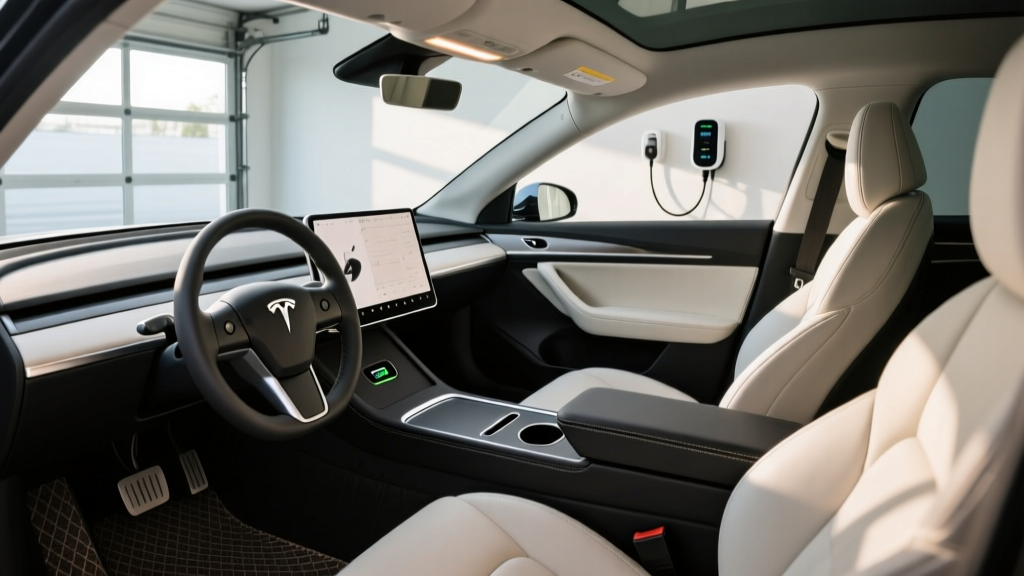
The 2020 Tesla Model 3 interior is polarizing by design. There is no instrument cluster, no physical buttons on the dash, and virtually every vehicle function — from mirror adjustment to glovebox release — routes through the 15-inch center touchscreen. This radical minimalism creates an airy, uncluttered cabin but demands a learning curve that not every buyer will accept.
Materials and Build Quality
The 2020 model year benefited from incremental improvements over the 2018–2019 launch cars. Vegan leather (synthetic polyurethane) seats replaced earlier cloth options on most trims, and fit-and-finish gaps tightened, though panel alignment still varied unit to unit. The wood trim strip across the dashboard and matte-black console give the cabin a Scandinavian-modern feel. Soft-touch materials cover the upper dash and door tops, but lower door panels and the rear seat back use harder plastics that show scuffs over time.
Passenger and Cargo Space
| Front Headroom | 40.3 in |
| Front Legroom | 42.7 in |
| Rear Headroom | 37.8 in |
| Rear Legroom | 35.2 in |
| Trunk (rear) | 15 cu ft |
| Frunk (front trunk) | 3.1 cu ft |
| Total Cargo | 18.1 cu ft (seats up) |
Rear-seat comfort is the 2020 Model 3 interior's most common complaint. The seat cushion is low and relatively flat, forcing taller passengers into a knees-up posture. The panoramic glass roof creates an open feel but offers no shade — cabin temperatures can spike in summer, and Tesla does not offer a factory retractable cover for this model year. Aftermarket shade panels are a near-universal owner accessory.
Infotainment and Tech
The 15-inch touchscreen runs Tesla's proprietary OS, which in the 2020 model year supported over-the-air (OTA) updates that have continued through 2026. Features include native navigation with real-time Supercharger routing, Spotify and Tidal integration, a built-in web browser, Sentry Mode dashcam recording, and Dog Mode cabin climate control. Apple CarPlay and Android Auto are not supported — a dealbreaker for some smartphone-dependent buyers.
Charging Architecture: Speeds, Connectors, and the NACS Transition
| Charging Level | Power | Rate / Time |
|---|---|---|
| Level 1 (120V household) | ~1.4 kW | ~5 mi/hr |
| Level 2 (240V, 48A) | 11.5 kW | ~44 mi/hr |
| DC Fast (V2 Supercharger) | 150 kW peak | 10–80% in ~35 min |
| DC Fast (V3 Supercharger) | 250 kW peak (LR/Perf) | 10–80% in ~28 min |
The 2020 Model 3 uses Tesla's proprietary connector (now standardized as NACS / SAE J3400). This gives it native access to the Tesla Supercharger network — the most reliable DC fast-charging infrastructure in North America, with over 30,000 stalls as of 2026. The Long Range and Performance trims support V3 Supercharger speeds up to 250 kW, though the charge curve tapers sharply above 60% state of charge. Expect sustained rates of ~100–120 kW in the 50–80% window.
The Standard Range Plus uses CATL's LFP (lithium iron phosphate) chemistry, which tolerates frequent 100% charging without degradation concerns — a genuine ownership advantage. Tesla recommends periodic 100% charges for LFP packs to recalibrate the battery management system (BMS). The Long Range and Performance trims use Panasonic NMC (nickel manganese cobalt) cells, which Tesla advises keeping between 20–90% for daily use.
Performance and Driving Dynamics
Even the base Standard Range Plus delivers brisk acceleration (0–60 in 5.3 seconds) thanks to instant electric torque and a low center of gravity. The Long Range AWD adds a front induction motor for all-weather traction and a 4.4-second sprint. The Performance trim drops to 3.2 seconds with track-mode torque vectoring and larger brakes.
Ride quality is firm across all trims — Tesla tuned the 2020 suspension for handling over comfort, and road imperfections transmit clearly into the cabin. The absence of a combustion engine eliminates vibration and noise at low speeds, but wind and tire noise become noticeable above 65 mph. Regenerative braking is aggressive and essentially enables one-pedal driving, though Tesla removed the user-adjustable regen setting in a 2020 OTA update — a controversial decision that remains in place.
Autopilot and Driver Assistance: SAE Level 2, Not Self-Driving
SAE Automation Level: Level 2
The 2020 Model 3 ships with Tesla's Basic Autopilot (traffic-aware cruise control and lane centering). Enhanced Autopilot ($6,000 option at the time) adds auto lane change, Navigate on Autopilot, and Summon. Full Self-Driving (FSD) was a $7,000 option in 2020. All of these features are SAE Level 2 — the driver must remain fully engaged, hands on or near the wheel, and eyes on the road at all times. The 2020 hardware suite (HW3.0) uses 8 cameras and 12 ultrasonic sensors. Tesla has since moved to a vision-only "Tesla Vision" architecture, and HW3.0 vehicles continue to receive FSD (Supervised) OTA updates through 2026.
Limitations Warning
Autopilot and FSD (Supervised) do not make the 2020 Model 3 autonomous. They cannot reliably handle construction zones, faded lane markings, heavy rain, or complex urban intersections without driver intervention. NHTSA has issued multiple investigations into Tesla's Level 2 systems — always verify current NHTSA safety bulletins before relying on these features.
Pricing, Used Market Values, and the Used-EV Tax Credit
| Trim | Original MSRP | Typical Used Price (2026) | §25E Used-EV Credit Potential |
|---|---|---|---|
| Standard Range Plus | $37,990 | $18,000–$22,000 | Up to $4,000 (30% of sale price, capped) |
| Long Range AWD | $46,990 | $22,000–$27,000 | Up to $4,000 |
| Performance | $54,990 | $26,000–$31,000 | Up to $4,000 |
Tax credit rules: The 2020 Model 3 is no longer eligible for the new-vehicle §30D credit. However, buyers may qualify for the §25E Used Clean Vehicle Credit, which provides 30% of the sale price up to $4,000 — but only if the sale price is $25,000 or less, the buyer's adjusted gross income is below $75,000 (single) / $150,000 (married filing jointly), and the vehicle is purchased from a licensed dealer. Always consult a tax professional and review current IRS guidance, as rules may shift.
Battery Warranty, Degradation, and Longevity
Tesla's battery and drive unit warranty for the 2020 Model 3 is 8 years / 100,000 miles (Standard Range Plus) or 8 years / 120,000 miles (Long Range and Performance), with a minimum 70% capacity retention guarantee. Real-world degradation data from owner fleets suggests the NMC packs in Long Range and Performance trims lose roughly 8–12% capacity over the first 100,000 miles, with the curve flattening significantly afterward. The LFP pack in the Standard Range Plus shows slower degradation but a lower starting capacity.
If the battery falls outside warranty, replacement costs range from $12,000 to $16,000 depending on pack size and labor — a material risk for high-mileage used buyers. Always request a State of Health (SoH) reading from Tesla Service or a third-party diagnostic tool before purchase.
Who the 2020 Model 3 Suits — and Who Should Look Elsewhere
Choose the 2020 Model 3 if:
- You want access to the Supercharger network without adapters
- You prioritize efficiency and driving dynamics over rear-seat comfort
- You're a tech-forward buyer comfortable with touchscreen-only controls
- You commute 40–80 miles daily and can charge at home overnight
Look elsewhere if:
- You regularly carry rear-seat adults (the low cushion and limited legroom frustrate passengers over 5'10")
- You need Apple CarPlay / Android Auto
- You want physical climate and volume controls
- You tow (the 2020 Model 3 is not rated for towing)
Pros and Cons
Pros
- Best-in-class Supercharger network access (NACS native)
- Excellent efficiency: 24–27 kWh/100mi depending on trim
- Continued OTA updates through 2026 keep software current
- Strong performance even in base RWD trim
- Used pricing now under $25K for many examples
Cons
- Rear-seat comfort and headroom are below segment average
- No physical buttons; all controls via touchscreen
- No Apple CarPlay or Android Auto
- PTC heater (no heat pump) reduces winter range significantly
- Panel gaps and paint quality inconsistent unit-to-unit
Frequently Asked Questions
What is the real-world range of the 2020 Tesla Model 3?
The Long Range AWD delivers roughly 270–290 miles on a mixed highway trip and 220–250 miles in freezing weather. The Standard Range Plus (LFP) achieves about 210–225 miles highway, dropping to ~180 miles in cold conditions.
How fast does the 2020 Model 3 charge?
On a V3 Supercharger, the Long Range and Performance peak at 250 kW and reach 10–80% in approximately 28 minutes. At home on a 48-amp Level 2 charger, expect ~44 miles of range per hour of charging — a full overnight session easily replenishes daily driving.
Does the 2020 Model 3 qualify for any tax credit?
Not the new-vehicle §30D credit. However, it may qualify for the §25E Used Clean Vehicle Credit (up to $4,000) if the sale price is $25,000 or less, the buyer meets income caps, and the purchase is through a licensed dealer. Verify current IRS rules before relying on this credit.
Is the 2020 Model 3 interior comfortable for long trips?
Front seats are supportive and well-bolstered, making the driver's experience excellent. Rear passengers on trips over two hours will find the low seat cushion and limited thigh support tiring. The panoramic glass roof adds to the sense of space but can cause heat buildup without an aftermarket shade.
Is it worth buying a 2020 Model 3 vs. a newer EV?
At $18,000–$27,000 on the used market, the 2020 Model 3 offers strong value for buyers who prioritize Supercharger access, efficiency, and software features. Newer competitors like the Hyundai Ioniq 6 and updated Model 3 "Highland" offer heat pumps, better rear-seat comfort, and CarPlay — but at significantly higher prices. For budget-conscious EV adopters, the 2020 Model 3 remains a compelling entry point.
What's the biggest risk of buying a used 2020 Model 3?
Battery degradation outside the 8-year warranty window is the primary financial risk. Request a State of Health diagnostic before purchase. Also verify that the vehicle has not been in a major collision, as Tesla's structural battery pack is expensive to repair and may not be covered by third-party insurers at full replacement cost.