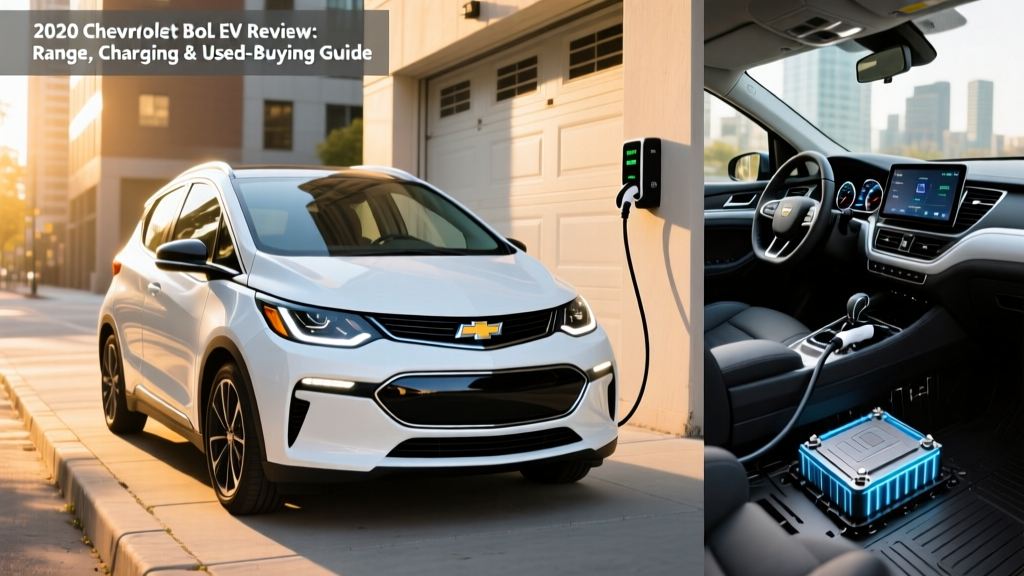
Quick Verdict: A Budget-Conscious EV With Real Range
The 2020 Chevrolet Bolt EV remains one of the most compelling used electric vehicles on the market. With an EPA-estimated 259 miles of range from a 66 kWh (usable) LG Chem NMC battery, a peppy 200-horsepower front-wheel-drive motor, and a starting used price well below $20,000 in many markets, it delivers daily-driving practicality that newer, pricier EVs still struggle to match at this price point. However, its DC fast-charging speed peaks at just 55 kW — a significant limitation for road trippers — and its interior materials reflect its economy-car origins. For urban commuters and suburban drivers with home charging access, the 2020 Bolt EV is a smart, data-backed buy.
| Spec | Value |
|---|---|
| EPA Range | 259 miles |
| Battery (Usable) | 66 kWh, NMC (LG Chem) |
| Motor Output | 200 hp / 266 lb-ft torque |
| Drivetrain | Front-wheel drive (FWD) |
| 0–60 mph | 6.5 seconds |
| EPA Efficiency | 118 MPGe combined (28 kWh/100 mi) |
| DC Fast Charge (Peak) | 55 kW (CCS) |
| Level 2 Charge Rate | 7.2 kW (25 miles/hr) |
| Cargo Volume | 16.9 cu ft (rear seats up) / 56.6 cu ft (folded) |
| Battery Warranty | 8 years / 100,000 miles |
| Original MSRP (LT) | $37,495 (before incentives) |
Range and Efficiency: EPA vs. Real-World Expectations
The 2020 Bolt EV's headline number is its EPA-estimated 259 miles of range, which placed it among the top non-Tesla EVs at launch. This figure was derived from the car's combined city/highway driving cycle and remains highly competitive even by 2026 standards — especially for a used vehicle in this price bracket.
EPA sticker: 259 miles. In practice, expect 220–245 miles in mixed suburban/highway driving during mild weather. On sustained 75-mph highway runs, the Bolt's efficiency drops to roughly 3.5–3.8 miles/kWh, yielding approximately 210–230 miles before you'll want to find a charger. In freezing temperatures (below 32°F), range can drop 25–35%, putting real-world winter range closer to 170–195 miles. The Bolt EV does not have a heat pump — it uses resistive cabin heating, which is a significant energy draw in cold weather.
According to fueleconomy.gov, the 2020 Bolt EV achieves 118 MPGe combined (131 city / 109 highway). Its efficiency of 28 kWh per 100 miles is excellent — comparable to the Hyundai Kona Electric and slightly better than the Nissan Leaf Plus. This efficiency is one of the Bolt's strongest ownership advantages: at a national average electricity rate of $0.16/kWh, you're paying roughly $0.045 per mile to drive, versus $0.12–$0.15/mile in a 30-MPG gas car at $3.50/gallon.
Charging Speed: The Bolt's Biggest Weakness
If the 2020 Bolt EV has an Achilles' heel, it's DC fast charging. The car uses a CCS1 connector and peaks at just 55 kW on a DC fast charger. That means a 10–80% charge takes approximately 60–75 minutes, depending on battery temperature and station output. For comparison, a Hyundai Ioniq 5 or Tesla Model Y can add that same charge in 18–25 minutes at a 150–250 kW station.
| Charging Level | Power | Time / Rate | Notes |
|---|---|---|---|
| Level 1 (120V) | ~1.2 kW | ~4 miles/hr | Emergency/trickle only; full charge ~55+ hours |
| Level 2 (240V) | 7.2 kW | ~25 miles/hr (~9.5 hrs full) | Home or public L2; ideal daily charging |
| DC Fast (CCS) | 55 kW peak | 10–80% in ~60–75 min | Tapers significantly above 80%; curve is flat, not peaked |
The 55 kW charge curve is notably flat. Unlike modern EVs that spike to a high peak and taper quickly, the Bolt sustains roughly 45–55 kW from 10% to about 60% state of charge, then gradually drops. Above 80%, charging slows to under 20 kW, making top-offs at DC stations painfully slow. For road trips, plan your stops around 30–40 minute breaks — and know that Electrify America, EVgo, and ChargePoint CCS stations will all work, but you won't be leveraging their full power output.
At home on a 240-volt Level 2 charger (like a ChargePoint Home Flex or Emporia Vue), the 7.2 kW onboard charger replenishes the battery at about 25 miles of range per hour. A full overnight charge from 20% to 100% takes roughly 10–11 hours. Most owners will plug in nightly and wake up fully charged — the intended use case for any EV with home charging access.
Performance and Driving Dynamics
The 2020 Bolt EV's single front-mounted permanent-magnet motor produces 200 horsepower and 266 lb-ft of torque. Torque is available instantly, giving the car a punchy, responsive feel in city driving. The 0–60 mph time of 6.5 seconds is quick for a compact hatchback and makes highway merging effortless.
Driving dynamics are competent but not sporty. The Bolt's 3,563-lb curb weight (with most of it low in the chassis thanks to the under-floor battery pack) gives it a planted feel, but the suspension tuning is soft and comfort-oriented. Steering is light and numb — fine for commuting, uninspiring on back roads. Regenerative braking offers two modes: standard (mild regen, coasting feel) and "L" mode with the steering-wheel paddle engaged, which provides near-one-pedal driving capability. Most owners quickly adapt to one-pedal mode for daily driving.
The Bolt EV is strictly front-wheel drive. There is no all-wheel-drive option, which may deter buyers in heavy snow regions, though the low center of gravity and standard traction control handle light winter conditions adequately with proper winter tires.
Interior, Cargo, and Technology
Inside, the 2020 Bolt EV shows its economy-car roots. Hard plastics dominate the dashboard and door panels, though the LT and Premier trims add some soft-touch materials and leatherette seating surfaces. The front seats are comfortable for long drives, and rear legroom is adequate at 36.5 inches — enough for average-sized adults on shorter trips. Headroom is generous front and rear thanks to the hatchback roofline.
Cargo space is a highlight: 16.9 cubic feet behind the rear seats and 56.6 cubic feet with the 60/40 split rear seats folded flat. That's competitive with the Honda HR-V and significantly more than the Nissan Leaf. There is no front trunk (frunk) — the space under the hood houses the motor, power electronics, and 12V battery.
The infotainment system centers on a 10.2-inch touchscreen running Chevrolet's Infotainment 3 system with Apple CarPlay and Android Auto (wired, not wireless). The system is responsive, logically organized, and includes an 8-inch digital driver display that shows range, energy flow, and regen status. Navigation is available on Premier trims. A Bose 7-speaker premium audio system is optional on Premier.
Driver-assistance features include:
- Chevrolet Safety Assist (standard on all trims): automatic emergency braking, forward collision alert, lane keep assist, lane departure warning, following distance indicator, and IntelliBeam automatic high beams.
- Adaptive cruise control (available on Premier trim only) — not full stop-and-go, but functional for highway cruising.
- Rear cross-traffic alert and blind-spot monitoring (available on LT, standard on Premier).
The 2020 Bolt EV's driver-assistance features are SAE Level 1–2, meaning the driver must remain fully attentive with hands on the wheel at all times. Chevrolet does not offer Super Cruise on the Bolt EV — that feature is reserved for Cadillac and select Chevrolet models like the Silverado and Blazer EV. Do not confuse lane-keep assist with autonomous driving capability.
Pricing, Trims, and Used-Market Value
When new, the 2020 Bolt EV came in two trims:
- LT: $37,495 MSRP (before incentives)
- Premier: $41,895 MSRP (before incentives)
Both trims were eligible for the full $7,500 federal tax credit under pre-2023 IRS rules, which brought effective prices down to roughly $30,000 and $34,400 respectively. General Motors' federal tax credit phase-out did not begin until later model years, so original 2020 buyers who qualified captured the full benefit.
As of 2026, the 2020 Bolt EV is only available on the used market. Typical used pricing ranges from $14,000 to $22,000 depending on mileage, condition, and trim. Premier models with under 40,000 miles command the high end; higher-mileage LT models sit at the low end. This makes the 2020 Bolt EV one of the most affordable long-range used EVs available.
| Scenario | Estimated Price | Notes |
|---|---|---|
| Used LT (60k+ miles) | $14,000–$17,000 | Good condition, average wear |
| Used Premier (30–50k miles) | $18,000–$22,000 | Leather, adaptive cruise, Bose audio |
| Federal Used EV Credit (§25E) | Up to $4,000 (30% of sale price) | Vehicle must be <$25,000; buyer income caps apply ($75k single / $150k joint); see IRS §25E rules |
The §25E Used Clean Vehicle Credit (not §30D, which applies only to new vehicles) can provide up to $4,000 or 30% of the sale price, whichever is lower. For a $16,000 Bolt EV, that's a potential $4,000 credit, bringing the effective cost to around $12,000. Income caps apply: modified adjusted gross income must not exceed $75,000 (single), $112,500 (head of household), or $150,000 (joint). The vehicle must be purchased from a licensed dealer, and the sale price must be $25,000 or less. The credit can be transferred to the dealer at point of sale as of 2024, reducing your out-of-pocket cost immediately. Consult a tax professional to confirm your eligibility.
Battery Health, Warranty, and Recall History
The 2020 Bolt EV uses a 66 kWh (usable) LG Chem NMC (nickel-manganese-cobalt) lithium-ion battery pack. NMC chemistry offers high energy density — which is how Chevrolet packed 259 miles of range into a compact hatchback — but it is more sensitive to sustained high temperatures and frequent DC fast charging than LFP chemistry.
Chevrolet covers the battery with an 8-year / 100,000-mile warranty (10 years / 150,000 miles in California Air Resources Board states). The warranty guarantees the battery will retain at least 60% of its original capacity during the coverage period. In practice, most Bolt owners report degradation of 5–10% over the first 50,000–60,000 miles, which is within normal NMC expectations. Some owners tracking State of Health (SoH) via the MyChevrolet app or third-party OBD-II tools like LeafSpy-compatible adapters report 90–93% SoH at 40,000 miles.
Critical recall note: The 2017–2019 Bolt EV was subject to a major battery fire recall (NHTSA Recall 21V-650) related to manufacturing defects in certain LG Chem cells that could cause short circuits and fires, particularly when charged to high states of charge. The 2020 model year was not included in the primary recall because GM had already implemented updated manufacturing processes and battery management software by that production cycle. However, prospective used buyers should verify the specific VIN against the NHTSA recall database to confirm no open recalls exist, and check that all software updates have been applied by a Chevrolet dealer.
If battery replacement is ever needed out of warranty, expect a cost of $14,000–$18,000 including parts and labor at a dealership — a significant expense relative to the vehicle's used value. This is a key risk factor for any out-of-warranty used EV purchase.
- 259-mile EPA range — excellent for the price
- Strong efficiency: 118 MPGe / 28 kWh/100 mi
- Punchy 200-hp motor; quick city acceleration
- Generous cargo space (56.6 cu ft max)
- Low used-market price ($14k–$22k)
- Eligible for up to $4,000 used EV tax credit
- Standard Apple CarPlay/Android Auto
- Comprehensive standard safety suite
- Slow DC fast charging (55 kW peak; 60–75 min 10–80%)
- No heat pump — significant winter range loss
- Economy-grade interior materials
- No AWD option
- Adaptive cruise only on Premier trim
- No front trunk (frunk)
- Out-of-warranty battery replacement is costly ($14k–$18k)
- Wired-only CarPlay/Android Auto
Who Should Buy the 2020 Bolt EV?
Choose the 2020 Bolt EV if:
- You commute 30–80 miles round-trip and can charge at home overnight.
- You want maximum range per dollar on the used EV market.
- You rarely take road trips exceeding 200 miles one-way, or you're willing to plan 60-minute charge stops.
- You live in a mild-to-moderate climate where winter range loss won't be severe.
- You want a practical hatchback with real cargo room for groceries, gear, or a small family.
Look elsewhere if:
- You frequently road-trip and need fast 150+ kW charging (consider a used Tesla Model 3, Hyundai Kona Electric, or Ioniq 5).
- You need AWD for heavy snow (consider a used Tesla Model Y or Ford Mustang Mach-E).
- You want premium interior materials and the latest ADAS tech (look at a used BMW i4 or Polestar 2, at a higher price).
- You live in an area with extreme cold and no garage charging — the lack of a heat pump is a real disadvantage.
Competitive Comparison: Bolt EV vs. Key Rivals
On the used market, the 2020 Bolt EV competes primarily with the 2020 Hyundai Kona Electric, 2020 Nissan Leaf Plus, and 2019–2020 Tesla Model 3 Standard Range. Here's how the numbers stack up:
| Spec | 2020 Bolt EV | 2020 Kona Electric | 2020 Leaf Plus | 2020 Model 3 SR+ |
|---|---|---|---|---|
| EPA Range | 259 mi | 258 mi | 226 mi | 250 mi |
| Battery (kWh) | 66 (NMC) | 64 (NMC) | 62 (NMC) | 50 (NMC) |
| DC Fast Charge | 55 kW | 77 kW | 50 kW (CHAdeMO) | 170 kW |
| 0–60 mph | 6.5 sec | 6.4 sec | 6.9 sec | 5.3 sec |
| Typical Used Price | $14k–$22k | $16k–$24k | $13k–$19k | $20k–$28k |
| Charging Standard | CCS | CCS | CHAdeMO | NACS (Tesla) |
The Kona Electric is the closest rival — similar range, slightly faster DC charging, but slightly less cargo room and a higher used price. The Leaf Plus uses the aging CHAdeMO standard, which is being phased out at most public charging networks — a growing disadvantage. The Model 3 offers far superior DC charging (170 kW) and access to the Tesla Supercharger network (now opening to NACS adapters for other brands), but commands a $5,000–$8,000 premium on the used market.
Frequently Asked Questions
What is the real-world range of the 2020 Chevrolet Bolt EV?
The EPA rates it at 259 miles. In real-world mixed driving during mild weather, expect 220–245 miles. Sustained highway driving at 75 mph drops that to roughly 210–230 miles. In sub-freezing temperatures, plan for 170–195 miles due to the lack of a heat pump and resistive cabin heating.
How fast does the 2020 Bolt EV charge?
On a Level 2 home charger (240V), it charges at 7.2 kW, adding about 25 miles of range per hour — a full charge from empty takes roughly 9.5 hours. On a DC fast charger, it peaks at 55 kW and takes approximately 60–75 minutes to go from 10% to 80%. Charging above 80% slows dramatically and is not practical at public DC stations.
Does the 2020 Bolt EV qualify for a federal tax credit?
As a used vehicle, it may qualify for the §25E Used Clean Vehicle Credit of up to $4,000 (30% of the sale price). The vehicle must sell for $25,000 or less from a licensed dealer. Buyer income must not exceed $75,000 (single), $112,500 (head of household), or $150,000 (joint filing). The credit can be applied at point of sale. It does not qualify for the §30D new-vehicle credit since it is no longer sold new. Verify current rules at irs.gov and consult a tax professional.
Is the 2020 Bolt EV worth buying vs. competitors?
For budget-focused buyers prioritizing range and efficiency, yes — it offers the best range-per-dollar ratio on the used market. If fast road-trip charging is a priority, a used Tesla Model 3 or Hyundai Kona Electric is a better choice despite the higher price. If you need AWD, look at the Model Y or Mach-E.
How long will the battery last?
NMC batteries in the Bolt EV typically show 5–10% degradation over 50,000–60,000 miles based on owner reports. With proper care (avoiding frequent 100% charges, minimizing DC fast charging, and avoiding extreme heat exposure), the battery should retain 80%+ capacity through 100,000 miles. Chevrolet's 8-year/100,000-mile warranty (60% capacity threshold) provides a safety net, but replacement out of warranty costs $14,000–$18,000.
Can I use a Tesla Supercharger with the 2020 Bolt EV?
Not natively. The Bolt uses a CCS1 connector. However, as of 2025–2026, Tesla has opened select Supercharger stalls to non-Tesla CCS vehicles via the Magic Dock adapter built into the station, or you can use a third-party CCS-to-NACS adapter (such as those from Lectron or A2Z). Availability varies by station — check the Tesla app or PlugShare for CCS-compatible Supercharger locations.
Does the 2020 Bolt EV have a heat pump?
No. The Bolt EV uses resistive (PTC) cabin heating, which draws significantly more energy than a heat pump system. This is the primary reason for the Bolt's pronounced winter range loss — expect 25–35% range reduction in freezing temperatures. Preconditioning the cabin while plugged in at home can mitigate some of this loss before departure.