Quick Verdict: A Luxury EV That Prioritizes Refinement Over Range
The 2020 Audi e-tron was Audi's first ground-up electric vehicle, and it shows in all the right and wrong ways. Built on a modified version of Audi's MLB platform (shared with the Q5 and Q7 SUVs), the e-tron delivers exceptional cabin isolation, a smooth ride, and a premium interior that still holds up against 2026's newer competition. But its 204-mile EPA range and 74 MPGe efficiency rating place it well behind rivals like the Tesla Model X, BMW iX, and even the Hyundai Ioniq 5 in terms of electric efficiency.
For used-EV shoppers in 2026, the e-tron's value proposition has shifted dramatically. With the Used Clean Vehicle Credit (§25E) offering up to $4,000 on qualifying pre-owned EVs, a well-maintained 2020 e-tron can be had for a fraction of its original $65,900 starting MSRP — making it a compelling luxury daily driver if range isn't your top priority.
| Spec | Value |
|---|---|
| EPA Range | 204 miles (Premium Plus & Prestige) |
| Battery (Gross / Usable) | 95 kWh gross / 83.6 kWh usable |
| Battery Chemistry | NMC (Nickel Manganese Cobalt) — LG Chem pouch cells |
| Drivetrain | Dual-motor AWD (quattro) |
| Horsepower / Torque | 355 hp (402 hp in Boost mode) / 414 lb-ft (490 lb-ft Boost) |
| 0-60 mph | 5.5 seconds |
| Top Speed | 124 mph (electronically limited) |
| EPA Efficiency | 74 MPGe combined / 43 kWh/100 mi |
| Max DC Fast Charge | 150 kW (CCS1) |
| Level 2 Charge Rate | 9.6 kW (240V / 40A) |
| Cargo (behind 2nd row / max) | 28.5 cu ft / 57.0 cu ft |
| Length / Wheelbase | 193.0 in / 115.1 in |
| Curb Weight | 5,644 lbs |
| Battery Warranty | 8 years / 100,000 miles |
| Original Base MSRP | $65,900 (Premium Plus) |
Real-World Range: What 204 EPA Miles Actually Means on the Road
EPA Estimated Range: 204 miles
Real-World Expectation: 170–195 miles in mixed driving; 155–170 miles sustained highway at 70+ mph; 130–150 miles in freezing temperatures (below 32°F) with cabin heat.
The e-tron's range story is one of honest engineering undercut by heavy mass and conservative battery management. Audi deliberately buffers a large portion of the 95 kWh gross battery — you get 83.6 kWh of usable capacity. That buffer protects long-term battery health (less degradation at the top and bottom of the charge cycle), but it also means you're carrying around 5,644 pounds of SUV with only ~84 kWh to work with.
In EPA testing, the 2020 e-tron achieves 74 MPGe combined (43 kWh per 100 miles). That's thirsty by modern EV standards — the 2024 Tesla Model Y Long Range manages 122 MPGe combined on a smaller battery. On real-world highway loops at 70–75 mph, expect consumption to climb to 48–52 kWh/100mi, dropping effective range to roughly 160–175 miles before you'll want to find a charger.
Cold weather compounds the issue. Without a heat pump (the 2020 e-tron uses resistive PTC heating), cabin warmth draws heavily from the traction battery. Owners in northern climates consistently report 25–35% range loss in sub-freezing conditions, bringing winter range down to 130–150 miles. If your daily commute exceeds 60 miles round-trip in winter, home charging becomes essential rather than optional.
Charging Speed: 150 kW Peak with a Flat Charge Curve
The e-tron's charging performance is where Audi's engineering shines — even by 2026 standards. While its 150 kW peak DC fast-charge rate isn't class-leading anymore, the e-tron sustains that rate for an unusually long portion of the charge session. Most EVs peak briefly and taper sharply; the e-tron holds above 120 kW from roughly 10% all the way to ~70% state of charge before tapering.
| Charge Level | Power / Voltage | Rate | Time / Notes |
|---|---|---|---|
| Level 1 (120V) | 1.2 kW | ~3–4 mi/hr | Full charge in ~70+ hours; emergency/trickle only |
| Level 2 (240V) | 9.6 kW (40A) | ~22–25 mi/hr | 0–100% in ~9 hours; ideal overnight home charging |
| DC Fast (CCS1) | Up to 150 kW | Up to 300+ mi/hr (peak) | 10–80% in ~30 minutes; 80–100% adds ~25 min |
On a 150 kW Electrify America or comparable CCS station, a 10–80% session takes approximately 30 minutes. That's slower than Hyundai/Kia's 800V architecture (10–80% in ~18 minutes at 350 kW chargers) but competitive with many 2023–2025 EVs still on the road. The e-tron uses the CCS1 connector standard — widely compatible across North America's non-Tesla DC fast-charging networks, and increasingly accessible via Tesla Superchargers with a CCS adapter.
For home charging, the onboard 9.6 kW charger is a strong point. A full overnight replenishment on a Level 2 wallbox takes about 9 hours, meaning a standard overnight session restores the full 204 miles. Installation of a 240V/50A circuit with a quality Level 2 charger (ChargePoint Home Flex, Emporia J1772, or similar) typically runs $800–$2,000 all-in depending on panel proximity and local permit requirements.
Performance and Driving Dynamics
The 2020 e-tron's dual asynchronous motors produce 355 horsepower in standard driving and 402 hp when you engage Boost mode (activated by holding the gear selector in Sport for one second). Torque peaks at 414 lb-ft standard and 490 lb-ft in Boost. The result is a 5.5-second 0-60 mph time — quick for a luxury crossover, but not the instant-torque thrill that a Tesla Model X Performance or Rivian R1S delivers.
Where the e-tron genuinely excels is ride quality and noise isolation. The standard adaptive air suspension smooths out highway expansion joints and broken pavement with a compliance that rivals the Mercedes EQS SUV at twice the used price. Cabin noise at 70 mph is remarkably low — Audi's dual-pane acoustic glass and extensive sound deadening create a library-quiet environment that makes the e-tron one of the best long-distance EV cruisers available on the used market.
The quattro AWD system is fully electric (no mechanical link between axles), with the rear motor handling most cruising duties and the front motor engaging for traction or hard acceleration. Regenerative braking offers three levels selectable via steering-wheel paddles, but Audi does not offer true one-pedal driving — you'll still use the brake pedal for complete stops, which some EV converts find frustrating.
Interior, Cargo, and Technology
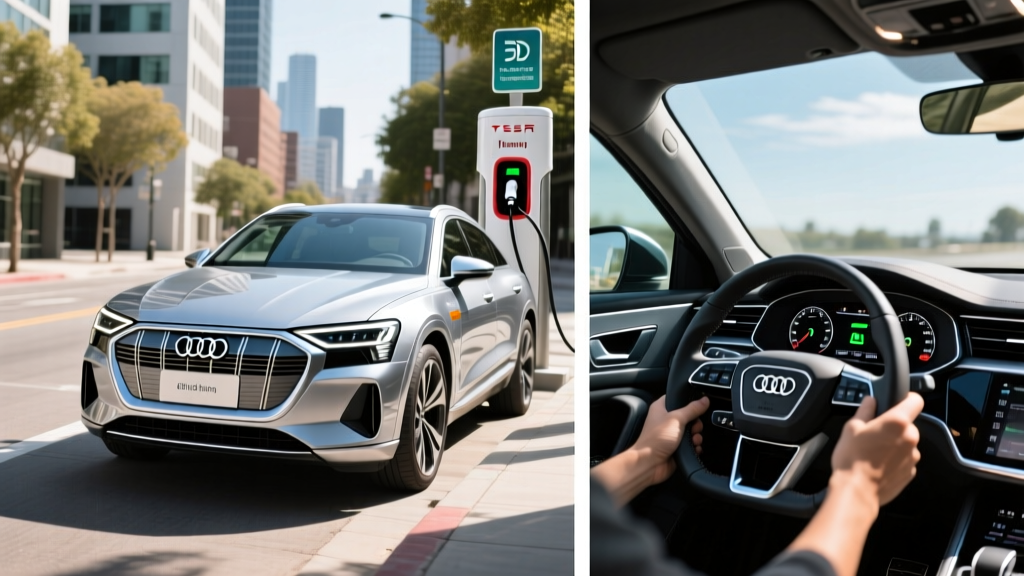
Step inside the 2020 e-tron and you're greeted by Audi's Virtual Cockpit Plus (12.3-inch digital instrument cluster) and a dual-touchscreen MMI setup: a 10.1-inch upper display for navigation and media, and an 8.6-inch lower screen for climate controls and handwriting input. The system runs Audi's MMI touch response software, which supports wireless Apple CarPlay and wired Android Auto, along with built-in navigation with EV-specific route planning and charging stop suggestions.
Material quality is a clear differentiator against the Tesla Model X. Soft-touch surfaces, genuine aluminum inlays, available Valcona leather, and tight panel gaps throughout give the e-tron a traditional luxury feel. Front seats offer 16-way power adjustment with available massage and ventilation.
Passenger and cargo dimensions:
- Front legroom: 40.0 inches
- Rear legroom: 39.1 inches
- Front headroom: 38.5 inches
- Rear headroom: 38.1 inches
- Cargo behind 2nd row: 28.5 cu ft
- Cargo with 2nd row folded: 57.0 cu ft
- Front trunk (frunk): None — the e-tron has no front storage compartment
The lack of a frunk is a notable omission. Audi mounted ancillary components (charger, HVAC) under the hood where an engine would normally sit, sacrificing front storage space entirely. For a vehicle with EV packaging advantages, 57 cu ft of total cargo is modest — the Model X offers 88 cu ft with both rows folded.
Driver assistance (SAE Level 2): The e-tron comes equipped with Audi pre sense basic and rear, adaptive cruise control with stop-and-go, lane departure warning, and a surround-view camera. The available Audi adaptive cruise assist adds lane centering and traffic-jam assist, but this remains a Level 2 driver-assistance system — you must keep hands on the wheel and eyes on the road at all times. There is no hands-free or eyes-off capability.
Pricing, Depreciation, and Tax Credit Eligibility in 2026
The 2020 Audi e-tron launched in two trims:
- Premium Plus: $65,900 MSRP (before destination)
- Prestige: $74,800 MSRP (adds head-up display, matrix LED headlights, Bang & Olufsen 3D audio, leather extended package)
By 2026, depreciation has been steep — a common pattern for early luxury EVs. Well-maintained 2020 e-tron models with 40,000–60,000 miles typically list between $25,000 and $35,000 depending on trim, mileage, and condition. Prestige trims command a $3,000–$5,000 premium over Premium Plus.
| Scenario | Estimated Price |
|---|---|
| 2020 e-tron Premium Plus (50k mi, avg condition) | $27,000–$30,000 |
| 2020 e-tron Prestige (45k mi, good condition) | $32,000–$35,000 |
| Used Clean Vehicle Credit (§25E) — max | Up to $4,000 (30% of sale price, capped at $4,000) |
| Effective price after max credit (Premium Plus) | ~$23,000–$26,000 |
| Effective price after max credit (Prestige) | ~$28,000–$31,000 |
Does the 2020 e-tron qualify for a federal tax credit? As a used vehicle, it may qualify for the IRS §25E Used Clean Vehicle Credit, which provides up to $4,000 (30% of the sale price, capped at $4,000). Key eligibility requirements for 2026:
- Sale price cap: The used vehicle must sell for $25,000 or less to qualify. This is a hard limit — a $25,001 sale price disqualifies the credit entirely.
- Buyer income limits (modified AGI): $75,000 single / $112,500 head of household / $150,000 married filing jointly.
- Vehicle age: Must be at least two model years old (2020 qualifies in 2026).
- Dealer requirement: Must be purchased from a licensed dealer (private-party sales do not qualify).
- First transfer: The credit applies only to the first qualified resale of the vehicle after August 16, 2022 — verify with the dealer that the credit hasn't already been claimed on this VIN.
- Battery capacity: Must have at least 7 kWh (the e-tron's 95 kWh pack easily qualifies).
Critical caveat: The $25,000 sale-price cap is a significant constraint. Many 2020 e-trons list above $25,000, especially Prestige trims and low-mileage examples. You may need to negotiate the purchase price to exactly $25,000 or below to unlock the credit — and dealer fees, documentation charges, and add-ons can push the final sale price over the limit. Always confirm the final sale price on the bill of sale before relying on the credit. Consult a tax professional to verify your personal eligibility.
Note: The e-tron does not qualify for the new-vehicle §30D credit, as it is no longer sold new and original §30D eligibility was affected by battery-sourcing rules that changed in 2023.
Ownership Costs: Insurance, Maintenance, and Battery Longevity
The e-tron's ownership profile is a mixed bag. On the positive side, EV maintenance costs are low — no oil changes, no transmission fluid, no spark plugs. Brake wear is minimal thanks to regenerative braking (many owners report 80,000+ miles on original pads). Audi's scheduled maintenance for the e-tron is limited to cabin air filter replacement, brake fluid checks, and tire rotation.
On the negative side, insurance premiums run 15–25% higher than a comparable gas-powered Audi Q5, reflecting the e-tron's higher repair costs and original MSRP. Expect annual premiums in the $2,200–$3,200 range depending on your state, driving record, and coverage level.
Battery warranty and degradation: Audi covers the e-tron's battery pack for 8 years or 100,000 miles, whichever comes first, against defects and capacity loss below 70% of original capacity. For a 2020 model, that warranty extends through the 2028 model year. Real-world data from early e-tron owners shows degradation of approximately 5–8% over the first 60,000 miles — well within the warranty threshold. The large buffer Audi built into the pack (11.4 kWh reserved) means you're unlikely to see dramatic range loss in normal ownership. LG Chem's NMC cells in the e-tron have proven thermally stable, and Audi's liquid thermal management system keeps cells in their optimal temperature window.
If the battery does need replacement out of warranty, expect costs in the $18,000–$25,000 range for parts and labor — a significant financial risk as the vehicle ages past its warranty coverage.
Pros and Cons
Pros
- Exceptionally quiet and refined cabin — rivals vehicles costing twice as much
- Sustained DC fast-charge curve holds above 120 kW longer than most competitors
- Adaptive air suspension delivers outstanding ride quality
- High-quality interior materials and build with tight panel gaps
- Strong battery warranty (8 yr / 100,000 mi) with conservative buffer management
- Steep depreciation makes it a value play on the used luxury EV market
- Potential §25E used EV credit of up to $4,000 if purchased at or below $25,000
Cons
- 204-mile EPA range trails most competitors — problematic for road trips without planning
- Low efficiency (43 kWh/100mi) means higher electricity costs per mile
- No frunk (front trunk) — wasted EV packaging potential
- No one-pedal driving mode — regen doesn't bring the car to a full stop
- No heat pump — cold-weather range loss is significant (25–35%)
- Dual-touchscreen MMI can be distracting and fingerprint-prone
- Cargo capacity (57 cu ft max) trails Model X and Rivian R1S
- CCS1 connector requires adapter for Tesla Supercharger access
How It Stacks Up: e-tron vs. Key Competitors
Shopping a used 2020 e-tron means cross-shopping it against other luxury EVs in the $25,000–$40,000 range. Here's how the critical numbers compare:
| Spec | 2020 Audi e-tron | 2020 Tesla Model X LR | 2020 Jaguar I-PACE |
|---|---|---|---|
| EPA Range | 204 mi | 328 mi | 234 mi |
| Battery (usable) | 83.6 kWh | ~95 kWh | 84 kWh |
| 0-60 mph | 5.5 sec | 4.4 sec | 4.5 sec |
| Max DC Charge | 150 kW | 150 kW | 100 kW |
| Efficiency (MPGe) | 74 | 101 | 76 |
| Cargo (max) | 57 cu ft | 88 cu ft | 51 cu ft |
| Typical Used Price (2026) | $27k–$35k | $35k–$50k | $22k–$30k |
The Tesla Model X offers far superior range and cargo space but at a higher used price, and its interior quality and ride comfort don't match the Audi. The Jaguar I-PACE is the closest competitor in character — similarly refined, similarly range-challenged — and often sells for slightly less. The e-tron's advantage over the I-PACE is its faster sustained charging curve and slightly larger battery buffer.
Who Should Buy the 2020 Audi e-tron?
Buy the 2020 e-tron if:
- You primarily commute under 80 miles round-trip and have home Level 2 charging
- You value cabin quietness, ride comfort, and build quality over maximum range
- You want a luxury EV badge at a mainstream price thanks to depreciation
- You can find a qualifying example at or below $25,000 to capture the §25E credit
- You rarely take road trips exceeding 150 miles one-way (or don't mind one charge stop)
Look elsewhere if:
- You regularly drive 200+ miles between charging stops
- You live in a cold climate and need maximum winter range
- You want one-pedal driving or access to Tesla's Supercharger network natively
- You need maximum cargo capacity for family gear or towing
- You want the latest infotainment, OTA updates, or ADAS features
Frequently Asked Questions
What is the real-world range of the 2020 Audi e-tron?
The EPA rates the 2020 e-tron at 204 miles. In real-world mixed driving at moderate temperatures, expect 170–195 miles. Sustained highway driving at 70+ mph drops that to 155–170 miles. In freezing weather, range can fall to 130–150 miles due to resistive cabin heating and reduced battery efficiency.
How fast does the 2020 e-tron charge?
On a 150 kW DC fast charger (CCS1), the e-tron charges from 10–80% in approximately 30 minutes. Its charge curve is notably flat — it sustains above 120 kW for most of the session, unlike many EVs that peak briefly and taper. At home on a 9.6 kW Level 2 charger, a full charge takes about 9 hours.
Does the 2020 Audi e-tron qualify for a federal tax credit?
As a used vehicle, the 2020 e-tron may qualify for the IRS §25E Used Clean Vehicle Credit of up to $4,000 (30% of sale price, capped at $4,000). However, the sale price must be $25,000 or less, buyer income must fall below IRS caps ($75k single / $150k joint), and the vehicle must be purchased from a licensed dealer. Many e-trons list above $25,000, so negotiation is often required to meet the price cap. Verify eligibility at irs.gov and consult a tax professional.
Is the 2020 e-tron worth buying in 2026 vs. competitors?
If you prioritize luxury, quietness, and ride quality and can charge at home, the used e-tron offers genuine value at $25,000–$30,000 — especially with the §25E credit. If range and efficiency are your priorities, the Tesla Model X, Model Y, or even a used Chevrolet Bolt EUV offer more miles per kWh. The Jaguar I-PACE is the closest alternative in character and price.
What are the biggest problems with the 2020 Audi e-tron?
The most common complaints include limited range for a large battery, no frunk, no one-pedal driving, excessive cabin fingerprint accumulation on the dual touchscreens, and higher-than-expected electricity consumption. Some owners report MMI infotainment lag and occasional software glitches. Mechanically, the e-tron has been reliable, with no widespread powertrain or battery failure patterns reported through 2026.
How long will the e-tron battery last?
Audi warranties the battery for 8 years / 100,000 miles against capacity loss below 70%. Real-world data from high-mileage e-trons shows approximately 5–8% degradation over 60,000 miles. The large 11.4 kWh buffer Audi reserves from the 95 kWh gross pack helps mask degradation over time. With proper care (avoiding frequent 100% charges and extreme heat exposure), the battery should provide reliable service well beyond 150,000 miles.
Can I charge the 2020 e-tron at Tesla Superchargers?
The 2020 e-tron uses the CCS1 connector. Tesla has opened select Supercharger locations to non-Tesla EVs via the Magic Dock (built-in CCS adapter) or through the use of a third-party CCS-to-NACS adapter. Availability varies by station — check the Tesla app for NACS-equipped stations in your area. For daily charging, CCS1 remains widely supported across Electrify America, EVgo, and ChargePoint DC fast networks.
Sources: EPA Fuel Economy — 2020 Audi e-tron, IRS Used Clean Vehicle Credit (§25E), NHTSA — 2020 Audi e-tron Safety Ratings