The 2019 Tesla Model X occupies a specific niche in the 2026 used-EV market: a three-row electric SUV with genuine performance credentials, unmistakable falcon-wing rear doors, and a price that has finally settled into reach for family buyers who might otherwise consider a newer Hyundai Ioniq 9 or Kia EV9. But buying a six-year-old luxury EV demands scrutiny that a new-car purchase does not. Battery health, Supercharger network access, outdated hardware, and the total absence of a federal tax credit all shape the ownership equation in ways the original MSRP never suggested.
This profile covers the 2019 Model X across its three main configurations—Standard Range, Long Range, and Performance—with exact EPA figures, real-world range expectations, charging behavior, and the practical realities of owning one in 2026.
2019 Model X Specifications at a Glance
| Specification | Standard Range | Long Range | Performance (Ludicrous) |
|---|---|---|---|
| EPA Range | 250 mi | 325 mi | 305 mi |
| Battery (usable) | ~75 kWh (NMC) | ~100 kWh (NMC) | ~100 kWh (NMC) |
| Drivetrain | AWD Dual Motor | AWD Dual Motor | AWD Dual Motor |
| Horsepower | ~518 hp | ~518 hp | ~778 hp |
| 0-60 mph | 4.6 sec | 4.4 sec | 2.6 sec |
| EPA Efficiency | 92 MPGe | 96 MPGe | 89 MPGe |
| Peak DC Fast Charge | ~120 kW | ~150 kW | ~150 kW |
| 10-80% DC Time | ~45 min | ~40 min | ~40 min |
| Level 2 Home Charge | 11.5 kW (~34 mi/hr) | 11.5 kW (~34 mi/hr) | 11.5 kW (~34 mi/hr) |
| Original Base MSRP | ~$83,000 | ~$93,000 | ~$104,000 |
| Typical 2026 Used Price | $32,000–$38,000 | $38,000–$48,000 | $45,000–$58,000 |
| Battery Warranty (orig.) | 8 yr / 150,000 mi | 8 yr / 150,000 mi | 8 yr / 150,000 mi |
Real-World Range: What the EPA Number Doesn't Tell You
EPA Sticker: 250 mi (Standard Range) / 325 mi (Long Range) / 305 mi (Performance)
Real-World Expectation: Highway driving at 70-75 mph typically yields 220-240 mi (Standard Range) or 270-295 mi (Long Range). In cold weather (below 32°F), expect a further 20-30% reduction, bringing the Long Range down to roughly 200-230 mi on winter road trips. The Model X's large frontal area and boxy SUV profile penalize it at highway speeds more than a sedan like the Model S.
The 100 kWh battery pack in Long Range and Performance trims uses nickel-manganese-cobalt (NMC) chemistry, which offers higher energy density than the LFP packs Tesla now uses in some Standard Range vehicles, but degrades somewhat faster over time. A 2019 Model X with 60,000-80,000 miles in 2026 may show 8-14% battery degradation depending on charging habits and climate exposure. This means a Long Range that originally delivered 325 EPA miles might now display 280-295 miles at a full charge.
Before purchasing, request a battery health reading from the vehicle's service menu or a third-party diagnostic. Tesla does not publish a standardized State of Health (SoH) figure in the app, but the estimated range at 100% SoC compared to the original EPA figure gives a reliable proxy.
Charging Speed and Infrastructure
The 2019 Model X predates Tesla's V3 Supercharger-optimized architecture. While it can physically connect to V3 stalls (250 kW), its battery management system limits peak intake to roughly 150 kW on the 100 kWh pack and around 120 kW on the 75 kWh pack. This is a meaningful gap versus newer EVs that sustain 200+ kW.
| Charging Level | Power / Rate | Miles Added per Hour | Notes |
|---|---|---|---|
| Level 1 (120V household) | ~1.4 kW | ~3-4 mi/hr | Emergency/trickle only |
| Level 2 (240V home, 48A) | 11.5 kW | ~34 mi/hr | Full charge in ~9-10 hours (100 kWh) |
| Level 2 (public, 40A) | 9.6 kW | ~28 mi/hr | Common at older ChargePoint stations |
| DC Fast (V2 Supercharger) | 150 kW peak | ~300 mi/hr at peak | Sustained rate much lower; tapers above 60% |
| DC Fast (V3 Supercharger) | ~150 kW peak (limited) | ~300 mi/hr at peak | Cannot utilize full 250 kW V3 capability |
| CHAdeMO adapter (optional) | ~50 kW | ~100 mi/hr at peak | Rare; adapter discontinued by Tesla |
The 10-80% DC fast-charge time of roughly 40 minutes for the Long Range is respectable but no longer class-leading. For context, a 2025 Hyundai Ioniq 5 with its 800V architecture completes 10-80% in about 18 minutes on a 350 kW charger. On road trips, plan for 30-40 minute Supercharger stops every 200-250 miles.
Preconditioning matters. The 2019 Model X supports battery preconditioning when a Supercharger is set as your navigation destination. This warms the NMC pack to optimal charging temperature, which can shave 5-10 minutes off your stop—especially critical in cold weather when an un-preconditioned pack may initially accept only 30-50 kW before ramping up.
Home Level 2 charging at 11.5 kW (48 amps on a 60-amp circuit) replenishes the 100 kWh pack from empty in roughly 9-10 hours. Most owners will plug in overnight and wake to a full battery. Installation of a Tesla Wall Connector or equivalent NACS (North American Charging Standard) Level 2 unit typically costs $800-$2,000 including electrician labor, assuming your electrical panel has capacity for a 60-amp circuit.
Performance and Driving Dynamics
Even in 2026, the 2019 Model X Performance with Ludicrous Mode remains absurdly quick. The 2.6-second 0-60 mph time puts it in supercar territory, and the instant torque delivery from dual electric motors makes it feel even more immediate than the number suggests. The Long Range variant at 4.4 seconds is hardly slow, and the Standard Range at 4.6 seconds still outruns most gas-powered SUVs in its class.
All 2019 Model X variants use a dual-motor all-wheel-drive system. The front motor is a permanent-magnet reluctance design for efficiency, while the rear is an induction motor optimized for power delivery. This combination provides strong regenerative braking, effective one-pedal driving in most conditions, and excellent traction in rain and snow.
The air suspension provides adjustable ride height—useful for clearing steep driveways or lowering for highway efficiency—and a generally comfortable ride. However, the Model X's substantial curb weight (over 5,000 lbs) is noticeable through corners, and the steering lacks the precision of the Model S. This is a family cruiser that happens to be fast, not a sports SUV.
Interior, Cargo, and Practicality
The 2019 Model X was offered in five-, six-, and seven-seat configurations. The six-seat layout with second-row captain's chairs is the most common and arguably the most practical, providing a center aisle for third-row access without folding the second row.
- Cargo behind 3rd row: 21.8 cu ft
- Cargo behind 2nd row (3rd row folded): 76.5 cu ft
- Total cargo (all rear seats folded): 81.5 cu ft
- Front trunk (frunk): 6.6 cu ft
- Second-row legroom: 38.4 inches
- Third-row legroom: 32.7 inches (tight for adults on long trips)
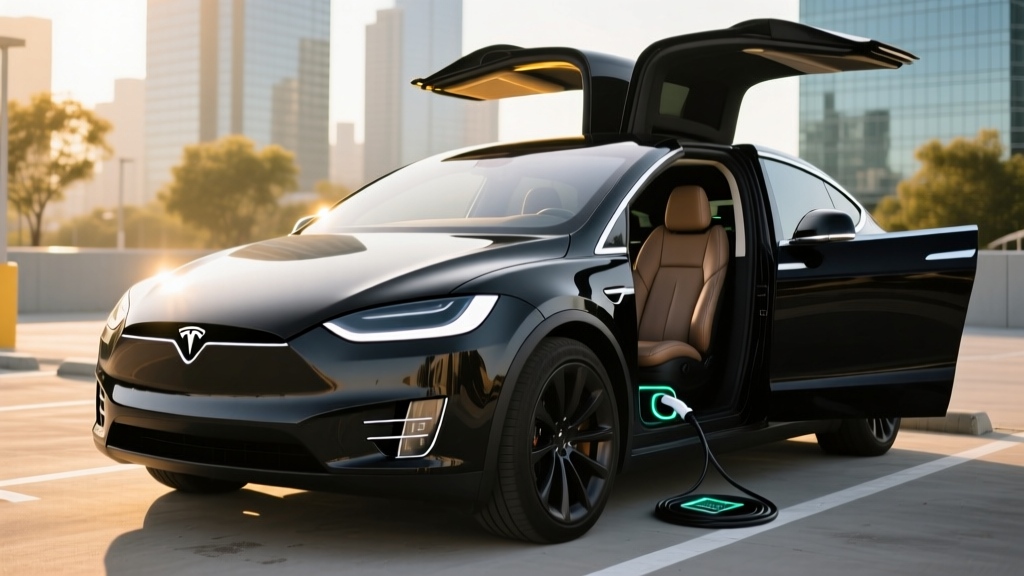
The falcon-wing rear doors are the Model X's signature feature and its most polarizing. They open vertically, requiring minimal side clearance—genuinely useful in tight parking spots when loading children into car seats. However, they add mechanical complexity, are slow to open compared to conventional doors, and have been a source of water-leak and sensor complaints among owners. In 2026, parts availability for falcon-wing mechanisms remains adequate but lead times for repairs can stretch to several weeks.
The 17-inch center touchscreen dominated the 2019 dashboard and remains functional by today's standards, though the hardware (MCU2, or Media Control Unit 2, with an Intel Atom processor) is noticeably slower than the AMD Ryzen-based MCU4 in 2022+ Teslas. Navigation, media, and climate controls all route through this screen. Apple CarPlay and Android Auto are not supported—a dealbreaker for some buyers accustomed to phone projection.
Tax Credits, Pricing, and Ownership Costs
Federal Tax Credit (§30D): The 2019 Model X does not qualify for the new-vehicle federal EV tax credit. The §30D credit applies only to new vehicle purchases, and the Model X exceeded Tesla's original 200,000-vehicle manufacturer cap long before 2019. Additionally, the original MSRP of $83,000-$104,000+ would exceed the current $80,000 SUV MSRP cap under revised IRS rules.
Used EV Credit (§25E): You may qualify for up to $4,000 (30% of sale price, capped at $4,000) under the federal used-EV tax credit when purchasing a 2019 Model X from a licensed dealer. Requirements include: sale price at or below $25,000, buyer income at or below $75,000 (single) / $150,000 (joint), and the vehicle must be at least two model years old. Given typical 2019 Model X used prices of $32,000-$58,000, most examples exceed the $25,000 sale-price cap, making the used credit unavailable in practice. Always verify current rules at IRS.gov.
| Cost Category | Estimated 5-Year Cost | Notes |
|---|---|---|
| Purchase price (Long Range, avg.) | $42,000 | Private party or dealer, 60k-80k miles |
| Electricity (charging) | $4,500–$6,500 | Based on 12,000 mi/yr, $0.14/kWh avg. |
| Insurance | $12,000–$18,000 | Higher than average; Tesla-specific body-shop costs |
| Maintenance | $2,500–$4,500 | Cabin filters, brake fluid, tires (heavy vehicle eats tires) |
| Potential out-of-warranty repairs | $3,000–$8,000 | Air suspension, falcon-wing motors, MCU, drive unit |
| Depreciation (est. 5-yr) | $12,000–$18,000 | Used EVs continue to lose value, but rate slows |
| Estimated 5-Year Total | $76,000–$97,000 | Including purchase price |
Insurance is a significant line item. Teslas carry higher premiums than comparable SUVs due to expensive collision-repair costs and limited body-shop networks. Expect quotes 25-40% above a similarly priced BMW X5 or Audi Q7.
The original 8-year/150,000-mile battery and drive-unit warranty on a 2019 Model X expires in 2027 at the latest. If you are purchasing in 2026 with 70,000+ miles, you may have less than two years of factory powertrain coverage remaining. Tesla does not offer an extended warranty for used vehicles purchased outside their CPO program, making a pre-purchase inspection essential.
Autopilot, FSD, and Driver-Assistance Technology
SAE Automation Level: The 2019 Model X with Autopilot or Full Self-Driving (FSD) capability operates at SAE Level 2. This means the system provides steering, acceleration, and braking assistance, but the driver must remain fully engaged and supervising at all times. This is not autonomous or self-driving capability. Only Level 4 services like Waymo operate without a human driver in defined areas.
The 2019 Model X shipped with Tesla's Hardware 2.5 (HW2.5) computer, which supports basic Autopilot (adaptive cruise control, lane centering, automatic emergency braking). Some 2019 models were built with Hardware 3 (HW3) later in the production year. HW3 is required for Tesla's current FSD (Supervised) software. If a 2019 Model X has HW2.5, Tesla has at times offered free or paid upgrades to HW3/HW4 for vehicles with active FSD subscriptions or purchases—but this policy has changed repeatedly and should not be assumed.
What Autopilot/FSD Does NOT Do: These systems cannot navigate unmapped roads, handle all construction-zone scenarios, reliably detect stopped emergency vehicles, or drive without active human supervision. The driver is legally and practically responsible for all vehicle actions. See NHTSA guidance on ADAS for safety context.
2019 Model X vs. Key 2026 Competitors
| Attribute | 2019 Tesla Model X LR (Used) | 2025 Kia EV9 GT-Line AWD (New) | 2025 BMW iX xDrive50 (New) |
|---|---|---|---|
| Price | $38,000–$48,000 | ~$73,000 (before credits) | ~$92,000 (before credits) |
| EPA Range | 325 mi | 279 mi | 324 mi |
| DC Fast Charge Peak | 150 kW | 210 kW (800V) | 195 kW |
| 10-80% Time | ~40 min | ~24 min | ~31 min |
| 3rd Row | Yes (tight) | Yes (more spacious) | No (2-row only) |
| Federal Tax Credit | None (used, over cap) | Up to $7,500 (§30D) | Up to $7,500 (§30D) |
| Warranty Remaining | 1-2 years battery | 10 yr / 100k mi battery | 8 yr / 100k mi battery |
| Supercharger Access | Native NACS | Native NACS (2025+) | CCS (adapter needed for NACS) |
The 2019 Model X wins on range-per-dollar and Supercharger network access. It loses on charging speed, warranty coverage, modern infotainment, and the security of a new-vehicle purchase. The Kia EV9 is the rational family choice if budget allows a new purchase; the BMW iX is the luxury pick for buyers who don't need a third row.
Pros and Cons
Pros
- 325-mile EPA range on Long Range remains competitive in 2026
- Native Tesla Supercharger (NACS) access — the most reliable DC network in the U.S.
- Supercar-rivaling acceleration in Performance trim (2.6 sec 0-60)
- Falcon-wing doors genuinely useful for child-seat loading in tight spaces
- Over-the-air updates continue to add features years after purchase
- Frunk + cargo volume exceeds most 3-row electric SUVs
- Air suspension with adjustable ride height
Cons
- DC fast charging capped at ~150 kW — slow vs. modern 800V platforms
- Falcon-wing doors: slow, complex, prone to leaks and sensor faults
- MCU2 infotainment hardware feels sluggish by 2026 standards
- No Apple CarPlay or Android Auto support
- Third-row legroom (32.7 in) is tight for adults
- Insurance premiums significantly above class average
- Original battery warranty expiring 2027 — expensive out-of-pocket replacement ($15,000-$22,000)
- No federal tax credit available at typical used prices
- HW2.5 may not support latest FSD features without upgrade
Who Should Buy a 2019 Model X?
Choose the 2019 Model X if:
- You need three rows and 300+ miles of range at a sub-$50,000 price point
- You rely on the Tesla Supercharger network for frequent road trips
- You value acceleration and performance in a family vehicle
- You have home Level 2 charging and mostly drive within 200 miles daily
- You accept the risk of out-of-warranty repairs in exchange for lower upfront cost
Look elsewhere if:
- You want fast DC charging for long road trips (consider Ioniq 5, EV9, or a newer Model X)
- You need reliable third-row space for adults (EV9 or a used Rivian R1S)
- You want a full factory warranty and the latest infotainment hardware
- You require Apple CarPlay or Android Auto
- You want federal tax credit eligibility (new EVs under $80,000 MSRP)
Frequently Asked Questions
What is the real-world range of the 2019 Tesla Model X?
The EPA rates the Long Range at 325 miles, but expect 270-295 miles in mixed real-world driving and 200-230 miles in cold-weather highway use. The Standard Range (250 EPA) typically delivers 210-230 miles in practice. Battery degradation of 8-14% at this vehicle age further reduces usable range.
How fast does the 2019 Model X charge?
On DC fast chargers, it peaks at roughly 150 kW (Long Range/Performance) or 120 kW (Standard Range), achieving a 10-80% charge in about 40 minutes. At home on a Level 2 charger (11.5 kW / 48A), it adds approximately 34 miles of range per hour, with a full charge taking 9-10 hours for the 100 kWh pack.
Does the 2019 Model X qualify for the federal EV tax credit?
Not the new-vehicle §30D credit—it is a used vehicle, and Tesla's original manufacturer cap was exceeded years ago. The used-EV §25E credit (up to $4,000) requires a sale price at or below $25,000 and buyer income limits. Since most 2019 Model X examples sell for $32,000-$58,000, the used credit is rarely available. Confirm current rules at IRS.gov.
Is the 2019 Model X worth buying vs. newer competitors?
It depends on priorities. For range-per-dollar and Supercharger access, the 2019 Model X Long Range is hard to beat at $38,000-$48,000. But newer vehicles like the Kia EV9 offer faster charging, full warranties, modern infotainment, and tax-credit eligibility at higher prices. If you can absorb the repair risk and don't need cutting-edge DC charge speed, the used Model X delivers strong value.
What are the biggest things to check before buying a used 2019 Model X?
Request a battery health diagnostic (compare full-charge range to original EPA figures). Verify whether the vehicle has HW2.5 or HW3 for FSD compatibility. Inspect falcon-wing door seals and sensors for water intrusion or malfunction. Check air suspension for leaks or slow response. Confirm remaining battery/drive-unit warranty coverage (8 yr / 150,000 mi from original in-service date). Review service history for drive-unit or MCU replacements.
How much does a battery replacement cost if it fails out of warranty?
Out-of-warranty 100 kWh battery replacements for the Model X typically range from $15,000 to $22,000 at Tesla service centers, including labor. Third-party EV battery shops may offer refurbished pack swaps for $10,000-$14,000. This is the single largest financial risk of buying a high-mileage 2019 Model X near the end of its battery warranty period.
Can I use non-Tesla chargers with the 2019 Model X?
The 2019 Model X uses Tesla's proprietary connector, which has since been standardized as NACS (North American Charging Standard). It can charge at any NACS-equipped station (increasingly common as other automakers adopt the standard). For CCS stations, Tesla previously sold a CCS adapter, but availability and compatibility with older vehicles should be confirmed directly with Tesla. CHAdeMO adapters existed but are effectively discontinued.
Sources: EPA fuel economy data via fueleconomy.gov; IRS EV tax credit rules at irs.gov; NHTSA ADAS safety guidance at nhtsa.gov.