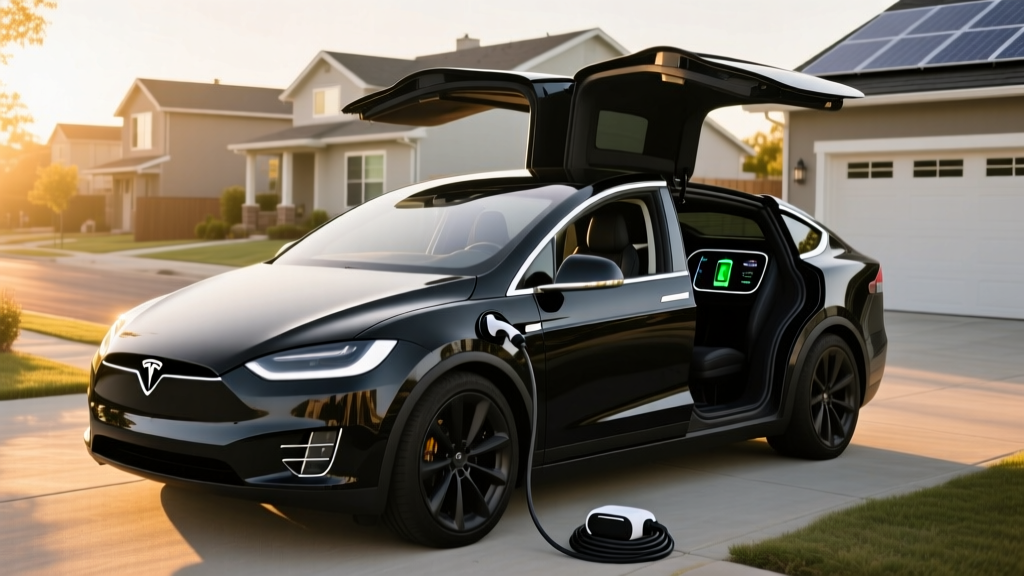
The 2019 Tesla Model X occupies a strange space in the used EV market in 2026. It's a three-row electric SUV with falcon-wing rear doors, Supercharger access, and performance that still embarrasses sports cars at stoplights — yet it carries the baggage of early Tesla build quality, a 100 kWh battery that has likely seen meaningful degradation, and zero federal tax credit eligibility on the used market. If you're cross-shopping a used Model X against a newer Hyundai Ioniq 5 or Kia EV9, you need hard data, not nostalgia.
This guide covers every spec that matters for a seven-year-old electric SUV: real-world range after battery wear, charging speeds on 2026 infrastructure, what to inspect before handing over cash, and whether the math works against fresh competition.
2019 Tesla Model X: Quick Verdict
The 2019 Model X is a compelling used buy for families who need three rows, Supercharger network access for road trips, and performance that no mainstream competitor matches at this price point. But it demands a buyer who can tolerate panel gaps, potential drive-unit replacements, and a charging architecture that's a generation behind 800V rivals. Budget $4,000–$6,000 annually for insurance and maintenance reserves, and have the battery State of Health (SoH) verified before purchase.
Range, Battery, and Efficiency
The 2019 Model X was sold in three main configurations, each with a different battery and EPA rating. All use an NMC (nickel-manganese-cobalt) lithium-ion chemistry in a ~100 kWh pack (approximately 95–98 kWh usable depending on the software buffer).
| Trim | Battery (Usable kWh) | Chemistry | EPA Range | MPGe (Combined) | kWh/100 mi |
|---|---|---|---|---|---|
| Standard Range | ~75 kWh | NMC | 250 mi | 93 MPGe | 36 |
| Long Range | ~100 kWh | NMC | 325 mi | 94 MPGe | 35 |
| Performance (Ludicrous) | ~100 kWh | NMC | 305 mi | 89 MPGe | 38 |
Efficiency is respectable for a 5,000+ lb SUV but not class-leading. The Model X's drag coefficient of 0.25 Cd is excellent, yet its weight and frontal area push consumption to 35–38 kWh per 100 miles in mixed driving. For comparison, a 2026 Kia EV9 achieves roughly 33 kWh/100 mi in a similarly sized package thanks to a more efficient heat pump and 800V architecture.
Charging Speeds: DC Fast and Level 2
The 2019 Model X uses Tesla's proprietary connector (now the NACS standard) and charges on a 400V architecture — meaning it cannot match the 250–350 kW peak rates of modern 800V platforms. Here's what to expect:
| Charging Level | Power / Rate | Speed (mi/hr added) | Notes |
|---|---|---|---|
| Level 1 (120V, 12A) | ~1.4 kW | ~3–4 mi/hr | Emergency/trickle only |
| Level 2 (240V, 48A) | 11.5 kW | ~30–34 mi/hr | Home Wall Connector; full charge in ~9–10 hrs |
| DC Fast (V2 Supercharger) | Peak 145 kW | ~300+ mi/hr (peak) | 10–80% in ~35–40 min |
| DC Fast (V3 Supercharger) | Peak 150 kW (capped) | ~320 mi/hr (peak) | 2019 Model X cannot accept full 250 kW; 10–80% in ~33–38 min |
Charging curve reality: The 2019 Model X peaks near 145–150 kW only between roughly 10–30% SoC. By 50% SoC, power tapers to ~90 kW, and above 80% it drops below 40 kW. A 10–80% session on a V3 Supercharger takes approximately 35 minutes in ideal thermal conditions. Preconditioning is critical: navigate to a Supercharger using the car's built-in routing and the battery will warm to optimal temperature en route. Without preconditioning (e.g., arriving at a charger after the car has sat cold), peak power may be limited to 60–90 kW for the first several minutes, adding 10–15 minutes to your session.
On a home Level 2 Tesla Wall Connector at 48 amps (11.5 kW), a full 100 kWh charge from near-empty takes about 9–10 hours. Most owners charging overnight from 30–80% will replenish roughly 50 kWh in 4–5 hours, adding ~150 miles of range — more than sufficient for daily use.
Performance and Drivetrain
Every 2019 Model X comes with dual-motor all-wheel drive. The performance spread between trims is significant:
| Trim | Drivetrain | Horsepower | 0–60 mph | Top Speed |
|---|---|---|---|---|
| Standard Range | Dual-Motor AWD | ~518 hp | 4.6 sec | 155 mph |
| Long Range | Dual-Motor AWD | ~518 hp | 4.4 sec | 155 mph |
| Performance (Ludicrous) | Dual-Motor AWD | ~762 hp | 2.7 sec | 163 mph |
Even the "slow" Standard Range trim hits 60 mph faster than most V6 SUVs. The Performance model with Ludicrous Mode remains one of the quickest production SUVs ever made, trading blows with a Lamborghini Urus. The air suspension provides adjustable ride height (useful for rough driveways or light off-roading) and a compliant highway ride, though sport mode firms things up noticeably.
Towing capacity is rated at 5,000 lbs when properly equipped — adequate for a small boat or utility trailer, but range will drop by 35–50% while towing at highway speeds.
Interior, Cargo, and Technology
The 2019 Model X seats up to seven across three rows, though the third row is best suited for children. A six-seat configuration with second-row captain's chairs was optional and is widely preferred for daily usability.
- Cargo (behind 3rd row): ~25.7 cu ft
- Cargo (3rd row folded): ~56.8 cu ft
- Cargo (all rear rows folded): ~81.2 cu ft
- Frunk (front trunk): ~6.6 cu ft
- Second-row legroom: 36.6 inches
- Third-row legroom: 32.7 inches
The falcon-wing rear doors are the Model X's signature feature. They open vertically with a double-hinge design, allowing them to clear obstacles in tight parking spaces (the car uses ultrasonic sensors to detect overhead and side clearance). In practice, they're excellent for loading children into car seats in the rain. The drawbacks: they're slower to open/close than conventional doors, they can leak if the seals age poorly (a known issue on 2016–2019 models), and replacement cost runs $1,500–$3,000 per door actuator.
Tech highlights:
- 17-inch touchscreen with Tesla's vertically oriented interface (responsive, regularly updated via OTA)
- Autopilot (Level 2 driver-assist): adaptive cruise, lane centering, auto lane-change — standard on most 2019 examples
- Enhanced Autopilot / Full Self-Driving (FSD) capability: available as a paid option or transferable purchase; note that FSD remains SAE Level 2 and requires constant driver supervision
- HEPA air filtration with "Bioweapon Defense Mode" — genuinely excellent cabin air quality
- Over-the-air software updates continue in 2026, though major hardware-dependent features (e.g., newer UI elements) may not reach HW2.5 computers found in some 2019 units
Pricing, Tax Credits, and Used Market Value
The 2019 Model X is only available on the used market in 2026. Federal tax credit rules under IRS §25E (used EV credit) apply as follows:
- Credit amount: 30% of the sale price, up to a maximum of $4,000
- Vehicle eligibility: Must be sold by a licensed dealer, priced at or below $25,000, and at least two model years old (the 2019 qualifies)
- Buyer income caps: AGI ≤ $75,000 (single), ≤ $112,500 (head of household), ≤ $150,000 (joint)
- Point-of-sale transfer: Eligible buyers can apply the credit as a down-payment reduction at the dealer
The pricing challenge: In early 2026, a used 2019 Model X Long Range with 70,000–90,000 miles typically sells for $28,000–$38,000 depending on condition, mileage, and FSD transferability. Performance trims command $35,000–$48,000. Because most examples exceed the $25,000 used-credit price cap, the $4,000 used EV credit is unavailable for the majority of 2019 Model X transactions. Only high-mileage or cosmetically challenged examples dip low enough to qualify — and those come with their own risk profile.
Note: The new-vehicle §30D credit ($7,500) does not apply to used purchases. Always verify current IRS rules at irs.gov before finalizing a transaction, as credit parameters can shift with legislation.
Battery Warranty, Degradation, and What to Inspect
Tesla's battery and drive unit warranty for the 2019 Model X covers 8 years or 150,000 miles (whichever comes first), with a capacity retention threshold of 70%. This means if the battery drops below 70% of its original capacity within the warranty window, Tesla will repair or replace it. In 2026, most 2019 Model X vehicles are approaching or have exceeded the 8-year mark — meaning warranty coverage is expiring or already expired based on time, even if mileage is under 150,000.
Pre-purchase inspection checklist:
- Battery SoH: Request a battery health report from Tesla service or use third-party tools (e.g., Tessie app, Scan My Tesla with an OBD2 dongle) to read actual degradation. Expect 8–15% loss at 80k–120k miles.
- Drive unit whine/noise: The front and rear induction/permanent-magnet motors can develop bearing noise. Listen for unusual whining or grinding during acceleration.
- Falcon-wing door operation: Test each door 10+ times. Watch for slow operation, uneven lifting, or error messages. Inspect rubber seals for cracking or water intrusion evidence.
- Windshield: The Model X's panoramic windshield is expensive to replace ($1,500–$2,500). Check for chips and cracks.
- Suspension: Air suspension struts can fail ($1,200–$2,000 per corner). Test ride height adjustments and listen for compressor noise.
- 12V battery: The 2019 Model X uses a conventional 12V lead-acid battery (not the lithium 12V found in newer Teslas). These typically last 3–4 years; confirm recent replacement.
A battery replacement out of warranty costs approximately $12,000–$20,000 depending on whether Tesla offers a remanufactured pack or requires a new one. This is the single largest financial risk in used Model X ownership.
Pros, Cons, and Who Should Buy
Pros
- Supercharger network access — still the most reliable DC fast-charging network in North America
- Genuine three-row seating with usable cargo space (25.7 cu ft behind 3rd row)
- Falcon-wing doors are practical for car-seat loading in tight spaces
- Performance variants (2.7s 0–60) offer supercar acceleration in an SUV body
- Continued OTA software updates in 2026 keep infotainment current
- HEPA cabin air filtration is best-in-class
- 5,000-lb towing capacity
Cons
- Build quality inconsistent — expect panel gaps, rattles, and interior trim issues
- Falcon-wing doors are expensive to repair and can leak
- 400V architecture limits DC fast-charging to ~150 kW peak (35+ min 10–80%)
- Battery warranty likely expired or expiring (8-year clock started at delivery in 2019)
- Insurance premiums run 20–40% higher than comparable non-Tesla SUVs
- No federal used-EV tax credit on most examples (price exceeds $25k cap)
- Outdated HW2.5 computer may limit future Autopilot/FSD feature updates
Who the 2019 Model X suits best: Families who need three rows and regularly road-trip on Supercharger corridors. Performance enthusiasts who want supercar acceleration with practicality. Buyers who can self-insure against potential $15,000+ repair bills by setting aside a maintenance reserve.
Who should look elsewhere: Budget-conscious buyers who can't absorb a potential battery or drive-unit replacement. Daily commuters in extreme cold climates where range loss compounds the degradation problem. Buyers who prioritize build quality and dealership service experience over performance and network access.
2019 Model X vs. Key Competitors
In the $30,000–$45,000 used EV SUV bracket, the 2019 Model X competes against newer but smaller or less powerful options:
| Attribute | 2019 Tesla Model X LR | 2022 Hyundai Ioniq 5 Limited AWD | 2024 Kia EV9 Land AWD |
|---|---|---|---|
| EPA Range | 325 mi (new) | 256 mi | 282 mi |
| Battery | 100 kWh NMC | 77.4 kWh NMC | 99.8 kWh NMC |
| DC Fast Charge (peak) | ~150 kW | ~235 kW (800V) | ~236 kW (800V) |
| 10–80% DC Time | ~35 min | ~18 min | ~24 min |
| 0–60 mph | 4.4 sec | 5.0 sec | 7.7 sec |
| Seating | 6 or 7 | 5 | 6 or 7 |
| Typical Used Price (2026) | $28k–$38k | $28k–$34k | $40k–$50k |
| Used EV Credit Eligible? | Rarely (>$25k) | Sometimes | No (>$25k) |
The Ioniq 5 charges dramatically faster and may qualify for the $4,000 used credit, but it only seats five. The EV9 is the closest modern rival in size and seating but commands a premium. The Model X wins on range (when new), performance, and Supercharger access — but loses on charging speed, warranty remaining, and build quality.
Frequently Asked Questions
What is the real-world range of a 2019 Tesla Model X in 2026?
With typical 8–15% battery degradation, a Long Range model delivers roughly 275–295 miles at full charge. Highway driving at 75 mph reduces this to about 240–260 miles. In cold weather below 30°F, expect 190–220 miles without preconditioning.
How fast does the 2019 Model X charge at home and on the road?
On a Level 2 home charger at 48 amps (11.5 kW), expect ~30–34 miles of range per hour, or a full charge in ~9–10 hours. On a V3 Supercharger, the 10–80% session takes approximately 35–40 minutes, with peak power limited to ~150 kW due to the 400V architecture.
Does the 2019 Tesla Model X qualify for any federal tax credit?
Only the §25E used EV credit (up to $4,000) could apply, and only if the sale price is at or below $25,000, the buyer meets income caps, and the car is sold by a licensed dealer. Most 2019 Model X examples sell above $25,000, making them ineligible. The §30D new-vehicle credit does not apply to used purchases.
Is the 2019 Model X worth buying over a newer used EV?
It depends on your priorities. If you need three rows, Supercharger access, and sub-5-second 0–60 performance for under $40,000, the Model X is hard to beat. If you prioritize fast charging, low maintenance risk, and remaining warranty, a newer Ioniq 5 or EV9 is the smarter financial choice.
What are the biggest risks of buying a 2019 Model X?
Expired battery warranty (8 years from delivery), falcon-wing door actuator failures ($1,500–$3,000 each), air suspension strut replacement ($1,200–$2,000 per corner), and potential battery replacement costs of $12,000–$20,000 if SoH drops below 70% post-warranty.
Can the 2019 Model X use non-Tesla chargers?
Yes, with the Tesla-supplied CCS adapter (included with newer vehicles, available for purchase for ~$250 for older models). With the adapter, the 2019 Model X can charge on Electrify America, EVgo, and other CCS-equipped networks, though charging speed remains limited by the car's ~150 kW peak acceptance rate.
Sources: EPA range and efficiency data from fueleconomy.gov; used EV tax credit rules from IRS §25E; safety ratings from NHTSA.