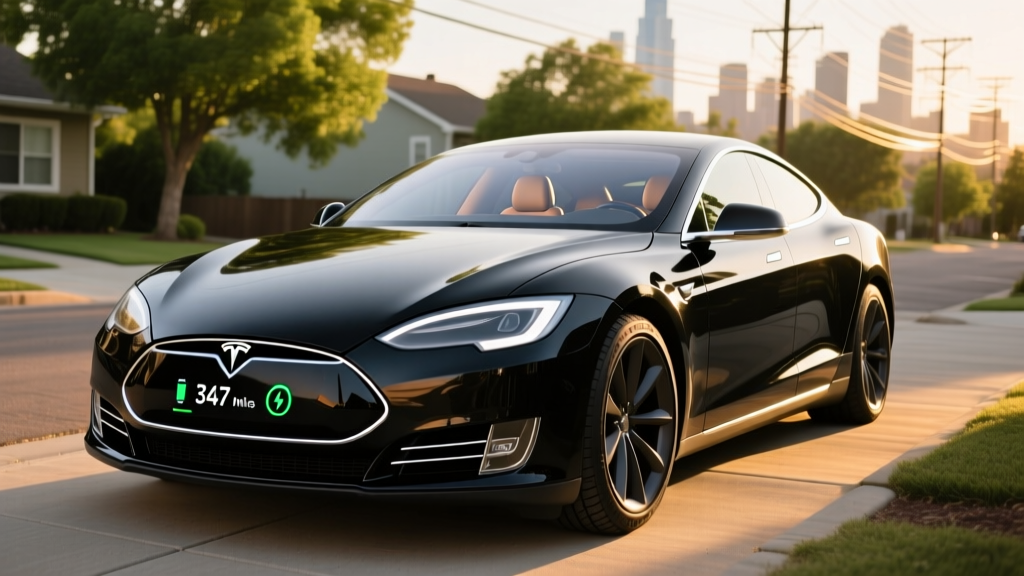
The 2019 Tesla Model S occupies a strange space in the used EV market. It's old enough to have depreciated steeply—putting it within reach of budget-conscious buyers—yet it still delivers a driving experience that rivals new luxury sedans costing twice as much. But buying a six-year-old electric vehicle comes with specific risks that don't apply to gas cars: battery degradation, outdated charging hardware, and expired warranties. This review breaks down exactly what you're getting, what to watch for, and whether a 2019 Model S is a smart buy in 2026.
Real-World Range Reality Check
EPA Estimated Range: 285 miles (Long Range) / 370 miles (Long Range, later 2019 software update)
Real-World Expectation in 2026: Expect 230–260 miles in mixed driving on a 7-year-old battery. Highway cruising at 75+ mph drops this to roughly 210–240 miles. In cold weather (below 30°F), plan for 180–210 miles of usable range before you're hunting for a charger. Battery degradation of 10–15% is typical at this age and mileage.
2019 Model S Lineup: Trims, Specs, and What Changed Mid-Year
Tesla simplified the Model S lineup in April 2019, killing off the old 75D, 100D, and P100D naming convention. Here's what was available:
| Spec | Standard Range (early 2019) | Long Range | Performance (Ludicrous) |
|---|---|---|---|
| Battery (usable) | ~75 kWh (NMC) | ~100 kWh (NMC) | ~100 kWh (NMC) |
| EPA Range | 270 mi | 370 mi | 345 mi |
| Drivetrain | Dual Motor AWD | Dual Motor AWD | Dual Motor AWD |
| Horsepower | ~518 hp | ~518 hp | ~762 hp |
| 0–60 mph | 4.2 sec | 4.2 sec | 2.4 sec (Ludicrous+) |
| Top Speed | 140 mph | 155 mph | 163 mph |
| Efficiency (EPA) | 101 MPGe | 111 MPGe | 100 MPGe |
| Energy Use | 33 kWh/100mi | 30 kWh/100mi | 34 kWh/100mi |
The 100 kWh battery uses NMC (nickel manganese cobalt) chemistry. This is significant: NMC offers higher energy density than LFP but is more sensitive to sustained high-state-of-charge storage. If you're buying used, this chemistry means you should avoid routinely charging to 100%—Tesla recommends a daily limit of 80–90% for longevity.
All 2019 Model S variants use the permanent-magnet front motor (introduced with the Raven refresh in mid-2019) paired with an induction rear motor. Early 2019 cars with the older dual-induction setup are noticeably less efficient. Verify the build date—cars built after April 2019 got the Raven powertrain and adaptive air suspension as standard, making them substantially more desirable.
Charging Speed: Supercharging and Home Charging in 2026
Charging infrastructure has evolved considerably since 2019, but the car's onboard hardware is the limiting factor. Here's what a 2019 Model S can actually accept:
| Charging Method | Max Power (kW) | Speed | Notes |
|---|---|---|---|
| Level 1 (120V outlet) | 1.4 kW | ~3–4 mi/hr | Emergency/top-off only |
| Level 2 (240V, 48A) | 11.5 kW | ~34 mi/hr | Full charge in ~9–10 hours (100 kWh) |
| Tesla Supercharger V2 | 150 kW (peak) | 10–80% in ~40 min | Peak only; tapers heavily above 60% |
| Tesla Supercharger V3 | ~150 kW (capped) | 10–80% in ~38 min | 2019 Model S cannot accept V3's 250 kW peak |
| CCS (via adapter) | ~150 kW | 10–80% in ~40 min | Requires Tesla CCS adapter; limited to car's max rate |
The critical limitation: the 2019 Model S maxes out at approximately 150 kW on DC fast charging, even when plugged into a 250 kW V3 Supercharger. The onboard charge controller simply can't accept more. This means you'll spend 35–40 minutes going from 10% to 80% on a road trip—acceptable, but noticeably slower than a 2024+ Model S (which peaks at 250 kW) or a Hyundai Ioniq 5 (350 kW capable).
The charge curve is the hidden story. The car pulls close to 150 kW only between roughly 10–30% state of charge. By 50% SoC, you're down to ~100 kW. By 70%, you're at ~60 kW. Above 80%, charging slows to a trickle—plan accordingly on road trips and don't sit at the charger past 80% unless you absolutely need those last miles.
For home charging, the 11.5 kW onboard charger is excellent. A Wall Connector or equivalent Level 2 station on a 60-amp circuit will fully replenish the Long Range overnight. Tesla's Mobile Connector with a NEMA 14-50 adapter delivers up to 40 amps (9.6 kW), adding roughly 29 miles per hour of charging—still practical for daily use.
Battery Health and Degradation: What to Expect at 7 Years Old
This is the single most important factor when buying a used 2019 Model S. According to aggregated fleet data from sources like Teslanorth and TeslaFi community tracking, the average 100 kWh Model S battery shows approximately 10–15% degradation after 6–7 years or 80,000–100,000 miles.
What this means practically:
- Long Range (originally 370 mi EPA): Expect 310–335 miles at 100% charge when new-equivalent, translating to roughly 230–260 real-world miles
- Performance (originally 345 mi EPA): Expect 290–310 miles at 100%, or about 215–245 real-world miles
- Standard Range (originally 270 mi EPA): Expect 230–245 miles at 100%, or about 180–200 real-world miles
Degradation isn't linear. Most loss occurs in the first 20,000–30,000 miles, after which the curve flattens. A car with 90,000 miles may have only marginally more degradation than one with 50,000 miles. The bigger risk is outlier cells or module imbalance, which can cause sudden capacity drops rather than gradual decline.
Before buying: Request a battery health report from the seller. You can check approximate degradation yourself by charging to 100% and comparing the displayed range to the original EPA figure (adjusting for Tesla's occasional software-based range recalculations). Third-party tools like TeslaFi or Teslamate can log detailed State of Health (SoH) data if the owner has been tracking it.
Tax Credits, Pricing, and Total Cost of Ownership
The 2019 Model S was never eligible for the federal EV tax credit as a new purchase—Tesla had already exceeded the 200,000-unit manufacturer cap by late 2018. However, as a used vehicle in 2026, it may qualify for the Used Clean Vehicle Credit under IRS §25E.
| Factor | Details |
|---|---|
| Used market price (2026) | $28,000–$42,000 depending on trim, mileage, and condition |
| Used EV tax credit (§25E) | Up to $4,000 or 30% of sale price (whichever is less) |
| Income cap (§25E) | $75,000 single / $112,500 HOH / $150,000 joint (AGI) |
| Vehicle price cap (§25E) | Sale price must be $25,000 or below to qualify |
| Dealer requirement | Must purchase from a licensed dealer (private-party sales excluded) |
This is the tricky part: most 2019 Model S vehicles sell above the $25,000 price cap, meaning many will not qualify for the used EV credit. Only the highest-mileage or cosmetically challenged Standard Range examples might dip below this threshold. Check current IRS §25E rules before counting on this credit in your budget.
For total cost of ownership, a 2019 Model S Long Range driven 12,000 miles per year at the national average electricity rate of $0.16/kWh costs roughly $580/year in "fuel" (30 kWh/100mi × 12,000 mi × $0.16). A comparable BMW 5 Series or Mercedes E-Class at 25 MPG combined and $3.50/gallon runs about $1,680/year. That's a $1,100 annual fuel savings, though insurance on a used Model S typically runs 15–25% higher than equivalent ICE luxury sedans.
Interior, Cargo, and Daily Livability
The 2019 Model S interior is a study in contrasts. The minimalist dashboard and 17-inch portrait touchscreen were futuristic in 2012 when the car launched, but by 2019—and certainly by 2026 standards—the materials and build quality lag behind German competitors. Expect some panel gap variation, creaking trim on rough roads, and a headliner that may show wear on higher-mileage examples.
Where the Model S excels is space:
- Front legroom: 42.7 inches
- Rear legroom: 35.4 inches
- Cargo (rear trunk): 26.3 cu ft
- Frunk (front trunk): 5.3 cu ft
- Total with rear seats folded: 58.1 cu ft
The frunk is useful for charging cables, groceries, or a carry-on bag. The rear hatch (not a traditional sedan trunk) makes loading bulky items easy. Rear seats fold 60/40 for longer cargo. For a family of four on a road trip, the Model S swallows luggage comfortably—something the smaller Model 3 can't match.
The 17-inch touchscreen handles navigation, media, climate, and vehicle settings. In 2019, Tesla was still using the older MCU1 (Media Control Unit) in some early-build cars, which is sluggish by modern standards and prone to the infamous "yellowing" of the display bond. Confirm the car has MCU2 (introduced March 2018), which uses an Intel Atom processor and supports modern software features including Theater mode and improved navigation rendering.
Autopilot and Driver Assistance: SAE Level 2, Not Self-Driving
SAE Automation Level: 2 — The 2019 Model S with Autopilot or Full Self-Driving (FSD) capability is a Level 2 driver-assistance system. The driver must remain fully engaged, hands on or near the wheel, and eyes on the road at all times. This is not autonomous or self-driving. Only Level 4 services like Waymo operate without a driver.
Every 2019 Model S came with basic Autopilot (traffic-aware cruise control and autosteer). Enhanced Autopilot ($6,000 option at the time) added auto lane change, autosteer on navigation routes, and Summon. FSD ($7,000–$10,000 depending on purchase date) added traffic light/stop sign recognition and the promise of future "full" capability.
In 2026 reality, FSD Supervised remains a Level 2 system requiring constant driver oversight. It's impressive on highways and has improved significantly in city driving, but it is not a chauffeur. If you're buying used, verify whether FSD was purchased and whether it transfers with the vehicle (Tesla's policy has changed multiple times—current as of 2026: FSD generally transfers on used cars sold through Tesla, but private-party transfers depend on current Tesla policy at time of sale).
What Autopilot/FSD Does NOT Do:
- Drive without your supervision—you are legally responsible at all times
- Handle all construction zones, unmapped roads, or severe weather reliably
- Replace attentive driving—NHTSA has investigated multiple incidents involving driver inattention with Autopilot engaged
2019 Model S vs. Key Competitors on the Used Market
| Attribute | 2019 Tesla Model S LR | 2019 Porsche Taycan 4S | 2019 Audi e-tron | 2020 Lucid Air (Pure) |
|---|---|---|---|---|
| Used Price (2026) | $32,000–$38,000 | $42,000–$52,000 | $28,000–$35,000 | $38,000–$45,000 |
| EPA Range | 370 mi | 203 mi | 204 mi | 410 mi |
| Real-World Range (aged) | ~240–270 mi | ~160–185 mi | ~170–190 mi | ~340–370 mi |
| Max DC Charge kW | ~150 kW | 270 kW | 150 kW | 300 kW |
| 0–60 mph | 4.2 sec | 3.8 sec | 5.5 sec | 3.2 sec |
| Supercharger Access | Native | Adapter needed (NACS) | Adapter needed (NACS) | Adapter needed (NACS) |
| Charging Network Ease | Best (native Tesla) | Good (with adapter) | Good (with adapter) | Good (with adapter) |
The Model S wins on range and charging network access. The Porsche Taycan charges faster and drives better but sacrifices nearly 100 miles of range. The Audi e-tron is comfortable but heavy and inefficient. The Lucid Air is the only competitor that beats the Model S on range and charging speed, but it's newer to the used market and carries less long-term reliability data.
Warranty Status and What to Budget For
As a 2019 model, the original 4-year/50,000-mile bumper-to-bumper warranty has expired for virtually every example on the market. The battery and drive unit warranty is the critical remaining coverage:
- Battery & Drive Unit: 8 years / 150,000 miles (Long Range & Performance), whichever comes first
- Capacity retention guarantee: Minimum 70% of original capacity during warranty period
- Standard Range: 8 years / 125,000 miles
For a 2019 Model S, this warranty runs through 2027 or until the mileage limit is hit. This is a major advantage—a 2019 Long Range with 90,000 miles still has battery/drive unit coverage until it reaches 150,000 miles or the 8-year mark.
Budget for out-of-warranty items: Air suspension struts ($1,200–$1,800 per corner), MCU2 screen replacement ($1,500–$2,000 if not covered), door handles (a known failure point, ~$400–$600 each), and 12V battery replacement ($300–$500). Set aside $2,000–$4,000 in your first year for deferred maintenance and surprises.
Pros
- Class-leading EPA range (370 mi Long Range) even after degradation
- Native Tesla Supercharger access—no adapters needed
- Massive cargo capacity with hatch and frunk
- Performance variants offer supercar acceleration at sedan prices
- OTA software updates still being delivered in 2026
- Battery/drive unit warranty may still have coverage remaining
- Low cost of "fuel" vs. gas luxury sedans
Cons
- Interior quality and materials lag behind 2019-era German competitors
- DC fast charging capped at ~150 kW—slow vs. modern EVs
- MCU1 in early-build cars is sluggish and prone to display issues
- Air suspension and door handles are known failure points
- No Apple CarPlay or Android Auto support
- Insurance premiums higher than comparable ICE luxury sedans
- FSD transfer on private-party sales is uncertain
- Likely above $25,000 sale price cap—disqualifying from used EV tax credit
Who Should Buy a 2019 Tesla Model S in 2026?
Choose the 2019 Model S Long Range if:
- You need 250+ real-world miles of range for road trips or a long commute
- You want Supercharger network access without adapters or workarounds
- You need sedan cargo space for family gear but don't want an SUV
- You can verify a post-April 2019 Raven build with MCU2
- You value over-the-air updates that keep a 7-year-old car feeling current
Choose the 2019 Model S Performance if:
- Acceleration thrills matter more than maximum range
- You understand the performance variant's lower real-world range (~215–245 mi)
- You're willing to pay a premium on the used market for Ludicrous mode
Look elsewhere if:
- You want the fastest possible DC charging (consider a used 2022+ Hyundai Ioniq 5 or Kia EV6)
- Interior luxury and build quality are top priorities (Porsche Taycan or BMW i5)
- You need a vehicle under $25,000 to qualify for the used EV tax credit
- You want Apple CarPlay (not available on any Tesla)
Frequently Asked Questions
What is the real-world range of a 2019 Tesla Model S in 2026?
For a Long Range model with typical 10–15% battery degradation, expect 240–270 miles in mixed driving conditions. Highway driving at 75+ mph reduces this to 210–240 miles. Cold weather (below 30°F) can drop range to 180–210 miles. The Performance variant will deliver roughly 10–15% less due to its sport-tuned powertrain. The Standard Range (75 kWh) model delivers approximately 180–200 real-world miles.
How fast does the 2019 Model S charge at home and on road trips?
At home on a 240V Level 2 charger (48 amps), the 100 kWh battery charges at 11.5 kW, adding roughly 34 miles of range per hour—a full charge takes 9–10 hours. On DC fast charging (Supercharger or CCS with adapter), the car peaks at approximately 150 kW, achieving a 10–80% charge in about 38–40 minutes. Charging slows significantly above 80% SoC. The car cannot accept the 250 kW peak of V3 Superchargers due to its onboard charge controller limitations.
Does a used 2019 Tesla Model S qualify for any federal tax credit?
It may qualify for the Used Clean Vehicle Credit (IRS §25E), which offers up to $4,000 or 30% of the sale price (whichever is less). However, the vehicle must sell for $25,000 or less, the buyer must meet income caps ($75,000 single / $150,000 joint), and the sale must be through a licensed dealer. Since most 2019 Model S vehicles sell for $28,000–$42,000, many will exceed the price cap and not qualify. Verify current rules at IRS.gov before budgeting for this credit. It does not qualify for the new-vehicle §30D credit.
Is the 2019 Model S worth buying over newer used EVs?
It depends on your priorities. The 2019 Model S Long Range still offers more real-world range than most EVs built through 2022, and native Supercharger access remains a significant advantage. However, a 2022+ Hyundai Ioniq 5 or Kia EV6 will charge nearly twice as fast on DC, offer modern interiors, and may still carry factory warranty—all for similar money. The Model S wins on range, space, and the Tesla software ecosystem. It loses on charging speed, interior luxury, and warranty coverage.
What are the biggest problems with a 2019 Model S?
The most common issues reported by owners include: air suspension strut failures ($1,200–$1,800 per corner), MCU1 display delamination or failure on early-build cars, retractable door handle mechanism failures, 12V auxiliary battery degradation, and minor rattles or trim creaks. The battery and drive units have proven generally reliable, with most examples showing 10–15% degradation at this age. Always get a pre-purchase inspection from a Tesla-qualified independent shop.
Does the 2019 Model S have the Raven powertrain?
Only if it was built after April 2019. The Raven refresh introduced the permanent-magnet synchronous reluctance front motor (replacing the older induction unit), adaptive air suspension as standard, and slightly improved range and efficiency. Early 2019 builds with the dual-induction motor setup are less efficient and less desirable. Check the build date on the driver's door jamb sticker or through the car's software menu.