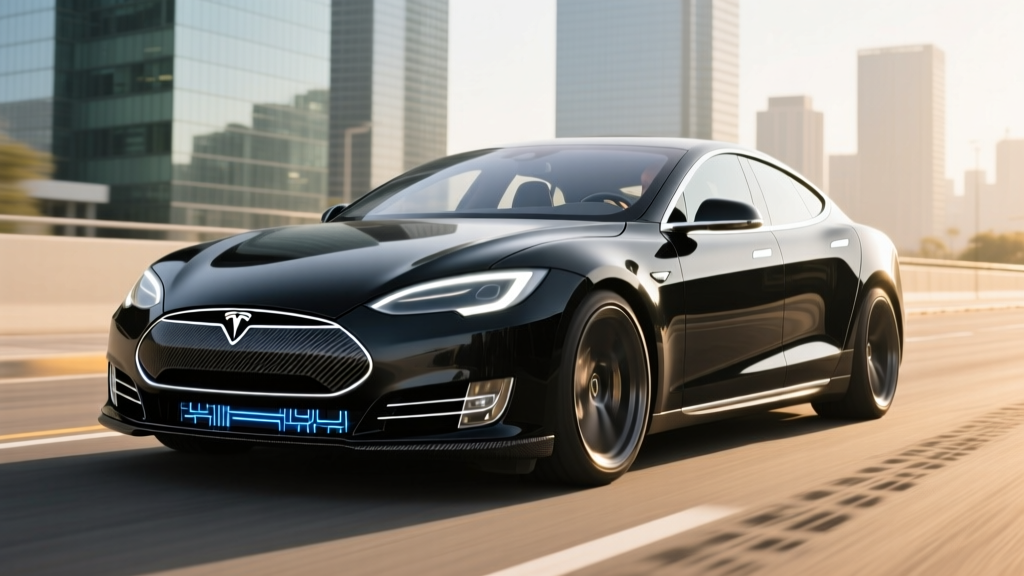
The 2019 Tesla Model S Performance at a Glance
The 2019 Tesla Model S Performance (badged "P100D" in early 2019, later renamed "Model S Performance" with the Raven suspension update in April 2019) remains one of the quickest production sedans ever built. Its headline 0-60 mph time of 2.4 seconds in Ludicrous mode still rivals hypercars costing five times its current used-market price. But beyond straight-line speed, this is a full-size luxury EV with genuine cross-country range, access to the Supercharger network, and over-the-air updates that have added features years after delivery.
For 2026 buyers shopping the used EV market, the 2019 Model S Performance occupies a compelling sweet spot: it benefits from Tesla's improved 100 kWh battery pack, the optional adaptive air suspension (Raven), and a mature software stack — while depreciating enough to be attainable well below its original $130,000+ MSRP. Below, we break down every spec that matters.
| Spec | Value |
|---|---|
| EPA Range (100D / P100D Performance) | 335 mi (P100D) / 370 mi (Raven Performance) |
| Battery Capacity | 100 kWh (NMC chemistry, ~98 kWh usable) |
| Drivetrain | Dual-motor AWD (permanent magnet front + induction rear on Raven; dual induction on pre-Raven) |
| Horsepower | ~762 hp (Ludicrous mode, peak output) |
| 0-60 mph | 2.4 seconds (with rollout subtracted) |
| Top Speed | 163 mph |
| Max DC Fast Charge | ~145 kW (V2 Supercharger peak) |
| Level 2 Charge Rate | 16.5 kW (48-amp onboard charger, ~52 mi/hr) |
| EPA Efficiency | 98 MPGe combined / 34 kWh per 100 mi |
| Cargo Volume | 26.3 cu ft (rear trunk + frunk combined) |
| Original MSRP (P100D, 2019) | ~$135,000 (before incentives) |
| 2026 Used Market Range | $38,000 – $58,000 (depending on mileage, condition, battery SoH) |
| Battery Warranty | 8 years / 150,000 miles (70% capacity retention) |
Real-World Range: What the EPA Number Doesn't Tell You
EPA Sticker: 335 miles (pre-Raven P100D) / 370 miles (Raven Performance, post-April 2019)
Real-World Highway (70 mph, moderate weather): ~270–300 miles
Real-World Cold Weather (below 32°F, highway): ~220–250 miles
Mixed Commute (city + highway, mild weather): ~290–320 miles
The 100 kWh NMC battery pack in the 2019 Model S Performance was Tesla's largest at the time, and its EPA-rated range still holds up well. According to fueleconomy.gov, the 2019 Model S 100D achieves 335 miles on a full charge, while the Raven Performance variant (introduced mid-2019 with a more efficient permanent-magnet front motor) bumps that to 370 miles.
However, the real-world picture demands nuance. At sustained highway speeds of 70–75 mph, expect to use roughly 320–350 Wh/mile, which translates to 270–300 miles before reaching a 5% buffer. Cold weather compounds this: below freezing, cabin heating and battery thermal management can push consumption to 380–420 Wh/mile, shrinking effective range to around 220–250 miles. The Model S lacks a heat pump (introduced on the refreshed 2021+ Model S), relying instead on resistive heating — a meaningful efficiency penalty in winter climates.
On the positive side, Tesla's battery management system and liquid thermal conditioning keep degradation relatively modest. Most 2019 Model S packs at 60,000–80,000 miles show 90–94% State of Health (SoH), meaning a car originally rated at 335 miles might deliver 300–315 miles at 100% charge today.
Charging Speed: Supercharger V2, V3, and Home Charging
| Level | Power / Rate | Miles Added per Hour | Notes |
|---|---|---|---|
| Level 1 (120V, 12A) | ~1.4 kW | ~3–4 mi/hr | Emergency/trickle only |
| Level 2 (240V, 48A) | 16.5 kW (onboard charger max) | ~52 mi/hr | Full charge in ~6.5 hours |
| DC Fast (V2 Supercharger) | Peak ~145 kW | ~300+ mi/hr at peak | 10–80% in ~40 minutes |
| DC Fast (V3 Supercharger) | Peak ~150 kW (capped by pack) | ~320 mi/hr at peak | 10–80% in ~38 minutes |
The 2019 Model S Performance uses Tesla's proprietary connector (now being adopted industry-wide as NACS). It charges natively at every Tesla Supercharger without adapters — a significant advantage in 2026 as the Supercharger network has grown to over 6,000 U.S. stations.
Here's the critical charging-curve detail many used-buyer guides omit: the 100 kWh pack peaks around 145 kW on V2 Superchargers and roughly 150 kW on V3 stalls, but that peak only holds between approximately 10–30% State of Charge (SoC). Above 50%, the curve tapers to ~90 kW, and above 80% it drops below 40 kW. A realistic 10–80% session takes 38–42 minutes — respectable for a 100 kWh pack, but noticeably slower than the 800V architectures in newer EVs like the Hyundai Ioniq 5 or Porsche Taycan, which can do 10–80% in 18 minutes.
At home on a 48-amp Level 2 Wall Connector (the most common residential setup), the onboard 16.5 kW charger replenishes roughly 52 miles of range per hour, meaning a full overnight charge from 20% to 100% takes about 6.5 hours. If your home electrical panel supports a 60-amp circuit, this is the optimal setup. Homes with older 100-amp panels may require a $1,500–$3,000 panel upgrade — confirm with a licensed electrician before committing.
The 2019 Tesla Model S Performance 0-60: How Quick Is It Really?
The headline number — 2.4 seconds from 0-60 mph — applies to the Model S P100D (and carryover Performance trim) in Ludicrous mode with launch control engaged and the rollout subtracted (Tesla's standard measurement method, which shaves ~0.2 seconds). Independent testing by outlets like Motor Trend and Car and Driver confirmed sub-2.5-second runs consistently, making this one of the fastest-accelerating production cars ever sold at any price.
The dual-motor AWD system delivers instant torque to all four wheels with no turbo lag, no transmission shift, and no traction loss. The pre-Raven P100D uses dual induction motors; the Raven Performance (April 2019 onward) swaps to a permanent-magnet reluctance motor up front for improved efficiency and slightly sharper low-end response.
Total system output peaks around 762 horsepower in Ludicrous mode, though Tesla doesn't publish official SAE-certified HP figures. What matters on the road is the relentless, silent surge that pins you to the seat and makes even a Porsche Taycan Turbo S feel slightly less urgent off the line. Quarter-mile times hover around 10.5–10.8 seconds at 125+ mph.
For context, the 2019 Model S Performance 0-60 time beat virtually every combustion supercar of its era — the Lamborghini Huracán Performante (2.3s), McLaren 720S (2.8s), and Ferrari 488 Pista (2.7s) — at a fraction of the cost. In 2026, it still outpaces most new EVs short of the Lucid Air Sapphire or Tesla's own Plaid models.
Tax Credits, Pricing, and What You'll Actually Pay in 2026
When new, the 2019 Model S Performance started around $135,000 (P100D) to $133,000 (Raven Performance), before the $7,500 federal tax credit that was still available for Tesla buyers in early 2019 (Tesla's credit began phasing out in Q1 2019 after the company hit 200,000 qualifying sales).
In the 2026 used market, expect to find these cars priced between $38,000 and $58,000, depending on mileage (typically 45,000–90,000 miles), battery State of Health, service history, and trim options (Enhanced Autopilot, premium interior, Raven suspension).
As of 2026, purchasing a used 2019 Model S Performance may qualify you for the Used Clean Vehicle Credit (§25E), worth up to $4,000 or 30% of the sale price (whichever is less). Key requirements per the IRS:
- Sale price must be $25,000 or less
- Buyer AGI must not exceed $75,000 (single) / $150,000 (joint)
- Vehicle must be at least 2 model years old (2019 qualifies)
- Must purchase from a licensed dealer (private sales excluded)
- Credit is non-refundable and can only be claimed once per vehicle
| Item | Estimated Cost |
|---|---|
| Used Purchase Price (avg. 65k miles) | $45,000 – $52,000 |
| Federal Tax Credit (§25E Used) | $0 (price exceeds $25K cap) |
| Home Level 2 Charger (Wall Connector + install) | $800 – $2,000 |
| Annual Insurance (national avg. for Model S) | $2,800 – $4,200 |
| Annual Electricity (12,000 mi/yr, $0.16/kWh avg.) | $650 – $750 |
| Estimated Annual Maintenance | $400 – $800 (tires, cabin filter, fluid top-offs) |
Interior, Cargo, and Daily Practicality
The 2019 Model S interior remains spacious, if showing its age compared to the 2021+ "Palladium" refresh. Key dimensions:
- Front legroom: 42.7 inches
- Rear legroom: 35.4 inches
- Rear trunk: 26.3 cu ft (with rear seats up)
- Frunk (front trunk): 5.3 cu ft
- Total cargo (seats folded): ~58.1 cu ft
- Seating: 5 passengers standard (optional rear-facing third-row jump seats available on earlier years, removed by 2019)
The 17-inch center touchscreen (vertical orientation, pre-refresh) controls virtually all vehicle functions — climate, media, navigation, vehicle settings, and Autopilot configuration. The 2019 model year received Tesla's updated MCU2 (Media Control Unit) with an Intel Atom processor, meaning it supports the full current Tesla software suite including Theater mode, Sentry Mode dashcam recording, and the latest navigation maps.
Notable drawbacks for 2026 buyers: the interior materials (synthetic leather, piano black plastic) show wear more readily than competing luxury sedans. Panel gaps on 2019 Fremont-built cars can be inconsistent. The instrument cluster is a small secondary screen behind the wheel rather than a full digital dash. And the lack of Apple CarPlay or Android Auto — still true across all Teslas — frustrates some buyers accustomed to phone mirroring.
Autopilot, Safety, and Driver Assistance
The 2019 Model S Performance comes with Tesla's Basic Autopilot as standard: Traffic-Aware Cruise Control and Autosteer (lane-centering). Enhanced Autopilot ($6,000 option at the time) added Auto Lane Change, Autopark, Summon, and Navigate on Autopilot. Full Self-Driving (FSD) was available as a $7,000–$8,000 option but remained in beta testing.
All Tesla Autopilot and FSD (Supervised) features are SAE Level 2 driver-assistance systems. The driver must remain fully engaged, keep hands on the wheel, and monitor the road at all times. These systems do not make the vehicle self-driving. Only Level 4 services like Waymo operate without a human driver in geofenced areas.
The 2019 Model S earned a 5-star overall safety rating from NHTSA, with 5 stars in frontal crash, side crash, and rollover categories. The Insurance Institute for Highway Safety (IIHS) rated it "Good" in most crashworthiness tests, though headlight ratings varied by trim.
Pros, Cons, and Who Should Buy
- 2.4-second 0-60 mph — still elite in 2026
- 335–370 mi EPA range covers most road trips
- Supercharger network access (NACS native)
- OTA updates keep software current
- Spacious cabin with frunk + large trunk
- Air suspension (Raven) provides excellent ride quality
- No heat pump — cold-weather range loss is significant
- Charging speed peaks at ~150 kW (slower than 800V rivals)
- Interior materials and build quality inconsistent
- No Apple CarPlay / Android Auto
- Insurance premiums above average for the segment
- Out-of-warranty battery replacement: $15,000–$22,000
Best suited for: Performance-minded drivers who want supercar acceleration with daily-driver practicality and road-trip capability. The 2019 Model S Performance is ideal if you have reliable home Level 2 charging, drive in moderate climates (or accept the winter range penalty), and value access to the Supercharger network for long-distance travel. It's less ideal for buyers who prioritize cutting-edge interior luxury, the fastest possible charging, or who live in extreme cold-weather regions without garage parking.
2019 Model S Performance vs. Key Used-Market Competitors
| Vehicle | 0-60 mph | EPA Range | Max DC Charge | Used Price Range |
|---|---|---|---|---|
| 2019 Tesla Model S Performance | 2.4s | 335–370 mi | ~150 kW | $38K–$58K |
| 2020 Porsche Taycan Turbo | 3.0s | 201 mi | 270 kW | $55K–$72K |
| 2021 Tesla Model S Plaid | 1.99s | 396 mi | 250 kW | $72K–$90K |
| 2020 Audi e-tron GT (concept-era) | 3.9s | 238 mi | 270 kW | $48K–$62K |
The Model S Performance trades charging speed and interior polish for unbeatable acceleration-per-dollar and superior range. If fast-charging on road trips is your priority, the Taycan's 800V architecture is meaningfully quicker. If you want the latest Tesla tech, a used Plaid is the upgrade path — but at a steep premium.
Frequently Asked Questions
What is the real-world range of the 2019 Tesla Model S Performance?
Expect 270–300 miles at highway speeds in mild weather, and 220–250 miles in freezing temperatures. The EPA sticker reads 335 miles (P100D) or 370 miles (Raven Performance), but real-world consumption at 70+ mph and in cold weather is higher than the test cycle assumes.
How fast does the 2019 Model S Performance charge?
On DC fast chargers (Tesla V2/V3 Superchargers), it peaks at roughly 145–150 kW, completing a 10–80% charge in about 38–42 minutes. At home on a 48-amp Level 2 Wall Connector, it charges at 16.5 kW, adding ~52 miles of range per hour.
Does the 2019 Tesla Model S qualify for any federal tax credit in 2026?
On the used market, the §25E Used Clean Vehicle Credit offers up to $4,000 — but only if the sale price is $25,000 or less and the buyer meets income caps. Since most 2019 Model S Performance examples sell for $38,000–$58,000, the credit generally does not apply. The new-vehicle §30D credit is not available on used purchases. Always verify current rules at irs.gov.
Is the 2019 Model S Performance worth buying in 2026?
If you want supercar-level acceleration, genuine 300+ mile range, and Supercharger access at a used-market price under $55K, it's one of the best performance-EV values available. Budget for higher-than-average insurance, potential out-of-warranty repairs, and understand the charging-speed limitations vs. newer 800V platforms.
How long will the 100 kWh battery last?
Tesla's battery warranty covers 8 years or 150,000 miles (whichever comes first) with a minimum 70% capacity retention. For a 2019 model, that warranty window closes in 2027. Real-world data from Tesla's Impact Reports and third-party fleet analyses suggest the 100 kWh NMC packs retain roughly 90–94% capacity at 80,000 miles. A full out-of-warranty replacement runs $15,000–$22,000 depending on source and labor.
What's the difference between the P100D and the Raven Performance?
Pre-April 2019 cars are badged P100D with dual induction motors and a conventional coil-spring or older air suspension. Raven Performance models (April 2019+) gained a permanent-magnet front motor, the adaptive air suspension from the Model 3, improved efficiency (370 vs. 335 EPA miles), and slightly sharper handling. The Raven is the more desirable variant on the used market.