Why the 2019 Tesla Model 3 Interior Still Matters in 2026
The 2019 Tesla Model 3 was a watershed vehicle — the first mass-market EV to prove that a minimalist, screen-centric cabin could sell in the hundreds of thousands. In 2026, this model year has become a prime target on the used-EV market, with prices settling between $16,000 and $24,000 depending on trim, mileage, and battery health. But the 2019 Tesla Model 3 interior is equal parts polarizing and practical: a single 15-inch landscape touchscreen controls everything from climate to mirrors, there is no traditional instrument cluster, and material quality was an early pain point Tesla addressed through running production changes.
This review covers what you need to know before buying a used 2019 Model 3 today — from real-world range and charging speeds to the used-EV federal tax credit and interior ergonomics that still divide owners.
Range, Battery, and Real-World Efficiency
The 2019 Model 3 was offered in three main configurations: Standard Range Plus (SR+), Long Range RWD, and Long Range AWD (Dual Motor). Battery chemistry across all 2019 trims is NMC (nickel-manganese-cobalt), not the LFP chemistry Tesla introduced in later Standard Range models.
| Spec | SR+ | Long Range RWD | Long Range AWD | Performance AWD |
|---|---|---|---|---|
| EPA Range | 240 mi | 322 mi | 310 mi | 310 mi |
| Battery (gross / usable) | ~54 kWh / ~50 kWh | ~79 kWh / ~75 kWh | ~79 kWh / ~75 kWh | ~79 kWh / ~75 kWh |
| Chemistry | NMC | NMC | NMC | NMC |
| Drivetrain | RWD | RWD | Dual-Motor AWD | Dual-Motor AWD |
| 0-60 mph | 5.2 sec | 4.4 sec | 3.2 sec | |
| Horsepower (est.) | 283 hp | 283 hp | 346 hp | 450 hp |
| MPGe (combined) | 141 MPGe | 133 MPGe | 126 MPGe | 121 MPGe |
| kWh/100 mi | 24 | 25 | 27 | 28 |
Charging Speed: DC Fast, Level 2, and Level 1
The 2019 Model 3 supports DC fast charging at up to 170 kW peak on V2 Superchargers (V3 Superchargers, which debuted mid-2019, can push ~250 kW but the 2019 Model 3's peak acceptance is closer to 195 kW under ideal conditions). At home, the onboard charger accepts up to 11.5 kW on a 48-amp Level 2 circuit, which is faster than most competitors of this era.
| Level | Power | Speed | Notes |
|---|---|---|---|
| Level 1 (120V) | ~1.4 kW | ~3-5 mi/hr | Emergency/trickle only |
| Level 2 (240V, 48A) | 11.5 kW | ~40-44 mi/hr | Full charge overnight in ~7-8 hr |
| DC Fast (V3 Supercharger) | Peak ~195 kW | 10-80% in ~28 min | Curve tapers sharply above 60%; 80-100% adds 25+ min |
| DC Fast (V2 Supercharger) | Peak ~150 kW | 10-80% in ~35 min | Most common public Tesla charger |
| CCS Adapter (2026) | Up to ~195 kW | Varies by station | Tesla's $175 CCS adapter unlocks Electrify America, EVgo, and other non-Tesla networks |
Charging-curve reality: Peak kW is not sustained kW. The 2019 Model 3 holds its highest charge rate between roughly 10-40% State of Charge (SoC), then progressively tapers. If you're road-tripping, plan Supercharger stops in the 10-60% window for the fastest average speed. Preconditioning — which the car does automatically when you navigate to a Supercharger — is essential for hitting peak rates, especially in cold weather.
The 2019 Tesla Model 3 Interior: Minimalism Meets Compromise
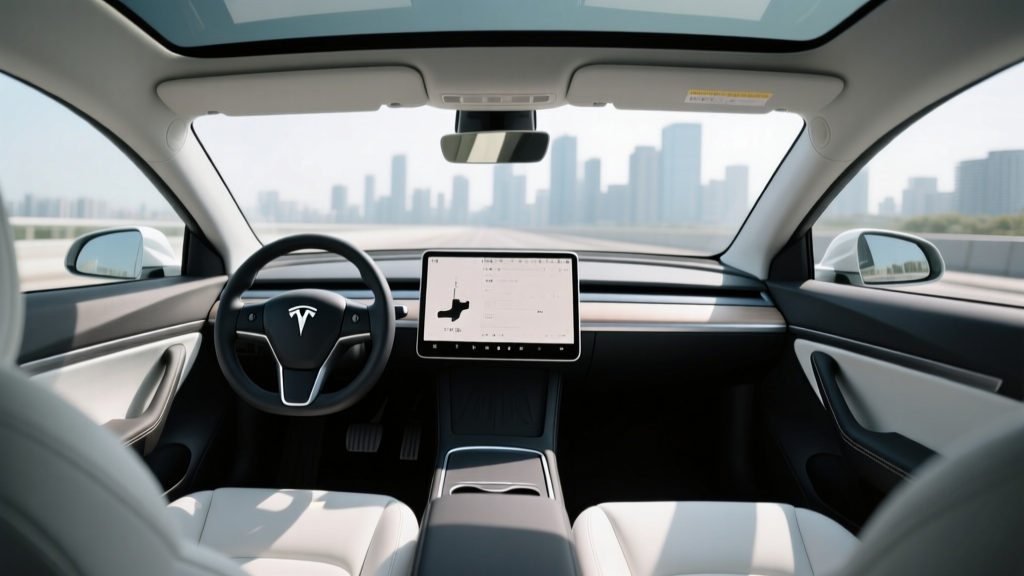
The 2019 Tesla Model 3 interior is defined by what it lacks. There is no gauge cluster, no head-up display, no physical buttons for climate or media, and no traditional vent adjusters. Everything routes through the 15-inch center touchscreen. This was radical in 2019 and remains distinctive in 2026, though competitors like the Hyundai Ioniq 5 and BMW i4 have since blended screens with tactile controls.
What Works
- 15-inch touchscreen: Responsive, high-resolution, and regularly updated via OTA software. In 2026, 2019 Model 3s running current Tesla software retain access to navigation, streaming (Netflix/YouTube while parked), and the Tesla app ecosystem.
- Over-the-air updates: Tesla has pushed hundreds of updates since 2019, adding features like Dog Mode, Sentry Mode enhancements, and improved voice commands.
- Panoramic glass roof: Creates an airy, spacious feel. UV and IR tinting is strong, but aftermarket ceramic tint is popular in hot climates to reduce cabin heat soak.
- Frunk + trunk: The front trunk (frunk) offers ~3.1 cu ft; the rear trunk provides ~15 cu ft. Combined with the 60/40 split-folding rear seats, total cargo flexibility is strong for the segment.
- Seating: Front seats are supportive on long drives. Rear legroom is 35.2 inches — adequate for adults under 6'0" but tighter than a Camry or Model S.
What Doesn't
- No instrument cluster: Speed, range, and navigation directions live on the left edge of the center screen, requiring a glance away from the road. Some owners add aftermarket HUD units.
- Early-build material quality: First-half 2019 Model 3s had inconsistent panel gaps, rattling door trim, and a "vegan leather" (polyurethane) seat material that could develop creases. Tesla improved these through 2019, so later-build cars tend to be better.
- Rear-seat USB ports: The 2019 model uses USB-A ports (two in the rear). If you rely on USB-C, you'll need adapters.
- No Apple CarPlay / Android Auto: Tesla's proprietary infotainment remains closed. This is still a dealbreaker for some buyers in 2026.
Autopilot, Safety, and Driver Assistance
The 2019 Model 3 comes with Basic Autopilot standard (Traffic-Aware Cruise Control + Autosteer lane-keeping). Enhanced Autopilot ($6,000 option at the time) added Auto Lane Change, Autopark, and Summon. FSD was available as a $7,000-$10,000 add-on, though capabilities in 2019 were far more limited than Tesla's 2026 FSD Supervised stack.
Key hardware note: 2019 Model 3s were built with Hardware 3.0 (HW3), the "Full Self-Driving Computer." Tesla confirmed HW3 supports the current FSD Supervised neural-net stack, though some advanced features perform better on HW4-equipped 2023+ vehicles. The 2019 car's camera suite (8 cameras) remains functional for all current Autopilot and FSD features.
Safety ratings remain a strong point. The 2019 Model 3 earned a 5-star overall NHTSA rating and was an IIHS Top Safety Pick+ (when equipped with specific headlights). However, note that headlight ratings varied by build date, and the automatic emergency braking system, while effective, has been subject to NHTSA investigations regarding phantom braking events.
Pricing, Tax Credits, and Used-EV Value in 2026
The 2019 Model 3 originally started at $39,990 (SR+) and topped out near $59,990 (Performance). In the 2026 used market, expect these approximate ranges:
| Trim | Used Price Range | Used-EV Credit (§25E) | Net Cost (Best Case) |
|---|---|---|---|
| Standard Range Plus | $15,000 – $19,000 | Up to $4,000 | ~$11,000 – $15,000 |
| Long Range RWD | $18,000 – $22,000 | Up to $4,000 | ~$14,000 – $18,000 |
| Long Range AWD | $20,000 – $25,000 | Up to $4,000 | ~$16,000 – $21,000 |
| Performance | $22,000 – $27,000 | Up to $4,000 | ~$18,000 – $23,000 |
Important tax credit details: The new-vehicle §30D credit no longer applies to 2019 purchases. However, the §25E Used Clean Vehicle Credit offers up to $4,000 (or 30% of the sale price, whichever is less) on qualifying used EVs. To qualify, per IRS guidelines:
- The vehicle must be purchased from a licensed dealer (private-party sales do not qualify).
- The sale price must be $25,000 or less — this caps most Performance trims out of eligibility.
- Buyer income limits apply: $75,000 single / $112,500 head of household / $150,000 joint (modified AGI).
- The vehicle must be at least two model years old (2019 qualifies in 2026).
- The credit is non-refundable — you must have sufficient tax liability to use it, unless point-of-sale transfer is arranged with the dealer.
- You can only claim this credit once every three years.
Warranty and Battery Longevity
The 2019 Model 3's original factory warranty included:
- Basic Vehicle Limited Warranty: 4 years / 50,000 miles (expired for nearly all 2019 vehicles by 2026).
- Battery & Drive Unit Warranty: 8 years / 100,000 miles (SR+) or 8 years / 120,000 miles (Long Range & Performance), whichever comes first, with a minimum 70% capacity retention threshold.
For a 2019 Model 3 purchased in 2026, the battery and drive unit warranty remains in effect until the earlier of the 8-year anniversary of the original delivery date or the mileage cap. A car delivered in March 2019 would see warranty expiration in March 2027 — leaving roughly a year of coverage for many units.
Battery degradation reality: Tesla's NMC packs in the 2019 Model 3 typically show 8-12% degradation at 60,000-80,000 miles, based on fleet data. This means a Long Range originally rated at 310 miles EPA may display ~275-285 rated miles at full charge. The degradation curve tends to flatten after the first 30,000 miles, with gradual loss thereafter. If the pack falls below 70% of original capacity within the warranty window, Tesla will repair or replace it. Out-of-warranty battery replacement costs range from $12,000 to $16,000 depending on the pack and labor.
Pros, Cons, and Who Should Buy
Pros
- Class-leading efficiency (24-28 kWh/100 mi) keeps charging costs low
- Access to Tesla Supercharger network — the most reliable DC fast-charging network in the U.S.
- OTA software updates continue in 2026, adding features years after purchase
- Strong safety ratings (5-star NHTSA, IIHS Top Safety Pick+)
- Used-EV tax credit up to $4,000 brings net cost as low as ~$11,000
- Low maintenance: no oil changes, minimal brake wear due to regen
Cons
- Interior material quality on early 2019 builds is below the price class
- No instrument cluster or HUD — all info on center screen
- No Apple CarPlay or Android Auto
- Rear seat space is tight for taller passengers (35.2" legroom)
- NMC battery requires 20-80% daily charging discipline (unlike LFP, which tolerates 100%)
- Insurance premiums run 15-25% higher than comparable gas sedans
- Original basic warranty has expired; battery warranty nearing end for some units
Who This EV Suits Best
The 2019 Model 3 is ideal for tech-savvy commuters and road-trippers who value charging infrastructure access and OTA improvements over traditional luxury materials. The Long Range AWD is the sweet spot for buyers needing all-weather capability and 250+ real-world miles. Budget-focused buyers should target the SR+ with the §25E credit for a sub-$15,000 net entry into the Tesla ecosystem. It is not the best choice for families needing spacious rear seats (consider the Model Y) or buyers who prefer physical controls and CarPlay.
Frequently Asked Questions
What is the real-world range of the 2019 Tesla Model 3?
The EPA-rated range is 240 miles (SR+), 322 miles (LR RWD), or 310 miles (LR AWD/Performance). In real-world mixed driving at moderate temperatures, expect 85-92% of EPA — roughly 200-220 mi (SR+) or 260-285 mi (Long Range). Highway-only driving at 75+ mph and cold weather below 30°F will reduce range by 15-30%.
How fast does the 2019 Model 3 charge?
On a V3 Supercharger, it peaks near 195 kW and charges from 10-80% in approximately 28 minutes. On a home Level 2 charger at 48 amps (11.5 kW), it adds roughly 40-44 miles of range per hour, fully charging overnight in 7-8 hours. Level 1 (120V) adds only 3-5 miles per hour and is suitable for emergency use only.
How much does a 2019 Model 3 cost after tax credits in 2026?
Used prices range from $15,000 (SR+) to $27,000 (Performance). The §25E Used Clean Vehicle Credit provides up to $4,000 if purchased from a dealer at $25,000 or below, subject to buyer income caps. Best-case net cost: ~$11,000 for an SR+ to ~$21,000 for a Long Range AWD. Performance trims often exceed the $25,000 price cap and may not qualify.
Is the 2019 Model 3 worth buying vs. competitors in 2026?
Against used alternatives like the 2019 Chevrolet Bolt EV (259 mi EPA, slower DC charging at 55 kW) or 2019 Nissan Leaf Plus (226 mi EPA, CHAdeMO connector with declining infrastructure), the Model 3 wins on charging speed, Supercharger network access, and software. The 2020+ Hyundai Kona Electric and Kia Niro EV are strong alternatives with better interior materials but lack comparable DC fast-charging speeds. If Supercharger access is a priority, the 2019 Model 3 remains the strongest used EV value in its price bracket.
Does the 2019 Tesla Model 3 qualify for the federal EV tax credit?
The new-vehicle §30D credit does not apply. However, the §25E Used Clean Vehicle Credit offers up to $4,000 when purchased from a licensed dealer for $25,000 or less, subject to buyer income limits ($75K single / $150K joint). Consult a tax professional and review current IRS guidance before purchasing, as rules may change.
What should I check before buying a used 2019 Model 3?
Request a battery health report (accessible through Tesla service or a third-party scan tool). Check for uneven panel gaps, door rattles, and seat wear — common on early-2019 builds. Verify the HW3 FSD computer is present (some very early 2019 cars shipped with HW2.5 and were later upgraded). Confirm the car has not been in a major accident, as Tesla's structural repair standards affect future serviceability. Finally, check whether the remaining battery/drive-unit warranty applies based on the original delivery date.