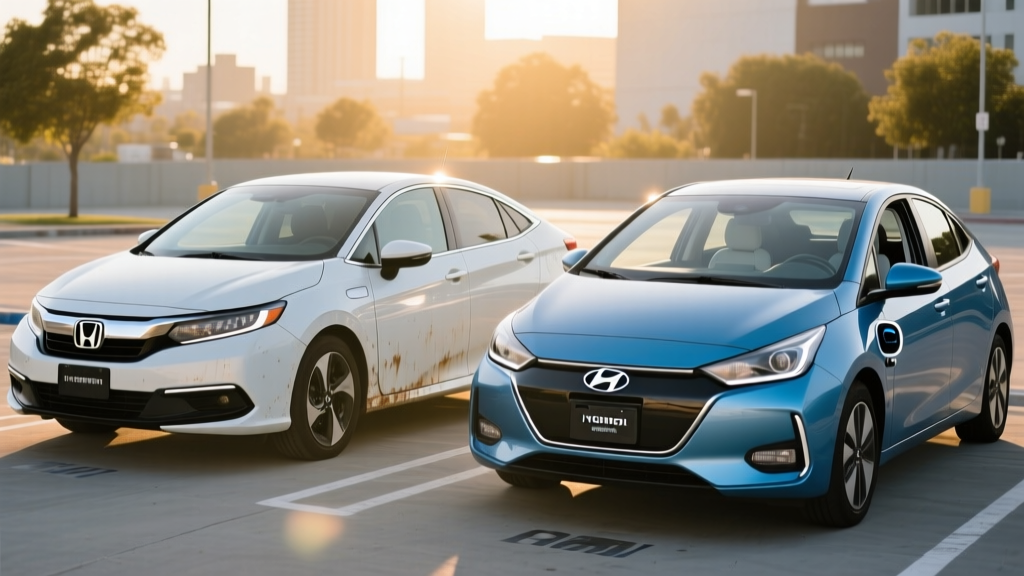
If you've been searching for a 2019 Honda Ioniq, you've likely hit a wall: that exact vehicle doesn't exist. "Ioniq" is Hyundai's electrified nameplate, while Honda's 2019 electric offering was the Clarity Electric. Shoppers frequently cross these wires, so this guide covers both the 2019 Honda Clarity Electric and the 2019 Hyundai Ioniq Electric side by side — giving you the exact specs, real-world range data, charging speeds, and 2026 used-market pricing you need to make a smart purchase.
Both vehicles are now exclusively available on the used market. That changes the tax-credit equation, the pricing calculus, and what you should inspect before buying. Let's get into the numbers.
Spec Showdown: 2019 Honda Clarity Electric vs. 2019 Hyundai Ioniq Electric
| Specification | 2019 Honda Clarity Electric | 2019 Hyundai Ioniq Electric |
|---|---|---|
| EPA Range | 89 miles | 170 miles |
| Battery (usable) | 25.5 kWh (NMC) | 28.0 kWh (NMC) |
| EPA Efficiency | 114 MPGe (30 kWh/100 mi) | 136 MPGe (25 kWh/100 mi) |
| Motor Output | 174 hp / 221 lb-ft | 118 hp / 218 lb-ft |
| 0–60 mph | ~7.7 sec | ~9.9 sec |
| Drivetrain | FWD (single motor) | FWD (single motor) |
| Max DC Fast Charge | ~50 kW (CCS) | ~50 kW (CCS, upgraded to ~75 kW on late builds) |
| 10–80% DC Time | ~30 min | ~34 min (50 kW) / ~24 min (75 kW) |
| Level 2 (240V) Rate | 6.6 kW (~25 mi/hr) | 6.6 kW (~26 mi/hr) |
| Cargo Volume | 15.5 cu ft | 23.8 cu ft (behind rear seats) |
| Rear Legroom | 36.2 in | 35.7 in |
| Original Base MSRP | $36,620 | $31,230 |
| Battery Warranty | 8 yr / 100,000 mi | 8 yr / 100,000 mi (lifetime in CA-emission states) |
Real-World Range: What the EPA Sticker Doesn't Tell You
Honda Clarity Electric: EPA 89 mi → Expect 70–80 mi highway at 70 mph; 55–65 mi in sub-30°F winter conditions.
Hyundai Ioniq Electric: EPA 170 mi → Expect 140–155 mi highway at 70 mph; 115–130 mi in sub-30°F winter conditions.
The Clarity Electric's 89-mile EPA range was short even for 2019, and it's a significant limitation in 2026 when the average new EV exceeds 260 miles. Honda sized the battery conservatively, prioritizing interior space and a low center of gravity over range. In practice, 89 miles means a tight daily commute loop with zero margin for detours, HVAC-heavy days, or winter driving.
The Ioniq Electric nearly doubles that figure at 170 miles EPA — still modest by today's standards but far more livable. Its efficiency is exceptional: 136 MPGe (25 kWh/100 mi) makes it one of the most efficient EVs ever sold in the U.S. That efficiency translates directly to lower charging costs and more miles from every kWh, partly compensating for the smaller battery.
Both cars use NMC (nickel-manganese-cobalt) lithium-ion cells, the standard chemistry of that era. Neither has an LFP option. For a 2026 used purchase, expect 10–18% battery degradation depending on mileage, climate history, and charging habits — meaning the Clarity may deliver as little as 72 miles on a full charge, while the Ioniq could see 140–153 miles.
Charging Speeds: Home and DC Fast Charging
| Charging Level | 2019 Honda Clarity Electric | 2019 Hyundai Ioniq Electric |
|---|---|---|
| Level 1 (120V, 12A) | ~1.4 kW / ~5 mi/hr | ~1.4 kW / ~5 mi/hr |
| Level 2 (240V, 32A) | 6.6 kW / ~25 mi/hr (full in ~4.5 hr) | 6.6 kW / ~26 mi/hr (full in ~5 hr) |
| DC Fast (CCS, peak) | ~50 kW (10–80% in ~30 min) | ~50–75 kW (10–80% in ~24–34 min) |
| Charge Port | CCS1 / J1772 | CCS1 / J1772 |
Neither vehicle was built for road-trip fast charging. The 50 kW DC peak on the Clarity means you'll add roughly 80 miles of range in a half-hour session — adequate for the car's limited range but painfully slow compared to modern 150–350 kW-capable EVs. The Ioniq's charge rate is similar, though some late-2019 builds received a thermal-management firmware update enabling up to 75 kW on compatible chargers.
At home on a Level 2 charger (240V, 32A circuit), both cars charge fully overnight. The Clarity's smaller battery actually tops off faster — roughly 4.5 hours from empty vs. the Ioniq's 5 hours. For daily commuting with home charging, either car refills completely while you sleep.
Important note for 2026 used buyers: Both vehicles use the CCS1/J1772 connector standard. With the industry's ongoing shift to NACS (Tesla's connector), you'll need a CCS-to-NACS adapter to access Tesla Supercharger stalls. Adapters from approved manufacturers like Lectron or Ford-authorized suppliers run $150–$250 and are essential for expanding your public-charging options.
Performance, Ride, and Daily Drivability
The Clarity Electric's 174-horsepower motor gives it a clear acceleration advantage: 0–60 mph in roughly 7.7 seconds. It pulls away from stoplights with the confident, instant torque that defines EV driving. The chassis is composed, the cabin is quiet, and Honda's ride tuning leans toward comfort. It's a genuinely pleasant car to drive — if you can live within its range envelope.
The Ioniq Electric's 118 hp and ~9.9-second 0–60 time feel leisurely by comparison. It's perfectly adequate for city and suburban driving, where electric torque makes it feel peppier than the numbers suggest, but highway merging requires planning. Where the Ioniq shines is efficiency — it sips electrons in a way that makes every charging dollar go further.
Cargo space heavily favors the Ioniq: 23.8 cubic feet behind the rear seats (hatchback design) vs. the Clarity's 15.5 cubic feet (traditional sedan trunk). The Ioniq's hatch makes it far more practical for groceries, luggage, or anything bulky. Rear legroom is comparable — within half an inch between the two.
Technology, Safety, and Driver Assistance
Both vehicles came equipped with their brand's core driver-assistance suites as standard equipment:
- Honda Clarity Electric: Honda Sensing suite — adaptive cruise control, lane-keeping assist, forward-collision warning, automatic emergency braking, road-departure mitigation. Infotainment is an 8-inch touchscreen with Apple CarPlay and Android Auto.
- Hyundai Ioniq Electric: Hyundai SmartSense — adaptive cruise control, lane-keeping assist, forward-collision-avoidance assist, blind-spot monitoring (on Limited trim). Infotainment is a 7-inch touchscreen with Apple CarPlay and Android Auto.
Both systems are SAE Level 2 driver-assist — they provide steering and acceleration/braking support but require continuous driver supervision. Neither is a self-driving system. Keep your hands on the wheel and eyes on the road.
Neither car offers over-the-air updates, advanced navigation with live charging-station routing, or vehicle-to-load (V2L) capability. These are 2019-era tech stacks, and it shows. If modern infotainment and connected features are priorities, these cars will feel dated.
2026 Used-Market Pricing and Tax Credit Eligibility
Neither the Clarity Electric nor the Ioniq Electric is available new. Here's what to expect on the used market in 2026:
| Model | Typical Used Price (40k–80k mi) | Original MSRP |
|---|---|---|
| 2019 Honda Clarity Electric | $11,000–$16,000 | $36,620 |
| 2019 Hyundai Ioniq Electric | $13,000–$18,000 | $31,230 |
Does either qualify for a federal tax credit?
The new-vehicle §30D credit does not apply — both are used purchases. However, the Used Clean Vehicle Credit (§25E) may apply if all conditions are met:
- Vehicle must be purchased from a licensed dealer (not private party)
- Sale price must be $25,000 or less (both cars easily qualify at current used prices)
- Buyer income caps: $75,000 single / $112,500 head of household / $150,000 joint (modified AGI)
- Credit equals 30% of sale price, up to a maximum of $4,000
- Vehicle must be at least 2 model years old (both qualify)
- Buyer must not have claimed a used-EV credit in the prior 3 years
- Credit is non-refundable — you need sufficient tax liability to use it
Practical example: Buy a 2019 Ioniq Electric for $15,000 from a dealer. The credit would be 30% × $15,000 = $4,500, capped at $4,000. Your effective cost: $11,000 — assuming you meet income limits and have the tax liability. Always verify current rules at IRS.gov and consult a tax professional.
Who Should Buy Each Car?
- Your daily round-trip commute is under 60 miles
- You prioritize a smooth, quiet ride and strong acceleration
- You have reliable home Level 2 charging
- You rarely drive long distances or can accept frequent charging stops
- You find one at a steep discount (under $12,000)
- Your daily round-trip commute is under 120 miles
- Efficiency and low charging costs are top priorities
- You need hatchback cargo versatility
- You want a more usable range buffer for errands and detours
- You live in a moderate climate (less winter range loss)
Neither car is ideal for: road trips, apartment dwellers without home charging, cold-climate drivers with long commutes, or anyone who needs more than ~140 miles of real-world range on a good day.
Pros and Cons at a Glance
- Very low used prices after $4,000 tax credit
- Low operating costs (electricity vs. gas)
- Standard driver-assist features on all trims
- Smooth, quiet electric driving experience
- Ioniq's class-leading efficiency (136 MPGe)
- Clarity's strong acceleration (174 hp)
- Reliable Honda/Hyundai build quality
- Clarity's 89-mile range is severely limiting
- 50 kW DC fast charging is slow by 2026 standards
- No NACS connector — requires adapter for Superchargers
- Dated infotainment (no OTA updates, small screens)
- Battery degradation further reduces already-low range
- Limited availability (Clarity EV was California/Oregon-only)
- No fast-charging thermal preconditioning
Frequently Asked Questions
Is there a 2019 Honda Ioniq?
No. "Ioniq" is Hyundai's electrified brand. Honda's 2019 battery-electric vehicle was the Clarity Electric. Honda also sold a Clarity Plug-In Hybrid (47-mile electric range + gas engine) and a Clarity Fuel Cell (hydrogen) in 2019. If you want a Honda EV from that era, the Clarity Electric is the one — but it was only sold in California and Oregon, making used inventory scarce nationwide.
What is the real-world range of the 2019 Honda Clarity Electric?
EPA-rated at 89 miles. In real-world driving, expect 70–80 miles on a highway-heavy commute and as low as 55–65 miles in cold weather (below 30°F) with cabin heating. With battery degradation of 10–18% on a 2019 model, those numbers drop further. This is strictly a commuter car with home charging.
How fast does the 2019 Hyundai Ioniq Electric charge?
On a Level 2 home charger (240V, 6.6 kW), it adds about 26 miles of range per hour and charges fully in roughly 5 hours. On a DC fast charger (CCS), it peaks at approximately 50 kW (some late builds at 75 kW), reaching 10–80% in 24–34 minutes. These speeds were competitive in 2019 but are slow compared to 2026 EVs capable of 150–350 kW.
Can I get a federal tax credit on these used EVs?
Yes, potentially — through the Used Clean Vehicle Credit (§25E). If you buy from a dealer for $25,000 or less and your income is below $75K (single) / $150K (joint), you can claim 30% of the purchase price up to $4,000. At current used prices ($11K–$18K), that means a credit of $3,300–$4,000. Confirm eligibility at IRS.gov and consult a tax professional.
Should I buy a 2019 Honda Clarity Electric or a 2019 Hyundai Ioniq Electric?
For most buyers, the Ioniq Electric is the stronger used buy. It offers nearly double the range (170 vs. 89 miles EPA), far better efficiency (136 vs. 114 MPGe), hatchback versatility, and broader availability. The Clarity Electric's only advantages are its stronger acceleration (174 hp vs. 118 hp) and slightly quieter ride. Unless you find a Clarity at a steep discount and your commute is under 60 miles, the Ioniq is the more practical daily driver.
What should I check before buying either car used?
Prioritize a battery health check. Ask the dealer or a qualified EV technician to pull the State of Health (SoH) reading from the battery management system. Anything below 85% SoH means meaningful range loss. Also verify the charging port and cable function, check for any open recalls at NHTSA.gov, and confirm the 8-year/100,000-mile battery warranty hasn't expired (it runs from the original in-service date — a 2019 model's warranty expires in 2027 or at 100,000 miles, whichever comes first).