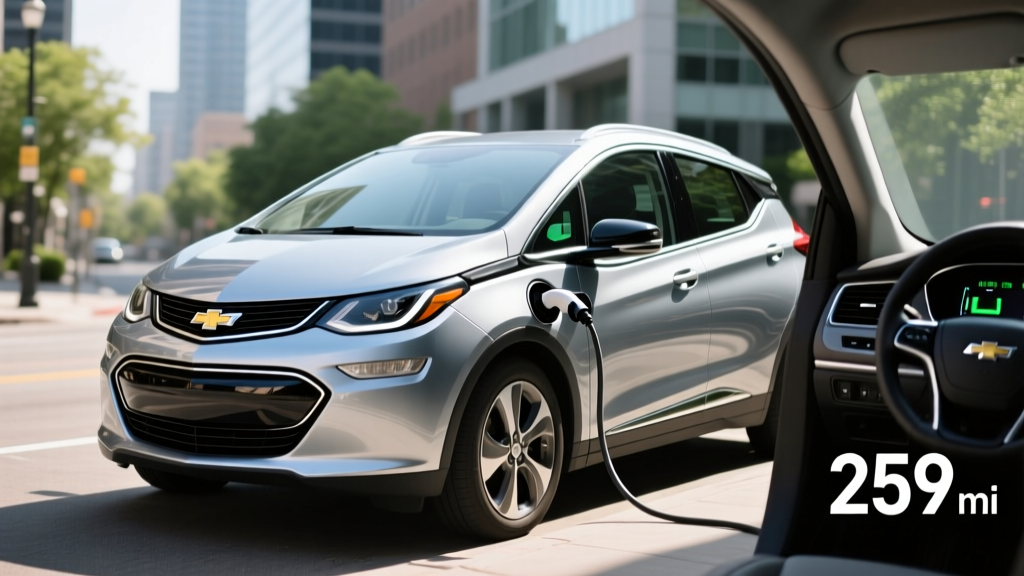
The 2019 Chevrolet Bolt EV occupies a unique position in the used electric vehicle market. As one of the first affordable long-range EVs to reach American driveways, it proved that a sub-$40,000 battery-electric car could deliver over 230 miles of EPA-rated range. Now, as a used EV in 2026, the Bolt EV represents one of the best value propositions for budget-conscious buyers entering electrification — but only if you understand its specific charging limitations, battery chemistry trade-offs, and what to look for in a pre-owned example.
This guide covers every number that matters: real-world range expectations, DC fast-charging realities, battery degradation data, used-market pricing, and how the 2019 Bolt EV stacks up against competing used EVs you'll find in the same price bracket.
2019 Chevy Bolt EV: Core Specifications at a Glance
| Specification | 2019 Chevrolet Bolt EV |
|---|---|
| EPA Range | 238 miles |
| Battery Capacity (Usable) | 60 kWh (NMC lithium-ion) |
| Battery Chemistry | NMC (Nickel Manganese Cobalt) — LG Chem cells |
| Motor Output | 200 hp / 266 lb-ft torque |
| Drivetrain | FWD (single front-mounted motor) |
| 0–60 mph | 6.5 seconds |
| Top Speed | 93 mph (electronically limited) |
| EPA Efficiency | 119 MPGe combined / 28 kWh/100 mi |
| Max DC Fast Charge Rate | 55 kW (CCS) |
| Level 2 Charge Rate | 7.2 kW (25 miles per hour of charging) |
| Cargo Volume | 56.6 cu ft (seats folded) / 16.9 cu ft (seats up) |
| Rear Legroom | 36.5 inches |
| Curb Weight | 3,563 lbs |
| Battery Warranty (Original) | 8 years / 100,000 miles |
Real-World Range: What the EPA Sticker Doesn't Tell You
Real-World Expectation: 200–220 miles (mixed driving, moderate temps) | 170–190 miles (highway sustained at 70+ mph) | 150–175 miles (sub-freezing winter conditions)
The 2019 Bolt EV's 238-mile EPA rating was genuinely impressive when the car launched, placing it in the same ballpark as the Tesla Model 3 Standard Range Plus at a lower price point. But EPA range is a laboratory estimate, and real-world results depend heavily on driving style, terrain, and — critically — temperature.
The Bolt EV's 60 kWh NMC battery pack delivers its best efficiency in city driving with frequent regenerative braking opportunities. In stop-and-go traffic at 30–45 mph, owners consistently report exceeding the EPA estimate, sometimes hitting 250+ miles of range in warm weather. The single-pedal driving mode, which Chevy calls "One Pedal Driving," maximizes regen recovery and reduces brake wear.
Highway driving tells a different story. The Bolt EV's tall hatchback shape creates more aerodynamic drag than a sedan like the Model 3, and at sustained 70–75 mph speeds, efficiency drops to roughly 3.0–3.2 miles per kWh — translating to approximately 180–195 miles of usable range before you'd want to find a charger. This isn't a flaw unique to the Bolt; it's physics affecting all tall, short-wheelbase EVs.
Cold weather is where the Bolt EV shows its most significant range limitation. Unlike newer EVs equipped with heat pump HVAC systems, the 2019 Bolt uses a resistive heater for cabin warming. In temperatures below 32°F, expect range reductions of 25–40%, depending on how aggressively you heat the cabin. Preconditioning the battery and cabin while plugged in at home mitigates some of this loss, but the absence of a heat pump is a meaningful trade-off for cold-climate buyers.
One practical note for used buyers: check the battery's State of Health (SoH) via the myChevrolet app or an OBD-II scanner with EV capability. A 2019 model with 60,000+ miles may show 90–95% capacity retention depending on charging habits and climate exposure. According to fueleconomy.gov, gradual lithium-ion degradation is normal, but anything below 85% retention on a 2019 example warrants caution.
Charging Speed: The Bolt EV's Most Important Limitation
| Charging Level | Power | Speed | Time (10–80%) |
|---|---|---|---|
| Level 1 (120V standard outlet) | 1.2 kW | ~4 miles per hour | N/A (overnight partial only) |
| Level 2 (240V home/public) | 7.2 kW | ~25 miles per hour | ~9 hours (0–100%) |
| DC Fast Charge (CCS) | 55 kW peak | ~160 miles per hour (peak) | ~55–65 minutes |
Here is where prospective used Bolt EV buyers need to pay close attention. The 2019 model's DC fast-charging capability maxes out at 55 kW via its CCS connector. In a 2026 market where newer EVs charge at 150–350 kW, this is the Bolt's single biggest weakness for anyone planning regular road trips.
At a 50+ kW CCS station (like those on the Electrify America or EVgo networks), the Bolt EV will accept its peak rate only between roughly 10–40% State of Charge. Above 50% SoC, the charge curve tapers significantly — dropping to 30–38 kW, then further to under 20 kW above 80%. A realistic 10–80% session takes 55–65 minutes, which is roughly double the time you'd spend at a modern 150 kW-capable vehicle.
The practical implication: the Bolt EV excels as a daily commuter with home Level 2 charging, where the 7.2 kW onboard charger refills the battery at a rate of about 25 miles per hour — meaning a typical overnight session (8 hours) adds roughly 200 miles, more than enough for most daily driving. For road trips, you'll need patience and route planning around CCS-equipped stations.
Level 1 charging from a standard 120V household outlet delivers approximately 4 miles of range per hour. This is suitable only for emergency top-ups or very low-mileage drivers who travel under 30 miles per day.
Important note on charging hardware: The 2019 Bolt EV uses the CCS1 connector standard. As of 2026, CCS remains widely supported at public charging networks, and adapters are available for Tesla Supercharger access (via Tesla's NACS-to-CCS adapter or third-party options). Confirm adapter compatibility before relying on Supercharger access.
Performance, Efficiency, and Daily Drivability
The Bolt EV's 200-horsepower front-mounted permanent magnet motor delivers brisk acceleration that surprises drivers unfamiliar with EV torque characteristics. The 0–60 mph time of 6.5 seconds is quicker than most compact gasoline hatchbacks, and the instant 266 lb-ft of torque makes city merging and passing effortless.
Efficiency is a genuine strong suit. At 119 MPGe combined (28 kWh per 100 miles), the Bolt EV is one of the most energy-efficient EVs ever sold in the U.S. For context, that translates to roughly $0.04–$0.05 per mile when charging at home on a national average electricity rate of $0.15/kWh — compared to $0.12–$0.14 per mile for a 30 MPG gasoline car at $3.50/gallon.
The front-wheel-drive layout and 3,563-pound curb weight (with the battery pack mounted low in the floor) give the Bolt surprisingly composed handling for a compact hatchback. It's not a sports car, but body roll is well-controlled and the low center of gravity inspires confidence in corners. The 17-inch Michelin Energy Saver tires prioritize efficiency over grip, so wet-weather traction is adequate rather than exceptional.
Regenerative braking offers multiple levels of engagement. In "D" mode with the regen-on-demand paddle behind the left steering wheel spoke, you get moderate one-pedal driving capability. Shift into "L" (Low) mode and the Bolt delivers aggressive regen that brings the car to a complete stop without touching the brake pedal — ideal for stop-and-go commuting.
Interior, Technology, and Practicality
The 2019 Bolt EV's interior is functional rather than luxurious. Hard plastics dominate the dashboard and door panels, which is expected at this price point but noticeable compared to the Tesla Model 3's minimalist cabin. The 8-inch touchscreen infotainment system runs Chevrolet's Infotainment 3 software with Apple CarPlay and Android Auto — both wired, not wireless. The system is responsive and logically laid out, with physical knobs for volume and tuning that many buyers prefer over touchscreen-only controls.
Passenger space is genuinely generous for the vehicle's footprint. Front legroom measures 42.8 inches, and rear legroom at 36.5 inches accommodates adults comfortably for short to medium trips. The flat floor (thanks to the under-floor battery pack) eliminates the transmission tunnel hump found in gas cars, making the middle rear seat usable.
Cargo capacity is excellent: 16.9 cubic feet behind the rear seats expands to 56.6 cubic feet with the 60/40 split rear seats folded. That's competitive with compact crossovers and significantly more than the Tesla Model 3's trunk (though the Model 3 offers a frunk, which the Bolt lacks).
Driver-assistance technology on the 2019 Bolt EV includes:
- Forward Collision Alert with automatic emergency braking (standard on all trims)
- Lane Keep Assist with lane departure warning
- Following Distance Indicator
- Rear Cross Traffic Alert (Premier trim)
- Surround Vision 360-degree camera (Premier trim)
Notably absent: adaptive cruise control is not available on the 2019 model year. This was added in the 2022 refresh. If highway cruise comfort is a priority, this is a meaningful gap. The Bolt EV's driver-assist features are SAE Level 1 — they provide warnings and basic intervention but do not offer hands-free or automated steering capability.
Used Pricing and the Federal Tax Credit Question
| Trim Level | Original MSRP (2019) | Typical Used Price (2026) | Federal Used EV Credit (§25E) |
|---|---|---|---|
| LT (base) | $36,620 | $12,000–$15,000 | Up to $4,000 (30% of sale price) |
| Premier (loaded) | $43,495 | $14,000–$18,000 | Up to $4,000 (30% of sale price) |
The 2019 Bolt EV was originally eligible for the full $7,500 federal tax credit under §30D, but that credit applies only to new vehicle purchases. As a used vehicle in 2026, the Bolt EV qualifies instead for the §25E Previously-Owned Clean Vehicle Credit, which provides up to $4,000 or 30% of the sale price (whichever is less).
Per IRS guidelines, the §25E credit has specific requirements:
- Price cap: The used vehicle must sell for $25,000 or less (the Bolt EV easily clears this)
- Income limits: Adjusted gross income cannot exceed $75,000 (single), $112,500 (head of household), or $150,000 (joint filers)
- Dealer requirement: The vehicle must be purchased from a licensed dealer (private-party sales don't qualify)
- Model year requirement: The vehicle must be at least two model years old (a 2019 qualifies)
- First-time transfer: The credit can only be claimed once per vehicle VIN after its original sale
For a 2019 Bolt EV LT purchased at $13,000 from a qualifying dealer, a buyer meeting income requirements could claim $3,900 (30% of $13,000) — bringing the effective cost to approximately $9,100. This makes the Bolt EV one of the most affordable long-range EVs available in the U.S. market. Always consult a tax professional to confirm your specific eligibility.
Battery Health, Warranty, and Long-Term Ownership
Chevrolet warranties the Bolt EV's battery pack for 8 years or 100,000 miles against defects and capacity loss below 60% of original capacity. For a 2019 model, that factory warranty extends through the 2027 model year or until 100,000 miles — meaning many examples still carry active battery coverage in 2026.
The 60 kWh NMC pack was manufactured by LG Chem, and it's worth noting that certain 2017–2019 Bolt EVs were included in a major battery recall (NHTSA recall 21V-650) due to fire risk from manufacturing defects in specific cell batches. Chevrolet addressed this through software limitations and, ultimately, complete battery pack replacements for affected vehicles. Before purchasing any 2019 Bolt EV, verify that the recall remedy has been completed by checking the VIN at nhtsa.gov/recalls. Vehicles that received the replacement pack effectively got a brand-new battery, which is a significant upside for used buyers.
Real-world degradation data from high-mileage Bolt EV owners suggests typical capacity retention of 90–94% at 60,000 miles for vehicles that avoided frequent DC fast charging and extreme SoC storage (consistently sitting at 100% or below 10%). NMC chemistry is more sensitive to high-SoC storage than LFP batteries found in some newer EVs, so best practice is daily charging to 80% and reserving 100% charges for road trips.
If the battery does eventually need replacement outside of warranty, expect costs in the $14,000–$18,000 range for parts and labor — a figure that makes the Bolt EV's remaining battery warranty a critical factor in purchase decisions.
How the 2019 Bolt EV Compares to Used Alternatives
In the $10,000–$18,000 used EV market of 2026, the Bolt EV faces competition from several worthy alternatives:
- 2018–2019 Nissan LEAF (40 kWh): EPA range of 151 miles, CHAdeMO connector (declining infrastructure support), passive battery cooling limits hot-climate longevity. The Bolt EV's 238-mile range and active thermal management make it the stronger choice for most buyers.
- 2018–2019 Tesla Model 3 Standard Range: EPA range of 220–240 miles, Supercharger network access, superior infotainment and Autopilot capability. However, used Model 3 pricing typically runs $18,000–$24,000 — a significant premium over the Bolt EV. Insurance costs also tend to be higher.
- 2020 Hyundai Kona Electric: EPA range of 258 miles, similar CCS charging limitations (64 kW peak). Comparable interior quality and slightly more cargo space. Used pricing is generally $2,000–$4,000 higher than the Bolt EV.
- 2019 Volkswagen e-Golf: EPA range of only 125 miles. Significantly less range, but refined driving dynamics and build quality. Suitable only for short-commute buyers.
Pros
- 238 miles EPA range — exceptional for the used price
- Outstanding efficiency (119 MPGe / 28 kWh/100 mi)
- Spacious interior and 56.6 cu ft cargo capacity
- Brisk 6.5-second 0–60 acceleration
- Low operating cost (~$0.04–$0.05/mile on home charging)
- Active battery thermal management (liquid cooled/heated)
- Eligible for up to $4,000 used EV tax credit
- Many examples still under battery warranty through 2027
Cons
- 55 kW DC fast charging is slow by 2026 standards
- No adaptive cruise control available
- Resistive cabin heater (no heat pump) reduces winter range significantly
- Interior materials feel budget-grade
- No front trunk (frunk)
- CCS charging curve tapers aggressively above 50% SoC
- Recall history requires VIN verification before purchase
Who Should Buy the 2019 Chevy Bolt EV?
Choose the 2019 Bolt EV if:
- You need a daily commuter with 200+ miles of real-world range and can charge at home overnight
- Your budget is under $15,000 after the used EV tax credit
- You prioritize cargo space and passenger room over premium interior materials
- Your driving is predominantly city and suburban (under 50 miles/day round trip)
- You live in a moderate climate or can precondition while plugged in during winter
Look elsewhere if:
- You take frequent road trips exceeding 200 miles and need fast DC charging
- You want adaptive cruise control or advanced driver-assist features
- You live in an extreme cold climate and need maximum winter range retention
- You require Tesla Supercharger access without adapter complications
The 2019 Chevy Bolt EV is, in 2026, the smartest budget entry point into long-range EV ownership. Its combination of 238-mile EPA range, excellent efficiency, practical cargo space, and sub-$15,000 used pricing (further reduced by the §25E credit) is unmatched in its price bracket. The trade-offs — slow DC charging, no heat pump, and basic driver assists — are real but acceptable for the right use case. If your daily driving stays within 80–100 miles and you charge at home, the Bolt EV delivers a near-ideal ownership experience at a fraction of the cost of newer EVs.
Frequently Asked Questions
What is the real-world range of the 2019 Chevy Bolt EV?
Expect 200–220 miles in mixed driving at moderate temperatures. Highway driving at 70+ mph reduces this to 170–195 miles. In sub-freezing winter conditions, range can drop to 150–175 miles due to the resistive cabin heater and reduced battery efficiency. The EPA rating of 238 miles is achievable primarily in warm-weather city driving with regenerative braking.
How fast does the 2019 Bolt EV charge?
On a DC fast charger (CCS), the Bolt EV peaks at 55 kW, achieving a 10–80% charge in approximately 55–65 minutes due to aggressive charge-curve tapering above 50% SoC. On a Level 2 home charger (240V, 7.2 kW), it adds about 25 miles of range per hour, fully charging overnight in roughly 9 hours. Level 1 (120V) adds approximately 4 miles per hour.
How much does a used 2019 Bolt EV cost after tax credits?
Used 2019 Bolt EVs typically sell for $12,000–$18,000 depending on trim, mileage, and condition. Qualifying buyers can claim the §25E used EV credit of up to $4,000 (30% of sale price), bringing the effective cost to approximately $8,500–$14,000. Income limits apply: $75,000 single / $150,000 joint. The vehicle must be purchased from a licensed dealer for $25,000 or less.
Is the 2019 Bolt EV worth buying vs. a used Tesla Model 3?
It depends on budget and priorities. The Bolt EV costs $5,000–$8,000 less than a comparable used Model 3 and offers similar EPA range. The Model 3 provides Supercharger access, adaptive cruise control, over-the-air updates, and a more premium interior. If budget is paramount and you charge at home, the Bolt EV is the better value. If road trips and tech features matter more, the Model 3 justifies its premium.
Does the 2019 Bolt EV qualify for any federal tax credit?
Not the original $7,500 new-vehicle credit (§30D). However, it qualifies for the §25E Previously-Owned Clean Vehicle Credit, which provides up to $4,000 or 30% of the sale price for income-eligible buyers purchasing from a licensed dealer. The car must sell for $25,000 or less, and buyer AGI must be under $75,000 (single) or $150,000 (joint). Consult a tax professional for your specific situation.
Was the 2019 Bolt EV affected by the battery fire recall?
Yes. Certain 2017–2019 Bolt EVs were recalled (NHTSA 21V-650) due to potential battery cell manufacturing defects that could cause fires, particularly when charging to 100% or in cold weather. Chevrolet remedied this through software updates and, for affected vehicles, complete battery pack replacement. Always verify recall completion at nhtsa.gov/recalls using the vehicle's VIN before purchasing. Vehicles that received replacement packs effectively have new batteries.
What should I check before buying a used 2019 Bolt EV?
Verify recall remedy completion (VIN check at NHTSA). Check battery State of Health via OBD-II scanner or dealer diagnostic (target: 90%+ retention). Confirm Level 2 charging works properly. Test DC fast charging at a CCS station if possible. Review service records for any battery-related software updates. Check tire condition (the OEM Michelin Energy Savers are expensive to replace). Finally, confirm the vehicle hasn't been in a major accident that could compromise the under-floor battery pack.