Quick Verdict: A City Commuter's Carbon-Fiber Quirky Classic
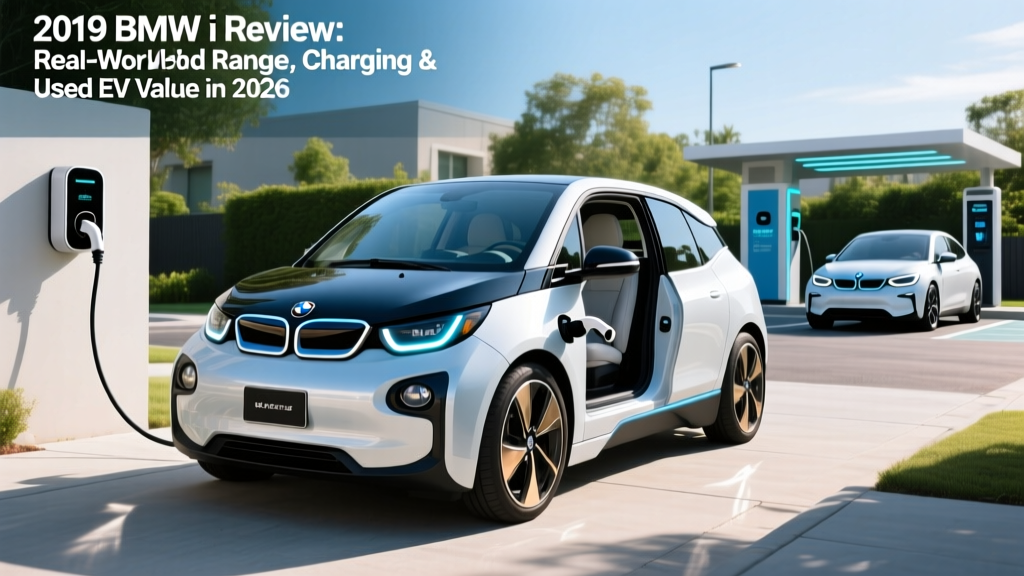
The 2019 BMW i3 remains one of the most unconventional electric vehicles ever sold in the United States. Built on a carbon-fiber-reinforced plastic (CFRP) passenger cell with an aluminum chassis, it weighs under 3,000 pounds — a featherweight by modern EV standards. For 2019, BMW upgraded the battery to a 42.2 kWh pack (120 Ah cells), pushing the EPA-estimated range to 153 miles, a meaningful jump from the 114 miles of the earlier 33 kWh (94 Ah) models.
In 2026, the i3 is exclusively a used-car proposition. BMW discontinued the model after the 2021 model year. But for urban dwellers who need a nimble, efficient runabout with premium build quality and a genuinely distinctive design, a well-maintained 2019 i3 can still make a compelling case — especially with the used EV tax credit potentially knocking up to $4,000 off the purchase price.
This review breaks down exactly what you're getting: real-world range expectations, charging practicality, ownership costs, and whether this compact hatchback still holds up against newer, longer-range alternatives on the used market.
Range & Efficiency: 153 Miles EPA, but Plan for Less
EPA Estimated Range: 153 miles (BEV model)
Real-World Expectation: 120–140 miles highway; 100–120 miles in cold weather (below 32°F)
Range Extender (REx) Model: 126 miles electric + ~80 miles on gasoline (72 total range combined electric + gas per EPA)
The 2019 i3's 153-mile EPA figure was respectable for a subcompact EV at the time, though it trails most new EVs on the market today. In real-world driving, your results depend heavily on conditions:
- City driving (mild weather): You can approach or even slightly exceed the 153-mile sticker thanks to aggressive regenerative braking and low-speed efficiency. The i3's one-pedal driving is strong enough to bring the car to a complete stop without touching the brake pedal.
- Highway driving (65–75 mph): Expect 120–140 miles. The i3's tall, narrow tires (155/70R19) minimize rolling resistance but the boxy shape creates aerodynamic drag at speed. Efficiency drops noticeably above 70 mph.
- Cold weather (below freezing): Plan for 100–120 miles. The i3 lacks a heat pump — it uses resistive cabin heating, which draws significant energy from the pack. Battery chemistry also delivers less capacity at low temperatures. Preconditioning while plugged in is essential to mitigate this.
Efficiency ratings from fueleconomy.gov list the 2019 i3 BEV at 131 MPGe combined (city 131 / highway 109), translating to approximately 25 kWh per 100 miles. That's efficient by any measure, aided by the car's low curb weight of roughly 2,900 lbs.
Battery & Charging: 42.2 kWh Pack, Modest DC Speeds
The 2019 i3 uses a 42.2 kWh lithium-ion battery pack (gross capacity; approximately 39–40 kWh usable) built with NMC (nickel manganese cobalt) Samsung SDI cells in a 120 Ah configuration. This was the third and largest battery option BMW offered in the i3 across its production run.
| Spec | 2019 BMW i3 BEV | 2019 BMW i3 REx |
|---|---|---|
| Battery Capacity (Gross) | 42.2 kWh | 42.2 kWh |
| Battery Chemistry | NMC (Samsung SDI) | NMC (Samsung SDI) |
| EPA Electric Range | 153 miles | 126 miles EV |
| Max DC Fast Charge | 50 kW (CCS) | 50 kW (CCS) |
| 10–80% DC Fast Charge | ~42 minutes | ~42 minutes |
| Level 2 Charge Rate | 7.4 kW (240V) | 7.4 kW (240V) |
| Level 2 Full Charge Time | ~5.5 hours | ~5.5 hours |
| Level 1 (120V) Charge Rate | ~1.4 kW | ~1.4 kW |
| Charge Port | CCS1 (Combo) | CCS1 (Combo) |
DC Fast Charging Reality
The i3's 50 kW peak DC fast-charge rate was standard for its era but feels dated in 2026 when competitors like the Chevrolet Bolt EV accept 55 kW and newer vehicles routinely pull 150–250 kW. At 50 kW, the i3 adds roughly 100 miles of range in 30 minutes under ideal conditions. The 10–80% charge takes approximately 42 minutes.
The charge curve is relatively flat compared to modern EVs — the i3 sustains close to its peak rate through most of the session before tapering above 85% SoC. That's actually a small advantage: you're not paying for peak kW you'll never see. However, the 50 kW ceiling means road-trip charging stops take noticeably longer than in newer vehicles.
Home Level 2 Charging
On a 240V Level 2 home charger (such as a ChargePoint Home Flex or BMW's own Wallbox), the i3 draws up to 7.4 kW, adding approximately 25–28 miles of range per hour. A full charge from near-empty takes roughly 5.5 hours — easily accomplished overnight. For daily commuting, this is more than adequate. Most owners will plug in each evening and wake up to a full battery.
Level 1 charging from a standard 120V outlet delivers about 1.4 kW, or roughly 4–5 miles per hour. This is viable only as a backup or for very low-mileage drivers.
Performance & Driving Dynamics
| Metric | Value |
|---|---|
| Motor Type | Single rear-mounted AC synchronous |
| Drivetrain | Rear-wheel drive (RWD) |
| Horsepower | 170 hp (125 kW) |
| Torque | 184 lb-ft |
| 0–60 mph | 7.2 seconds (BEV) |
| Top Speed | 93 mph (electronically limited) |
| Curb Weight | ~2,899 lbs (BEV) |
| Turning Circle | 32.3 feet |
The i3's 170 horsepower and 184 lb-ft of torque are delivered instantly to the rear wheels, making it feel punchy around town despite modest numbers. The 0–60 mph time of 7.2 seconds is adequate for merging and passing, though it won't win any stoplight drag races against modern dual-motor EVs.
Where the i3 genuinely shines is urban agility. The 32.3-foot turning circle is exceptionally tight — U-turns on narrow streets are trivial. The skinny 19-inch wheels (155 mm wide) feel unusual at first but contribute to low rolling resistance and surprisingly capable handling thanks to the low center of gravity from the floor-mounted battery.
The Range Extender (REx) variant adds a 647cc two-cylinder gasoline engine that acts solely as a generator. It doesn't drive the wheels. When the battery depletes to a low state of charge, the engine fires up to maintain battery level, extending total range by roughly 80 miles. The REx is heavier (curb weight ~3,230 lbs) and slightly slower (0–60 in ~7.7 seconds), and its electric-only range drops to 126 miles due to the added weight.
Interior, Cargo & Technology
The i3's cabin is unlike anything else in BMW's lineup — or arguably any automaker's. The dashboard uses eucalyptus wood and recycled materials, the door panels feature natural kenaf fibers, and the overall aesthetic is minimalist-futuristic. Build quality is excellent, consistent with BMW's standards.
Dimensions & Space
| Measurement | Value |
|---|---|
| Front Headroom | 39.6 inches |
| Front Legroom | 40.5 inches |
| Rear Headroom | 37.8 inches |
| Rear Legroom | 31.9 inches |
| Cargo Volume (rear seats up) | 15.1 cu ft |
| Cargo Volume (rear seats folded) | 39.2 cu ft |
| Seating Capacity | 4 passengers |
Front-seat space is generous thanks to the tall roofline, but the rear seats are best suited for children or occasional adult use on short trips. The 31.9 inches of rear legroom is tight. The rear-hinged "coach doors" (suicide doors) require the front door to open first for rear access — charming design, less practical in tight parking spots.
Cargo volume at 15.1 cubic feet is competitive with subcompact hatchbacks and expands to 39.2 cu ft with the rear seats folded. There's no frunk (front trunk) — the space under the hood houses electronics and, on REx models, the gasoline engine.
Infotainment & Driver Assists
The 2019 i3 features BMW's iDrive 6.0 system with a 10.25-inch display, navigation (on most trims), Bluetooth, and a rotary controller on the center console. Apple CarPlay is available but was a subscription-based feature in some configurations — verify with the specific vehicle. Android Auto was not offered on the 2019 model year.
Driver-assistance technology is modest by 2026 standards:
- Standard: Rearview camera, dynamic cruise control, automatic emergency braking (city collision warning)
- Available (Technology + Driving Assistance Package): Adaptive cruise control with stop-and-go, lane departure warning, parking assistant, surround-view camera
- Not available: Lane-keeping assist, blind-spot monitoring, semi-autonomous highway driving. The i3 predates BMW's current Driving Assistant Professional suite.
This is an SAE Level 0–1 vehicle in terms of driver assistance. There is no hands-free or semi-autonomous driving capability.
Pricing, Tax Credits & Used Market Value
| Trim | Original 2019 MSRP | Typical 2026 Used Price |
|---|---|---|
| i3 BEV (base) | $45,395 | $16,000–$20,000 |
| i3 BEV (w/ Tech + Driving Assist Pkg) | ~$50,000–$52,000 | $18,000–$23,000 |
| i3 REx (base) | $49,295 | $17,000–$21,000 |
| i3s BEV (sportier variant) | $52,395 | $19,000–$24,000 |
Original MSRPs included the $995 destination charge. The i3s variant adds slightly more power (184 hp), a sport suspension, wider wheels (175/60R20), and cosmetic upgrades.
Federal Tax Credit for Used EVs (§25E)
As a used vehicle purchased from a dealer in 2026, the 2019 BMW i3 may qualify for the Used Clean Vehicle Credit (IRS §25E), which provides up to $4,000 or 30% of the sale price, whichever is less. Key eligibility requirements per IRS guidelines:
- Sale price must be $25,000 or less — most 2019 i3s fall within this cap
- Buyer income limits: AGI cannot exceed $75,000 (single), $112,500 (head of household), or $150,000 (joint filers)
- Vehicle age: Must be at least 2 model years old (the 2019 i3 qualifies)
- Must purchase from a licensed dealer — private-party sales do not qualify
- Can only be claimed once per buyer in a 3-year period
- The credit is non-refundable — you must have tax liability to benefit, though point-of-sale transfer is available at participating dealers
At a typical used price of $18,000, the maximum credit would be $4,000 (since 30% of $18,000 = $5,400, but the cap is $4,000). This can bring a solid i3 down to an effective cost of $14,000–$16,000 — exceptional value for a carbon-fiber BMW EV. Always confirm eligibility with a tax professional before purchasing, as IRS rules are subject to change.
Note: The new-vehicle §30D tax credit (up to $7,500) does not apply to used purchases. The §30D credit also expired for new BMW i3s years ago, as BMW exceeded the manufacturer cap under the pre-2023 rules.
Battery Health, Warranty & Longevity
BMW provided an 8-year / 100,000-mile battery warranty on the 2019 i3, covering defects and capacity loss below 70% of original capacity. For a 2019 model, this warranty remains active through the 2027 model year or until the odometer hits 100,000 miles — whichever comes first.
NMC battery chemistry in the i3 has demonstrated reasonable longevity in real-world ownership. Data from EV tracking communities suggests typical degradation of 8–12% over 5 years / 60,000 miles under normal use. Some high-mileage examples have reported 15%+ degradation, particularly in hot climates where the i3's passive battery thermal management (air cooling rather than liquid cooling) is a limitation.
This is a critical consideration: the i3 does not have active liquid thermal management for its battery pack. Instead, it relies on a combination of air cooling and a refrigerant-based system that is less effective than the liquid-cooled systems in vehicles like the Chevrolet Bolt, Tesla Model 3, or Hyundai Kona Electric. In extreme heat or during repeated DC fast-charging sessions, the pack can thermally throttle, reducing charge speeds and potentially accelerating long-term degradation.
If you're evaluating a used 2019 i3, request a battery state-of-health (SoH) reading from a BMW dealer or use an OBD-II app like BimmerCode or CarScanner to pull the degradation figure. A pack showing 88%+ SoH is in good shape; below 80% warrants caution and potential negotiation on price.
Pros, Cons & Who Should Buy
Pros
- Carbon-fiber construction keeps weight under 3,000 lbs — exceptional efficiency
- Ultra-tight 32.3-ft turning circle for city maneuverability
- Premium build quality with unique sustainable interior materials
- Strong one-pedal regenerative braking
- Used EV tax credit can drop effective price below $15,000
- Reliable BMW iDrive infotainment with 10.25-inch screen
- REx option eliminates range anxiety for occasional longer trips
Cons
- 153-mile EPA range is limiting for highway or road-trip use
- 50 kW DC fast charging is slow by 2026 standards
- No active liquid battery thermal management — degradation risk in hot climates
- Rear seats are cramped (31.9" legroom); coach doors impractical in tight spaces
- Expensive replacement tires (narrow 155/70R19 are a specialty size)
- Outdated driver-assist features; no lane-keeping or blind-spot monitoring
- No Android Auto support
- Discontinued model — long-term parts availability uncertainty for body panels
Who the 2019 BMW i3 Suits Best
Ideal buyer: An urban or suburban commuter driving 30–60 miles round trip who values distinctive design, premium build quality, and low running costs. Someone with reliable home Level 2 charging who rarely drives more than 100 miles in a day and wants a second car for errands and commuting.
Not ideal for: Families needing rear-seat space for teenagers or car seats, frequent road-trippers, drivers in extreme-heat climates (Phoenix, Las Vegas) concerned about battery longevity, or anyone who needs more than 153 miles of range between charges.
How It Compares to Key Used-EV Competitors
In the $15,000–$22,000 used EV market in 2026, the 2019 i3 faces several strong alternatives:
| Spec | 2019 BMW i3 BEV | 2019 Chevrolet Bolt EV | 2019 Nissan LEAF Plus | 2019 Hyundai Kona Electric |
|---|---|---|---|---|
| EPA Range | 153 mi | 238 mi | 226 mi | 258 mi |
| Battery (kWh) | 42.2 | 60 | 62 | 64 |
| DC Fast Charge (kW) | 50 | 55 | 100* | 75 |
| 0–60 mph | 7.2 sec | 6.5 sec | 7.3 sec | 6.4 sec |
| Cargo (rear seats up) | 15.1 cu ft | 16.9 cu ft | 23.6 cu ft | 19.2 cu ft |
| Rear Legroom | 31.9" | 36.5" | 33.5" | 34.6" |
| Battery Thermal Mgmt | Passive (air) | Active (liquid) | Passive (air) | Active (liquid) |
| Typical Used Price | $16K–$20K | $14K–$18K | $13K–$17K | $17K–$21K |
*Nissan LEAF uses CHAdeMO connector, which has limited DC fast-charging infrastructure compared to CCS.
The Bolt EV and Kona Electric offer substantially more range, liquid-cooled batteries, and more practical rear seats for similar or lower used prices. The LEAF Plus matches or beats the i3 on range and cargo space, though its CHAdeMO connector is a growing liability as the industry standardizes on CCS and NACS.
So why choose the i3? The answer is character. Nothing else drives, looks, or feels like it. The carbon-fiber construction, coach doors, sustainable interior, and BMW badge carry an intangible appeal that spec sheets don't capture. If your commute is short and your priority is driving something unique and premium rather than maximizing range, the i3 has no direct substitute.
Frequently Asked Questions
What is the real-world range of the 2019 BMW i3?
The EPA rates the 2019 i3 BEV at 153 miles. In real-world driving, expect 120–140 miles on the highway and 100–120 miles in freezing temperatures. City driving in mild weather can approach or match the EPA figure thanks to strong regenerative braking.
How fast does the 2019 i3 charge?
On DC fast charging, the i3 peaks at 50 kW (CCS connector), taking approximately 42 minutes from 10–80%. At home on a Level 2 (240V) charger, it draws 7.4 kW and fully charges in about 5.5 hours, adding roughly 25–28 miles of range per hour.
Does the 2019 BMW i3 qualify for any federal tax credit?
Not the new-vehicle §30D credit, but it may qualify for the Used Clean Vehicle Credit (§25E) of up to $4,000 when purchased from a licensed dealer for $25,000 or less. Buyer income limits apply ($75K single / $150K joint). Consult a tax professional and check current IRS §25E rules before purchasing.
Is the BMW i3 battery expensive to replace?
Out-of-warranty replacement is costly. BMW dealer quotes for a new 42.2 kWh pack have ranged from $12,000 to $16,000+ including labor. However, independent EV shops can sometimes source refurbished or salvaged modules for $4,000–$8,000. Most i3 batteries are lasting well — check the SoH reading before purchase and buy one still under the 8-year/100,000-mile warranty when possible.
Is the 2019 BMW i3 worth buying in 2026?
If you need a compact, efficient city commuter with premium build and don't require more than ~130 miles of real-world range, the i3 is a compelling used buy — especially with the potential $4,000 tax credit bringing effective cost below $15,000. If you need more range, rear-seat practicality, or faster DC charging, the Chevrolet Bolt EV or Hyundai Kona Electric are more practical choices at similar prices.
What's the difference between the i3 and i3s?
The i3s adds 14 horsepower (184 hp total), a sport-tuned suspension, wider 20-inch wheels, and cosmetic upgrades including a lowered stance and unique bumpers. The 0–60 time drops to 6.9 seconds. Range is slightly lower (EPA 153 miles is shared, but real-world efficiency is marginally worse due to wider tires). The i3s originally cost about $7,000 more than the base i3.
Can I charge a 2019 BMW i3 at a Tesla Supercharger?
Not natively. The i3 uses the CCS1 connector. Tesla Superchargers use NACS. As of 2026, third-party CCS-to-NACS adapters (such as those from Lectron or A2Z) exist but are not universally reliable at all Supercharger stalls. You can also use Tesla's Magic Dock adapter at select Supercharger locations that support non-Tesla vehicles. For routine charging, the CCS/Electrify America/ChargePoint network is more straightforward for i3 owners.