The 2019 Audi e-tron at a Glance
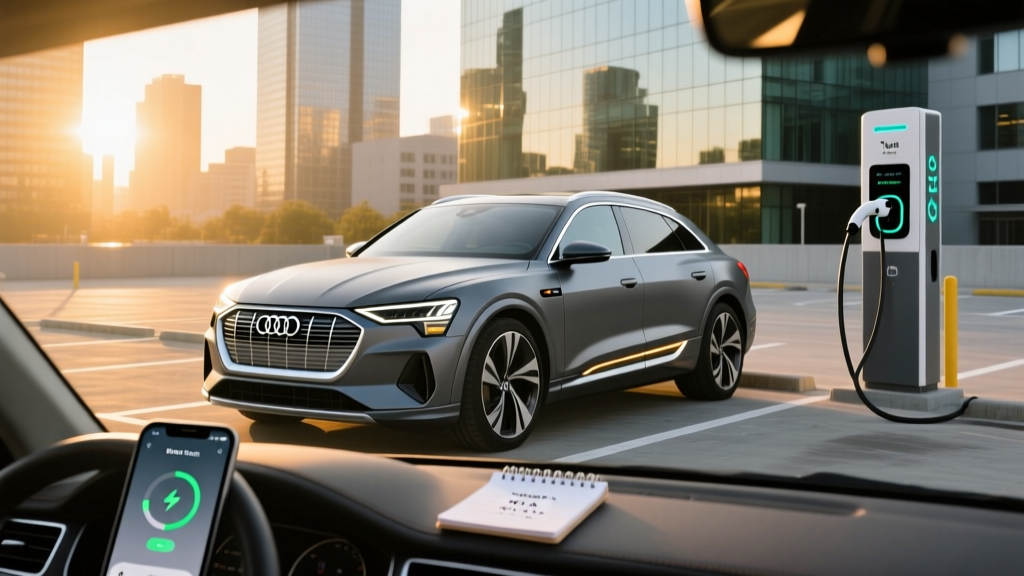
Audi's first dedicated battery-electric vehicle arrived in the U.S. for the 2019 model year as a premium midsize SUV that prioritized refinement and build quality over headline-grabbing range numbers. Built on the same MLB Evo platform as the Q7 and Q8, the e-tron delivers the cabin isolation and material quality Audi buyers expect — wrapped in a battery-electric package that, while conservative by today's standards, remains a compelling used-EV proposition.
If you're shopping the used market for a 2019 Audi e-tron in 2026, you're looking at a luxury electric SUV that typically trades between $22,000 and $32,000 depending on mileage, condition, and trim. But before you sign, you need to understand its real-world range limitations, charging behavior, and where it stands against newer competitors.
| Spec | Value |
|---|---|
| EPA Range | 204 miles |
| Battery (gross / usable) | 95 kWh / ~84 kWh |
| Battery Chemistry | NMC (Nickel Manganese Cobalt) — LG Chem pouch cells |
| Drivetrain | Dual-motor AWD (quattro) |
| Horsepower | 355 hp (402 hp in Boost mode, 8-second bursts) |
| Torque | 414 lb-ft (490 lb-ft in Boost) |
| 0–60 mph | 5.5 seconds (5.3 sec in Boost mode) |
| Top Speed | 124 mph (electronically limited) |
| Max DC Fast Charge | 150 kW (CCS1) |
| 10–80% DC Charge Time | ~30 minutes |
| Level 2 Charge Rate | 9.6 kW (240V / 40A) |
| MPGe (city / hwy / combined) | 74 / 73 / 74 MPGe |
| Efficiency | 46 kWh per 100 miles |
| Cargo (behind 2nd row / folded) | 28.5 cu ft / 57.0 cu ft |
| Front Legroom / Rear Legroom | 41.3 in / 39.1 in |
| Curb Weight | 5,765 lbs |
| Towing Capacity | 4,000 lbs (with factory tow package) |
| Battery Warranty | 8 years / 100,000 miles |
| Original MSRP (Premium Plus) | $74,800 |
| Original MSRP (Prestige) | $81,800 |
Real-World Range: What to Actually Expect
The 2019 Audi e-tron carries an EPA-estimated range of 204 miles. That figure was conservative at launch and remains modest compared to 2025–2026 competitors routinely exceeding 300 miles. But EPA numbers tell only part of the story.
EPA Combined: 204 miles
Real-World Highway (70 mph, moderate temps): ~170–185 miles
Real-World City/Mixed (moderate temps): ~190–210 miles
Cold Weather (below 32°F, highway): ~140–160 miles
Why the gap? The e-tron's 5,765-lb curb weight and relatively high drag coefficient (0.30 Cd for an SUV) hit efficiency hard at sustained highway speeds. In cold weather, the resistive heating system and battery thermal management draw significant energy from the ~84 kWh usable pack. The e-tron does have a heat pump in some markets, but U.S.-spec 2019 models use a PTC heater, which is less efficient.
What this means for ownership: the e-tron is a comfortable daily commuter and a capable regional road-tripper, but 300+ mile highway stretches between chargers will require planning. Most owners will find 170–190 miles of usable range before needing to charge, with a practical buffer of 20–30 miles kept in reserve.
The e-tron's large battery buffer — Audi locks roughly 11 kWh of the 95 kWh gross capacity — was designed specifically to minimize degradation concerns. This conservative approach protects long-term battery health but sacrifices range. According to fueleconomy.gov, the combined efficiency of 46 kWh/100mi is notably thirstier than rivals like the Tesla Model X or the Jaguar I-PACE.
Charging Speed and Infrastructure
The 2019 e-tron's charging capability was genuinely impressive at launch and remains competitive for a used EV today. Audi equipped it with a 150 kW peak DC fast-charge rate on the CCS1 connector — and crucially, the e-tron sustains high charge rates longer than most competitors of its era.
| Charging Level | Power | Connector | Miles Added per Hour | Notes |
|---|---|---|---|---|
| Level 1 (120V) | ~1.4 kW | J1772 adapter | ~3–4 mi/hr | Emergency/trickle only |
| Level 2 (240V) | 9.6 kW | J1772 | ~20–22 mi/hr | Full charge in ~10 hours |
| DC Fast Charge | 150 kW peak | CCS1 | N/A (see time below) | 10–80% in ~30 min |
The charge curve advantage: Where many EVs of this era peak at their maximum kW for only a narrow SoC window before tapering sharply, the e-tron holds close to 150 kW from roughly 10% to around 70% SoC. This means real-world charging sessions are faster than the peak number alone suggests. From 10–80%, expect approximately 30 minutes at a functioning 150+ kW Electrify America or compatible DC fast charger.
Above 80%, the charge rate tapers significantly — dropping to roughly 50 kW by 90% and further to around 25 kW past 95%. This is standard lithium-ion behavior, but the e-tron's taper is well-managed in the usable zone.
Home charging: The onboard 9.6 kW Level 2 charger means a full charge from near-empty takes about 10 hours on a 240V/40A circuit. Most owners installing a Level 2 home charger will need a NEMA 14-50 outlet or a hardwired wallbox (such as the ChargePoint Home Flex or Tesla Wall Connector with J1772 adapter). Budget $800–$2,000 for professional installation depending on your electrical panel's capacity and the run distance from panel to garage. If your home has a 100-amp main panel, a $1,500–$3,000 panel upgrade to 200 amps may be necessary.
Performance and Driving Dynamics
The dual-motor quattro powertrain delivers 355 horsepower in normal driving, with an overboost function that unlocks 402 hp and 490 lb-ft of torque for 8-second bursts. The 0–60 mph sprint completes in 5.5 seconds (5.3 seconds in Boost mode) — respectable for a 5,765-lb luxury SUV, if not thrilling by EV standards.
What the e-tron does exceptionally well is deliver its performance with refinement. Road noise is minimal, the adaptive air suspension absorbs imperfections with composure, and the steering is precise if light. This is a luxury cruiser, not a performance EV. If you want sportscar acceleration, the Tesla Model X or the Porsche Taycan (which shares the VW Group's J1 platform) are better fits.
Regenerative braking: The 2019 e-tron offers three regen levels selectable via steering-wheel paddles, but the default "coasting" mode is unusually aggressive about disengaging regen. Audi's philosophy was to mimic a conventional automatic transmission's feel. This means one-pedal driving is not the default experience — you'll use the brake pedal more than in a Nissan LEAF or Tesla. The brake pedal feel is notably good for an EV, with a natural transition between regen and friction braking.
Interior, Technology, and Daily Usability
Step inside the 2019 e-tron and the Audi DNA is unmistakable. The dual-screen MMI touch response system (10.1-inch upper display, 8.6-inch lower climate/control display) replaced physical buttons with haptic-feedback glass panels. The Virtual Cockpit digital instrument cluster (12.3 inches) remains one of the best-executed driver displays in any EV, with a dedicated EV power meter and range readout.
Standout features on the 2019 e-tron:
- Virtual Cockpit with EV-specific energy flow and range displays
- Standard Apple CarPlay and Android Auto (wired)
- Bang & Olufsen 3D premium audio (16 speakers, 755 watts on Prestige)
- Matrix-design LED headlights with dynamic turn signals
- Adaptive air suspension with automatic level control
- Standard Audi pre sense basic and pre sense city (automatic emergency braking)
- Available Adaptive Cruise Assist with Traffic Jam Assist (SAE Level 2)
Notable drawbacks:
- No over-the-air (OTA) software updates — the 2019 e-tron's software is frozen at its last dealer-applied version
- The dual-screen MMI system has a steeper learning curve than Tesla's single-screen interface or newer MMI generations
- Rear visibility is compromised by thick C-pillars; a backup camera is standard but a 360-degree camera was optional
- The "e-tron" badge on the charge port door uses a motorized mechanism that some owners report as failure-prone over time
- No front trunk (frunk) — the space is occupied by power electronics and the HVAC system
The 2019 e-tron's available Adaptive Cruise Assist with Traffic Jam Assist is an SAE Level 2 driver-assistance system. This means it can manage steering, acceleration, and braking under certain conditions, but the driver must remain fully engaged and attentive at all times. It is not a self-driving system. Hands-on-wheel detection is enforced, and the system will disengage if the driver does not respond to prompts.
Cargo and passenger space: With 28.5 cubic feet behind the second row and 57.0 cubic feet with rear seats folded, the e-tron trails the Tesla Model X (which offers a frunk and more total volume) but matches the Mercedes EQC and Jaguar I-PACE. Rear legroom of 39.1 inches is generous, and the flat floor (no transmission tunnel) makes the middle rear seat usable for adults on shorter trips.
Pricing, Trims, and Tax Credit Reality for 2026 Buyers
The 2019 Audi e-tron was offered in two trims at launch:
| Trim | Original MSRP | Typical 2026 Used Price | Federal Used EV Credit (§25E) |
|---|---|---|---|
| Premium Plus | $74,800 | $22,000–$28,000 | Up to $4,000 (30% of sale price, max $4,000) |
| Prestige | $81,800 | $26,000–$32,000 | Up to $4,000 (30% of sale price, max $4,000) |
Tax credit clarification: Because the 2019 e-tron is a used vehicle in 2026, it is not eligible for the new-vehicle §30D credit (up to $7,500). Instead, buyers purchasing from a licensed dealer may qualify for the §25E Previously-Owned Clean Vehicle Credit, which provides 30% of the sale price up to a maximum of $4,000. Key eligibility requirements per the IRS:
- Sale price must be $25,000 or less
- Buyer's adjusted gross income must not exceed $75,000 (single), $112,500 (head of household), or $150,000 (joint)
- Vehicle must be purchased from a licensed dealer (not a private party)
- The model must be at least two model years old (the 2019 e-tron qualifies)
- The credit can be transferred to the dealer at point of sale, reducing the purchase price directly
This means a 2019 e-tron Premium Plus purchased for $24,000 from a qualifying dealer could net a $4,000 credit, bringing the effective price to $20,000 — a significant value for a luxury electric SUV. However, if you find a Prestige trim priced above $25,000, the §25E credit is eliminated entirely. Negotiate accordingly.
Warranty, Battery Health, and Long-Term Ownership
Audi backs the 2019 e-tron's high-voltage battery with an 8-year / 100,000-mile warranty against defects and excessive capacity loss (defined as dropping below 70% of original capacity). For a 2019 model, this factory warranty extends through the 2027 model year or until the odometer hits 100,000 miles — whichever comes first.
The powertrain (electric motors, power electronics) carries a separate 8-year/100,000-mile warranty, and the basic vehicle warranty was 4 years/50,000 miles — which has expired on all 2019 models by now.
Battery degradation in practice: The e-tron's large gross-to-usable buffer (~11 kWh locked) has proven effective at preserving long-term State of Health (SoH). Owner-reported data from forums and fleet analyses suggest typical 2019 e-tron batteries retain approximately 90–94% capacity after 5 years and 50,000–60,000 miles. This is among the better degradation curves in the industry, attributable to the conservative buffer strategy and liquid thermal management.
When shopping a used 2019 e-tron, request a battery health report from the dealer or have an independent Audi specialist perform a diagnostic scan to read the actual SoH percentage. This is the single most important data point for a used EV purchase.
Maintenance costs: EV maintenance is significantly lower than ICE equivalents — no oil changes, no spark plugs, no transmission fluid. Budget for cabin air filter replacement (~$150–$200 every 20,000 miles), brake fluid flush (every 2 years), and tire rotation. The e-tron's heavy weight and instant torque accelerate tire wear; expect to replace tires every 30,000–40,000 miles. Premium 255/55R19 or 265/45R21 tires run $250–$400 each.
How It Stacks Up Against Competitors
| Spec | 2019 Audi e-tron | 2019 Tesla Model X Long Range | 2019 Jaguar I-PACE | 2020 Mercedes EQC |
|---|---|---|---|---|
| EPA Range | 204 mi | 325 mi | 234 mi | 220 mi (est.) |
| 0–60 mph | 5.5 sec | 4.4 sec | 4.5 sec | 4.8 sec |
| Max DC Charge | 150 kW | 150 kW (V3 Supercharger) | 100 kW | 110 kW |
| Cargo Volume | 28.5 cu ft | 25.7 cu ft (+ frunk) | 25.3 cu ft | 17.7 cu ft |
| Typical 2026 Used Price | $22K–$32K | $30K–$42K | $22K–$30K | $22K–$28K |
| Battery Warranty Remaining | Through ~2027 | Through ~2027 | Through ~2027 | Through ~2028 |
The verdict on competition: The Tesla Model X wins on range and Supercharger network access but costs more on the used market and trades interior material quality for tech minimalism. The Jaguar I-PACE offers sharper driving dynamics and slightly more range but charges slower (100 kW peak). The Mercedes EQC was never officially sold in the U.S. market. The e-tron's best argument is its combination of build quality, quiet ride, strong DC charging, and relatively low used pricing.
Pros and Cons
✓ Pros
- Excellent build quality and cabin materials
- Sustained 150 kW DC charging with a flat curve to ~70% SoC
- Quiet, composed ride with adaptive air suspension
- Generous battery buffer protects long-term SoH
- 4,000-lb towing capacity is practical for a midsize EV SUV
- Virtual Cockpit remains a best-in-class digital display
- Strong used-market value with potential §25E tax credit
✗ Cons
- 204-mile EPA range is low for 2026 standards
- No OTA software updates — tech is frozen
- CCS1 connector only; NACS adapters add cost and complexity
- No frunk reduces total cargo utility
- Heavy curb weight (5,765 lbs) accelerates tire wear
- Efficiency of 46 kWh/100mi means higher charging costs
- Resistive PTC heater hurts cold-weather range significantly
Who Should Buy the 2019 Audi e-tron?
Choose the 2019 e-tron if: You want a luxury electric SUV with premium materials, a quiet ride, and strong DC charging for under $25,000 (after the §25E credit). You primarily commute under 150 miles round-trip and have home Level 2 charging. You value build quality over maximum range or cutting-edge infotainment.
Look elsewhere if: You regularly drive 250+ miles between charges, need access to the Tesla Supercharger network without adapters, want the latest OTA-updated software, or prioritize efficiency and low charging costs above all else. In that case, consider a used Tesla Model Y, Hyundai Ioniq 5, or Ford Mustang Mach-E.
Frequently Asked Questions
What is the real-world range of the 2019 Audi e-tron?
Expect 170–190 miles in mixed driving at moderate temperatures, dropping to 140–160 miles on cold-weather highway trips. The EPA estimate of 204 miles is achievable in city driving at 50–70°F but optimistic for highway cruising.
How fast does the 2019 e-tron charge at home and on the road?
At home on a 240V Level 2 charger (9.6 kW), it adds roughly 20–22 miles per hour and fully charges in about 10 hours. On a 150 kW DC fast charger, it goes from 10–80% in approximately 30 minutes, with a sustained charge curve that holds near-peak power up to 70% SoC.
Does the 2019 Audi e-tron qualify for any federal tax credit?
Not the new-vehicle §30D credit. However, it may qualify for the §25E Previously-Owned Clean Vehicle Credit of up to $4,000 when purchased from a licensed dealer for $25,000 or less, subject to buyer income limits. Consult a tax professional to confirm your eligibility.
Is the 2019 e-tron worth buying vs. a Tesla Model Y or newer EV?
It depends on priorities. The e-tron offers superior interior quality and ride comfort compared to a Model Y at a similar used price. But the Tesla delivers significantly more range (300+ miles), OTA updates, and Supercharger access. If luxury and refinement matter more than range, the e-tron is a strong value. If range and tech are paramount, look at a used Model Y or Ioniq 5.
What happens when the battery warranty expires?
The 8-year/100,000-mile battery warranty expires around 2027 for 2019 models. If the battery drops below 70% capacity before then, Audi will repair or replace it. After warranty expiration, a full battery replacement would cost an estimated $15,000–$25,000 based on current parts pricing — though given the conservative buffer design, most batteries should retain 85%+ capacity well past 100,000 miles.
Can I use Tesla Superchargers with the 2019 e-tron?
The 2019 e-tron uses a CCS1 connector. As of 2026, Tesla has opened a growing number of Supercharger stalls to non-Tesla EVs via the built-in Magic Dock CCS adapter or through third-party adapters (such as the Lectron or A2Z NACS-to-CCS adapter). However, not all Supercharger locations support non-Tesla vehicles, and charging speeds may be limited compared to native CCS networks like Electrify America. Check the Tesla app or PlugShare for compatible stations in your area.