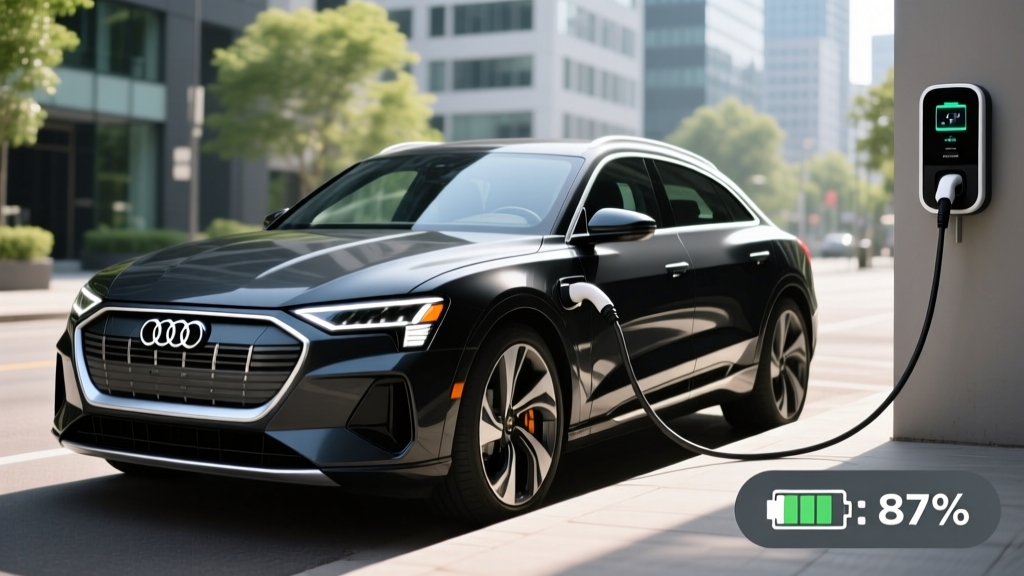
The 2019 Audi e-tron Prestige was Audi's first serious battery-electric vehicle — a luxury SUV that prioritized refinement, build quality, and charging stability over headline-grabbing range numbers. Now in 2026, with the e-tron nameplate retired in favor of the Q8 e-tron lineage, the original 2019 model has become a compelling used-EV proposition. If you're shopping the pre-owned market, the Prestige trim represents the fully loaded variant, and understanding its real-world range, charging behavior, and ownership economics is essential before signing any paperwork.
This review breaks down every spec that matters for a used 2019 e-tron Prestige buyer: the actual miles you'll get per charge, how fast it charges on DC fast chargers and at home, what the battery warranty still covers, and whether it qualifies for the federal used-EV tax credit under current IRS §25E rules.
Range, Efficiency, and Real-World Expectations
The 2019 Audi e-tron carries an EPA-estimated range of 204 miles on a full charge. That figure was conservative even at launch, and it remains modest by 2026 standards, where competitors like the Tesla Model X and BMW iX push well past 300 miles. But the EPA number only tells part of the story.
EPA sticker: 204 miles
Typical highway (70 mph, moderate temps): ~175–190 miles
City/mixed driving (mild weather): ~195–215 miles (regen-friendly routes can exceed EPA)
Cold weather (below 32°F, highway): ~140–160 miles
Cold weather + cabin heat + highway: ~130–150 miles
The e-tron's thermal management system is among the best in its class, which helps limit cold-weather degradation compared to passively cooled packs. But physics is physics — expect 20–30% range loss in freezing conditions, especially on sustained highway runs where cabin heating draws heavily from the 95 kWh pack.
Efficiency is rated at 74 MPGe combined (74 city / 73 highway), which translates to roughly 43 kWh per 100 miles — not class-leading. The e-tron is a heavy vehicle (5,765 lbs curb weight) with a relatively brick-like aerodynamic profile compared to sleeker rivals. If efficiency is your top metric, the Tesla Model X or even the Jaguar I-PACE will edge it out. But if you value ride comfort and cabin isolation over squeezing every mile from a kilowatt-hour, the trade-off is deliberate.
Battery Chemistry, Capacity, and Degradation
The 2019 e-tron uses a 95 kWh gross / ~84 kWh usable lithium-ion battery pack with NMC (nickel manganese cobalt) chemistry. Audi deliberately locked off roughly 11 kWh of buffer (about 5.5% at the top and bottom of the pack) to protect long-term cell health. This is a significant design choice: it means you sacrifice some range on paper, but the battery degrades more slowly than packs with smaller buffers.
| Specification | 2019 Audi e-tron Prestige |
|---|---|
| Battery (gross / usable) | 95 kWh / ~84 kWh |
| Chemistry | NMC (Nickel Manganese Cobalt) |
| EPA Range | 204 miles |
| MPGe (combined) | 74 MPGe |
| Efficiency | 43 kWh / 100 mi |
| Drivetrain | Dual-motor AWD (quattro) |
| Horsepower (boost mode) | 402 hp / 490 lb-ft torque |
| 0–60 mph | 5.5 seconds |
| Curb Weight | 5,765 lbs |
| Max DC Fast Charge | 150 kW |
| 10–80% DC Charge Time | ~30 minutes |
| Level 2 Home Charge Rate | 9.6 kW (48A) |
| Cargo (behind 2nd row) | 28.5 cu ft |
| Cargo (seats folded) | 57.2 cu ft |
| Battery Warranty | 8 years / 100,000 miles |
Real-world degradation data from high-mileage e-tron owners and fleet studies suggests the 95 kWh NMC pack loses roughly 5–8% capacity over the first 100,000 miles, thanks in large part to that generous buffer and Audi's active liquid thermal management. By 2026, a well-maintained 2019 e-tron with 50,000–70,000 miles should still retain 92–95% of its original usable capacity. Always request a State of Health (SoH) reading from a dealer diagnostic tool before purchasing used.
Charging Speed: DC Fast, Level 2, and Level 1
Charging is where the original e-tron still holds up surprisingly well. Audi engineered the pack to sustain high charge rates longer than most competitors from the same era, which matters far more than peak kW numbers in real-world road trips.
| Charge Level | Power / Rate | Miles Added per Hour | Notes |
|---|---|---|---|
| Level 1 (120V household) | ~1.4 kW | ~3–4 mi/hr | Emergency/trickle only; full charge ~60+ hours |
| Level 2 (240V home, 48A) | 9.6 kW | ~22–25 mi/hr | Full 0–100% in ~9 hours; overnight-ready |
| Level 2 (240V home, 32A) | 7.7 kW | ~18–20 mi/hr | Common with lower-amperage wall units |
| DC Fast Charge (150 kW peak) | 150 kW max | ~250+ mi/hr (peak) | 10–80% in ~30 min; sustained curve is flat |
| DC Fast Charge (50 kW) | 50 kW | ~110 mi/hr | Older CHAdeMO/CCS stations; 10–80% in ~90 min |
The headline spec is 150 kW peak DC fast charging via CCS1 connector. But the real advantage is the charge curve: the e-tron sustains roughly 130–150 kW all the way to about 80% SoC before tapering. Most competitors from 2019 (Jaguar I-PACE, Mercedes EQC) hit peak kW briefly and then drop sharply. On a road trip, the e-tron's flat charge curve means your 10–80% stop genuinely takes about 30 minutes at a capable Electrify America or EVgo station — not 45 minutes as some rivals require despite similar peak numbers.
Above 80%, charging slows considerably (as with all lithium-ion packs). If you're road-tripping, plan to unplug at 80% and keep moving. Pushing to 100% on DC fast charge can add 20–25 extra minutes for the last 20% of the battery.
At home, the e-tron accepts up to 9.6 kW on Level 2 (48 amps on a 60-amp circuit). A full charge from near-empty takes about 9 hours. Most owners who charge nightly from 30–40% back to 80% will need only 3–4 hours, which is easily achievable with any quality Level 2 home charger. Installation costs for a 240V/60A circuit typically run $800–$2,500 depending on panel proximity and local permitting. If your electrical panel is at capacity, a panel upgrade can add $1,500–$3,000.
Performance and Driving Dynamics
The 2019 e-tron Prestige uses a dual-motor all-wheel-drive system (Audi's electric quattro) producing 355 hp in standard mode and 402 hp / 490 lb-ft in boost mode (activated via a kickdown switch or launch control). The 0–60 mph sprint takes 5.5 seconds, which is quick but not thrilling by 2026 EV standards — a Tesla Model X Plaid does it in 2.5 seconds, and even the base Model Y hits 4.8 seconds.
Where the e-tron earns its keep is ride quality. The standard adaptive air suspension delivers a genuinely plush, isolated ride that outclasses the firmer, sportier setups in the Jaguar I-PACE and Tesla Model X. Road noise suppression is exceptional. This is a luxury cruiser, not a performance SUV, and the Prestige trim adds massaging front seats, a head-up display, and Audi's Virtual Cockpit Plus digital instrument cluster to reinforce that grand-touring character.
Prestige Trim: What You Get and What It Costs in 2026
When new, the 2019 e-tron Prestige carried an MSRP of approximately $81,800 (including destination). The mid-level Premium Plus started around $74,800. The Prestige added:
- Head-up display
- Massaging front seats with ventilation
- Bang & Olufsen 3D premium audio (16 speakers)
- Audi Virtual Cockpit Plus
- HD Matrix-design LED headlights with dynamic turn signals
- Power soft-close doors
- Top-view camera system with 3D surround view
- Adaptive cruise control with traffic jam assist (SAE Level 2)
In the 2026 used market, expect to pay roughly $28,000–$38,000 for a 2019 e-tron Prestige depending on mileage, condition, and region. Higher-mileage examples (70,000+ miles) can dip below $26,000, while low-mileage Certified Pre-Owned units from Audi dealers may command a premium.
| Cost Factor | Estimate |
|---|---|
| Used market price (typical) | $28,000–$38,000 |
| Federal used-EV tax credit (§25E) | Up to $4,000 (30% of sale price, capped) |
| Effective price after credit | ~$24,000–$34,000 |
| Home Level 2 charger install | $800–$2,500 |
| Annual insurance (national avg) | $1,800–$2,600 |
Federal Used-EV Tax Credit (IRS §25E)
The 2019 e-tron does not qualify for the new-vehicle §30D credit (which has MSRP caps, income limits, and battery-sourcing rules that the original e-tron never met). However, it can qualify for the §25E used-EV credit, which provides 30% of the sale price, up to a maximum of $4,000, for qualifying pre-owned electric vehicles. Requirements include:
- Sale price must be $25,000 or less to qualify for the full $4,000 (since 30% of $25,000 = $7,500, but the cap is $4,000; vehicles priced above $13,333 will hit the $4,000 cap)
- Buyer income limits: $75,000 single / $112,500 head of household / $150,000 joint (modified AGI, based on current-year or prior-year tax return)
- Vehicle must be at least two model years old (2019 qualifies in 2026)
- Must be purchased from a licensed dealer (private-party sales do not qualify)
- Buyer cannot have claimed the used-EV credit in the prior 3 years
- Vehicle must have a battery capacity of at least 7 kWh (the e-tron's 95 kWh pack easily meets this)
Because many 2019 e-tron Prestige examples now sell in the $25,000–$35,000 range, buyers should look for units priced at or below $25,000 to maximize the credit. Always verify current rules at IRS.gov §25E before finalizing a purchase, as incentive programs can change.
Interior, Cargo, and Daily Practicality
The e-tron's cabin was class-leading at launch for material quality, and it still holds up against newer luxury EVs. Soft-touch surfaces, real wood or aluminum inlays, and Audi's dual-screen MMI touch response infotainment system (10.1-inch upper, 8.6-inch lower) give the Prestige a premium atmosphere that Tesla's minimalist interior cannot match.
Practicality specs:
- Cargo behind 2nd row: 28.5 cu ft
- Cargo with rear seats folded: 57.2 cu ft
- Front legroom: 40.0 inches
- Rear legroom: 39.1 inches
- Frunk (front trunk): None — the e-tron has a small storage compartment under the hood for charging cables only, not usable cargo space
- Towing capacity: 4,000 lbs (with factory tow package)
The lack of a meaningful frunk is a notable miss. The Jaguar I-PACE and Tesla Model X both offer front cargo space. The e-tron's 28.5 cu ft of rear cargo is adequate for a family of four on a weekend trip but falls short of the Model X's ~37 cu ft behind the second row.
Driver Assistance and Technology
The Prestige trim includes Audi's Adaptive Cruise Assist with Traffic Jam Assist, which combines adaptive cruise control, lane centering, and stop-and-go functionality. This is an SAE Level 2 driver-assistance system — it requires the driver to remain attentive, keep hands on the wheel, and supervise at all times. It is not autonomous driving.
The 2019 e-tron's Adaptive Cruise Assist is an SAE Level 2 system. You must monitor the road, keep your hands on the steering wheel, and be prepared to take over instantly. It does not handle construction zones, unmapped roads, or complex urban intersections reliably. Never treat it as a substitute for active driving.
Other standard Prestige tech includes:
- Audi pre sense basic and front (automatic emergency braking, collision preparation)
- Blind-spot monitoring with rear cross-traffic alert
- Park assist with 360-degree camera
- Wireless Apple CarPlay (wired Android Auto — note: wireless Android Auto was not available in 2019)
- Phone box with wireless charging
One drawback by 2026 standards: the MMI infotainment system, while responsive, lacks over-the-air (OTA) software updates for core vehicle functions. Audi pushed OTA capability to later model years. Map updates and infotainment patches require dealer visits.
Warranty Coverage and Battery Longevity
The 2019 e-tron's warranty package was generous at launch and remains relevant for used buyers:
- Battery warranty: 8 years / 100,000 miles (whichever comes first) — guarantees the pack retains at least 70% of original capacity
- Powertrain warranty: 4 years / 50,000 miles
- Bumper-to-bumper: 4 years / 50,000 miles
- Roadside assistance: 4 years / unlimited miles
For a 2019 model in 2026, the battery warranty may still be active if the vehicle has fewer than 100,000 miles — it doesn't expire until the end of the 2027 calendar year at the latest (8 years from the original in-service date, which for most 2019 e-trons was mid-to-late 2019). This is a significant safety net: if the pack drops below 70% capacity, Audi is obligated to repair or replace it. Always confirm the original in-service date and current mileage before purchase.
Battery replacement cost out of warranty is estimated at $15,000–$22,000 for the 95 kWh pack, though individual module replacements (if only a few cells degrade) can cost significantly less. Given the e-tron's conservative buffer strategy and robust thermal management, full pack replacement remains rare.
How It Compares: e-tron Prestige vs. Key Used-EV Rivals
| Spec | 2019 Audi e-tron Prestige | 2019 Jaguar I-PACE HSE | 2019 Tesla Model X Long Range |
|---|---|---|---|
| EPA Range | 204 mi | 234 mi | 325 mi |
| Battery (usable) | ~84 kWh (NMC) | 84 kWh (NMC) | ~95 kWh (NMC) |
| DC Fast Charge Peak | 150 kW | 100 kW | ~145 kW |
| 10–80% DC Time | ~30 min | ~45 min | ~35 min |
| 0–60 mph | 5.5 sec | 4.5 sec | 4.7 sec |
| MPGe (combined) | 74 | 76 | 100 |
| Cargo (rear seats up) | 28.5 cu ft | 25.3 cu ft | 36.7 cu ft |
| Used Price Range (2026) | $28K–$38K | $22K–$32K | $30K–$42K |
| Battery Warranty | 8 yr / 100K mi | 8 yr / 100K mi | 8 yr / 150K mi |
- Exceptional ride comfort and cabin quietness — best-in-class luxury feel
- Sustained 150 kW DC charging with a flat curve to 80%
- Generous battery buffer supports long-term pack health
- Battery warranty may still be active through 2027
- Prestige trim loaded with premium features (HUD, massage, B&O audio)
- 4,000-lb towing capacity
- Eligible for up to $4,000 used-EV tax credit (§25E)
- 204-mile EPA range is below average for the class, even at launch
- Heavy vehicle with middling efficiency (43 kWh/100 mi)
- No usable frunk
- Infotainment lacks OTA updates for core systems
- Wireless Android Auto not supported
- Used prices can exceed $25,000 threshold for max §25E credit
- Driver assist is basic Level 2 — no hands-free highway capability
Who Should Buy the 2019 Audi e-tron Prestige?
Choose the 2019 e-tron Prestige if: You want a luxury electric SUV with the best ride quality and cabin refinement in its price range, you charge primarily at home, your daily commute is under 80 miles round-trip, and you value build quality and brand prestige over maximum range or acceleration.
Look elsewhere if: You regularly drive more than 200 miles between charges, you need maximum cargo space (Model X), you want the fastest acceleration (I-PACE or Tesla), or you want hands-free highway driving (BlueCruise or Super Cruise-equipped vehicles).
The e-tron Prestige is best suited as a luxury commuter and family hauler for households with reliable home charging. Its 204-mile range covers the vast majority of daily driving, and its 150 kW DC charging makes weekend road trips viable with 30-minute stops. It's not the right EV for high-mileage road warriors or anyone in a charging desert without dependable Level 2 access.
Frequently Asked Questions
What is the real-world range of the 2019 Audi e-tron Prestige?
The EPA rates it at 204 miles. In real-world mixed driving at moderate temperatures, expect 195–215 miles. Sustained highway driving at 70 mph drops that to roughly 175–190 miles, and cold weather (below freezing) can reduce range to 130–160 miles depending on cabin heating use and speed.
How fast does the 2019 e-tron charge?
On a 150 kW DC fast charger, it charges from 10–80% in approximately 30 minutes, sustaining near-peak power throughout most of the curve. At home on a Level 2 (240V, 48A) charger, it accepts 9.6 kW and fully charges in about 9 hours. Level 1 (120V) adds roughly 3–4 miles per hour and is only practical for overnight top-offs.
Does the 2019 Audi e-tron qualify for a federal tax credit?
Not the new-vehicle §30D credit, but it can qualify for the §25E used clean vehicle credit — up to $4,000 (30% of sale price) if the sale price is $25,000 or less, buyer income is within limits ($75K single / $150K joint), and the purchase is from a licensed dealer. Verify current eligibility at IRS.gov.
Is the 2019 e-tron Prestige worth buying over a Tesla Model X?
It depends on priorities. The Model X offers significantly more range (325 vs. 204 miles EPA), more cargo space, access to the Supercharger network, and OTA updates. The e-tron Prestige delivers superior ride comfort, a quieter cabin, higher-quality interior materials, and a more traditional luxury-car ownership experience. If range and tech features are paramount, the Model X wins. If refinement and ride quality matter more, the e-tron is the better choice — and it often costs less on the used market.
How long will the 2019 e-tron battery last?
Audi's 8-year/100,000-mile battery warranty guarantees at least 70% capacity retention. Real-world data suggests the e-tron's NMC pack, protected by an 11 kWh buffer and active liquid cooling, degrades only 5–8% over 100,000 miles. Many owners report minimal range loss after 50,000+ miles. The battery should comfortably last 150,000–200,000 miles before capacity drops below 70%.
What connector does the 2019 e-tron use?
The 2019 e-tron uses a CCS1 (Combo) connector for DC fast charging and a standard J1772 connector for Level 1 and Level 2 AC charging. It does not have a NACS (Tesla) connector, though CCS-to-NACS adapters are available for accessing Tesla Supercharger stations that support non-Tesla vehicles.
Does the e-tron have a frunk?
Technically there is a small compartment under the hood, but it's designed to store the included charging cables and is not practical for cargo. Unlike the Tesla Model X or Jaguar I-PACE, the e-tron does not offer a usable front trunk for groceries or luggage.
Sources: EPA fueleconomy.gov — 2019 Audi e-tron, IRS §25E Used Clean Vehicle Credit, Audi USA specifications archive.