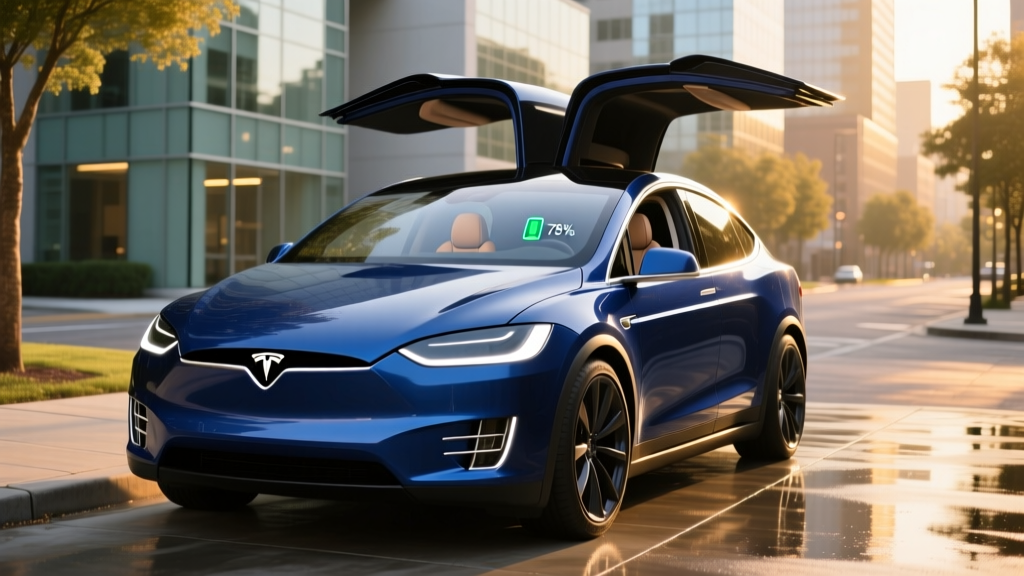
The 2018 Tesla Model X occupies a strange space in the used EV market. It's a three-row electric SUV with falcon-wing rear doors, a massive 100 kWh battery, and access to Tesla's Supercharger network — all available for a fraction of its original $80,000+ sticker. But buying a six-to-eight-year-old luxury EV demands clear-eyed analysis of battery degradation, charging hardware limitations, and ownership costs that no brochure will warn you about.
This review breaks down exactly what you're getting with a used 2018 Model X in 2026, including real-world range data, charging speeds on both older V2 and newer V3/V4 Superchargers, and whether this generation still makes sense against modern competitors like the Rivian R1S or a new Tesla Model Y.
2018 Tesla Model X: Quick Specs at a Glance
| Spec | 75D | 100D | P100D |
|---|---|---|---|
| EPA Range | 237 mi | 295 mi | 289 mi |
| Battery (Usable) | ~75 kWh (NMC) | ~100 kWh (NMC) | ~100 kWh (NMC) |
| Drivetrain | Dual Motor AWD | Dual Motor AWD | Dual Motor AWD |
| Horsepower | ~518 hp | ~518 hp | ~762 hp (Ludicrous) |
| 0–60 mph | 5.2 sec | 4.7 sec | 2.9 sec (Ludicrous) |
| Max DC Fast Charge | ~120 kW | ~120 kW | ~120 kW |
| 10–80% DC Time | ~40 min | ~50 min | ~50 min |
| Level 2 Home Rate | 11.5 kW (34 mi/hr) | 11.5 kW (34 mi/hr) | 11.5 kW (34 mi/hr) |
| EPA Efficiency (100D) | 89 MPGe / 36 kWh/100mi | ||
| Battery Warranty (Original) | 8 yr / 150,000 mi (70% retention) | ||
Sources: EPA / fueleconomy.gov, Tesla archived spec sheets.
Real-World Range: What the EPA Sticker Doesn't Tell You
EPA Rated: 295 miles
Real-World Highway (65–75 mph, moderate temps): ~235–260 miles
Real-World City/Mixed: ~255–280 miles
Cold Weather (below 32°F, highway): ~190–220 miles
With Battery Degradation (8-yr-old pack, ~10–15% loss): Subtract 30–45 miles from figures above
The 2018 Model X 100D was rated at 295 miles EPA — impressive when new and still competitive today. But the Model X is a heavy, boxy vehicle (curb weight around 5,300 lbs for the 100D) with the aerodynamic profile of a small building. At sustained highway speeds of 70–80 mph, expect to use 38–42 kWh/100mi, which brings practical range down to roughly 240 miles in fair weather.
Cold weather hits the Model X particularly hard. Unlike newer Teslas with heat pump HVAC systems, the 2018 Model X uses a resistive PTC heater that draws significant energy from the traction battery. In sub-freezing conditions, range loss of 25–35% is typical, especially on short trips where the cabin and battery must be heated from cold. Preconditioning while plugged in is essential — it warms the battery pack for better efficiency and protects long-term health.
The 75D variant, with its ~75 kWh usable pack, was EPA-rated at 237 miles. In practice, that means roughly 185–210 miles of real-world highway driving, which limits road-trip utility and increases Supercharger dependency.
Battery Degradation: What to Expect from an 8-Year-Old Pack
All 2018 Model X variants use NMC (nickel-manganese-cobalt) lithium-ion cells. NMC offers higher energy density than LFP but is more sensitive to high state-of-charge storage and extreme heat. Based on fleet data from Tesla owners and third-party studies, a 2018 Model X battery in 2026 will typically show 8–15% degradation depending on charging habits and climate.
A 100D that started with ~100 kWh usable may now deliver 85–92 kWh. That translates to a real-world highway range closer to 200–230 miles for a well-maintained example. When evaluating a used 2018 Model X, check the car's energy screen for a full-charge range estimate and compare it against the original EPA figure. A drop below 250 miles on a full charge for the 100D suggests above-average degradation.
The original battery warranty was 8 years / 150,000 miles with a 70% capacity retention threshold. Most 2018 Model X vehicles will have exited this warranty window by 2026, meaning any battery replacement cost falls on the owner. A Model X battery replacement at a Tesla Service Center typically runs $15,000–$22,000 depending on labor and whether a refurbished pack is available.
Charging Speeds: Supercharger Network Access with Older Hardware
| Charging Level | Power (kW) | Rate | Notes |
|---|---|---|---|
| Level 1 (120V household) | ~1.4 kW | ~3–4 mi/hr | Emergency/trickle only |
| Level 2 (240V, 48A) | 11.5 kW | ~34 mi/hr | Full charge in ~9–10 hrs (100D) |
| Level 2 (240V, 32A Mobile Connector) | 7.7 kW | ~23 mi/hr | Standard NEMA 14-50 adapter |
| DC Fast (V2 Supercharger) | Peak ~120 kW | ~170 mi in 30 min | Sustained rate lower; taper above 60% |
| DC Fast (V3/V4 Supercharger) | Capped ~120 kW | Same as V2 | Hardware cannot exceed ~120 kW |
The 2018 Model X maxes out at approximately 120 kW on DC fast charging. This is the critical limitation for used buyers to understand: even when plugged into a 250 kW V3 Supercharger or a 350 kW V4 station, the car's onboard charge hardware caps the draw at ~120 kW. You'll never see the 15-minute 10–80% times that modern EVs achieve.
On a V2 Supercharger (the most common type this car was designed for), expect a 10–80% charge in roughly 45–55 minutes for the 100D. The charge curve tapers significantly above 60% state of charge, so the last 20% can take as long as the first 50%. For road trips, plan stops around 20–30 minutes targeting 60–70% SoC rather than waiting for a full charge.
Home Level 2 charging is straightforward. With a Tesla Wall Connector on a 60A circuit, the Model X charges at its maximum 11.5 kW (48A), adding roughly 34 miles of range per hour. A full overnight charge easily replenishes a day's driving. The car uses the Tesla proprietary connector (now being rebranded as NACS), which in 2026 remains the most widely supported DC fast-charging connector in North America — a significant advantage over CCS-equipped used EVs from other brands.
One important note: the 2018 Model X does not support the CCS1 adapter natively. Tesla released a CCS adapter for newer vehicles, but 2018 Model X units generally cannot use non-Tesla DC fast chargers without a hardware retrofit that may not be available or cost-effective.
Performance and Driving Dynamics
The 2018 Model X remains genuinely quick by any standard. The 100D hits 0–60 mph in 4.7 seconds with 518 horsepower from its dual-motor all-wheel-drive system. The P100D with Ludicrous Mode is absurdly fast at 2.9 seconds — quicker than most supercars, in a three-row SUV weighing over 5,000 pounds.
But performance isn't just about straight-line speed. The Model X's air suspension (standard on all 2018 variants) provides adjustable ride height and a comfortable highway ride. However, air suspension systems are a known maintenance concern on older Teslas. Compressor and air strut failures are common past 80,000–100,000 miles, with replacement costs of $1,500–$3,000 per corner.
The electric powertrain itself is robust. Tesla's drive units have proven durable well past 200,000 miles in many cases, with the front motor being the more common failure point. Regenerative braking reduces wear on the friction brakes significantly, though the Model X's weight means brake rotors and pads still require periodic replacement.
Towing Capability
The 2018 Model X is rated to tow up to 5,000 pounds when equipped with the factory tow package. This is sufficient for a small boat, utility trailer, or light camper. However, towing cuts range dramatically — expect a 40–50% reduction, bringing a 100D down to roughly 120–150 miles of practical range while towing. Plan charging stops accordingly.
Interior, Cargo, and the Falcon-Wing Reality
The 2018 Model X seats five, six, or seven depending on configuration. The six-seat layout with second-row captain's chairs is the most popular and practical. Third-row space is tight — suitable for children or short trips, with about 26.5 inches of third-row legroom.
| Measurement | Value |
|---|---|
| Front Headroom | 41.7 in |
| Front Legroom | 41.2 in |
| Second-Row Legroom | 38.4 in |
| Cargo (behind 3rd row) | 12.6 cu ft |
| Cargo (behind 2nd row) | 57.3 cu ft |
| Cargo (max, seats folded) | 88.1 cu ft |
| Frunk (front trunk) | 6.6 cu ft |
The falcon-wing rear doors are the Model X's signature feature and its most divisive. They open upward using a double-hinge mechanism, requiring less side clearance than conventional doors — useful in tight parking spaces. They also make loading child seats and accessing the third row significantly easier than in a conventional SUV.
But the falcon wings have a reputation for issues. Early-production units (2016–2017) had widespread sensor and seal problems. By 2018, Tesla had addressed many of these, but owners still report occasional sensor false-positives (doors refusing to close near overhangs), water seal degradation, and expensive actuator replacements ($800–$1,500 per door). The ultrasonic sensors around the doors can also be triggered by low garage ceilings or roof racks on adjacent vehicles.
The panoramic windshield is stunning — the largest in any production vehicle, stretching from the dashboard to behind the front seats. It creates an airy, open cabin but offers no shade option on the 2018 model (later years added a retractable sunshade). In hot climates, cabin heat soak through that glass is real.
Tech, Software, and Driver Assistance
The 2018 Model X came with Tesla's Hardware 2.5 (HW2.5) Autopilot computer. This is a critical detail for used buyers: HW2.5 is significantly less capable than the HW3.0 and HW4.0 systems in newer Teslas. While Tesla has offered paid hardware upgrades to HW3.0 for some vehicles, availability and cost vary — expect $1,500–$2,000 if eligible.
Basic Autopilot (included) provides adaptive cruise control and lane-keeping assist — what the SAE classifies as Level 2 driver assistance. The driver must remain fully engaged with hands on the wheel and eyes on the road at all times. Enhanced Autopilot and Full Self-Driving (FSD) were optional add-ons. FSD Capability on HW2.5 is limited compared to current FSD (Supervised) on HW4.0 vehicles. If FSD was purchased on a used 2018 Model X, verify the transfer with Tesla — it doesn't always carry to second owners.
All Tesla Autopilot and FSD (Supervised) features are SAE Level 2 driver-assist systems. They do NOT make the vehicle self-driving. The driver must continuously supervise, keep hands on the steering wheel, and be prepared to take over instantly. No 2018 Model X — regardless of software package — can drive itself without human oversight.
The 17-inch center touchscreen remains one of the largest in any vehicle. In 2018, it ran a snappy interface with navigation, media, climate controls, and vehicle settings. Over-the-air updates have kept the software reasonably current, though some newer features (like the redesigned UI in 2024+ Teslas) are not available on HW2.5 hardware. Built-in streaming for Spotify, Netflix (while parked), and a web browser are included.
Used Pricing and Value in 2026
| Trim | Original MSRP | 2026 Used Range (60k–90k mi) | Notes |
|---|---|---|---|
| 75D | $79,500 | $24,000 – $30,000 | Lower range; less desirable |
| 100D | $96,000+ | $30,000 – $40,000 | Sweet spot for value |
| P100D | $140,000+ | $38,000 – $50,000 | Performance premium; higher maintenance risk |
The 2018 Model X has depreciated steeply — typical for luxury EVs with high original MSRPs and advancing battery technology. A well-maintained 100D with 70,000 miles can be found in the $32,000–$38,000 range, representing a remarkable amount of vehicle for the money.
Federal Tax Credit for Used EVs
Under the IRS §25E used clean vehicle credit, qualifying buyers can receive up to $4,000 (30% of the sale price, capped at $4,000) on a used 2018 Model X purchased from a dealer. Eligibility requirements include:
- Buyer income caps: AGI ≤ $75,000 (single), $112,500 (head of household), $150,000 (joint)
- Vehicle price cap: Sale price must be $25,000 or less
- Dealer sale required: Private-party sales do not qualify
- Vehicle age: Must be at least 2 model years old (2018 qualifies)
- First transfer since Aug 16, 2022: The vehicle must not have been transferred to a qualified buyer after that date previously
The $25,000 price cap is the sticking point. Most 2018 Model X 100D and P100D examples sell above $25,000, making them ineligible. Some high-mileage 75D units or project-condition vehicles may fall under the cap. The new-vehicle §30D credit ($7,500) does not apply to used purchases. Always verify current rules with a tax professional and the IRS §25E page.
Ownership Costs: Insurance, Maintenance, and the Big Unknowns
Insurance for a used Model X remains elevated. Despite the lower vehicle value, insurers factor in expensive repair costs (aluminum body panels, sensor-laden doors, proprietary parts). Expect annual premiums of $2,000–$3,500 depending on your state, driving record, and coverage level. Get quotes before purchasing.
Routine maintenance is minimal compared to ICE vehicles: no oil changes, no spark plugs, cabin air filter replacements every 1–2 years, and brake fluid checks. Tire costs are higher than average — the Model X uses 20- or 22-inch wheels with performance tires that run $250–$400 each and may need replacement every 25,000–35,000 miles due to the vehicle's weight and instant torque.
The financial risk items are the battery, drive unit(s), air suspension, and falcon-wing actuators. Setting aside $3,000–$5,000 as a repair reserve in the first year of ownership is prudent. A pre-purchase inspection at a Tesla Service Center or an independent EV specialist is strongly recommended — ask specifically for a battery health report showing current usable kWh vs. original capacity.
Pros and Cons of a Used 2018 Model X
- Supercharger network access (most reliable DC network in North America)
- Genuine three-row seating with usable cargo space
- 100D range still competitive (250+ real-world miles when healthy)
- Strong performance across all trims
- Over-the-air updates keep software reasonably current
- Falcon wings genuinely useful for child-seat loading
- NACS connector = future-proof charging standard
- 120 kW DC fast-charge cap = slower road-trip charging vs. modern EVs
- Battery warranty expired; replacement cost $15K–$22K
- Falcon-wing door mechanisms are expensive failure points
- Air suspension failures common past 80K–100K miles
- HW2.5 Autopilot hardware limits driver-assist capability
- No heat pump — cold-weather range loss is severe
- High insurance premiums relative to vehicle value
- Most examples exceed $25K used-EV credit cap
Who Should Buy a Used 2018 Model X?
Choose the 2018 Model X 100D if: You need three rows of seating, want Supercharger access for road trips, can budget for potential out-of-warranty repairs, and find a well-maintained example under $38,000 with a battery health report showing less than 12% degradation.
Choose a newer alternative if: You prioritize fast DC charging (200+ kW), want current-generation driver-assist hardware, prefer the security of an active battery warranty, or plan to drive in consistently cold climates where a heat pump matters.
Skip the 75D unless: Your daily commute is under 100 miles round-trip, you charge at home every night, and you rarely road-trip. The 75D's ~190-mile real-world range is limiting in 2026.
Frequently Asked Questions
What is the real-world range of the 2018 Tesla Model X?
The 100D achieves approximately 235–260 miles in real-world highway driving in moderate temperatures, and 255–280 miles in mixed city/highway use. Cold weather drops highway range to 190–220 miles. Factor in 8–15% battery degradation for an 8-year-old pack, reducing these figures by another 20–40 miles.
How fast does the 2018 Model X charge?
DC fast charging peaks at ~120 kW, yielding a 10–80% charge in approximately 45–55 minutes for the 100D. At home on a Level 2 Wall Connector (11.5 kW), you'll add about 34 miles per hour, with a full charge taking 9–10 hours. The 120 kW hardware cap means V3/V4 Superchargers offer no speed advantage over V2 stations.
Does the 2018 Model X qualify for the federal EV tax credit?
It may qualify for the used EV credit (§25E) of up to $4,000, but only if the sale price is $25,000 or less, the buyer meets income caps ($75K single / $150K joint), and it's purchased from a dealer. Most 100D and P100D examples exceed the $25K price cap. The new-vehicle §30D $7,500 credit does not apply to used purchases. Consult a tax professional for your specific situation.
Is the 2018 Model X worth buying vs. competitors?
Against a used Rivian R1S (starting ~$45,000+ used), the Model X offers lower pricing and Supercharger access but older charging hardware and higher maintenance risk. Against a new Tesla Model Y Long Range (~$48,000 new, ~320 miles EPA, 250 kW charging), the Model X provides three-row seating and more cargo space but significantly slower charging, no warranty, and higher running costs. If you need three rows on a budget and accept the repair risk, the Model X 100D is compelling. If reliability and charging speed matter more, the Model Y or a newer EV is the better choice.
What are the biggest maintenance concerns?
Battery degradation (replacement: $15K–$22K), air suspension failure ($1,500–$3,000 per corner), falcon-wing actuator/sensor issues ($800–$1,500 per door), and drive unit replacement ($4,000–$7,000) are the primary risks. A pre-purchase inspection with a battery health report is essential before buying.
Can the 2018 Model X use non-Tesla chargers?
Not easily. The 2018 Model X uses Tesla's proprietary connector (NACS). While NACS is now the North American standard and many networks are adding NACS cables, the 2018 Model X cannot use a CCS adapter without a hardware retrofit that Tesla has not broadly offered for this model year. Your DC fast-charging options are effectively limited to Tesla Superchargers and Destination Chargers.