The 2018 Tesla Model X occupies a strange space in the used EV market. It's a full-size, three-row electric SUV with falcon-wing doors, standard all-wheel drive, and access to Tesla's Supercharger network — all at a depreciated price that undercuts new crossovers by tens of thousands of dollars. But buying a six-to-eight-year-old luxury EV comes with real questions: How much range has the 100 kWh battery lost? What are the actual DC fast-charging speeds? And does it still make sense against newer, more efficient competition?
We've spent time with the 2018 Model X across multiple trims — the 75D, 100D, and the range-topping P100D — to give you the data you need before handing over any money. This isn't a brochure recap; it's a buyer's guide for a specific model year that's now flooding the used market.
2018 Model X at a Glance: Key Specifications
| Spec | 75D | 100D | P100D |
|---|---|---|---|
| EPA Range | 237 mi | 295 mi | 289 mi |
| Battery (Usable) | 75 kWh | 100 kWh | 100 kWh |
| Chemistry | NMC (Nickel Manganese Cobalt) | NMC | NMC |
| Drivetrain | Dual-Motor AWD | Dual-Motor AWD | Dual-Motor AWD |
| Horsepower | ~518 hp | ~518 hp | ~670 hp (Ludicrous) |
| 0–60 mph | 4.9 sec | 4.7 sec | 2.9 sec (Ludicrous) |
| MPGe (Combined) | 93 MPGe | 100 MPGe | 97 MPGe |
| Efficiency (kWh/100 mi) | 36 kWh | 33 kWh | 35 kWh |
| Max DC Fast Charge | ~120 kW | ~120 kW (V2 SC) | ~120 kW (V2 SC) |
| 10–80% DC Charge Time | ~45 min | ~55 min | ~55 min |
| Level 2 Home Charge (48A) | ~29 mi/hr | ~34 mi/hr | ~34 mi/hr |
| Cargo (Seats Folded) | 88.1 cu ft | ||
| Cargo (Behind 3rd Row) | 12.6 cu ft | ||
| Battery Warranty (New) | 8 yr / 150,000 mi | 8 yr / 150,000 mi | 8 yr / 150,000 mi |
| Original MSRP | ~$79,500 | ~$96,000 | ~$140,000+ |
Real-World Range: What the EPA Number Doesn't Tell You
EPA Estimate: 237 mi (75D) / 295 mi (100D) / 289 mi (P100D)
Real-World Highway: Expect ~210–225 mi (75D), ~260–275 mi (100D) at 70–75 mph
Cold Weather (30°F and below): Subtract 20–30% — the 100D drops to ~200–220 mi in freezing temps
The 2018 Model X is a heavy vehicle — curb weight exceeds 5,000 lbs across all trims — and that mass shows up at highway speeds. In our experience and consistent with owner data aggregated by fueleconomy.gov, the 100D delivers roughly 260–275 miles on a flat highway at 70 mph in moderate temperatures. That's a 7–12% reduction from the 295-mile EPA sticker.
The 75D, with its smaller battery, feels the squeeze more acutely. Plan for roughly 210–225 real-world highway miles, which means you'll want to know where every Supercharger is on a road trip. Cold weather compounds the loss significantly: NMC chemistry loses efficiency below freezing, and while the Model X has a battery thermal management system (unlike some early passive-cooled EVs), preconditioning only partially mitigates the hit.
City and suburban driving with regenerative braking engaged gets you closer to — and occasionally above — the EPA number. The Model X's regen is strong enough for near one-pedal driving, and stop-and-go traffic recovers meaningful energy.
Charging Speed and Infrastructure: Supercharger Access Is the Advantage
| Charging Level | Power (kW) | Speed (mi/hr added) | Notes |
|---|---|---|---|
| Level 1 (120V, 12A) | ~1.4 kW | ~3–4 mi/hr | Emergency/trickle only |
| Level 2 (240V, 48A) | 11.5 kW | ~29–34 mi/hr | Home Wall Connector; full charge overnight |
| Level 2 (240V, 32A) | 7.7 kW | ~20–23 mi/hr | Mobile Connector on 240V outlet |
| DC Fast (V2 Supercharger) | Peak ~120 kW | ~200+ mi/hr (peak) | 10–80% in ~45–55 min; tapers above 60% |
| DC Fast (V3 Supercharger) | ~120 kW (capped) | Similar to V2 | 2018 Model X cannot utilize V3's 250 kW peak |
The 2018 Model X uses Tesla's proprietary connector (pre-NACS standardization) and charges at a peak of roughly 120 kW on V2 Superchargers. This is a critical limitation to understand: even when you plug into a V3 Supercharger capable of 250 kW, the 2018 Model X's architecture caps out around 120 kW. The newer 2021+ Model X with the refreshed powertrain can pull 250 kW; this generation cannot.
The charge curve matters as much as the peak number. The 100D pulls its maximum rate from roughly 10% to 50–60% state of charge, then tapers progressively. The 10–80% charge takes approximately 55 minutes for the 100D and 45 minutes for the 75D (smaller battery fills faster in absolute terms). That's competitive with CCS-equipped rivals from the same era but noticeably slower than 2024+ models on 800V architectures that do 10–80% in under 20 minutes.
At home, a Tesla Wall Connector on a 60-amp circuit delivers 48 amps (11.5 kW), adding roughly 34 miles of range per hour on the 100D. An overnight session from 20% to full takes about 7–8 hours. If you're limited to a NEMA 14-50 outlet with the Mobile Connector at 32 amps, expect 20–23 miles per hour — adequate for daily replenishment but slow for a full charge from near-empty.
Performance: Ludicrous Is a Party Trick, AWD Is the Daily Reality
Every 2018 Model X comes with dual motors and all-wheel drive. The base 75D hits 60 mph in 4.9 seconds with roughly 518 combined horsepower — quick by any SUV standard. The 100D shaves that to 4.7 seconds with the same powertrain but more torque availability from the larger battery.
The P100D with Ludicrous Mode is the headline act: 2.9 seconds to 60 mph and roughly 670 horsepower. It's genuinely startling acceleration from a 5,000-lb family hauler. But Ludicrous Mode adds weight, cost, and complexity, and it's a feature most owners use twice before settling into Normal for daily driving.
The adaptive air suspension was standard on the 2018 Model X and offers adjustable ride height — useful for clearing steep driveways or lowering for highway efficiency. However, air suspension is a known maintenance item on this generation; budget for potential strut replacement ($1,500–$2,500 per corner) as these vehicles age past 80,000 miles.
Interior, Cargo, and Falcon Wing Doors: Practical or Gimmick?
The 2018 Model X offers seating for five, six, or seven depending on configuration. The six-seat layout with second-row captain's chairs is the most popular and the most practical — it provides a walk-through to the third row and individual seat adjustments.
Cargo volume is generous with the seats folded: 88.1 cubic feet with both second and third rows down. Behind the third row alone, you get just 12.6 cubic feet — enough for a few grocery bags, not a family road trip. The front trunk (frunk) adds roughly 6.5 cubic feet of secure, weatherproof storage.
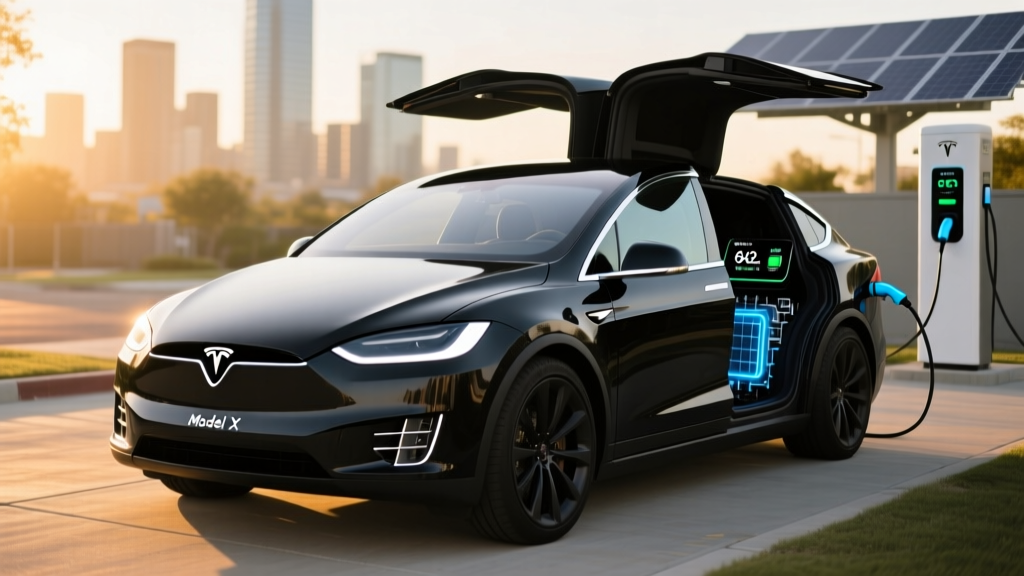
The falcon wing doors are the Model X's most polarizing feature. They're genuinely useful in tight parking spaces where a traditional door would ding a neighboring car — the double-hinged design requires less lateral clearance. But they're slower to open and close than conventional doors, they can struggle in low-clearance garages (ultrasonic sensors adjust the arc, but it's not flawless), and they add mechanical complexity that has generated warranty claims for seal leaks and actuator failures.
The 17-inch touchscreen runs Tesla's software, which in 2018 was already ahead of competitors for responsiveness and over-the-air update capability. Features like Navigate on Autopilot, Sentry Mode, and Dog Mode were added via OTA updates after delivery. The infotainment hardware (MCU1 or MCU2 depending on build date) is dated by 2026 standards — MCU1 units in particular are sluggish and were subject to a recall for eMMC memory failure. Verify whether the vehicle has the upgraded MCU2 or the newer Ryzen-based MCU; it significantly affects daily usability.
Pricing, Tax Credits, and Used Market Value in 2026
| Trim | Original MSRP | Typical Used Price (2026) | Used EV Tax Credit (§25E) | Effective Price |
|---|---|---|---|---|
| 75D | ~$79,500 | $22,000–$28,000 | Up to $4,000 | $18,000–$24,000 |
| 100D | ~$96,000 | $28,000–$36,000 | Up to $4,000 | $24,000–$32,000 |
| P100D | ~$140,000+ | $35,000–$48,000 | Up to $4,000 | $31,000–$44,000 |
The 2018 Model X has depreciated steeply — which is bad news for original owners and excellent news for used buyers. As of early 2026, a well-maintained 100D with 60,000–80,000 miles typically lists between $28,000 and $36,000 depending on condition, options, and MCU upgrade status.
Federal tax credit eligibility: The new-vehicle §30D credit no longer applies to a 2018 purchase. However, the §25E Used Clean Vehicle Credit may apply if you buy from a licensed dealer. Per IRS guidelines, the credit is 30% of the sale price, capped at $4,000, and applies to used EVs sold for $25,000 or less. Income limits apply: modified AGI cannot exceed $75,000 (single), $112,500 (head of household), or $150,000 (joint). The vehicle must be at least two model years old (the 2018 qualifies), and you can only claim the credit once per VIN every three years.
This means the 75D and lower-priced 100D units are most likely to fall under the $25,000 cap and qualify for the full $4,000 credit. Higher-priced 100D and P100D examples that sell above $25,000 do not qualify. Always confirm eligibility with a tax professional before relying on the credit.
Battery Health, Warranty, and Long-Term Ownership Costs
The 2018 Model X's NMC battery was warranted for 8 years or 150,000 miles (whichever comes first) with a minimum 70% capacity retention threshold. As of 2026, most 2018 examples are either at the tail end of that warranty or just past it. This is the single most important factor in your purchase decision.
Tesla's NMC packs from this era have shown degradation curves that are better than early industry fears but not trivial. Owner-reported data on forums like Tesla Motors Club indicates typical degradation of 8–15% at 80,000–100,000 miles. A 100D that started at 295 EPA miles might realistically show 250–270 miles of range at 80,000 miles. Units that were frequently Supercharged to 100% or regularly sat at high state of charge in hot climates may show more.
If you're buying outside the battery warranty, a replacement pack costs between $15,000 and $22,000 at a Tesla Service Center, depending on whether a refurbished or new pack is installed. Third-party EV battery shops are emerging as a lower-cost option ($10,000–$15,000), but availability varies by region.
Before purchasing, request the vehicle's battery health data through the Tesla app (if the seller grants access) or have a Tesla Service Center run a diagnostic. State of Health (SoH) percentage is the number that matters — anything above 88% at this age is acceptable; below 82% warrants negotiation or walking away.
Autopilot and Driver Assistance: Level 2, Not Self-Driving
SAE Automation Level: Level 2
The 2018 Model X with Enhanced Autopilot or Full Self-Driving (FSD) capability is a Level 2 driver-assistance system. The driver must remain fully engaged, hands on or near the wheel, eyes on the road, and ready to take over at any moment. This is not autonomous driving. Tesla's FSD (Supervised) — even on vehicles that paid $8,000–$10,000 for the option in 2018 — remains Level 2. Only Level 4 services like Waymo operate without a human driver in defined zones.
The 2018 Model X hardware suite (HW2.5 or HW3 depending on build date) supports Autopilot features including Traffic-Aware Cruise Control, Autosteer, Auto Lane Change, and Navigate on Autopilot. Vehicles with the FSD package purchased at delivery have received ongoing software updates, though feature delivery has been slower and more limited than Tesla originally promised.
For 2026 buyers, the practical question is whether the Autopilot experience justifies paying a premium for an FSD-equipped used vehicle. Our take: FSD transferability adds value only if you'll use it daily in well-mapped areas. For highway commuting, standard Autopilot (included on all 2018 Model X vehicles) handles lane centering and adaptive cruise competently.
Pros, Cons, and Who Should Buy a Used 2018 Model X
Pros
- Supercharger network access — still the most reliable DC fast-charging infrastructure in the US
- Genuine three-row seating with usable adult-sized second row
- 88.1 cu ft cargo capacity with seats folded rivals gas SUVs
- Standard AWD with strong traction in rain and light snow
- OTA software updates continue to add features years after purchase
- Heavy depreciation makes it one of the best value-per-mile-of-range EVs on the used market
- Frunk adds secure, weatherproof storage
Cons
- DC fast charging capped at ~120 kW — slow by 2026 standards
- Falcon wing doors add mechanical complexity and potential repair costs
- Air suspension failures are common and expensive out of warranty
- Highway real-world range significantly below EPA sticker, especially in cold
- MCU1 infotainment hardware is dated and was subject to recall
- No heat pump — resistive cabin heater draws significant battery in winter
- Insurance costs remain elevated for Tesla vehicles
- Battery warranty is expired or nearly expired on most 2018 examples
Who this EV suits best: Families who need three rows and cargo space, have access to home Level 2 charging, and take road trips along Supercharger-dense corridors. The 100D is the sweet spot — its 260+ real-world highway miles and 34 mi/hr home charging rate cover most daily needs with margin for longer drives. The 75D is a budget-friendly commuter if your daily round trip is under 100 miles and you charge nightly.
Who should look elsewhere: Buyers in extreme cold climates (no heat pump, significant range loss), those who need the fastest possible road-trip charging (newer EVs on 800V architectures charge in half the time), or anyone unwilling to budget $2,000–$4,000 annually for potential out-of-warranty repairs on air suspension, door actuators, or MCU hardware.
How the 2018 Model X Stacks Up Against Used Competitors
The direct used-EV competition at similar price points is limited. The 2018–2019 Jaguar I-PACE offers a more engaging drive and conventional doors but has only 234 EPA miles, spotty DC charging reliability, and no Supercharger access. The 2019 Audi e-tron (now badged Q8 e-tron) is refined with a 204-mile EPA range and excellent build quality but charges faster (150 kW peak) while offering less range and no third row.
If three rows are non-negotiable, the 2018 Model X is essentially alone in the used EV market at this price. The Rivian R1S (2022+) offers three rows and superior off-road capability but starts around $45,000+ used — significantly more. The newer Kia EV9 (2024+) is the closest modern competitor but hasn't depreciated to 2018 Model X pricing yet.
Choose the 2018 Model X 100D if: You need three rows, want Supercharger access for road trips, can install a Level 2 home charger, and find a well-maintained example under $35,000 with verified battery health above 88%.
Choose a newer alternative if: You need sub-20-minute DC charging, want a heat pump for cold climates, prefer a current factory warranty, or don't need three rows (a used Model 3 or Model Y offers better efficiency and faster charging at similar prices).
Frequently Asked Questions
What is the real-world range of the 2018 Tesla Model X?
The 100D delivers approximately 260–275 miles on the highway at 70 mph in moderate temperatures, compared to its 295-mile EPA estimate. The 75D manages roughly 210–225 real-world highway miles. In freezing weather, subtract 20–30% from these figures. City driving with regenerative braking can match or slightly exceed the EPA number.
How fast does the 2018 Model X charge at home and on the road?
On a Tesla Wall Connector (48A/11.5 kW Level 2), the 100D adds roughly 34 miles of range per hour, fully charging overnight in 7–8 hours. On DC fast charging, the 2018 Model X peaks at approximately 120 kW even on V3 Superchargers, achieving a 10–80% charge in roughly 45–55 minutes depending on battery size. It cannot use the 250 kW peak that newer Teslas support.
Does a used 2018 Model X qualify for any federal tax credit?
Not the new-vehicle §30D credit. However, the §25E Used Clean Vehicle Credit may apply if you purchase from a licensed dealer for $25,000 or less, meet income limits ($75K single / $150K joint), and the VIN hasn't been claimed in the past three years. The credit is 30% of the sale price, capped at $4,000. Consult a tax professional and review IRS §25E guidelines before purchasing.
Is the 2018 Model X worth buying vs. newer EVs?
It depends on your priorities. If you need three rows, Supercharger network access, and a low purchase price, the 2018 Model X is unmatched in the used market. If you prioritize fast charging (newer 800V EVs charge twice as fast), a heat pump for cold weather, or a remaining factory warranty, you're better served by a newer Model Y, Kia EV9, or Rivian R1S at a higher price point. Always verify battery SoH before purchasing.
What are the most common problems with the 2018 Model X?
Known issues include air suspension strut failure ($1,500–$2,500 per corner), falcon wing door actuator and seal problems, MCU1 eMMC memory failure (subject to recall — verify upgrade status), and half-shaft wear on high-mileage examples. The powertrain and battery are generally robust, but out-of-warranty repairs on ancillary systems can be costly. Budget $2,000–$3,000 annually for maintenance reserves.
How long will the 2018 Model X battery last?
Tesla's NMC batteries from this era typically show 8–15% degradation at 80,000–100,000 miles based on owner-reported data. With proper care (daily charging to 80–90%, avoiding prolonged 100% storage, moderate Supercharging frequency), many packs reach 150,000+ miles with 80%+ capacity retention. A replacement pack costs $15,000–$22,000 from Tesla, or $10,000–$15,000 from independent EV shops. The original 8-year/150,000-mile battery warranty has expired or is expiring on most 2018 examples as of 2026.
Sources: EPA range and efficiency data from fueleconomy.gov; used EV tax credit rules from IRS.gov §25E; Tesla owner battery degradation data aggregated from Tesla Motors Club forums and Recurrent Auto research.