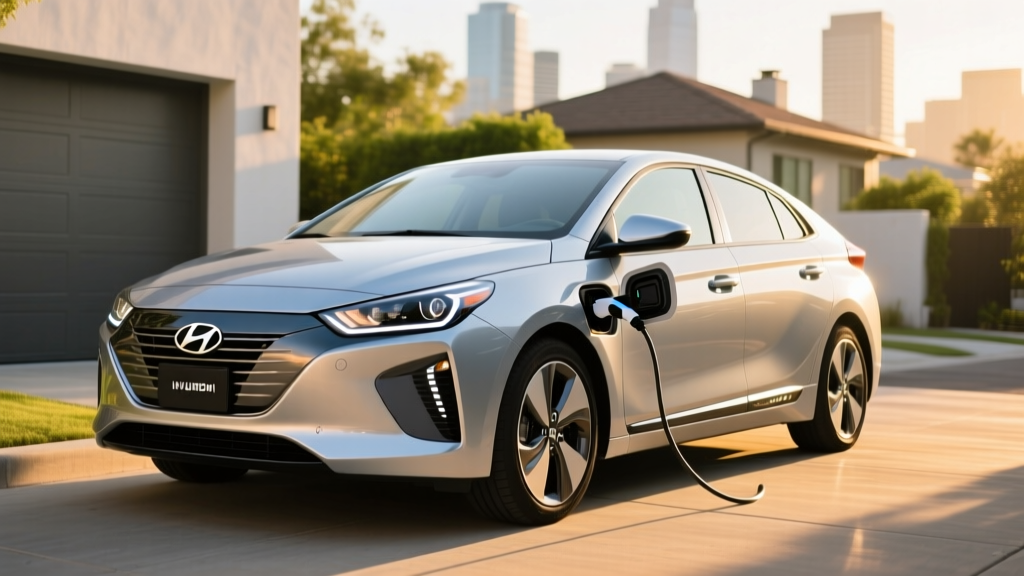
The 2018 Hyundai Ioniq Electric was never designed to win range wars. Built on a modest 28.3 kWh battery and aimed squarely at efficiency-obsessed commuters, it delivers an EPA-estimated 124 miles of range with class-leading MPGe. For 2026 used-EV shoppers, it represents one of the most affordable entry points into battery-electric ownership — especially when the federal used-EV tax credit applies. Here is everything you need to know before buying one today.
2018 Hyundai Ioniq Electric: Core Specifications
| Attribute | Value |
|---|---|
| EPA Range | 124 miles |
| Battery (usable) | 28.0 kWh (28.3 kWh gross), Lithium-ion Polymer (NMC) |
| MPGe (city / hwy / combined) | 150 / 122 / 136 MPGe |
| Energy Consumption | 25 kWh / 100 miles |
| Motor Output | 88 kW (118 hp), 218 lb-ft torque |
| Drivetrain | Front-wheel drive (FWD), single-speed reduction gear |
| 0–60 mph | ~9.9 seconds |
| Top Speed | ~103 mph (electronically limited) |
| DC Fast Charge (peak) | Up to 100 kW (CCS Combo 1) |
| Level 2 Charge Rate | 6.6 kW onboard charger |
| Cargo Volume (rear seats up) | 23.0 cu ft |
| Cargo Volume (rear seats folded) | 55.0 cu ft |
| Base MSRP (2018 new) | $29,500 (Electric Limited trim) |
| Typical 2026 Used Price | $11,000–$16,000 (varies by mileage/condition) |
| Battery/Powertrain Warranty | 8 years / 100,000 miles (original); 10 years / 100,000 miles in CARB states |
Real-World Range: What 124 EPA Miles Actually Means
Real-World Expectation: 95–115 miles highway; 110–130 miles city in mild weather. Expect 75–95 miles in freezing temperatures with cabin heat active.
The Ioniq Electric's 136 MPGe combined rating made it one of the most efficient EVs ever sold in the U.S. at the time of its release, per fueleconomy.gov. That efficiency is the reason Hyundai squeezed 124 miles out of a battery smaller than what many modern plug-in hybrids carry.
However, 124 miles is a best-case combined figure. In real-world highway driving at 70 mph, aerodynamic drag and the single-speed reduction gear push consumption closer to 28–30 kWh/100 mi, cutting range to roughly 95–115 miles. City driving with frequent regenerative braking opportunities can push range back toward the EPA figure or slightly above.
Cold weather is the Ioniq's biggest enemy. The 2018 model uses a resistive PTC heater rather than a heat pump. In sub-30°F conditions, cabin heating can draw 3–5 kW continuously, reducing effective range by 20–35%. Owners in northern climates should realistically budget 80–95 miles of usable range in winter. Preconditioning the cabin while still plugged in at home is essential — it warms the battery and cabin using grid power rather than battery energy.
Charging Speed: DC Fast, Level 2, and Level 1
| Level | Connector | Power | Time / Rate |
|---|---|---|---|
| Level 1 (120V) | J1772 | ~1.2 kW | ~24+ hours 0–100%; ~4 mi/hr |
| Level 2 (240V) | J1772 | 6.6 kW (onboard limit) | ~4 hours 0–100%; ~22 mi/hr |
| DC Fast Charge | CCS Combo 1 | Peak ~100 kW | 10–80% in ~24 minutes (see curve note below) |
The Ioniq Electric's DC fast-charging capability was genuinely competitive for 2018. On a 50 kW CHAdeMO-to-CCS or standard CCS station, expect 10–80% in roughly 30 minutes. On newer 100 kW+ CCS chargers (Electrify America, EVgo), the Ioniq can accept up to approximately 100 kW at low state of charge, pulling the 10–80% time down to around 24 minutes under ideal thermal conditions.
Charging curve reality: Peak 100 kW is only sustained between roughly 5–40% SoC. Above 55%, the rate tapers to ~60 kW; above 80%, it drops to ~25–30 kW to protect battery health. This is normal for NMC chemistry, but it means charging from 80–100% adds nearly as much time as 10–80%. For road-trip efficiency, plan stops around the 10–80% window.
At home, the 6.6 kW onboard charger is adequate. A standard 240V / 32A Level 2 station (like a ChargePoint Home Flex or Emporia Vue) will refill the 28 kWh pack in about 4 hours. This means overnight charging is more than sufficient — most daily commutes will require only 1–2 hours of Level 2 top-up.
Performance, Drivetrain, and Daily Drivability
The 88 kW (118 hp) permanent-magnet synchronous motor sends 218 lb-ft of instant torque to the front wheels. The 0–60 mph time of approximately 9.9 seconds is unhurried by modern EV standards, but the torque delivery is linear and responsive around town. Merging onto highways requires planning at full capacity, but the Ioniq feels peppy below 45 mph thanks to electric-motor immediacy.
Ride quality is firm but compliant — Hyundai tuned the Ioniq's multi-link rear suspension for efficiency and stability rather than sportiness. Cabin noise is well-managed at city speeds, though wind and tire noise become noticeable above 65 mph. The steering is light and precise, making it an easy car to park and navigate in urban environments.
Regenerative braking is adjustable via steering-wheel paddles (three levels plus a maximum-regen mode). At the highest setting, one-pedal driving is possible in stop-and-go traffic, though the Ioniq does not come to a complete hold — you will still need the friction brake for final stops.
Interior, Cargo, and Technology
The 2018 Ioniq Electric was offered only in a single well-equipped "Limited" trim. Standard features include:
- 8-inch touchscreen with Apple CarPlay and Android Auto
- Infinity premium audio (7 speakers)
- Heated and ventilated front seats, heated steering wheel
- Leather seating surfaces
- Automatic emergency braking with pedestrian detection
- Lane departure warning, blind-spot detection, rear cross-traffic alert
- Adaptive cruise control (with stop-and-go capability)
- LED headlights and taillights
- Proximity key with push-button start
Passenger space is reasonable for a compact hatchback: 42.2 inches of front legroom and 35.7 inches of rear legroom. Two adults fit comfortably in back; three is tight. The rear seatbacks fold in a 60/40 split, expanding cargo from 23.0 to 55.0 cu ft — competitive with compact crossovers.
Notable drawbacks: The infotainment system, while functional, uses resistive-touch buttons and feels dated by 2026 standards. There is no over-the-air update capability, no wireless CarPlay, and the navigation mapping (if equipped) is from the pre-smartphone era. The instrument cluster uses a 7-inch TFT display rather than a modern configurable digital cockpit. Rear visibility is compromised by the split-rear-window design (a hallmark of the Ioniq/Prius liftback shape).
Pricing, Tax Credits, and Used-EV Value
| Scenario | Approximate Cost |
|---|---|
| Original 2018 MSRP (Limited trim) | $29,500 + destination |
| Typical 2026 used price (dealer, 60k–90k mi) | $11,000–$16,000 |
| Federal used-EV credit (§25E, up to 30% / max $4,000) | –$3,300 to –$4,000 (if eligible) |
| Effective price after credit | ~$7,000–$12,000 |
Tax credit note: The 2018 Ioniq Electric does not qualify for the new-vehicle §30D credit (it is no longer sold new). However, it may qualify for the §25E used clean vehicle credit, which provides up to $4,000 (30% of sale price, capped at $4,000) for qualifying used EVs. Key eligibility requirements for §25E:
- Sale price must be $25,000 or less
- Buyer income caps: $75,000 single / $112,500 head of household / $150,000 joint (modified AGI)
- Vehicle must be at least two model years old (2018 qualifies)
- Must be purchased from a licensed dealer (private-party sales do not qualify)
- Vehicle must have a battery capacity of at least 7 kWh (28.3 kWh qualifies)
- Buyer must not have claimed the used-EV credit in the prior 3 years
At a $13,000 dealer sale price, the 30% credit equals $3,900, bringing effective cost to $9,100. At $15,000, the $4,000 cap kicks in, making the effective price $11,000. This makes the 2018 Ioniq one of the cheapest ways to get into a modern, liquid-cooled, CCS-equipped EV in 2026.
Battery Health, Warranty, and Longevity
The Ioniq Electric uses a 28.3 kWh (gross) lithium-ion polymer pack with NMC (nickel-manganese-cobalt) chemistry, manufactured by LG Chem. Hyundai equipped it with an active liquid thermal management system — a significant advantage over air-cooled competitors like the early Nissan Leaf, which suffered accelerated degradation in hot climates.
Real-world degradation data from owner communities (Ioniq Forum, SpeakEV) suggests typical capacity loss of 5–10% over the first 5 years / 60,000 miles. Most 2018 models in 2026 should still retain 88–94% of original capacity, translating to roughly 110–117 miles of range when new-equivalent. Always check the State of Health (SoH) via an OBD-II reader and the EV BMS module before purchasing used.
The original battery warranty is 8 years / 100,000 miles (10 years / 100,000 miles in CARB-adopting states including CA, NY, MA, NJ, CT, RI, VT, ME, MD, OR, WA, CO). Hyundai defines a warranty claim as the battery dropping below 70% of original capacity. For a 2018 model, the federal 8-year warranty remains active through the 2026 model year for vehicles with under 100,000 miles — a meaningful safety net for used buyers.
Who Should Buy the 2018 Hyundai Ioniq Electric?
- Your daily round-trip commute is under 80 miles
- You have reliable home Level 2 charging access
- You want the most affordable used EV with liquid-cooled battery and CCS fast charging
- You value efficiency (136 MPGe) and low running costs over range and performance
- You live in a mild-to-moderate climate, or accept winter range loss as a trade-off
- You regularly drive more than 100 miles one-way without charging access
- You need AWD or high performance
- You want modern infotainment, OTA updates, or a large battery for road trips
- You tow anything (not rated for towing)
The Ioniq Electric is a purpose-built commuter appliance. It excels at turning electrons into miles with minimal waste, and it does so with a surprisingly well-equipped interior. For a second car, a solo commuter, or a budget-conscious first-time EV buyer who can charge at home, it is difficult to beat at 2026 used pricing.
Pros and Cons at a Glance
- Class-leading 136 MPGe combined efficiency
- Liquid-cooled battery with excellent degradation track record
- CCS DC fast charging up to ~100 kW
- Well-equipped Limited trim as standard (heated/vented seats, adaptive cruise, AEB)
- Strong remaining factory battery warranty on low-mile examples
- Eligible for up to $4,000 federal used-EV tax credit (§25E)
- Low total cost of ownership — minimal maintenance, cheap fueling
- 124-mile EPA range limits road-trip utility
- Resistive PTC heater causes significant winter range loss (no heat pump)
- Modest 118 hp; 0–60 in ~10 seconds
- Dated infotainment with no wireless smartphone integration
- Split rear window impairs rearward visibility
- Only one trim level was offered — no budget option when new
- Small frunk area (no dedicated front trunk; electronics occupy the space)
Frequently Asked Questions
What is the real-world range of the 2018 Hyundai Ioniq Electric?
The EPA rates it at 124 miles combined. In real-world driving, expect 95–115 miles on the highway, 110–130 miles in city driving with regen opportunities, and 75–95 miles in freezing temperatures due to the resistive cabin heater. Preconditioning while plugged in helps mitigate cold-weather losses.
How fast does the 2018 Ioniq Electric charge?
On a CCS DC fast charger, it peaks at approximately 100 kW and charges 10–80% in roughly 24 minutes under ideal conditions. On a 240V Level 2 home charger, the 6.6 kW onboard charger refills the battery in about 4 hours. Level 1 (120V) adds approximately 4 miles of range per hour.
Does the 2018 Ioniq Electric qualify for the federal EV tax credit?
It no longer qualifies for the new-vehicle §30D credit. However, as a used EV purchased from a licensed dealer for $25,000 or less, it may qualify for the §25E used clean vehicle credit — up to $4,000 (30% of sale price). Income caps and prior-claim restrictions apply. Consult a tax professional and review IRS guidance for your situation.
Is the 2018 Ioniq Electric worth buying vs. a used Chevy Bolt EV or Nissan Leaf?
It depends on your priorities. The 2018 Chevy Bolt EV offers 238 miles of range and similar pricing, making it superior for range. The 2018 Nissan Leaf (40 kWh) offers 151 miles but uses passive air cooling, which risks faster battery degradation in hot climates. The Ioniq trades range for best-in-class efficiency, liquid cooling, and strong DC charging speed. If your commute is short and charging is reliable, the Ioniq's lower energy cost per mile and proven battery management make it a strong value pick.
What is the battery warranty status on a 2018 Ioniq Electric in 2026?
The original 8-year / 100,000-mile battery warranty is still active for most 2018 models in 2026 (it expires at the earlier of 8 years from original sale date or 100,000 miles). In CARB states, coverage extends to 10 years / 100,000 miles. Hyundai covers battery replacement if capacity drops below 70% of original.
Does the 2018 Ioniq Electric have a heat pump?
No. The 2018 model uses a resistive PTC heater for cabin warmth. This is one of the car's main efficiency drawbacks in cold weather, as resistive heating draws significantly more energy than a heat pump system. Hyundai added heat pump systems to later Ioniq generations and other models like the Kona Electric in certain markets.