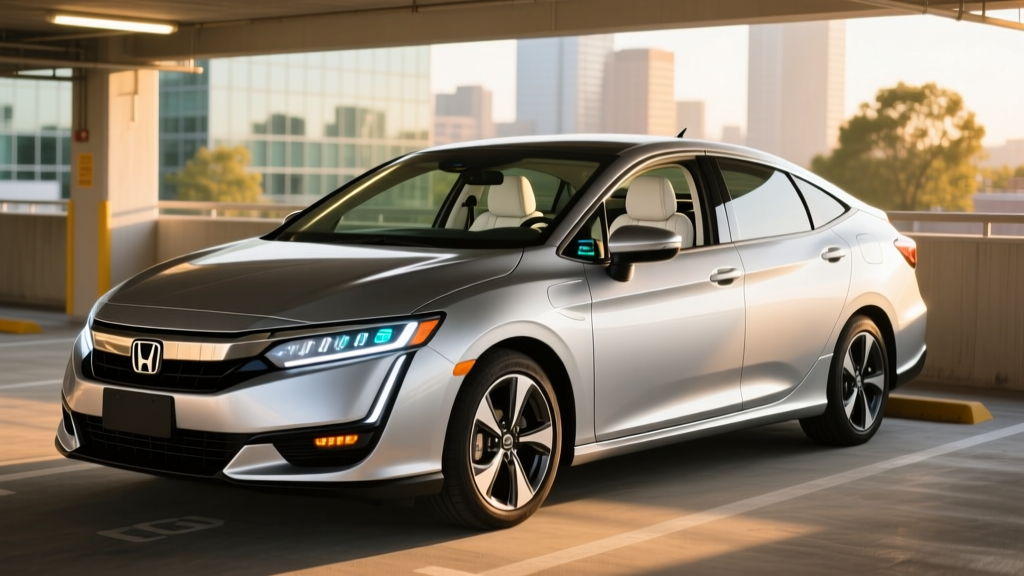
The short answer: The 2018 Honda Clarity Electric is a discontinued, California-and-Oregon-only compliance EV with just 89 miles of EPA range and a 25.5 kWh battery. In 2026, it makes sense only as a low-cost second car for short urban commutes with reliable home charging — typically priced between $10,000–$16,000 on the used market. It does not qualify for the federal §30D new-vehicle credit, and the up-to-$4,000 used-EV credit depends on strict income, price, and dealer requirements. If you need highway range, fast charging, or all-weather capability, look elsewhere.
What the 2018 Honda Clarity Electric Actually Is
Honda built the Clarity Electric as a compliance car — a low-volume EV sold exclusively in California and Oregon to satisfy zero-emission vehicle (ZEV) mandate credits. It shared the Clarity platform with the far more popular Clarity Plug-In Hybrid (47 miles electric + gas engine) and the Clarity Fuel Cell (hydrogen). Only the Electric variant was a true battery-electric vehicle (BEV), and Honda discontinued the entire Clarity line after the 2021 model year.
The 2018 model year was the Clarity Electric's only full year of meaningful availability. Honda quietly dropped the BEV variant for 2019, keeping only the PHEV and fuel cell versions. That makes the 2018 the primary model year you'll encounter on the used market.
| Spec | Value |
|---|---|
| EPA Range | 89 miles |
| Battery Capacity (total / usable) | 25.5 kWh / ~22.5 kWh (est.) |
| Battery Chemistry | NMC (nickel manganese cobalt) |
| Motor Output | 174 hp / 221 lb-ft torque |
| 0–60 mph | ~8.1 seconds |
| EPA Efficiency | 110 MPGe combined (31 kWh/100 mi) |
| DC Fast Charge (CCS) | ~50 kW peak; 10–80% in ~30 min |
| Level 2 Charge (240V, J1772) | 6.6 kW; full charge ~3.5 hours |
| Level 1 Charge (120V) | ~1.2 kW; full charge ~18+ hours |
| Drivetrain | FWD, single-speed reduction gear |
| Cargo Volume | 15.5 cu ft (battery intrudes into trunk) |
| Original MSRP (before incentives) | ~$36,620 (with $940 destination) |
| Battery/Powertrain Warranty (original) | 8 yr / 100,000 mi (CARB states: 10 yr / 150,000 mi) |
Sources: EPA Fuel Economy, Honda Newsroom archives.
Real-World Range: What 89 EPA Miles Means in Practice
EPA Sticker: 89 miles
Real-world expectation: 70–85 miles in mixed driving; 55–65 miles at sustained 70 mph highway speeds; as low as 50–60 miles in freezing temperatures with cabin heat.
The Clarity Electric's 89-mile EPA rating was modest even by 2018 standards — the Chevrolet Bolt EV delivered 238 miles that same year, and the Nissan Leaf offered 151 miles (with the 40 kWh pack). In 2026, when the average new EV exceeds 270 miles of range, 89 miles is firmly in "neighborhood runabout" territory.
Several factors compress that number further:
- Highway driving: The Clarity Electric's aerodynamics and single-speed gearing aren't optimized for sustained 70+ mph travel. Expect 20–30% range loss versus the EPA combined figure on the interstate.
- Cold weather: The Clarity Electric uses resistive cabin heating rather than a heat pump. In sub-40°F conditions, range loss of 25–40% is typical for EVs with resistive heaters. A 30°F winter morning commute could leave you with 55 effective miles.
- Battery degradation: On a 2018 model, the NMC pack has aged 7–8 years. Expect 8–15% capacity loss depending on climate, charging habits, and mileage. A car that originally delivered 85 real-world miles may now deliver 72–78.
The practical upshot: this car works for round-trip commutes under 50 miles with home charging. Anything beyond that requires mid-day charging planning — and the 50 kW DC fast-charging ceiling means a 30-minute stop gets you roughly 50–60 miles back, not a full battery.
Charging Speed and Connector Reality
The 2018 Clarity Electric uses a CCS1 (Combo) connector for DC fast charging and a standard J1772 inlet for Level 1 and Level 2 AC charging. It does not have a NACS (Tesla-style) port, which matters in 2026 as the industry shifts toward NACS as the North American standard.
| Level | Power (kW) | Connector | Time / Miles Added |
|---|---|---|---|
| Level 1 (120V, 12A) | ~1.2 kW | J1772 | ~4 mi/hr; 0–100% in 18+ hours |
| Level 2 (240V, 28A) | 6.6 kW | J1772 | ~22 mi/hr; 0–100% in ~3.5 hours |
| DC Fast Charge | ~50 kW peak | CCS1 | 10–80% in ~30 min; ~60 mi in 30 min |
A few ownership realities to factor in:
- Level 1 is too slow for daily use unless you drive under 20 miles per day and can plug in for 16+ hours overnight. Most owners will need a Level 2 home charger.
- Level 2 home installation for a 240V/30A circuit typically runs $500–$1,500 if your electrical panel has capacity. Older homes may need a panel upgrade ($1,500–$3,000+). A quality Level 2 station (ChargePoint Home Flex, Emporia Level 2) costs $350–$700.
- DC fast charging at 50 kW is painfully slow by 2026 standards. Most modern EVs charge at 150–350 kW. On a road trip, the Clarity Electric's charge curve will have you spending more time at chargers than behind the wheel.
- CCS network access: Electrify America, EVgo, and ChargePoint all support CCS1. However, Tesla Supercharger access for non-Tesla vehicles (via Magic Dock or NACS adapter) does not apply to the Clarity — it lacks NACS hardware, and CCS-to-NACS adapters for DC fast charging remain limited and expensive.
Cost Breakdown: Buying and Owning the Clarity Electric
The used-market case for the Clarity Electric rests almost entirely on price. Here's what the numbers look like in 2026:
| Cost Category | Estimated Amount |
|---|---|
| Used purchase price | $10,000–$16,000 (varies by mileage, condition, region) |
| Federal used-EV tax credit (§25E) | Up to $4,000 or 30% of sale price (whichever is lower) — income caps, dealer registration, and vehicle price caps apply; verify eligibility on IRS.gov |
| Effective price after max credit | ~$6,000–$12,000 |
| Home Level 2 charger + install | $850–$2,200 (equipment + electrician) |
| Annual electricity (10,000 mi @ $0.16/kWh, 31 kWh/100mi) | ~$496/year |
| Annual insurance | $900–$1,400 (varies by state, driver, coverage) |
| Annual maintenance | $200–$400 (tire rotation, cabin filter, wipers — no oil changes) |
Clarity Electric vs. Gas Car vs. Clarity PHEV — Annual Fueling Costs
| Vehicle | Efficiency | Energy Cost | Annual Cost |
|---|---|---|---|
| 2018 Clarity Electric | 31 kWh/100 mi | $0.16/kWh (home avg.) | ~$496 |
| 2018 Clarity PHEV (EV + gas combined) | 42 MPG combined (gas mode) | $3.40/gal | ~$810 (hybrid driving mix) |
| 2018 Honda Accord 1.5T (gas) | 33 MPG combined | $3.40/gal | ~$1,030 |
The EV saves roughly $500–$530 per year in energy costs versus a comparable gas midsize sedan. Over five years, that's about $2,500 in fuel savings. Factor in the lower maintenance (no oil changes, fewer brake replacements thanks to regenerative braking), and total five-year operating savings versus gas might reach $3,500–$4,500.
However — the Clarity Electric's low purchase price is its main financial advantage. A 2024+ used EV with 250+ miles of range (Bolt EV, Model 3, ID.4) will cost $18,000–$28,000 but eliminate range anxiety entirely. The question is whether $8,000–$12,000 in upfront savings is worth the daily range constraint.
Common Misconceptions — Myth vs. Fact
| Myth | Fact |
|---|---|
| "89 miles is enough for anyone's daily commute." | The median US commute is ~16 miles one-way, but 25% of commuters drive 30+ miles one-way. Add errands, detours, and climate control, and 89 EPA miles (realistically 70–80) can fall short even for moderate drivers. |
| "The battery will need a $20,000 replacement." | NMC packs from this era typically lose 8–15% capacity over 8 years. A full replacement would cost $8,000–$12,000, but most packs outlast the car's economic life. Check the battery's State of Health (SoH) before purchasing. |
| "It qualifies for the $7,500 federal tax credit." | The §30D new-vehicle credit is unavailable on used purchases. The §25E used-EV credit offers up to $4,000, but requires the buyer's AGI to fall under $75,000 (single) / $150,000 (joint), the sale price to be $25,000 or less, and the dealer to be IRS-registered. See IRS §25E guidelines. |
| "I can use Tesla Superchargers." | The Clarity Electric uses CCS1, not NACS. Tesla Supercharger access for non-Tesla EVs requires NACS hardware or a qualified adapter. CCS-only vehicles like the Clarity are limited to Electrify America, EVgo, and other CCS networks. |
| "It's basically the same as the Clarity Plug-In Hybrid." | They share a body shell, but the powertrains are entirely different. The PHEV has a 1.5L Atkinson-cycle engine, 17 kWh battery, and 47 miles of electric range plus unlimited gas range. The Electric is a pure BEV with no gas backup. |
Who Should (and Shouldn't) Buy the 2018 Clarity Electric
Choose the 2018 Clarity Electric if:
- You need an inexpensive second car for short errands and commutes under 40 miles round-trip
- You have guaranteed home Level 2 charging (garage or driveway with 240V access)
- You live in a mild climate (Southern California, Oregon coast) where cold-weather range loss is minimal
- You qualify for the §25E used-EV credit and can get the effective price under $10,000
- You already own a gas or hybrid vehicle for longer trips
Look at other options if:
- This will be your only car and you drive more than 50 miles per day
- You live in a region with harsh winters (Upper Midwest, Northeast) — resistive heating crushes range
- You lack home charging and would rely on public infrastructure
- You take regular road trips over 100 miles
- You want access to the expanding NACS/Tesla Supercharger network
- You want modern ADAS features (the 2018 Clarity has Honda Sensing, but it's an early-generation system — no low-speed follow, no traffic sign recognition on the Electric trim)
Better Alternatives at Similar Used Prices (2026 Market)
If the Clarity Electric's limitations give you pause, consider these used EVs in the $12,000–$20,000 range:
- 2019–2020 Chevrolet Bolt EV: 238–259 miles EPA, CCS fast charging, practical hatchback. The best value-per-mile-of-range used EV on the market.
- 2018–2019 Nissan Leaf (60 kWh): 226 miles EPA, but CHAdeMO connector (a dying standard) and passive battery cooling limit fast-charge longevity.
- 2018–2020 Hyundai Kona Electric: 258 miles EPA, CCS, compact crossover form factor. Strong efficiency and better DC charging than the Clarity.
- 2018–2021 Honda Clarity PHEV: If range flexibility matters, the PHEV gives you 47 electric miles for daily driving plus a gas engine for longer trips. More versatile, and Honda made far more of them.
Pre-Purchase Checklist for a Used 2018 Clarity Electric
If you've decided the Clarity Electric fits your needs, here's what to verify before handing over cash:
- Battery State of Health (SoH): Ask the seller or a Honda dealer to pull the battery health report. Look for SoH above 85%. Below 80% means noticeable range reduction and potential warranty territory.
- Warranty status: Original battery warranty was 8 years/100,000 miles (10 years/150,000 miles in CARB states like California). A 2018 model's 8-year federal warranty expired in 2026; the 10-year CARB warranty runs through 2028. Verify remaining coverage with a Honda dealer using the VIN.
- Charging hardware: Confirm the CCS DC fast-charge port works (not all buyers ever used it). Test both the Level 2 J1772 inlet and the included Level 1 cord.
- Recall status: Check the VIN at NHTSA.gov for open recalls. Honda issued recalls for certain Clarity models related to the electric powertrain and software.
- Tire condition: EVs are heavier than gas equivalents and wear tires faster. Budget $600–$900 for a set of low-rolling-resistance tires if the current set is aged or worn.
- Parts availability: The Clarity Electric was low-volume. Body panels, headlight assemblies, and EV-specific components may take longer to source than for mainstream Honda models.
Frequently Asked Questions
Is the 2018 Honda Clarity Electric still a good car in 2026?
It's a competent, comfortable commuter car with a smooth ride and Honda's typical build quality. But 89 miles of EPA range — realistically less — severely limits its usefulness. It works as a cheap second EV for short trips, not as a primary vehicle for most households.
Can I get a federal tax credit on a used 2018 Clarity Electric?
Not the $7,500 new-vehicle credit. The §25E used-EV credit offers up to $4,000 (30% of sale price, max $4,000) if you meet income limits ($75,000 single / $150,000 joint AGI), the sale price is $25,000 or less, you buy from an IRS-registered dealer, and the vehicle hasn't previously triggered the used credit after August 16, 2022. Confirm details at IRS.gov.
How long does the battery last on a 2018 Clarity Electric?
Honda's NMC pack should retain 85–92% of original capacity at 8 years, depending on climate exposure and charging habits. Frequent DC fast charging and exposure to extreme heat accelerate degradation. Most packs will outlast the car's practical economic life, but a replacement would cost $8,000–$12,000 if needed.
Does the Clarity Electric have Honda Sensing safety features?
Yes — the 2018 Clarity Electric includes Honda Sensing: adaptive cruise control, lane-keeping assist, forward collision warning, and automatic emergency braking. However, this is Honda's first-generation suite. It lacks the low-speed follow, lane-centering precision, and traffic sign recognition found in 2022+ Honda systems.
What happens if the battery fails out of warranty?
You'd face a dealer replacement quote in the $8,000–$12,000 range — which would likely exceed the car's value at that point. Independent EV battery repair shops can sometimes replace individual modules for $2,000–$4,000, but availability for the low-volume Clarity is limited. This is the key financial risk of buying an aging, low-production EV.
How does the Clarity Electric compare to the Clarity Plug-In Hybrid?
The PHEV is far more versatile: 47 miles of electric range covers most daily commutes, and the 1.5L gas engine provides unlimited range for road trips. The PHEV was sold nationwide in much higher volumes, making parts and service easier to find. Unless you specifically need a pure BEV (for HOV lane access in some states, or zero tailpipe emissions), the PHEV is the more practical Clarity choice.