Quick Verdict: The Used-EV Bargain That Still Delivers
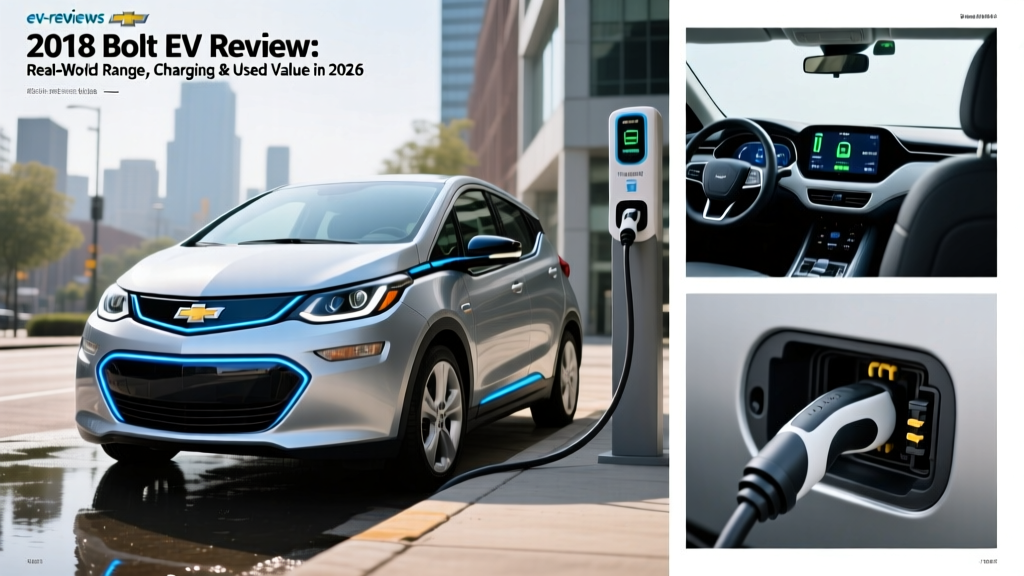
The 2018 Chevrolet Bolt EV remains one of the most compelling used electric vehicles on the market in 2026. With an EPA-estimated 238 miles of range, a usable 60 kWh NMC battery, and a spacious hatchback body, it undercuts nearly every modern EV on price-per-mile-of-range. But its aging CCS1 connector, sluggish 55 kW DC fast-charging ceiling, and the shadow of GM's 2021–2022 battery recall demand a careful buyer's eye. If you're shopping the used market and can charge primarily at home, the 2018 Bolt EV is a data-backed steal — provided you verify the battery replacement status before signing.
Range, Efficiency & Real-World Expectations
The 2018 Bolt EV carries an EPA-estimated 238 miles of range from its 60 kWh lithium-ion (NMC chemistry) battery pack. That figure held up as class-leading when the car launched, and it still outpaces many 2026 compacts. On the EPA's official fuel-economy page, the Bolt EV rates at 119 MPGe combined (128 city / 110 highway), translating to roughly 28 kWh per 100 miles.
The 238-mile EPA sticker assumes mixed driving at moderate temperatures. Expect ~215–225 miles in mostly highway driving at 70 mph, where aerodynamic drag reduces efficiency to roughly 30–31 kWh/100mi. In cold weather (below 32°F), range can drop 20–30% — putting you in the 165–190 mile window without preconditioning. City commuters using regenerative braking in mild weather can occasionally exceed the EPA number, hitting 250+ miles. The Bolt EV lacks a heat pump (resistive cabin heater), which is the primary culprit for winter range loss.
Battery Chemistry, Degradation & the Recall Factor
The 2018 Bolt EV uses a 60 kWh gross / ~57 kWh usable battery pack built with NMC (nickel-manganese-cobalt) pouch cells supplied by LG Energy Solution. NMC offers high energy density — which is how GM packed 238 miles into a compact hatch — but it's more sensitive to high state-of-charge storage and extreme heat than LFP chemistry.
The critical ownership question: In 2021–2022, GM recalled all 2017–2019 Bolt EVs (and some 2020–2022 models) due to a manufacturing defect in LG cells that could cause battery fires when charged to high states of charge. GM replaced affected battery packs with new-modules assemblies under warranty. As of 2026, most recalled Bolts have received replacement packs, but you must verify this with the VIN at a Chevy dealer before purchasing. A Bolt with a confirmed replacement pack actually gains value — the new modules reset degradation concerns and carry fresh warranty coverage.
For pre-recall-replacement packs, expect 5–10% degradation at 60,000–80,000 miles based on owner-reported State of Health (SoH) data. Post-replacement packs should show near-zero degradation. GM's battery warranty covers 8 years / 100,000 miles with a capacity retention threshold of 60% — though most replacements were done as a safety recall, not a warranty claim.
Charging Speed: Home vs. DC Fast Charging
The 2018 Bolt EV's charging profile is its most dated characteristic by 2026 standards. Here's the full breakdown:
| Level | Connector | Max Power | Speed | 10–80% Time |
|---|---|---|---|---|
| Level 1 (120V) | J1772 | 1.2 kW | ~4 mi/hr | ~55+ hours |
| Level 2 (240V) | J1772 | 7.2 kW | ~25 mi/hr | ~9.5 hours (full) |
| DC Fast Charge | CCS1 (Combo) | 55 kW (peak) | ~160 mi/hr (peak) | ~55–60 min |
The charging-curve reality: The Bolt EV's DC fast-charging peaks at 55 kW only between roughly 10–40% State of Charge, then tapers significantly. From 40–80%, you'll see 35–40 kW, and above 80% it drops to under 15 kW. This means a 10–80% session takes nearly an hour — roughly three times longer than a 2026 Hyundai Ioniq 5 or Tesla Model Y on a 350 kW charger. The optional DC fast-charge package was not standard on all trims; verify the CCS port is present on any used example.
For daily use, Level 2 home charging at 7.2 kW is perfectly adequate — a nightly plug-in easily replenishes 100–150 miles of driving in a standard 8-hour sleep window. The Bolt EV is a home-charging-first vehicle; road-trippers will feel the 55 kW limitation acutely.
Performance, Drivetrain & Driving Dynamics
The 2018 Bolt EV is motivated by a single front-mounted permanent-magnet electric motor producing 200 horsepower and 266 lb-ft of torque. Power reaches the front wheels through a single-speed reduction gear — no multi-speed transmission.
| Spec | Value |
|---|---|
| 0–60 mph | 6.5 seconds |
| Horsepower | 200 hp |
| Torque | 266 lb-ft |
| Drivetrain | FWD (single motor) |
| Top Speed | 91 mph (electronically limited) |
| Curb Weight | 3,563 lbs |
| EPA Range | 238 miles |
| Battery | 60 kWh (NMC) |
| MPGe (combined) | 119 MPGe |
| Efficiency | 28 kWh/100mi |
The instant 266 lb-ft of torque gives the Bolt EV punchy city acceleration that still feels quick in 2026 traffic. The 6.5-second 0–60 time is respectable, though it trails the Tesla Model 3 and newer EVs. The low center of gravity (battery pack under the floor) keeps body roll controlled, but the all-season eco tires prioritize efficiency over grip. Regen braking offers two modes: a traditional coasting mode and a strong "L" mode that enables near one-pedal driving around town.
Interior Space, Cargo & Technology
Despite its compact exterior, the Bolt EV's packaging is excellent. The flat battery floor creates generous cabin volume:
- Front legroom: 42.8 inches
- Rear legroom: 35.6 inches
- Cargo (rear seats up): 16.9 cu ft
- Cargo (rear seats folded): 56.6 cu ft
That cargo volume beats the Tesla Model 3's trunk and rivals small crossovers, making the Bolt EV surprisingly practical for grocery hauls, IKEA runs, or a week's luggage for two.
Tech highlights:
- 8-inch touchscreen with Apple CarPlay and Android Auto (standard)
- 10.2-inch digital instrument cluster
- Available leather seats, heated front seats and steering wheel (Premier trim)
- Available DC fast-charging (CCS1 port)
- Available Driver Confidence II package: forward collision alert, automatic emergency braking, lane keep assist, following distance indicator
Notable drawbacks: The infotainment system feels dated by 2026 standards — no wireless CarPlay/Android Auto, no over-the-air updates, and the resistive-touch buttons around the screen are fiddly. The seats are flat and lack lumbar adjustment, which matters on drives over two hours. There's no adaptive cruise control or lane-centering — the driver assists are basic Level 1 features, not a Level 2 system like GM's Super Cruise (which was never offered on the Bolt EV).
Used Pricing, Tax Credits & Ownership Costs
When new, the 2018 Bolt EV started at $36,620 MSRP (LT trim) and $40,920 (Premier trim), before the then-available $7,500 federal credit. In 2026, used-market pricing has dropped dramatically:
| Scenario | Estimated Cost |
|---|---|
| Used 2018 Bolt EV LT (50k–70k mi) | $13,000–$16,000 |
| Used 2018 Bolt EV Premier (40k–60k mi) | $15,000–$18,500 |
| Federal used-EV credit (§25E, max) | Up to $4,000 (30% of sale price) |
| Net cost after max credit (LT example) | ~$9,000–$12,000 |
Tax credit rules for used EVs in 2026: The IRS §25E used-EV credit provides up to $4,000 or 30% of the sale price (whichever is less) for qualified used electric vehicles. Key eligibility requirements:
- Vehicle price cap: Sale price must not exceed $25,000
- Vehicle age: Must be at least 2 model years old (2018 qualifies)
- Buyer income caps: AGI ≤ $75,000 (single) / $112,500 (head of household) / $150,000 (joint)
- Dealer requirement: Must be purchased from a licensed dealer (private sales don't qualify)
- One-time use: The specific VIN can only claim this credit once; verify it hasn't been claimed before
- Point-of-sale transfer: Available — the credit can be applied at purchase, reducing the cash price directly
At $9,000–$12,000 net cost, the 2018 Bolt EV delivers roughly $38–$50 per mile of EPA range — a value metric no new EV in 2026 can match. For context, a new 2026 Chevy Equus EV LT starts around $33,000 after credits, yielding ~$105/mile of range.
Pros, Cons & Who Should Buy
Pros
- 238-mile EPA range still competitive in 2026
- Excellent cargo space (56.6 cu ft max)
- Punchy 266 lb-ft torque for city driving
- Extremely low used pricing after §25E credit
- Apple CarPlay / Android Auto standard
- Proven battery platform (post-recall replacement)
- Low running costs: ~$0.04–0.06/mi on home electricity
Cons
- DC fast-charging limited to 55 kW (~1 hour 10–80%)
- CCS1 connector (NACS adapter needed for Tesla Superchargers)
- No heat pump — significant winter range loss
- Dated infotainment, no wireless phone integration
- No adaptive cruise or lane-centering (basic Level 1 assists only)
- Flat seats lack long-distance comfort
- Battery recall history requires VIN verification
Best suited for: The 2018 Bolt EV is ideal as a daily commuter and city errand vehicle for individuals or couples who can charge at home (Level 2) and whose typical daily driving stays under 80 miles. It works well as a second car in a two-vehicle household, a budget-conscious first EV for apartment dwellers with workplace charging, or a college commuter. It's not ideal for frequent road-trippers (the 55 kW charging will frustrate), families needing three-across rear seating, or anyone in extreme-cold climates without a garage and preconditioning routine.
Frequently Asked Questions
What is the real-world range of the 2018 Bolt EV?
Expect 215–225 miles on the highway, 235–250 miles in city driving with regenerative braking, and 165–190 miles in cold weather (below 32°F). The EPA sticker is 238 miles, but the lack of a heat pump means winter drivers should budget for a 25–30% reduction.
How fast does the 2018 Bolt EV charge?
On a DC fast charger, it peaks at 55 kW and takes approximately 55–60 minutes for a 10–80% charge. On a Level 2 home charger at 7.2 kW, a full charge takes about 9.5 hours, adding roughly 25 miles of range per hour. Level 1 (120V) adds about 4 miles per hour — useful only for overnight top-ups.
Does the 2018 Bolt EV qualify for any federal tax credit in 2026?
Not the new-vehicle §30D credit (which applies to new purchases only). However, it does qualify for the §25E used-EV credit — up to $4,000 or 30% of the sale price — when purchased from a licensed dealer, provided the buyer's AGI falls within IRS income caps and the sale price is under $25,000. Check IRS guidelines for current-year eligibility details.
Is the 2018 Bolt EV worth buying vs. a newer used EV?
For pure value-per-mile-of-range, it's hard to beat. A 2018 Bolt at $12,000 net (after credit) with 238 miles of range costs $50/mile. A used 2021 Tesla Model 3 SR+ with 263 miles typically runs $20,000–$23,000 ($76–$87/mile). The trade-off: the Tesla charges faster (170 kW vs. 55 kW), has access to the Supercharger network, and offers a more modern interior. If road trips are rare and home charging is reliable, the Bolt wins on economics. If you need fast public charging, the Model 3 or a used Ioniq 5 is worth the premium.
How do I check if the battery recall was addressed?
Enter the VIN at Chevrolet's recall lookup or ask any Chevy dealer to run it. Confirm that the battery replacement (if required) was completed and documented. A Bolt with a verified replacement pack and remaining warranty coverage is the safest purchase.
What's the battery warranty on a 2018 Bolt EV in 2026?
GM covers the battery for 8 years / 100,000 miles against defects and capacity loss below 60%. For a 2018 model, the 8-year window expired in 2026 — but if the pack was replaced during the recall (2021–2023), the replacement may carry its own warranty. Verify with the dealer. The 100,000-mile threshold may still apply depending on the replacement date.